

Plants, Adventures in the World
 |
Description
Book Introduction
How did plants travel the Earth?
A world-renowned botanist and a "friendly science narrator" who encompasses science, philosophy, and art.
The epic conquest of plants, told by Stefano Mancuso
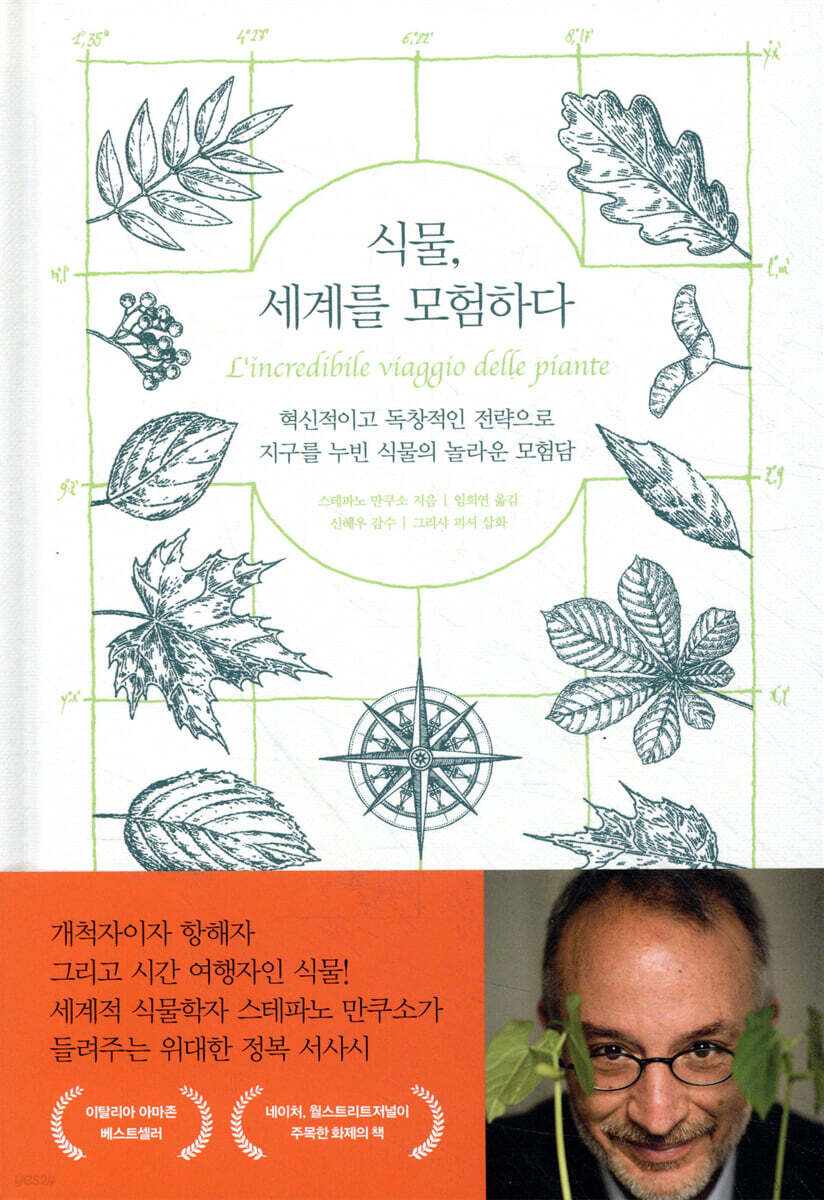
World-renowned botanist Stefano Mancuso's book, "Plants, Adventures Around the World," has been published, brimming with vivid stories and rich scientific knowledge.
He was selected as one of the 'People Changing the World' by The New Yorker in 2013 and received attention for his unique perspective. In this book, he turns his attention to the 'movement' of plants.
With unique expressions such as pioneer, navigator, fighter, and time traveler, and with flowing writing skills, it unfolds an amazing adventure story of plants that encompasses history, philosophy, and humor.
As the author says, “If you look at plants with eyes that have removed the animal filter, the special features of the plants become very clear.” The world of plants, viewed as “a diverse form of life,” is awe-inspiring.
This book offers a glimpse into the limitless drive of plants towards expansion.
Plants have developed a variety of sophisticated seed dispersal strategies, including being carried by the wind, rolling on the ground, clinging to animal fur, and seeking out animals to eat their seeds.
Humans also played a part in the movement of plants.
Whether by those captivated by their beauty and fruity flavor or by the hands of passionate botanists, plants have shaped the history of the continent.
How did plants navigate the world? How did they survive on remote islands in harsh climates? How did they survive in lands devastated by human disaster? How did they persuade animals to carry their seeds? How did they successfully travel across geological eras? This book presents the answers, along with poetic watercolors depicting the world of plants.
It offers us the opportunity to broaden our horizons by taking a journey beyond the familiar animal world to the wondrous plant world.
A world-renowned botanist and a "friendly science narrator" who encompasses science, philosophy, and art.
The epic conquest of plants, told by Stefano Mancuso
World-renowned botanist Stefano Mancuso's book, "Plants, Adventures Around the World," has been published, brimming with vivid stories and rich scientific knowledge.
He was selected as one of the 'People Changing the World' by The New Yorker in 2013 and received attention for his unique perspective. In this book, he turns his attention to the 'movement' of plants.
With unique expressions such as pioneer, navigator, fighter, and time traveler, and with flowing writing skills, it unfolds an amazing adventure story of plants that encompasses history, philosophy, and humor.
As the author says, “If you look at plants with eyes that have removed the animal filter, the special features of the plants become very clear.” The world of plants, viewed as “a diverse form of life,” is awe-inspiring.
This book offers a glimpse into the limitless drive of plants towards expansion.
Plants have developed a variety of sophisticated seed dispersal strategies, including being carried by the wind, rolling on the ground, clinging to animal fur, and seeking out animals to eat their seeds.
Humans also played a part in the movement of plants.
Whether by those captivated by their beauty and fruity flavor or by the hands of passionate botanists, plants have shaped the history of the continent.
How did plants navigate the world? How did they survive on remote islands in harsh climates? How did they survive in lands devastated by human disaster? How did they persuade animals to carry their seeds? How did they successfully travel across geological eras? This book presents the answers, along with poetic watercolors depicting the world of plants.
It offers us the opportunity to broaden our horizons by taking a journey beyond the familiar animal world to the wondrous plant world.
- You can preview some of the book's contents.
Preview
index
prolog
Reviewer's note
Chapter 1: Plants: Pioneers, Fighters, and Survivors
01.
Pioneers of the newly formed volcanic island of Surtsey
02.
The fighter who won the Chernobyl disaster
03.
A tree that survived the atomic bomb
Chapter 2: The Fugitives Conquer New Territories
01.
A country bumpkin from Sicily becomes a celebrity at Oxford.
02.
Sukryung succeeded in escaping and conquering through the use of a beautiful woman.
03.
If a hippopotamus swims in a wetland covered with water hyacinths,
Chapter 3: Brave Captains Who Sail the Seas
01.
The Fruit of the Gods: The Mystery of the Coconut Palm
02.
The Callipije palm, which has the largest wild fruit in nature
Chapter 4: Trees that Travel Through Time
01.
Jan Tirink's seeds sprouted after many twists and turns.
02.
Masada's Date Palms Resurrected After 2,000 Years
03.
Seeds from the Extreme
Chapter 5: The Survival Guide of the World's Loneliest Trees
01.
Campbell Island's spruce trees marked the beginning of the Anthropocene
02.
The unfortunate fate of the Tenere acacia
03.
Bahrain's Tree of Life, a Champion of Extreme Climates
Chapter 6: Anachronists Who Entrusted Their Survival to Extinct Animals
01.
Survivors saved from extinction
02.
The special relationship between the dodo and the tambalacococcus
References
Reviewer's note
Chapter 1: Plants: Pioneers, Fighters, and Survivors
01.
Pioneers of the newly formed volcanic island of Surtsey
02.
The fighter who won the Chernobyl disaster
03.
A tree that survived the atomic bomb
Chapter 2: The Fugitives Conquer New Territories
01.
A country bumpkin from Sicily becomes a celebrity at Oxford.
02.
Sukryung succeeded in escaping and conquering through the use of a beautiful woman.
03.
If a hippopotamus swims in a wetland covered with water hyacinths,
Chapter 3: Brave Captains Who Sail the Seas
01.
The Fruit of the Gods: The Mystery of the Coconut Palm
02.
The Callipije palm, which has the largest wild fruit in nature
Chapter 4: Trees that Travel Through Time
01.
Jan Tirink's seeds sprouted after many twists and turns.
02.
Masada's Date Palms Resurrected After 2,000 Years
03.
Seeds from the Extreme
Chapter 5: The Survival Guide of the World's Loneliest Trees
01.
Campbell Island's spruce trees marked the beginning of the Anthropocene
02.
The unfortunate fate of the Tenere acacia
03.
Bahrain's Tree of Life, a Champion of Extreme Climates
Chapter 6: Anachronists Who Entrusted Their Survival to Extinct Animals
01.
Survivors saved from extinction
02.
The special relationship between the dodo and the tambalacococcus
References
Detailed image

Into the book
Well, we were wrong.
Plants don't stay still.
They travel far.
It just takes a long time.
Plants cannot move, but they can at least move during their lifetime.
The adjective that defines a plant should actually be 'able to take root or stick to any place' rather than 'able to move'.
Sessile organisms cannot move from their place of birth, but plants can move as much as they want.
That's exactly what plants do, and anyone can verify it by looking at thousands of videos available online today.
--- From the "Prologue"
Most species considered invasive today arrived here this way, escaping from places where humans thought they could be contained.
To be precise, not only the species we consider invasive today, but also many of the plants we believed to be part of our environment because they have always been there, were actually immigrants who have been with us for quite some time.
Plants recognized today as part of our cultural heritage are simply alien species that coexist well with us.
--- From "Chapter 2: The Fugitives Conquer New Territories"
Many trees act as true time travelers from the past, providing important testimony to our understanding of history.
This is due to its extremely long lifespan.
For example, studies of tree ring growth and composition have helped to unravel some of history's mysteries, such as the background to the Golden Horde's sudden withdrawal from Hungary in 1242.
--- From "Chapter 4: Trees that Travel Through Time"
Some plants, unwilling to risk entrusting their seeds to a carrier, make the courageous decision to stand out from their fellow plants.
These plants decide to take charge of the overall diffusion process themselves, developing innovative and ingenious tools such as explosive diffusion.
A tool that would never have been imagined in the plant kingdom, where it is clear that the plant cannot move on its own, has been discovered in the Pacific Ocean.
Not many species entrust the fate of their offspring to explosions, but those few that do are accompanied by loud noises, as the word explosion suggests.
Plants don't stay still.
They travel far.
It just takes a long time.
Plants cannot move, but they can at least move during their lifetime.
The adjective that defines a plant should actually be 'able to take root or stick to any place' rather than 'able to move'.
Sessile organisms cannot move from their place of birth, but plants can move as much as they want.
That's exactly what plants do, and anyone can verify it by looking at thousands of videos available online today.
--- From the "Prologue"
Most species considered invasive today arrived here this way, escaping from places where humans thought they could be contained.
To be precise, not only the species we consider invasive today, but also many of the plants we believed to be part of our environment because they have always been there, were actually immigrants who have been with us for quite some time.
Plants recognized today as part of our cultural heritage are simply alien species that coexist well with us.
--- From "Chapter 2: The Fugitives Conquer New Territories"
Many trees act as true time travelers from the past, providing important testimony to our understanding of history.
This is due to its extremely long lifespan.
For example, studies of tree ring growth and composition have helped to unravel some of history's mysteries, such as the background to the Golden Horde's sudden withdrawal from Hungary in 1242.
--- From "Chapter 4: Trees that Travel Through Time"
Some plants, unwilling to risk entrusting their seeds to a carrier, make the courageous decision to stand out from their fellow plants.
These plants decide to take charge of the overall diffusion process themselves, developing innovative and ingenious tools such as explosive diffusion.
A tool that would never have been imagined in the plant kingdom, where it is clear that the plant cannot move on its own, has been discovered in the Pacific Ocean.
Not many species entrust the fate of their offspring to explosions, but those few that do are accompanied by loud noises, as the word explosion suggests.
--- From "Chapter 6: Anachronists Who Entrusted Their Survival to Extinct Animals"
Publisher's Review
Plants are pioneers, navigators, fighters, and hermits!
The unstoppable march of plants and the amazing world they've transformed.
If you look closely, the world of plants is bustling.
Plants perceive their surroundings more sensitively than animals and clearly convey their opinions.
Also, plants do not stay still.
It takes a long time, but you can travel to faraway places, even poor places.
Some plants have conquered the place beyond movement and settlement.
Since the 1986 nuclear accident, plants have thrived in the Chernobyl exclusion zone, a place once thought to be inhospitable, achieving the impossible feat of absorbing radioactive nuclides.
A ragwort plant from an active volcano in Sicily, armed with the ability to survive in poor soil, took over the walls of Oxford University Library in just a century and earned the nickname 'Oxford ragwort'.
The author asserts that the movement of plants cannot be stopped.
The author's words, "Today's invasive plants are tomorrow's native plants," encapsulate this.
For example, tomatoes, an essential ingredient in Italian cuisine, are an 'immigrant plant' that came from Central and South America.
It took quite a while for tomatoes, which were distrusted by people due to their yellow fruit, to become loved with their red skin.
The role of humans is becoming more important in coexisting with plants, the 'Earth's greatest travelers'.
A prime example is the 'malignant invasive alien species', the water hyacinth, which stole people's hearts with its beautiful appearance and spread throughout the world in an instant.
The story of a former soldier who proposed introducing hippos to America's rivers and wetlands in the early 20th century when the water hyacinth was devastating them is both fascinating and instructive.
From Avocado Seeds to Clues of the Anthropocene
'Time Traveler' Plants Give Us Hints About the Future
How did the avocado survive with its massive seed? After the disappearance of the giant animals that could devour its large seeds about 13,000 years ago, the avocado faced a crisis.
The plant, which was aided by the sharp teeth and strong jaws of the jaguar as a makeshift measure, later caught the eye of humans who tasted its fruit.
Avocados, which have hastily formed an alliance with humans, are now facing the risk of becoming a 'seedless fruit'.
The author worries that plants that have survived for a long time may face a threat to their survival, like the 'seedless banana', which is helpless against a new strain of fungus.
Although humans often treat plants carelessly without understanding their ecosystem, plants still have many stories to tell us.
The same goes for any spruce tree on Campbell Island.
Campbell Island, located off the coast of New Zealand's Antarctic Peninsula, is an uninhabited island with little sunlight, cold weather, frequent rain, and strong winds, making it difficult for people to settle there.
An eccentric British gentleman planted a tree here in the early 20th century.
The trees were all destroyed by the harsh climate, and only one species of spruce, the Sitka spruce, survived.
This tree later became a special witness.
The highest values of the radioactive isotope carbon-14 from the nuclear tests remained in the tree rings.
The discovery of the effects of nuclear testing in the Northern Hemisphere in a remote and completely uncontaminated location provides a clue to the beginning of the Anthropocene.
This book gently balances historical fact with scientific knowledge, while igniting the reader's imagination by unraveling a story instead of relying on difficult scientific jargon.
With its exciting structure that transcends time and space and encompasses the entire world, it is perfect for science readers as well as those who want to see the world through new eyes.
The life story of plants that have roamed the Earth makes us reflect on what attitude we should have in the vast ecosystem.
And it hints that the world seen through the eyes of plants is quite fascinating.
The unstoppable march of plants and the amazing world they've transformed.
If you look closely, the world of plants is bustling.
Plants perceive their surroundings more sensitively than animals and clearly convey their opinions.
Also, plants do not stay still.
It takes a long time, but you can travel to faraway places, even poor places.
Some plants have conquered the place beyond movement and settlement.
Since the 1986 nuclear accident, plants have thrived in the Chernobyl exclusion zone, a place once thought to be inhospitable, achieving the impossible feat of absorbing radioactive nuclides.
A ragwort plant from an active volcano in Sicily, armed with the ability to survive in poor soil, took over the walls of Oxford University Library in just a century and earned the nickname 'Oxford ragwort'.
The author asserts that the movement of plants cannot be stopped.
The author's words, "Today's invasive plants are tomorrow's native plants," encapsulate this.
For example, tomatoes, an essential ingredient in Italian cuisine, are an 'immigrant plant' that came from Central and South America.
It took quite a while for tomatoes, which were distrusted by people due to their yellow fruit, to become loved with their red skin.
The role of humans is becoming more important in coexisting with plants, the 'Earth's greatest travelers'.
A prime example is the 'malignant invasive alien species', the water hyacinth, which stole people's hearts with its beautiful appearance and spread throughout the world in an instant.
The story of a former soldier who proposed introducing hippos to America's rivers and wetlands in the early 20th century when the water hyacinth was devastating them is both fascinating and instructive.
From Avocado Seeds to Clues of the Anthropocene
'Time Traveler' Plants Give Us Hints About the Future
How did the avocado survive with its massive seed? After the disappearance of the giant animals that could devour its large seeds about 13,000 years ago, the avocado faced a crisis.
The plant, which was aided by the sharp teeth and strong jaws of the jaguar as a makeshift measure, later caught the eye of humans who tasted its fruit.
Avocados, which have hastily formed an alliance with humans, are now facing the risk of becoming a 'seedless fruit'.
The author worries that plants that have survived for a long time may face a threat to their survival, like the 'seedless banana', which is helpless against a new strain of fungus.
Although humans often treat plants carelessly without understanding their ecosystem, plants still have many stories to tell us.
The same goes for any spruce tree on Campbell Island.
Campbell Island, located off the coast of New Zealand's Antarctic Peninsula, is an uninhabited island with little sunlight, cold weather, frequent rain, and strong winds, making it difficult for people to settle there.
An eccentric British gentleman planted a tree here in the early 20th century.
The trees were all destroyed by the harsh climate, and only one species of spruce, the Sitka spruce, survived.
This tree later became a special witness.
The highest values of the radioactive isotope carbon-14 from the nuclear tests remained in the tree rings.
The discovery of the effects of nuclear testing in the Northern Hemisphere in a remote and completely uncontaminated location provides a clue to the beginning of the Anthropocene.
This book gently balances historical fact with scientific knowledge, while igniting the reader's imagination by unraveling a story instead of relying on difficult scientific jargon.
With its exciting structure that transcends time and space and encompasses the entire world, it is perfect for science readers as well as those who want to see the world through new eyes.
The life story of plants that have roamed the Earth makes us reflect on what attitude we should have in the vast ecosystem.
And it hints that the world seen through the eyes of plants is quite fascinating.
GOODS SPECIFICS
- Publication date: November 30, 2020
- Format: Hardcover book binding method guide
- Page count, weight, size: 204 pages | 586g | 155*225*20mm
- ISBN13: 9791190357517
- ISBN10: 1190357518
You may also like
카테고리
korean


korean

![ELLE 엘르 스페셜 에디션 A형 : 12월 [2025]](http://librairie.coreenne.fr/cdn/shop/files/b8e27a3de6c9538896439686c6b0e8fb.jpg?v=1766436872&width=3840)


