

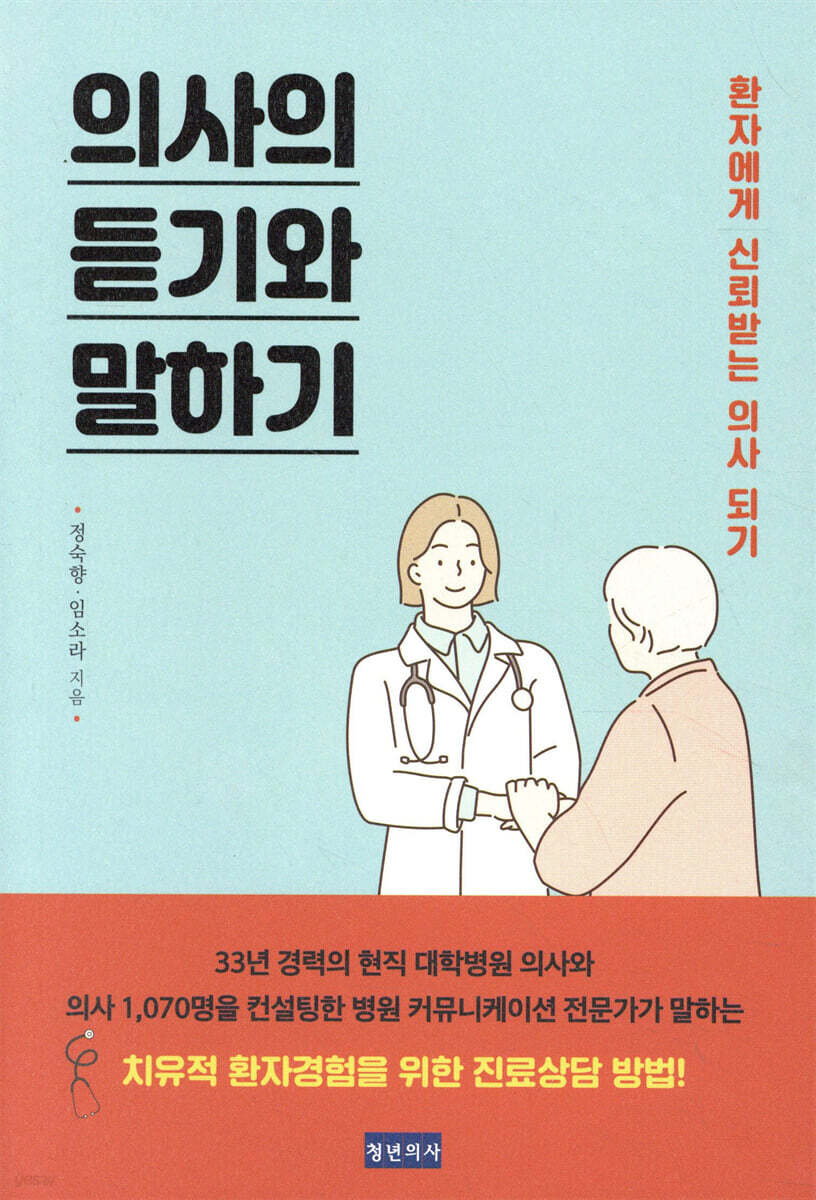
Listening and speaking with a doctor
 |
Description
Book Introduction
“This is my first time being a doctor.”
How does a doctor listen to a patient?
What should I say?
It is self-evident that a good doctor-patient relationship must be established during the medical treatment process.
In today's world of patient-centered care and patient experience, patients are no longer recipients of one-sided medical services, nor do they unconditionally accept the blind trust or vertical relationships they once had with doctors.
But there is a more fundamental reason why the doctor-patient relationship must be maintained well.
A positive doctor-patient relationship leads to patients' trust in their doctors, and patient trust directly leads to better treatment outcomes.
But how can we truly gain patients' trust? In the Korean medical landscape, where the three-minute consultation is a hallmark, is a good doctor-patient relationship truly a distant dream? To answer this question, a doctor with 33 years of experience at a university hospital and a hospital communications expert with experience consulting 1,070 physicians took up the pen.
For doctors and aspiring doctors who are concerned about the doctor-patient relationship for better healing effects, this book goes beyond simply teaching communication skills and provides situational coping methods and patient-specific communication methods through real-life examples.
He also offers advice on how to deal with the weight of life and past mistakes that doctors inevitably have to bear.
How does a doctor listen to a patient?
What should I say?
It is self-evident that a good doctor-patient relationship must be established during the medical treatment process.
In today's world of patient-centered care and patient experience, patients are no longer recipients of one-sided medical services, nor do they unconditionally accept the blind trust or vertical relationships they once had with doctors.
But there is a more fundamental reason why the doctor-patient relationship must be maintained well.
A positive doctor-patient relationship leads to patients' trust in their doctors, and patient trust directly leads to better treatment outcomes.
But how can we truly gain patients' trust? In the Korean medical landscape, where the three-minute consultation is a hallmark, is a good doctor-patient relationship truly a distant dream? To answer this question, a doctor with 33 years of experience at a university hospital and a hospital communications expert with experience consulting 1,070 physicians took up the pen.
For doctors and aspiring doctors who are concerned about the doctor-patient relationship for better healing effects, this book goes beyond simply teaching communication skills and provides situational coping methods and patient-specific communication methods through real-life examples.
He also offers advice on how to deal with the weight of life and past mistakes that doctors inevitably have to bear.
- You can preview some of the book's contents.
Preview
index
prolog
For Better Therapeutic Communication | How This Book Was Created
introduction.
Why is it important for doctors to listen and speak?
Why Doctors Need to Improve Their Consultation Skills | Why Do Patients Leave the Exam Room Feeling Uneasy?
Chapter 1.
Principles of listening and speaking for doctors
Supportive Communication Methods | Listening: The Most Effective Communication Method (1) | Listening: The Most Effective Communication Method (2) | Using Body Language and Voice | Nonverbal Behaviors That Can Destroy Patients' Trust | Physicians' Speech Habits and Patient Addressing | Understanding the Stigmatization of Illness and Communicating Correctly
Chapter 2.
Listening and speaking in general clinical situations
Words and actions that make a good first impression on patients | How to be considerate during a physical examination | Convincing patients when prescribing tests | How to explain test results | Medical advice that changes patient behavior | Tools for effective communication | Why the conclusion is important in medical consultations
Chapter 3.
Listening and speaking in hospital and other situations
A doctor's words of reassurance to hospitalized patients during rounds | The effect of a doctor's thoughtful intervention in patient-centered care | When a diagnosis is difficult or the clinical course is unexpectedly poor | Cases of communication failures among medical staff (1) | Cases of communication failures among medical staff (2) | How to deal with mistakes that occur during treatment
Chapter 4.
Listening and speaking in special situations
Communicating with pregnant women | Communicating with pediatric and adolescent patients | Communicating with elderly patients | Communicating with emergency patients | Communicating during the anesthesia phase before surgery | Communicating in complex medical procedures | When delivering bad news | Communicating with young terminally ill cancer patients | Actively seeking and speaking about 'well-founded hope' | Interviewing patients with alcohol dependence | Considerations in the changing medical landscape | When making decisions about life-sustaining treatment
Chapter 5.
Communicating with Patients Who Have Difficulty Communicating
Coping with an Angry Patient | When Building a Good Doctor-Patient Relationship is Difficult | Physicians' Emotional Expression and Self-Management
Epilogue
Are you providing an unforgettable medical experience? | About my mentor, the best doctor
References
For Better Therapeutic Communication | How This Book Was Created
introduction.
Why is it important for doctors to listen and speak?
Why Doctors Need to Improve Their Consultation Skills | Why Do Patients Leave the Exam Room Feeling Uneasy?
Chapter 1.
Principles of listening and speaking for doctors
Supportive Communication Methods | Listening: The Most Effective Communication Method (1) | Listening: The Most Effective Communication Method (2) | Using Body Language and Voice | Nonverbal Behaviors That Can Destroy Patients' Trust | Physicians' Speech Habits and Patient Addressing | Understanding the Stigmatization of Illness and Communicating Correctly
Chapter 2.
Listening and speaking in general clinical situations
Words and actions that make a good first impression on patients | How to be considerate during a physical examination | Convincing patients when prescribing tests | How to explain test results | Medical advice that changes patient behavior | Tools for effective communication | Why the conclusion is important in medical consultations
Chapter 3.
Listening and speaking in hospital and other situations
A doctor's words of reassurance to hospitalized patients during rounds | The effect of a doctor's thoughtful intervention in patient-centered care | When a diagnosis is difficult or the clinical course is unexpectedly poor | Cases of communication failures among medical staff (1) | Cases of communication failures among medical staff (2) | How to deal with mistakes that occur during treatment
Chapter 4.
Listening and speaking in special situations
Communicating with pregnant women | Communicating with pediatric and adolescent patients | Communicating with elderly patients | Communicating with emergency patients | Communicating during the anesthesia phase before surgery | Communicating in complex medical procedures | When delivering bad news | Communicating with young terminally ill cancer patients | Actively seeking and speaking about 'well-founded hope' | Interviewing patients with alcohol dependence | Considerations in the changing medical landscape | When making decisions about life-sustaining treatment
Chapter 5.
Communicating with Patients Who Have Difficulty Communicating
Coping with an Angry Patient | When Building a Good Doctor-Patient Relationship is Difficult | Physicians' Emotional Expression and Self-Management
Epilogue
Are you providing an unforgettable medical experience? | About my mentor, the best doctor
References
Into the book
Why is it important for doctors to build strong relationships with their patients? First and foremost, patients' high trust in their doctors leads to efficient and successful treatment.
For example, patients who trust their doctors and understand their illness through proper communication tend to take the medication prescribed by the doctor on time and endure difficult treatments well, ultimately increasing the success rate of treatment.
--- p.27
While it is important to listen carefully to your patient, it is also important to give them confidence that you have understood what they are saying.
That is, after hearing a complaint of symptoms like Case 2, you could say something like this:
“So, the patient’s problem is that he keeps having to urinate at night.
Also, when I try to urinate, I feel a burning sensation, and it is also uncomfortable that I cannot urinate quickly even when I want to.
“You must have had a hard time.” What if you had summarized and confirmed what the patient had said or expressed empathy for the patient’s discomfort?
--- p.52~53
What a doctor should prepare before a physical examination is consideration and interest in the patient.
You should not embarrass the patient, cover the patient's sensitive areas with clothing or blankets, and check to see if the patient is uncomfortable during the examination.
If the doctor's hands are very cold, one way is to warm them up in advance with a hot pack or something similar. If that is not possible, you can ask for their understanding and hope they are not surprised if their hands are a little cold.
It's okay to have a light conversation with the patient during the examination, but there's no need to talk constantly.
--- p.83~84
When a patient's medical condition is complex or they are having a hard time because they have been diagnosed with a major illness for the first time, it is very helpful for a doctor to sit by the patient's bedside and explain things.
In particular, when a doctor sits in a chair next to the bed and explains things while physically adjusting to the patient's eye level, the patient feels like the conversation lasted much longer, even if the actual explanation did not take that long.
--- p.117~118
When I was younger and less experienced, I was so obsessed with conveying the medical truth that I failed to fully grasp the importance of hope to patients.
Many patients have left me, wasting their time and money on folk remedies or unfounded treatments because they saw no hope in me.
Even if a poor prognosis was predicted, I regret and reflect that it would have been better if I had paid more personal attention to the patient, worked hard to gather hopeful evidence, big or small, and shared that hope with the patient.
--- p.190~191
Anyone who works in a hospital can be a patient's experience.
And if you're a doctor, it's an even more powerful experience for the patient.
The choice is yours.
Will you provide your patients with an unforgettable emotional experience or a heartbreaking experience they will never forget?
The words and actions you say and do without thinking can also determine it.
For example, patients who trust their doctors and understand their illness through proper communication tend to take the medication prescribed by the doctor on time and endure difficult treatments well, ultimately increasing the success rate of treatment.
--- p.27
While it is important to listen carefully to your patient, it is also important to give them confidence that you have understood what they are saying.
That is, after hearing a complaint of symptoms like Case 2, you could say something like this:
“So, the patient’s problem is that he keeps having to urinate at night.
Also, when I try to urinate, I feel a burning sensation, and it is also uncomfortable that I cannot urinate quickly even when I want to.
“You must have had a hard time.” What if you had summarized and confirmed what the patient had said or expressed empathy for the patient’s discomfort?
--- p.52~53
What a doctor should prepare before a physical examination is consideration and interest in the patient.
You should not embarrass the patient, cover the patient's sensitive areas with clothing or blankets, and check to see if the patient is uncomfortable during the examination.
If the doctor's hands are very cold, one way is to warm them up in advance with a hot pack or something similar. If that is not possible, you can ask for their understanding and hope they are not surprised if their hands are a little cold.
It's okay to have a light conversation with the patient during the examination, but there's no need to talk constantly.
--- p.83~84
When a patient's medical condition is complex or they are having a hard time because they have been diagnosed with a major illness for the first time, it is very helpful for a doctor to sit by the patient's bedside and explain things.
In particular, when a doctor sits in a chair next to the bed and explains things while physically adjusting to the patient's eye level, the patient feels like the conversation lasted much longer, even if the actual explanation did not take that long.
--- p.117~118
When I was younger and less experienced, I was so obsessed with conveying the medical truth that I failed to fully grasp the importance of hope to patients.
Many patients have left me, wasting their time and money on folk remedies or unfounded treatments because they saw no hope in me.
Even if a poor prognosis was predicted, I regret and reflect that it would have been better if I had paid more personal attention to the patient, worked hard to gather hopeful evidence, big or small, and shared that hope with the patient.
--- p.190~191
Anyone who works in a hospital can be a patient's experience.
And if you're a doctor, it's an even more powerful experience for the patient.
The choice is yours.
Will you provide your patients with an unforgettable emotional experience or a heartbreaking experience they will never forget?
The words and actions you say and do without thinking can also determine it.
--- p.234
Publisher's Review
For a healing patient experience
How do I consult with a doctor?
Patients experience illness physically, and doctors experience it with knowledge.
The encounter between patient and doctor should develop into a relationship that moves toward healing while overcoming the common 'enemy' of disease.
So, what are the goals of the doctor-patient encounter? First, to diagnose the patient's illness and determine a treatment plan. Second, to build a positive relationship with the patient, facilitating successful diagnosis and treatment.
The first goal is to acquire the skill through education, practice, and testing.
However, the second goal, the skill of ‘building a doctor-patient relationship’, has been relatively less educated and evaluated, and its importance has not been given much attention.
However, in order to maintain a high level of medical care in the difficult reality of our country with a high volume of medical care, 'appropriate communication skills' and the formation of a 'satisfactory doctor-patient relationship' are essential.
Effective and compassionate communication skills can help achieve the ultimate goal of medicine: improving patient survival and quality of life.
In this warm and effective communication skill, 'the doctor's listening to the patient's words' and 'the doctor's ability to appropriately express what he or she wants to convey to the patient' are especially important.
Just as physical training strengthens muscles and strength, communication skills for medical consultations can also be learned and continuously practiced, further enhancing a doctor's clinical competence.
With a current university hospital doctor with 33 years of experience
What a hospital communications expert says
How to provide medical consultations for a healing patient experience!
Appropriate communication skills and a positive doctor-patient relationship are important factors in enhancing the healing effect.
So what is necessary to form a good doctor-patient relationship? How should doctors listen to their patients, and what should they say? This book, "Listening and Speaking for Doctors," is for doctors and aspiring doctors who grapple with these practical concerns. It contains vivid examples from over 30 years of clinical experience with patients, the experiences gained through these experiences, and the advice he offers to countless doctors struggling with their patient relationships and their calling as doctors.
Additionally, a hospital communications expert who consulted with 1,070 doctors shared what he learned and felt while coaching doctors, along with vivid examples observed through monitoring.
Through this book, you can learn about the perspectives and know-how of treating patients as a doctor, and through actual doctor coaching cases, you can learn how and what you can change.
A single word from a doctor can either cure a patient's illness or, conversely, make it worse.
This is also why doctors must pay attention to communication with patients and build positive doctor-patient relationships.
Structure of this book
This book introduces a doctor's consultation method for a 'healing doctor-patient relationship' over a total of five chapters.
The introduction explores why listening and speaking are important for doctors.
If you consistently practice this communication skill, you will gradually develop not only your listening skills but also your relationship-building skills.
Chapter 1 covers the principles of listening and speaking for physicians, explaining why listening is important in communication.
It also covers how doctors use body language and voice during consultations, doctors' speech habits and how to address patients, and how to understand the stigmatization effect of illness and communicate appropriately.
Chapter 2 teaches you how to listen and speak in common clinical situations.
It covers how to make a good first impression on a patient, how to be considerate of the patient during a physical examination, how to explain test results, and how to conclude a medical consultation.
Chapter 3 covers how to communicate with patients during hospitalization and other situations.
We explore how to reassure patients during rounds, the impact of communication failures among medical staff and how to overcome them, and how to deal with mistakes that occur during treatment.
Chapter 4 covers more specialized situations and how to communicate with patients.
It teaches you how to communicate with pregnant women, children and adolescents, elderly patients, emergency patients, young terminally ill cancer patients, and alcoholics.
It also includes several case studies on communication methods during the anesthesia stage before surgery, communication methods when delivering bad news, and things to consider in the changing clinical environment.
The final chapter, Chapter 5, covers how to communicate with patients who have difficulty communicating.
It provides advice on how to deal with an angry patient and what doctors can do when it is difficult to form a positive doctor-patient relationship.
The doctor also did not forget to give advice on expressing emotions and self-care.
How do I consult with a doctor?
Patients experience illness physically, and doctors experience it with knowledge.
The encounter between patient and doctor should develop into a relationship that moves toward healing while overcoming the common 'enemy' of disease.
So, what are the goals of the doctor-patient encounter? First, to diagnose the patient's illness and determine a treatment plan. Second, to build a positive relationship with the patient, facilitating successful diagnosis and treatment.
The first goal is to acquire the skill through education, practice, and testing.
However, the second goal, the skill of ‘building a doctor-patient relationship’, has been relatively less educated and evaluated, and its importance has not been given much attention.
However, in order to maintain a high level of medical care in the difficult reality of our country with a high volume of medical care, 'appropriate communication skills' and the formation of a 'satisfactory doctor-patient relationship' are essential.
Effective and compassionate communication skills can help achieve the ultimate goal of medicine: improving patient survival and quality of life.
In this warm and effective communication skill, 'the doctor's listening to the patient's words' and 'the doctor's ability to appropriately express what he or she wants to convey to the patient' are especially important.
Just as physical training strengthens muscles and strength, communication skills for medical consultations can also be learned and continuously practiced, further enhancing a doctor's clinical competence.
With a current university hospital doctor with 33 years of experience
What a hospital communications expert says
How to provide medical consultations for a healing patient experience!
Appropriate communication skills and a positive doctor-patient relationship are important factors in enhancing the healing effect.
So what is necessary to form a good doctor-patient relationship? How should doctors listen to their patients, and what should they say? This book, "Listening and Speaking for Doctors," is for doctors and aspiring doctors who grapple with these practical concerns. It contains vivid examples from over 30 years of clinical experience with patients, the experiences gained through these experiences, and the advice he offers to countless doctors struggling with their patient relationships and their calling as doctors.
Additionally, a hospital communications expert who consulted with 1,070 doctors shared what he learned and felt while coaching doctors, along with vivid examples observed through monitoring.
Through this book, you can learn about the perspectives and know-how of treating patients as a doctor, and through actual doctor coaching cases, you can learn how and what you can change.
A single word from a doctor can either cure a patient's illness or, conversely, make it worse.
This is also why doctors must pay attention to communication with patients and build positive doctor-patient relationships.
Structure of this book
This book introduces a doctor's consultation method for a 'healing doctor-patient relationship' over a total of five chapters.
The introduction explores why listening and speaking are important for doctors.
If you consistently practice this communication skill, you will gradually develop not only your listening skills but also your relationship-building skills.
Chapter 1 covers the principles of listening and speaking for physicians, explaining why listening is important in communication.
It also covers how doctors use body language and voice during consultations, doctors' speech habits and how to address patients, and how to understand the stigmatization effect of illness and communicate appropriately.
Chapter 2 teaches you how to listen and speak in common clinical situations.
It covers how to make a good first impression on a patient, how to be considerate of the patient during a physical examination, how to explain test results, and how to conclude a medical consultation.
Chapter 3 covers how to communicate with patients during hospitalization and other situations.
We explore how to reassure patients during rounds, the impact of communication failures among medical staff and how to overcome them, and how to deal with mistakes that occur during treatment.
Chapter 4 covers more specialized situations and how to communicate with patients.
It teaches you how to communicate with pregnant women, children and adolescents, elderly patients, emergency patients, young terminally ill cancer patients, and alcoholics.
It also includes several case studies on communication methods during the anesthesia stage before surgery, communication methods when delivering bad news, and things to consider in the changing clinical environment.
The final chapter, Chapter 5, covers how to communicate with patients who have difficulty communicating.
It provides advice on how to deal with an angry patient and what doctors can do when it is difficult to form a positive doctor-patient relationship.
The doctor also did not forget to give advice on expressing emotions and self-care.
GOODS SPECIFICS
- Publication date: February 14, 2020
- Page count, weight, size: 240 pages | 319g | 130*190*20mm
- ISBN13: 9788991232846
- ISBN10: 8991232841
You may also like
카테고리
korean


korean

![ELLE 엘르 스페셜 에디션 A형 : 12월 [2025]](http://librairie.coreenne.fr/cdn/shop/files/b8e27a3de6c9538896439686c6b0e8fb.jpg?v=1766436872&width=3840)


