

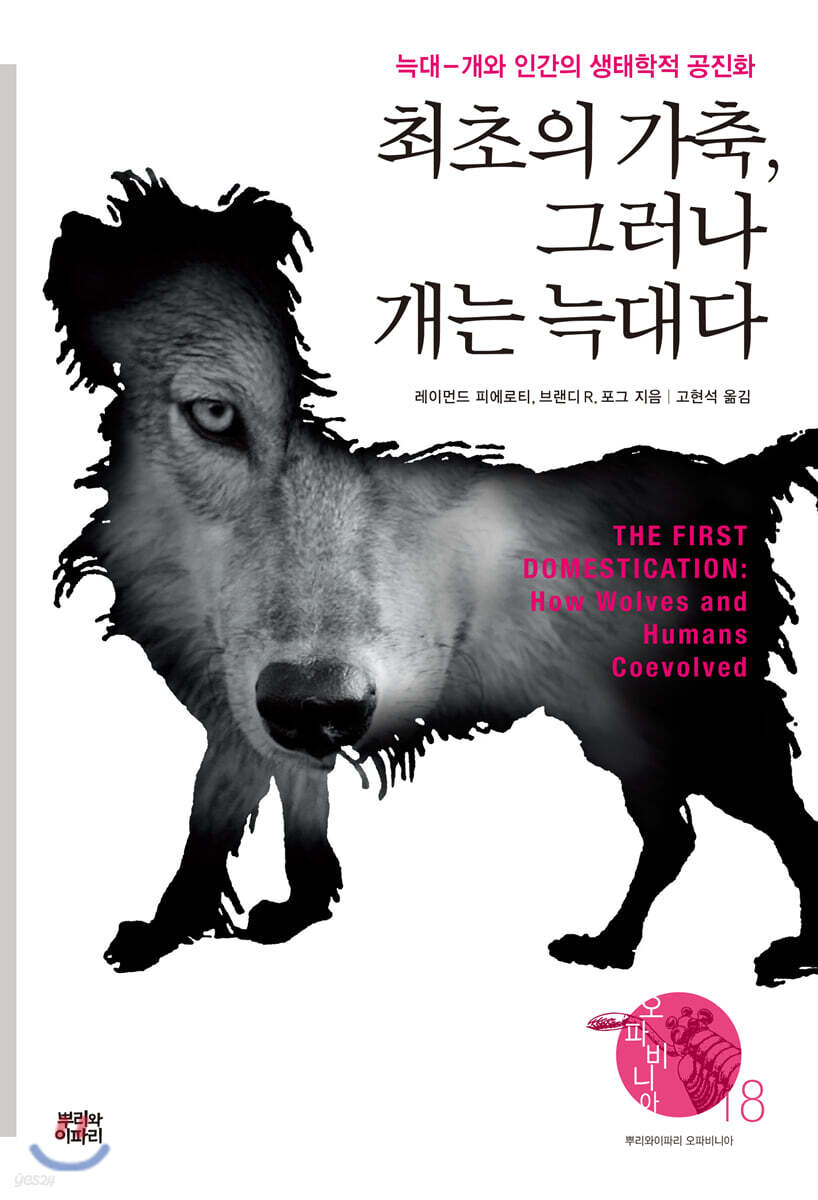
The first domesticated animal, but the dog is a wolf
 |
Description
Book Introduction
When and how did wolves and dogs become our companions?
The Origins of Dogs Revealed Through Evolutionary Biology, Ecology, and Anthropology
When did wolves become our companion dogs? Archaeologist Mice Hermonfrey and her team present evidence showing that wolf domestication occurred very early.
A skull of a 'Stone Age dog' dating back to 36,000 to 32,000 years ago was discovered in the Goyet Cave in Belgium.
This was evidence that refuted the later school's 'garbage heap' model, which holds that wolves were domesticated into dogs about 10,000 years ago while scavenging for food in human-discarded garbage dumps.
Raymond Pierotti and Brandy R., who studied evolutionary biology and Native American folklore,
Fogg points out that the existing domestication model is overly anthropocentric and contains the traditional (Christian) biases of Western science, and re-creates the history of cooperation and coexistence between wolves, dogs, and humans based on various scientific evidence and stories of indigenous people.
The purpose of this book is to examine how the first domestication occurred during the coevolution of humans and wolves, thereby confirming the long-standing bond between the two.
The Origins of Dogs Revealed Through Evolutionary Biology, Ecology, and Anthropology
When did wolves become our companion dogs? Archaeologist Mice Hermonfrey and her team present evidence showing that wolf domestication occurred very early.
A skull of a 'Stone Age dog' dating back to 36,000 to 32,000 years ago was discovered in the Goyet Cave in Belgium.
This was evidence that refuted the later school's 'garbage heap' model, which holds that wolves were domesticated into dogs about 10,000 years ago while scavenging for food in human-discarded garbage dumps.
Raymond Pierotti and Brandy R., who studied evolutionary biology and Native American folklore,
Fogg points out that the existing domestication model is overly anthropocentric and contains the traditional (Christian) biases of Western science, and re-creates the history of cooperation and coexistence between wolves, dogs, and humans based on various scientific evidence and stories of indigenous people.
The purpose of this book is to examine how the first domestication occurred during the coevolution of humans and wolves, thereby confirming the long-standing bond between the two.
- You can preview some of the book's contents.
Preview
index
Preface and Acknowledgments
Introduction: Getting Started
01 The Spaniel of San Marcos: What is a dog? And who cares?
Cooperation between species 02
03 Homo canis: Why humans are different from all other primates
04 Wolves, Archaeologists, and the Origin of Dogs
05 Asia: The Origins of Dog-Humanity and Japanese Dog-Wolf
06 “Dingoes Make Us Human”: Australian Aborigines and the Canis Lupus Dingo
07 North America: A World Made by Wolves
08 Wolf and Coyote: The Creator and the Deceiver
09 The Process of Domestication: 'Tame' vs. 'Returned to the Wild' and 'Domesticated' vs. 'Wild'
10 Living with Wolves and Dogs: Issues and Controversies
11 Living Well with Wolves and Dogs
Conclusion: Friendly predators
Image source
References
Search
Introduction: Getting Started
01 The Spaniel of San Marcos: What is a dog? And who cares?
Cooperation between species 02
03 Homo canis: Why humans are different from all other primates
04 Wolves, Archaeologists, and the Origin of Dogs
05 Asia: The Origins of Dog-Humanity and Japanese Dog-Wolf
06 “Dingoes Make Us Human”: Australian Aborigines and the Canis Lupus Dingo
07 North America: A World Made by Wolves
08 Wolf and Coyote: The Creator and the Deceiver
09 The Process of Domestication: 'Tame' vs. 'Returned to the Wild' and 'Domesticated' vs. 'Wild'
10 Living with Wolves and Dogs: Issues and Controversies
11 Living Well with Wolves and Dogs
Conclusion: Friendly predators
Image source
References
Search
Into the book
Anthropologist Pat Shipman's book Animal Connection (2011) is a goldmine of early inspiration.
Shipman's latest book is Invasive Humans: A Fundamental Exploration of Human Flourishing and the Future (2015, translated by Eunyoung Jo, Pureunsup, 2017).
This book has contributed to our research by examining the archaeological record of Neanderthals in detail, examining the close chronological relationship between the extinction of Neanderthals and the emergence of modern humans, and the relationship between modern humans and dogs (wolves).
Schiffman argues that modern humans' close relationship with dogs gave them an ecological advantage and allowed them to replace Neanderthals, who (apparently) had no dogs.
--- p.14
We are not attempting to explain the origins of the hundreds of 'breeds' of dogs that exist today (Morris 2001; Spady and Ostrander 2008; Hunn 2013).
Most of these varieties have been created by humans within the last 200 years, and many are much more recent.
This can be seen in the recent trend of creating 'designer' dogs by mixing existing breeds, such as the 'Pikachu', which is a cross between a Miniature Poodle and a Pekingese.
Our purpose is to discuss the early stages of the coevolutionary relationship between humans and wolves that resulted in what we call the "domesticated dog."
--- p.34
A wolf pack or family group of wolves usually consists of members similar to a human extended family.
There is an alpha female, a mate, and offspring of various ages (Moehlman 1989; Pierotti 2011a; Spotte 2012).
The young, especially the females, remain with the herd led by their mothers after they grow up.
Older cubs help care for the younger ones, making the group larger.
Modern humans are the only great apes that generally practice monogamy.
Because mating systems are emergent and influenced by the environment, it is likely that monogamy is a trait acquired from wolves, or at least a trait shared by both species due to convergence of ecological niches.
Both species share a similar ecological role as capable predators capable of hunting large prey in packs.
Additionally, both species benefit from cooperative food sharing.
Human adoption of wolf social strategies may explain why wolves assimilate into human social groups, and this reciprocal situation is documented in many cultural traditions.
Examples include the legend of Romulus and Remus, The Jungle Book, and many stories from Native American tribes (Bettelheim 1959; Itard 1962; Singh and Zingg 1966; Lane 1976).
--- p.113
The model proposed by Schleidt and Shalter in their 2003 study gave new meaning to Thomas Hobbes's notion of Homo homini lupus (“man is god to man, and bad wolf” [meaning that in the state of nature, humans behave violently like wolves toward other humans, and a war of all against all ensues - translator's note]) (Hobbes 1985, cited in Schleidt and Shalter 2003).
Schleiter and Schalter, given the strong social bond between humans and canines, wrote, “To humans, humans are friendly wolves.
No, at least that's how it should be," he argues, arguing that recent shifts in people's perceptions of wolves give us a chance to change our minds.
“Rather than continuing the conventional wisdom that ‘domesticated animals’ are deliberately human inventions,” we should “consider the initial contact between wolves and humans to have been reciprocal, and the subsequent changes in both species to have been a process of coevolution” (Schleidt and Shalter 2003, 58).
--- pp.120~121
In our discussion, there are two separate questions.
(1) Did Homo sapiens develop a cooperative relationship with a non-domesticated canid, namely wolves, immediately after migrating into Eurasia? (2) When and where did this non-domesticated canid transform into what is now considered a domesticated animal, namely dogs? The problem arises when researchers combine or conflate these two distinct questions into a third.
The question is, 'When did we first establish a relationship with an animal that could be easily recognized as a domesticated dog?'
Much of the confusion fueling the ongoing debate begins here.
--- p.151
Explorers of European descent would have been unable to accept the evidence before their eyes that Native Americans lived with socialized wolves.
A European who visited an indigenous tribe said:
“The Indian dog seen here in such detail resembles a wild wolf so much that if one had encountered one in the forest, one would almost certainly have killed it, thinking it was a wolf” (Audubon 1960, 520).
Early European visitors assumed that since this animal lived alongside humans, it must fit the European concept of a domesticated canis, or dog.
Modern scholars also make this mistake.
This is because Europeans only consider written records as true evidence (Pierotti 2011a).
Most scholars claim to be fair, but they are unable to see beyond the shackles created by their own narrow cultural perceptions (Ritvo 2010).
--- p.207
What is largely undiscussed, at least among scholars studying the origins of domestic dogs, is that the relentless campaign of persecution of Canis lupus by people of European descent (McIntyre 1995; Grimaud 2003; Coleman 2004; Rose 2011; Pierotti 2011a) has led to strong selection that ensures that only the most shy and unsocialized wolves survive in the wild today.
Oddly enough, most scholars who write about dogs, such as Mori (2010) and Schiffman (2011, 2015), write as if today's shy and timid wolf were the archetypal ancestor of all wolves.
Starting from that assumption, these scholars explain why modern wolves are described as “dangerous,” “ferocious,” and “aggressive”—descriptions that genuinely misrepresent the characteristics of these shy animals—and other terms that implicitly acknowledge the negative image of wolves that appears in much of popular culture.
In popular media, especially in film and television, wolves are almost always portrayed as vicious, uncontrollable killers.
Examples range from Liam Neeson's fantasy film [The Grey] to Disney's animated film [Beauty and the Beast].
--- p.300
As has been well established in the philosophy and sociology of science, many scientific practices are not value-neutral but rather imbued with the values they purport to assert (Hess 1995; Tauber 2009; Pierotti 2011a; Medin and Bang 2014).
Few fields reflect Western social values more strongly than the study of the relationship between domesticated and non-domesticated forms of the same species: dogs and wolves.
However, if human-wolf interactions have changed significantly over time, wolves selected as human companions during the early stages of domestication would have been subject to different selection pressures and would likely have exhibited behavioral traits different from those of wolves living alongside humans in modern societies.
For most of human history, we hunted with wolves, shared food, and even lived in close proximity, seeking out and interacting with the individuals most socialized.
Shipman's latest book is Invasive Humans: A Fundamental Exploration of Human Flourishing and the Future (2015, translated by Eunyoung Jo, Pureunsup, 2017).
This book has contributed to our research by examining the archaeological record of Neanderthals in detail, examining the close chronological relationship between the extinction of Neanderthals and the emergence of modern humans, and the relationship between modern humans and dogs (wolves).
Schiffman argues that modern humans' close relationship with dogs gave them an ecological advantage and allowed them to replace Neanderthals, who (apparently) had no dogs.
--- p.14
We are not attempting to explain the origins of the hundreds of 'breeds' of dogs that exist today (Morris 2001; Spady and Ostrander 2008; Hunn 2013).
Most of these varieties have been created by humans within the last 200 years, and many are much more recent.
This can be seen in the recent trend of creating 'designer' dogs by mixing existing breeds, such as the 'Pikachu', which is a cross between a Miniature Poodle and a Pekingese.
Our purpose is to discuss the early stages of the coevolutionary relationship between humans and wolves that resulted in what we call the "domesticated dog."
--- p.34
A wolf pack or family group of wolves usually consists of members similar to a human extended family.
There is an alpha female, a mate, and offspring of various ages (Moehlman 1989; Pierotti 2011a; Spotte 2012).
The young, especially the females, remain with the herd led by their mothers after they grow up.
Older cubs help care for the younger ones, making the group larger.
Modern humans are the only great apes that generally practice monogamy.
Because mating systems are emergent and influenced by the environment, it is likely that monogamy is a trait acquired from wolves, or at least a trait shared by both species due to convergence of ecological niches.
Both species share a similar ecological role as capable predators capable of hunting large prey in packs.
Additionally, both species benefit from cooperative food sharing.
Human adoption of wolf social strategies may explain why wolves assimilate into human social groups, and this reciprocal situation is documented in many cultural traditions.
Examples include the legend of Romulus and Remus, The Jungle Book, and many stories from Native American tribes (Bettelheim 1959; Itard 1962; Singh and Zingg 1966; Lane 1976).
--- p.113
The model proposed by Schleidt and Shalter in their 2003 study gave new meaning to Thomas Hobbes's notion of Homo homini lupus (“man is god to man, and bad wolf” [meaning that in the state of nature, humans behave violently like wolves toward other humans, and a war of all against all ensues - translator's note]) (Hobbes 1985, cited in Schleidt and Shalter 2003).
Schleiter and Schalter, given the strong social bond between humans and canines, wrote, “To humans, humans are friendly wolves.
No, at least that's how it should be," he argues, arguing that recent shifts in people's perceptions of wolves give us a chance to change our minds.
“Rather than continuing the conventional wisdom that ‘domesticated animals’ are deliberately human inventions,” we should “consider the initial contact between wolves and humans to have been reciprocal, and the subsequent changes in both species to have been a process of coevolution” (Schleidt and Shalter 2003, 58).
--- pp.120~121
In our discussion, there are two separate questions.
(1) Did Homo sapiens develop a cooperative relationship with a non-domesticated canid, namely wolves, immediately after migrating into Eurasia? (2) When and where did this non-domesticated canid transform into what is now considered a domesticated animal, namely dogs? The problem arises when researchers combine or conflate these two distinct questions into a third.
The question is, 'When did we first establish a relationship with an animal that could be easily recognized as a domesticated dog?'
Much of the confusion fueling the ongoing debate begins here.
--- p.151
Explorers of European descent would have been unable to accept the evidence before their eyes that Native Americans lived with socialized wolves.
A European who visited an indigenous tribe said:
“The Indian dog seen here in such detail resembles a wild wolf so much that if one had encountered one in the forest, one would almost certainly have killed it, thinking it was a wolf” (Audubon 1960, 520).
Early European visitors assumed that since this animal lived alongside humans, it must fit the European concept of a domesticated canis, or dog.
Modern scholars also make this mistake.
This is because Europeans only consider written records as true evidence (Pierotti 2011a).
Most scholars claim to be fair, but they are unable to see beyond the shackles created by their own narrow cultural perceptions (Ritvo 2010).
--- p.207
What is largely undiscussed, at least among scholars studying the origins of domestic dogs, is that the relentless campaign of persecution of Canis lupus by people of European descent (McIntyre 1995; Grimaud 2003; Coleman 2004; Rose 2011; Pierotti 2011a) has led to strong selection that ensures that only the most shy and unsocialized wolves survive in the wild today.
Oddly enough, most scholars who write about dogs, such as Mori (2010) and Schiffman (2011, 2015), write as if today's shy and timid wolf were the archetypal ancestor of all wolves.
Starting from that assumption, these scholars explain why modern wolves are described as “dangerous,” “ferocious,” and “aggressive”—descriptions that genuinely misrepresent the characteristics of these shy animals—and other terms that implicitly acknowledge the negative image of wolves that appears in much of popular culture.
In popular media, especially in film and television, wolves are almost always portrayed as vicious, uncontrollable killers.
Examples range from Liam Neeson's fantasy film [The Grey] to Disney's animated film [Beauty and the Beast].
--- p.300
As has been well established in the philosophy and sociology of science, many scientific practices are not value-neutral but rather imbued with the values they purport to assert (Hess 1995; Tauber 2009; Pierotti 2011a; Medin and Bang 2014).
Few fields reflect Western social values more strongly than the study of the relationship between domesticated and non-domesticated forms of the same species: dogs and wolves.
However, if human-wolf interactions have changed significantly over time, wolves selected as human companions during the early stages of domestication would have been subject to different selection pressures and would likely have exhibited behavioral traits different from those of wolves living alongside humans in modern societies.
For most of human history, we hunted with wolves, shared food, and even lived in close proximity, seeking out and interacting with the individuals most socialized.
--- p.301
Publisher's Review
Doesn't our dog bite? - But dogs are wolves.
The root of the problem was that 18th-century creationist Linnaeus classified domesticated dogs as Canis Familiaris and gray wolves as Canis Lupus.
Today, the public, and even prominent scholars, are mistaken in thinking that dogs are a separate species from wolves, or at least a subspecies of wolves.
This leads people to forget that dogs are still carnivorous predators who know how to hunt, and under this illusion, accidents involving dogs being handled carelessly and being bitten continue to be passed down.
The authors emphasize that dogs, no matter how domesticated, are still wolves.
Even in light of Ernst Mayr's concept of biological species, dogs and wolves, which can still interbreed, belong to the same species.
Moreover, while modern phylogenetics requires that dogs have only a single origin to be classified as a true species, several DNA studies published over the past two decades suggest that domesticated dogs are polyphyletic.
Pierotti likens the evolution of dogs to a 'tapestry' rather than a phylogenetic tree (evolutionary tree).
The domestication of wolves into dogs has been going on for at least 40,000 years and has continued several times since then, and dogs have evolved in a complex network shape with more than one ancestor.
The authors ask those who argue that domesticated dogs are a separate species:
So what are the characteristics that distinguish dogs as a single species? Dogs, through a complex evolutionary process and the artificial breeding of dogs over the past few hundred years, have become the most diverse mammal on Earth.
Dogs are so phenotypically diverse, with Chihuahuas, toy poodles, and Great Danes, that it is impossible to find a consistent type specimen (type) to identify a new species.
The American Association of Mammalogists has placed domestic dogs and their wild ancestors in the same taxonomic group, correcting the misconception that there is a clear boundary between dogs and wolves.
“Domestication is evolution” - Criticizing the anthropocentric definition of domestication
“All dogs are wolves.
But not all wolves are dogs.” The difference between dogs and wolves, which belong to the same species, is that Canis familiaris is the domesticated form of Canis lupus.
Here, the identity of the dog becomes entirely dependent on the meaning of the term 'domesticated'.
The problem is that most scholars define domestication anthropocentrically: "Humans controlled and tamed wild animals for their own benefit."
This assumes a clear boundary between wild and domesticated (out of the wild) states.
However, German animal behaviorist Wolfgang Schleiter points out that such a definition is inadequate to explain the first encounter between humans and wolves.
Because at that time, humans were 'wild animals' standing on equal footing with wolves.
“Were our ancestors, long before they built permanent dwellings (domiciles[domus]), really less ‘wild’ than wolves?”
Inspired by Schleiter, who offered “another perspective on the domestication of dogs,” the authors explore alternative definitions of domestication.
Archaeologist Dasi Mori, who studies human burials of dogs, argues that:
“Domestication is best viewed as the development of an ecological symbiosis between two organisms, with each organism providing evolutionary benefit to the other.” This comprehensive definition clearly applies to the early stages of the human-wolf relationship.
It is important to note that wolves and humans influenced each other.
That is, while wolves were domesticated into dogs, humans themselves were also 'domesticated'.
In her paper “Human Domestication,” New Zealand anthropologist Helen Rich argues that interaction with other species is a key factor in evolution, and that the domestication process involved “unconscious self-selection.”
Changes resulting from domestication (such as reduced skeletal size and increased sociality) have occurred not only in wolves but also in humans.
The authors point out that the long-standing paradigm that humans controlled domestication does not adequately explain such changes.
Are wolves ferocious and vicious? - The influence of Western prejudice.
The reason why existing scholars insisted on an anthropocentric definition of domestication was because they assumed wolves were dangerous and aggressive beings.
In order to domesticate those fearsome animals, humans must have complete control over the situation.
This aligns with the Christian tradition of Western civilization, which demonizes wild wolves.
Despite numerous examples of positive interactions between wild wolves and humans in the traditions of Central Asian and North American indigenous peoples, the West, especially during the expansion of colonialism, often dismissed these potential rivals as "savages" and ignored them.
This tradition underlies today's unpleasant attitudes, such as racism and xenophobia, and has led Western scientists to become prejudiced.
The authors call this attitude of considering only European (or Euro-American) experiences when evaluating ecological relationships between different species “Euro-bias.”
“All interactions between wolves and humans were clearly hostile,” says science writer Richard C.
Francis's argument is a prime example of such bias.
This contrasts with the Chischista people, who say they learned hunting from wolves, and the Salish people, who say wolves fed humans.
Scientists have recently discovered that cooperation is more important than competition in ecological communities, and in fact, 85 to 95 percent of behavior observed among non-human species is cooperative.
In that respect, the stories of indigenous tribes that show how humans and wolves have cooperated are noteworthy.
In modern America, and even in our own country, there is much talk about other societies that 'threaten our freedom.'
Many people set up a very alien entity and use the fear of it to justify hatred and murder.
The wolf was the typical scapegoat of 'civilized' humans.
There is a legend among Native Americans that Europeans who arrived on their lands placed a bounty on the head of a wolf, and then they placed a bounty on the head of an Indian.
The ruthless predators that slaughtered countless animals between the 15th and 19th centuries were not wolves, but humans.
This book aims to wash away the unfair stigma attached to wolves, to help us understand these animals correctly, and to find a way for wolves (dogs) and humans to live in harmony without harming each other, just as our ancestors did in the past.
The root of the problem was that 18th-century creationist Linnaeus classified domesticated dogs as Canis Familiaris and gray wolves as Canis Lupus.
Today, the public, and even prominent scholars, are mistaken in thinking that dogs are a separate species from wolves, or at least a subspecies of wolves.
This leads people to forget that dogs are still carnivorous predators who know how to hunt, and under this illusion, accidents involving dogs being handled carelessly and being bitten continue to be passed down.
The authors emphasize that dogs, no matter how domesticated, are still wolves.
Even in light of Ernst Mayr's concept of biological species, dogs and wolves, which can still interbreed, belong to the same species.
Moreover, while modern phylogenetics requires that dogs have only a single origin to be classified as a true species, several DNA studies published over the past two decades suggest that domesticated dogs are polyphyletic.
Pierotti likens the evolution of dogs to a 'tapestry' rather than a phylogenetic tree (evolutionary tree).
The domestication of wolves into dogs has been going on for at least 40,000 years and has continued several times since then, and dogs have evolved in a complex network shape with more than one ancestor.
The authors ask those who argue that domesticated dogs are a separate species:
So what are the characteristics that distinguish dogs as a single species? Dogs, through a complex evolutionary process and the artificial breeding of dogs over the past few hundred years, have become the most diverse mammal on Earth.
Dogs are so phenotypically diverse, with Chihuahuas, toy poodles, and Great Danes, that it is impossible to find a consistent type specimen (type) to identify a new species.
The American Association of Mammalogists has placed domestic dogs and their wild ancestors in the same taxonomic group, correcting the misconception that there is a clear boundary between dogs and wolves.
“Domestication is evolution” - Criticizing the anthropocentric definition of domestication
“All dogs are wolves.
But not all wolves are dogs.” The difference between dogs and wolves, which belong to the same species, is that Canis familiaris is the domesticated form of Canis lupus.
Here, the identity of the dog becomes entirely dependent on the meaning of the term 'domesticated'.
The problem is that most scholars define domestication anthropocentrically: "Humans controlled and tamed wild animals for their own benefit."
This assumes a clear boundary between wild and domesticated (out of the wild) states.
However, German animal behaviorist Wolfgang Schleiter points out that such a definition is inadequate to explain the first encounter between humans and wolves.
Because at that time, humans were 'wild animals' standing on equal footing with wolves.
“Were our ancestors, long before they built permanent dwellings (domiciles[domus]), really less ‘wild’ than wolves?”
Inspired by Schleiter, who offered “another perspective on the domestication of dogs,” the authors explore alternative definitions of domestication.
Archaeologist Dasi Mori, who studies human burials of dogs, argues that:
“Domestication is best viewed as the development of an ecological symbiosis between two organisms, with each organism providing evolutionary benefit to the other.” This comprehensive definition clearly applies to the early stages of the human-wolf relationship.
It is important to note that wolves and humans influenced each other.
That is, while wolves were domesticated into dogs, humans themselves were also 'domesticated'.
In her paper “Human Domestication,” New Zealand anthropologist Helen Rich argues that interaction with other species is a key factor in evolution, and that the domestication process involved “unconscious self-selection.”
Changes resulting from domestication (such as reduced skeletal size and increased sociality) have occurred not only in wolves but also in humans.
The authors point out that the long-standing paradigm that humans controlled domestication does not adequately explain such changes.
Are wolves ferocious and vicious? - The influence of Western prejudice.
The reason why existing scholars insisted on an anthropocentric definition of domestication was because they assumed wolves were dangerous and aggressive beings.
In order to domesticate those fearsome animals, humans must have complete control over the situation.
This aligns with the Christian tradition of Western civilization, which demonizes wild wolves.
Despite numerous examples of positive interactions between wild wolves and humans in the traditions of Central Asian and North American indigenous peoples, the West, especially during the expansion of colonialism, often dismissed these potential rivals as "savages" and ignored them.
This tradition underlies today's unpleasant attitudes, such as racism and xenophobia, and has led Western scientists to become prejudiced.
The authors call this attitude of considering only European (or Euro-American) experiences when evaluating ecological relationships between different species “Euro-bias.”
“All interactions between wolves and humans were clearly hostile,” says science writer Richard C.
Francis's argument is a prime example of such bias.
This contrasts with the Chischista people, who say they learned hunting from wolves, and the Salish people, who say wolves fed humans.
Scientists have recently discovered that cooperation is more important than competition in ecological communities, and in fact, 85 to 95 percent of behavior observed among non-human species is cooperative.
In that respect, the stories of indigenous tribes that show how humans and wolves have cooperated are noteworthy.
In modern America, and even in our own country, there is much talk about other societies that 'threaten our freedom.'
Many people set up a very alien entity and use the fear of it to justify hatred and murder.
The wolf was the typical scapegoat of 'civilized' humans.
There is a legend among Native Americans that Europeans who arrived on their lands placed a bounty on the head of a wolf, and then they placed a bounty on the head of an Indian.
The ruthless predators that slaughtered countless animals between the 15th and 19th centuries were not wolves, but humans.
This book aims to wash away the unfair stigma attached to wolves, to help us understand these animals correctly, and to find a way for wolves (dogs) and humans to live in harmony without harming each other, just as our ancestors did in the past.
GOODS SPECIFICS
- Date of issue: August 16, 2019
- Page count, weight, size: 436 pages | 754g | 152*225*30mm
- ISBN13: 9788964621196
- ISBN10: 8964621190
You may also like
카테고리
korean


korean

![GQ KOREA Mark (Monthly): December [2025]](http://librairie.coreenne.fr/cdn/shop/files/8ef265dbbfbf186523ed75ba7319009d.jpg?v=1765340328&width=3840)


