

100 Great Science Experiments That Changed the World
 |
Description
Book Introduction
100 Stories of Experiments That Shaped the History of Science
“Science without experiments is nothing!”
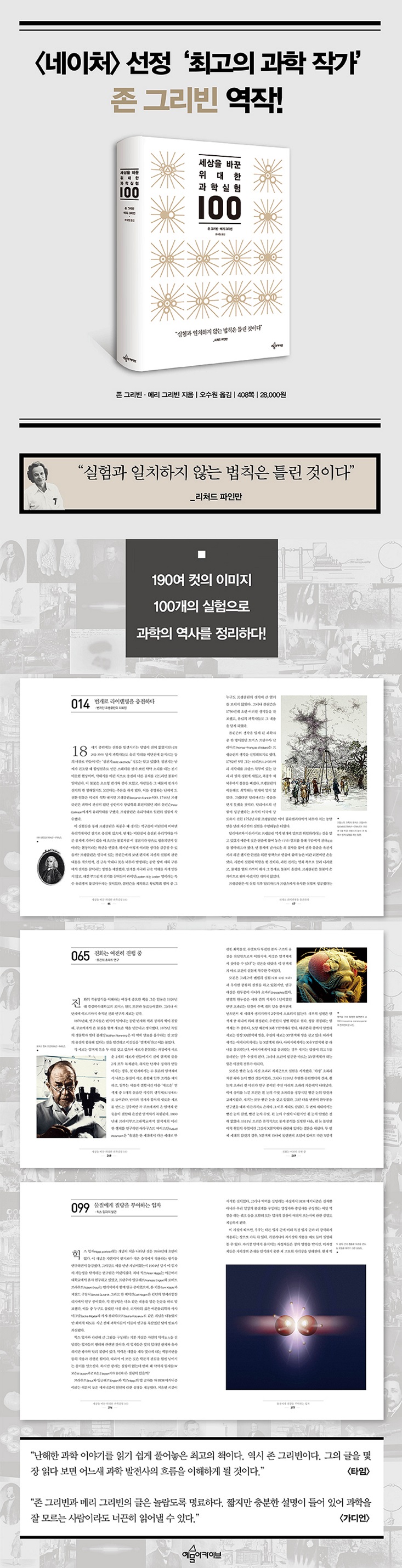
"100 Great Science Experiments That Changed the World" is a book that condenses the explanation of 'how science has developed' through the stories of 100 important experiments.
From 1,600-year-old experiments on the buoyancy of water to today's discoveries about the components of the universe, this exhibition captures historical moments in science through over 190 images.
The basis of all scientific worldviews is ‘experimentation.’
This is because all scientific theories and hypotheses gain ‘authority’ through ‘proof (experimentation)’.
Professor John Gribbin, the author of this book and one of Nature's "best science writers," selected 100 groundbreaking experiments to reveal the historical development of science and completed "100 Great Science Experiments That Changed the World."
As we follow the stories of each experiment, we can see that the dazzlingly advanced modern science did not suddenly appear one day, but rather that previous experiments developed into the next science.
This masterpiece depicts the great moments that have advanced human knowledge of living and non-living things, the Earth, and the universe, from the discovery of the microscopic world to the measurement of Earth's gravity, the generation of electricity, and experiments on the accelerated expansion of the universe.
“Science without experiments is nothing!”
"100 Great Science Experiments That Changed the World" is a book that condenses the explanation of 'how science has developed' through the stories of 100 important experiments.
From 1,600-year-old experiments on the buoyancy of water to today's discoveries about the components of the universe, this exhibition captures historical moments in science through over 190 images.
The basis of all scientific worldviews is ‘experimentation.’
This is because all scientific theories and hypotheses gain ‘authority’ through ‘proof (experimentation)’.
Professor John Gribbin, the author of this book and one of Nature's "best science writers," selected 100 groundbreaking experiments to reveal the historical development of science and completed "100 Great Science Experiments That Changed the World."
As we follow the stories of each experiment, we can see that the dazzlingly advanced modern science did not suddenly appear one day, but rather that previous experiments developed into the next science.
This masterpiece depicts the great moments that have advanced human knowledge of living and non-living things, the Earth, and the universe, from the discovery of the microscopic world to the measurement of Earth's gravity, the generation of electricity, and experiments on the accelerated expansion of the universe.
- You can preview some of the book's contents.
Preview
index
introduction
001_Verify that the crown is made of pure gold.
002_The sun visible even from a deep well
003_The eye is like a pinhole camera.
004_Time the execution for the lecture
005_The 'Compass Myth' Overcame by Science
006_Aristotle was wrong
007_Evidence that 'Galen may be wrong'
008_Measuring the Weight of Air
009_Scientists Fascinated by Vacuum
010_The World Through a Microscope
011_Be skeptical of everything you hear
012_Why do lunar eclipse cycles differ?
013_Sailor's Vitamins
014_Charging a Leyden Jar with Lightning
015_The Heat of Ice: The Starting Point of the Steam Engine
016_Synergy of Experimentation and Invention: The Steam Engine
017_Plant Breathing and 'Pure Air'
018_Discovering the Sixth Planet
019_Animal body temperature is not magic.
020_The Convulsive Frog and the Birth of the Battery
021_How to Measure the Weight of the Earth
022_Creating Heat with a Perforation Experiment
023_Humanity's first vaccine
024_Chasing the Invisible Light
025_A pile of rocks floating in space
026_Flying in the Sky Using Hydrogen
027_The hypothesis that light is a wave
028_Water vapor and air mixed in the same space
029_Electrical Experiments That Led to a Leap in Science
030_Quantifying Chemistry
031_Thought experiment that revealed the power of fire
032_Particles Dance, Random Walk
033_Understanding the Magnetism of Electricity
034_Making organic compounds in test tubes
035_Attaching a motor to a generator
036_Skating on Thin Ice
037_From body temperature to the law of conservation of energy
038_Trumpeter on the Train
039_Evidence of an Ice Age
040_Explaining Climate Change
041_The world's largest telescope
042_Who first developed anesthesia?
043_The Birth of Astrophysics
044_Prevention is better than cure
045_Measuring the exact speed of light
046_Death Sentence to Bacteria
047_The Flower of Evolutionary Theory Blooms
048_The structure of benzene is like a snake biting its own tail.
049_The Monk and the Pea
050_What Happens Inside a Vacuum Tube
051_The piezoelectric effect that created various acoustic devices
052_The speed of light is constant
053_Unraveling the Mysteries of Electromagnetic Waves
054_Discovering the 'Noble Aircraft'
055_Biochemistry Born from Fermentation Research
056_A photo showing death
057_The long-awaited emergence of 'electronics'
058_From X-rays to radioactivity
059_Discovery of photons using light and electrons
060_Conditioned reflex discovered by chance
061_Journey to the Center of the Earth
062_Uncovering the Inside of the Atom
063_Measuring the Size of the Universe
064_Discovery of Nucleic Acids
065_Evolution is still in progress
066_The discovery of X-ray diffraction by the Braggs
067_Light through the darkness
068_No one understands quantum mechanics
069_Discovering Transformation
070_Antibiotics that saved humanity
071_Finally Splitting the Atom
072_Synthesize Vitamin C
073_Analyzing protein structure
074_Warning of a Great Disaster
075_Schrödinger's Cat
076_From nuclear fission to nuclear fusion
077_Manhattan Project
078_The first modern computer
079_Unraveling the Role of DNA
080_Leap genes discovered in corn
081_Model made by twisting long paper strings
082_Wearing Blender Experiment Using a Mixer
083_Double helix of mirror images
084_Molecules that make up living things
085_Major and Laser
086_Magnetic Strips and Seafloor Spreading
087_Dry Cleaning Solution and Neutrinos
088_From Vitamin B12 to Insulin
089_The Earth Takes a Long Breath
090_The Unending Noise of the Universe
091_Time to board the plane
092_Proving Gravitational Waves
093_Why isn't the Earth in an ice age now?
094_The world is nonlocal
095_The Ultimate Quantum Experiment
096_The receding supernova
097_A Path to Gene Repair
098_15 is 3 times 5
099_Particles that give mass to matter
100_The standard of current knowledge about the universe
Bonus Experiment 101
main
Image source
Search
001_Verify that the crown is made of pure gold.
002_The sun visible even from a deep well
003_The eye is like a pinhole camera.
004_Time the execution for the lecture
005_The 'Compass Myth' Overcame by Science
006_Aristotle was wrong
007_Evidence that 'Galen may be wrong'
008_Measuring the Weight of Air
009_Scientists Fascinated by Vacuum
010_The World Through a Microscope
011_Be skeptical of everything you hear
012_Why do lunar eclipse cycles differ?
013_Sailor's Vitamins
014_Charging a Leyden Jar with Lightning
015_The Heat of Ice: The Starting Point of the Steam Engine
016_Synergy of Experimentation and Invention: The Steam Engine
017_Plant Breathing and 'Pure Air'
018_Discovering the Sixth Planet
019_Animal body temperature is not magic.
020_The Convulsive Frog and the Birth of the Battery
021_How to Measure the Weight of the Earth
022_Creating Heat with a Perforation Experiment
023_Humanity's first vaccine
024_Chasing the Invisible Light
025_A pile of rocks floating in space
026_Flying in the Sky Using Hydrogen
027_The hypothesis that light is a wave
028_Water vapor and air mixed in the same space
029_Electrical Experiments That Led to a Leap in Science
030_Quantifying Chemistry
031_Thought experiment that revealed the power of fire
032_Particles Dance, Random Walk
033_Understanding the Magnetism of Electricity
034_Making organic compounds in test tubes
035_Attaching a motor to a generator
036_Skating on Thin Ice
037_From body temperature to the law of conservation of energy
038_Trumpeter on the Train
039_Evidence of an Ice Age
040_Explaining Climate Change
041_The world's largest telescope
042_Who first developed anesthesia?
043_The Birth of Astrophysics
044_Prevention is better than cure
045_Measuring the exact speed of light
046_Death Sentence to Bacteria
047_The Flower of Evolutionary Theory Blooms
048_The structure of benzene is like a snake biting its own tail.
049_The Monk and the Pea
050_What Happens Inside a Vacuum Tube
051_The piezoelectric effect that created various acoustic devices
052_The speed of light is constant
053_Unraveling the Mysteries of Electromagnetic Waves
054_Discovering the 'Noble Aircraft'
055_Biochemistry Born from Fermentation Research
056_A photo showing death
057_The long-awaited emergence of 'electronics'
058_From X-rays to radioactivity
059_Discovery of photons using light and electrons
060_Conditioned reflex discovered by chance
061_Journey to the Center of the Earth
062_Uncovering the Inside of the Atom
063_Measuring the Size of the Universe
064_Discovery of Nucleic Acids
065_Evolution is still in progress
066_The discovery of X-ray diffraction by the Braggs
067_Light through the darkness
068_No one understands quantum mechanics
069_Discovering Transformation
070_Antibiotics that saved humanity
071_Finally Splitting the Atom
072_Synthesize Vitamin C
073_Analyzing protein structure
074_Warning of a Great Disaster
075_Schrödinger's Cat
076_From nuclear fission to nuclear fusion
077_Manhattan Project
078_The first modern computer
079_Unraveling the Role of DNA
080_Leap genes discovered in corn
081_Model made by twisting long paper strings
082_Wearing Blender Experiment Using a Mixer
083_Double helix of mirror images
084_Molecules that make up living things
085_Major and Laser
086_Magnetic Strips and Seafloor Spreading
087_Dry Cleaning Solution and Neutrinos
088_From Vitamin B12 to Insulin
089_The Earth Takes a Long Breath
090_The Unending Noise of the Universe
091_Time to board the plane
092_Proving Gravitational Waves
093_Why isn't the Earth in an ice age now?
094_The world is nonlocal
095_The Ultimate Quantum Experiment
096_The receding supernova
097_A Path to Gene Repair
098_15 is 3 times 5
099_Particles that give mass to matter
100_The standard of current knowledge about the universe
Bonus Experiment 101
main
Image source
Search
Detailed image
Into the book
It doesn't matter how beautiful the reasoning is, how skilled the scientist is, who made the reasoning, or how famous his reputation is.
Any law that does not agree with experiment is wrong.
---p.7 From the "Preface"
Above all, this true story shows how important the power of experimentation is.
An experiment conducted honestly tells the truth.
It doesn't matter what outcome you want to achieve from your experiment.
Philosophers who followed Aristotle wanted to prove Galileo wrong, but experiments proved Galileo right.
---p.42 From "006: Aristotle Was Wrong"
However, there were still people who viewed the theory of the spirit with skepticism.
Because Newton was held in awe by everyone, some scientists were reluctant to accept that he could be wrong.
They found it hard to believe that a black stripe could be created simply by combining two light rays.
However, just a few years later, French physicist Augustin Fresnel proved that Young's theory was true.
---p.115 From "027: The Hypothesis that Light is a Wave"
Scientific inquiry led to the invention of the battery, which provided a source of electrical current for further scientific inquiry, which in turn led to new technologies (see Experiment 33).
The availability of new tools meant that the foundations for a significant number of similar experiments aimed at exploring the nature of the material world were laid.
---p.121 From "029: Electrical Experiments That Led to a Leap in Science"
Faraday's experiments opened the door to developing ways to generate electricity on demand, either by rotating a magnet around a coil of wire, or by moving the wire near the magnet (it is the relative motion that matters, not the position of the magnet and the wire that matters).
Just as electricity can be converted into mechanical motion, mechanical motion can also be converted into electricity.
It has also become possible to generate electricity in one place and then transport it through wires to another place to drive an electric motor there.
---p.144 From "035: Attaching a Motor to a Generator"
J.
J. Thomson received the Nobel Prize “for his demonstration that electrons are particles,” and his son received the Nobel Prize “for his demonstration that electrons are waves.”
Both of them were right.
Even if you don't know how this is possible, don't worry.
Because, as another Nobel laureate, Richard Feynman, said, “Nobody understands quantum mechanics.”
---p.261 From "068: No One Understands Quantum Mechanics"
Any law that does not agree with experiment is wrong.
---p.7 From the "Preface"
Above all, this true story shows how important the power of experimentation is.
An experiment conducted honestly tells the truth.
It doesn't matter what outcome you want to achieve from your experiment.
Philosophers who followed Aristotle wanted to prove Galileo wrong, but experiments proved Galileo right.
---p.42 From "006: Aristotle Was Wrong"
However, there were still people who viewed the theory of the spirit with skepticism.
Because Newton was held in awe by everyone, some scientists were reluctant to accept that he could be wrong.
They found it hard to believe that a black stripe could be created simply by combining two light rays.
However, just a few years later, French physicist Augustin Fresnel proved that Young's theory was true.
---p.115 From "027: The Hypothesis that Light is a Wave"
Scientific inquiry led to the invention of the battery, which provided a source of electrical current for further scientific inquiry, which in turn led to new technologies (see Experiment 33).
The availability of new tools meant that the foundations for a significant number of similar experiments aimed at exploring the nature of the material world were laid.
---p.121 From "029: Electrical Experiments That Led to a Leap in Science"
Faraday's experiments opened the door to developing ways to generate electricity on demand, either by rotating a magnet around a coil of wire, or by moving the wire near the magnet (it is the relative motion that matters, not the position of the magnet and the wire that matters).
Just as electricity can be converted into mechanical motion, mechanical motion can also be converted into electricity.
It has also become possible to generate electricity in one place and then transport it through wires to another place to drive an electric motor there.
---p.144 From "035: Attaching a Motor to a Generator"
J.
J. Thomson received the Nobel Prize “for his demonstration that electrons are particles,” and his son received the Nobel Prize “for his demonstration that electrons are waves.”
Both of them were right.
Even if you don't know how this is possible, don't worry.
Because, as another Nobel laureate, Richard Feynman, said, “Nobody understands quantum mechanics.”
---p.261 From "068: No One Understands Quantum Mechanics"
--- From the text
Publisher's Review
A giant leap forward, built on small steps
“If we look back at the progress of physics, we see that countless small steps have accumulated, and then countless giant leaps have been superimposed on top of each other.”
These are the words of Paul Dirac, a pioneer in quantum theory.
As he says, science does not advance in revolutionary ways except in very rare cases.
Science has an incremental nature, building on what has already been developed.
Spectacle lenses were converted into telescopes and used for astronomical research, and high-performance telescope technology contributed to overcoming severe visual impairment.
The invention of the vacuum pump also led to the study of cathode rays, the discovery of X-rays and electrons, and today, through the development of the Large Hadron Collider, it has made possible the understanding of the Higgs particle and the subatomic world.
Stories of scientists who challenged authority and overcame prejudice.
“Be suspicious of everything you hear (Nullius in Verba)”
This is the motto of the Royal Society of London.
Great scientists don't just accept a discovery as is, they conduct experiments to verify it.
Even world-renowned physicist Richard Feynman said, “It doesn’t matter how famous he is.
He emphasized the importance of experiments in science, saying, “A law that does not agree with experiments is wrong.”
"100 Great Science Experiments That Changed the World" is a book that shows the history and flow of science through 100 experiments, and it is also a story about the hundreds of scientists who carried out each experiment.
Scientific discoveries that are great enough to change the world often begin by verifying existing hypotheses and theories of famous scientists of the time.
This is the result of the challenge of several scientists who overcame the 'prejudice' that was considered true in the scientific community at the time.
For example, Galileo proved that Aristotle's claim about the speed of falling objects was wrong, and Thomas Young proved through the 'double slit experiment' that 'even Newton can be wrong.'
Also, Einstein's 'general theory of relativity' explained what Newton's theory could not explain.
However, Einstein's theory did not replace Newton's theory, but rather built upon it.
Likewise, future, better theories must explain everything that has been done before, while also explaining more.
Science progresses in this way as new theories fill in the gaps in existing theories.
From 'Eureka' to 'LIGO Experiment'
The author begins the story by citing Archimedes' discovery of the 'buoyancy' of water as the first scientific experiment.
Starting with Eratostes' measurement of the Earth's diameter, Alhazen's optical experiments, known as the 'Arab Newton', and Andreas Vesalius's human dissection, the curtain gradually rises on the scientific exploration of the Earth and humans.
And finally, in 1600, the first book based solely on scientific experiments, William Gilbert's De Magnete, was published.
The author describes this period as “a crucial period in which mystical and superstitious views of the world transitioned into scientific research.”
The experiments, presented in chronological order from then until the present day, show the process through which the numerous scientific theories and laws we learned in science textbooks were born.
It also tells us how historical scientific experiments have changed the world we live in, such as how Torricelli's discovery of the 'vacuum' is important in science, and why James Watt's 'steam engine' and Faraday's 'electric motor' are the starting points of the technological revolution.
This book is designed to provide a comprehensive understanding of how all things encompassed under the umbrella of science have organically developed, from the process by which chemistry developed its system, to the development of genetics, the birth of astrophysics, and even the world of quantum mechanics.
It is explained in a friendly manner so that even those with limited scientific knowledge can easily access it, and it also has significance as a 'record' that organizes the major trends of scientific development.
As a definitive scientific experiment, the story of the LIGO experiment, which detected gravitational waves, is a bonus.
“If we look back at the progress of physics, we see that countless small steps have accumulated, and then countless giant leaps have been superimposed on top of each other.”
These are the words of Paul Dirac, a pioneer in quantum theory.
As he says, science does not advance in revolutionary ways except in very rare cases.
Science has an incremental nature, building on what has already been developed.
Spectacle lenses were converted into telescopes and used for astronomical research, and high-performance telescope technology contributed to overcoming severe visual impairment.
The invention of the vacuum pump also led to the study of cathode rays, the discovery of X-rays and electrons, and today, through the development of the Large Hadron Collider, it has made possible the understanding of the Higgs particle and the subatomic world.
Stories of scientists who challenged authority and overcame prejudice.
“Be suspicious of everything you hear (Nullius in Verba)”
This is the motto of the Royal Society of London.
Great scientists don't just accept a discovery as is, they conduct experiments to verify it.
Even world-renowned physicist Richard Feynman said, “It doesn’t matter how famous he is.
He emphasized the importance of experiments in science, saying, “A law that does not agree with experiments is wrong.”
"100 Great Science Experiments That Changed the World" is a book that shows the history and flow of science through 100 experiments, and it is also a story about the hundreds of scientists who carried out each experiment.
Scientific discoveries that are great enough to change the world often begin by verifying existing hypotheses and theories of famous scientists of the time.
This is the result of the challenge of several scientists who overcame the 'prejudice' that was considered true in the scientific community at the time.
For example, Galileo proved that Aristotle's claim about the speed of falling objects was wrong, and Thomas Young proved through the 'double slit experiment' that 'even Newton can be wrong.'
Also, Einstein's 'general theory of relativity' explained what Newton's theory could not explain.
However, Einstein's theory did not replace Newton's theory, but rather built upon it.
Likewise, future, better theories must explain everything that has been done before, while also explaining more.
Science progresses in this way as new theories fill in the gaps in existing theories.
From 'Eureka' to 'LIGO Experiment'
The author begins the story by citing Archimedes' discovery of the 'buoyancy' of water as the first scientific experiment.
Starting with Eratostes' measurement of the Earth's diameter, Alhazen's optical experiments, known as the 'Arab Newton', and Andreas Vesalius's human dissection, the curtain gradually rises on the scientific exploration of the Earth and humans.
And finally, in 1600, the first book based solely on scientific experiments, William Gilbert's De Magnete, was published.
The author describes this period as “a crucial period in which mystical and superstitious views of the world transitioned into scientific research.”
The experiments, presented in chronological order from then until the present day, show the process through which the numerous scientific theories and laws we learned in science textbooks were born.
It also tells us how historical scientific experiments have changed the world we live in, such as how Torricelli's discovery of the 'vacuum' is important in science, and why James Watt's 'steam engine' and Faraday's 'electric motor' are the starting points of the technological revolution.
This book is designed to provide a comprehensive understanding of how all things encompassed under the umbrella of science have organically developed, from the process by which chemistry developed its system, to the development of genetics, the birth of astrophysics, and even the world of quantum mechanics.
It is explained in a friendly manner so that even those with limited scientific knowledge can easily access it, and it also has significance as a 'record' that organizes the major trends of scientific development.
As a definitive scientific experiment, the story of the LIGO experiment, which detected gravitational waves, is a bonus.
GOODS SPECIFICS
- Date of publication: October 16, 2017
- Page count, weight, size: 408 pages | 1,172g | 195*256*30mm
- ISBN13: 9791187749424
- ISBN10: 1187749427
You may also like
카테고리
korean


korean

![GQ KOREA Mark (Monthly): December [2025]](http://librairie.coreenne.fr/cdn/shop/files/8ef265dbbfbf186523ed75ba7319009d.jpg?v=1765340328&width=3840)


