

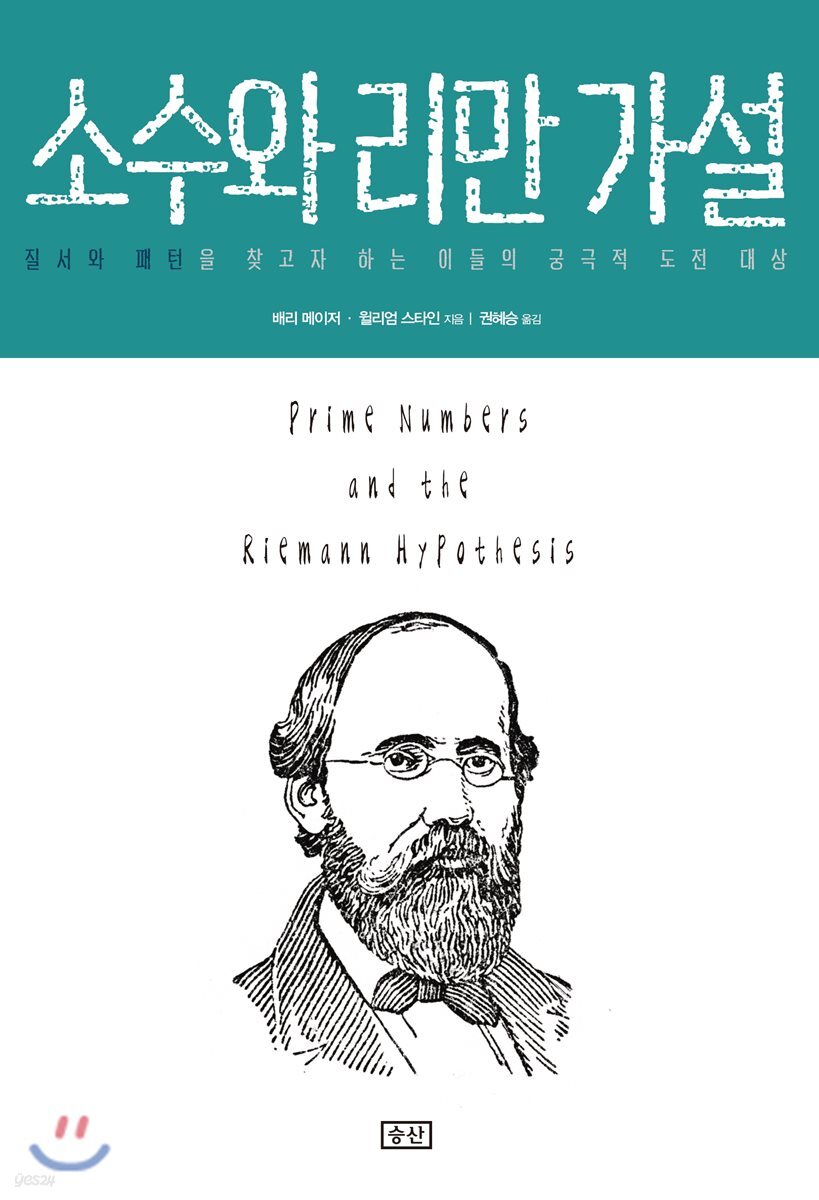
Prime numbers and the Riemann hypothesis
 |
Description
Book Introduction
Until now, popular books on the Riemann hypothesis have focused on richly describing the people who dedicated themselves to solving it and the mathematical and historical issues related to them.
But this book has a slightly different goal.
Explains in the most direct way possible what the Riemann Hypothesis is all about and why it is so important.
This book will provide a broad discussion of prime numbers that both students with limited mathematical background and mathematics scholars will enjoy.
But this book has a slightly different goal.
Explains in the most direct way possible what the Riemann Hypothesis is all about and why it is so important.
This book will provide a broad discussion of prime numbers that both students with limited mathematical background and mathematics scholars will enjoy.
- You can preview some of the book's contents.
Preview
index
preface
Part 1: The Riemann Hypothesis
1.
Thoughts on numbers in ancient, medieval, and modern times
2.
What is a prime number?
3.
“Named” prime numbers
4.
sieves
5.
Questions about prime numbers that anyone can ask
6.
More questions about prime numbers
7.
How many prime numbers exist?
8.
Minorities viewed from afar
9.
Pure and Applied Mathematics
10.
First probabilistic guess
11.
What is a “good approximation”?
12.
Square root error and random walk
13.
What is the Riemann Hypothesis? (First Formulation)
14.
The mystery shifts to the error term.
15.
Cesaro Smoothing
16.
lLi(X)-pi(X)l view
17.
Prime number theorem
18.
Information contained in a few steps
19.
A few steps to be repaired
20.
What on earth do computer music files, data compression, and prime numbers have to do with each other?
21.
The word “Spectrum”
22.
Sum of spectrum and trigonometric functions
23.
Spectrum and minority steps
24.
To the readers of Part 1
Part 2: Superfunctions (Distribution)
25.
How can calculus find the slope of a graph that has no slope?
26.
Superfunctions: Making Approximate Functions Sharp Even When Sending Them to Infinity
27.
Fourier Transform: Second Visit
28.
What is the Fourier transform of the delta function?
29.
trigonometric series
30.
A brief overview of Part 3
Part 3: Riemann Spectrum of Prime Numbers
31.
Without losing information
32.
From prime numbers to the Riemann spectrum
33.
How many theta_i's are there?
34.
Additional Questions About the Riemann Spectrum
35.
From the Riemann spectrum to prime numbers
Part 4: Return to Riemann
36.
How to create pi(X) from a spectrum? (Riemann's method)
37.
As predicted by Riemann, the zeta function connects a few steps to the Riemann spectrum.
38.
Companions of the zeta function
Americas
Image source
Search
Part 1: The Riemann Hypothesis
1.
Thoughts on numbers in ancient, medieval, and modern times
2.
What is a prime number?
3.
“Named” prime numbers
4.
sieves
5.
Questions about prime numbers that anyone can ask
6.
More questions about prime numbers
7.
How many prime numbers exist?
8.
Minorities viewed from afar
9.
Pure and Applied Mathematics
10.
First probabilistic guess
11.
What is a “good approximation”?
12.
Square root error and random walk
13.
What is the Riemann Hypothesis? (First Formulation)
14.
The mystery shifts to the error term.
15.
Cesaro Smoothing
16.
lLi(X)-pi(X)l view
17.
Prime number theorem
18.
Information contained in a few steps
19.
A few steps to be repaired
20.
What on earth do computer music files, data compression, and prime numbers have to do with each other?
21.
The word “Spectrum”
22.
Sum of spectrum and trigonometric functions
23.
Spectrum and minority steps
24.
To the readers of Part 1
Part 2: Superfunctions (Distribution)
25.
How can calculus find the slope of a graph that has no slope?
26.
Superfunctions: Making Approximate Functions Sharp Even When Sending Them to Infinity
27.
Fourier Transform: Second Visit
28.
What is the Fourier transform of the delta function?
29.
trigonometric series
30.
A brief overview of Part 3
Part 3: Riemann Spectrum of Prime Numbers
31.
Without losing information
32.
From prime numbers to the Riemann spectrum
33.
How many theta_i's are there?
34.
Additional Questions About the Riemann Spectrum
35.
From the Riemann spectrum to prime numbers
Part 4: Return to Riemann
36.
How to create pi(X) from a spectrum? (Riemann's method)
37.
As predicted by Riemann, the zeta function connects a few steps to the Riemann spectrum.
38.
Companions of the zeta function
Americas
Image source
Search
Into the book
P.62: In our view, this particular problem before us (the Riemann hypothesis) has aspects of both applied mathematics and pure mathematics.
Is it possible to create a smooth approximation curve that fits the "few steps" and is given by a simple analytical formula? The story behind this is truly astonishing, with incredible applications.
P.109: Oddly enough, the Riemann hypothesis leads us to questions like these (about the spectrum of prime steps and their calculation).
We began with a question about prime numbers—"How do we count the number of primes?"—but this question led us to discover a profound regularity hidden in their structure.
P.198: The Riemann zeta function acts as a clamp that fits the information about the location of the prime number and its spectrum so elegantly!
Is it possible to create a smooth approximation curve that fits the "few steps" and is given by a simple analytical formula? The story behind this is truly astonishing, with incredible applications.
P.109: Oddly enough, the Riemann hypothesis leads us to questions like these (about the spectrum of prime steps and their calculation).
We began with a question about prime numbers—"How do we count the number of primes?"—but this question led us to discover a profound regularity hidden in their structure.
P.198: The Riemann zeta function acts as a clamp that fits the information about the location of the prime number and its spectrum so elegantly!
--- From the text
Publisher's Review
▼Riemann hypothesis
No matter how much you look at the list of prime numbers, it is impossible to predict when the next prime number will appear.
The appearance of prime numbers is confusing and random, and gives no clue as to how to find the next prime number.
To borrow the words of Don Jaier, former director of the Max Planck Institute for Mathematics, prime numbers are “the most unruly and irritating objects studied by mathematicians, growing like weeds among the natural numbers and seemingly obeying no laws other than those of chance.”
The list of prime numbers is the heartbeat of mathematics, but it is erratic, as if it were drunk on strong caffeine.
However, the belief that the world of the few will not be ruled by chaos dominates the mathematical community today.
The person who provided the decisive basis for this belief was the Göttingen mathematician Bernhard Riemann.
In 1859, Riemann developed Euler's idea (the zeta function) in a dramatically new way and defined what is called the Riemann zeta function.
One of the many results this zeta function yielded was an “exact formula” for finding the number of primes in a range X.
▼The Importance of the Riemann Hypothesis
This conjecture, known as the Riemann hypothesis, has given rise to over 500 other conclusions that begin with assuming it to be true, and is widely recognized today as one of the most difficult and important unsolved problems in mathematics.
The Riemann hypothesis is difficult to prove, but the ripple effects of its proof are expected to be enormous.
The proof is expected to bring about a revolution in applied mathematics, including number theory.
Modern computer cryptography and credit cards, which were born from prime numbers, also have their roots in the Riemann hypothesis.
The study of the Riemann hypothesis, which had frustrated countless mathematicians for 160 years and raised fundamental questions about its solvability, was shockingly revealed in the latter half of the 20th century by Hugh Montgomery and Freeman Dyson to be related to core fields of quantum physics, and now even physicists are beginning to be drawn into this field.
The proof of the Riemann hypothesis is gaining new vitality with the development of computational mathematics and interdisciplinary research in mathematics and physics, and Alain Cohn, one of the greatest mathematicians of his time, jumped into the Riemann hypothesis by proposing a new solution using noncommutative geometry.
Many mathematicians are betting that the Riemann hypothesis is correct.
Assuming that the minority actually behaves as Riemann predicted, numerous other conclusions have emerged.
Because the fate of so many conclusions depends on conquering the Riemann hypothesis, mathematicians call it a hypothesis rather than a conjecture.
The term 'hypothesis' strongly implies that it is an assumption that is essential for mathematicians to establish a theory.
If this hypothesis is proven true, the more than 500 papers that have been floating around will also be automatically proven and organized.
▼Prime Numbers and the Riemann Hypothesis by Barry Major and William Stein
At a time when it was difficult to find popular books on the Riemann Hypothesis, Seungsan translated and published two excellent books on the subject: John Derbyshire's The Riemann Hypothesis (Seungsan, 2006, 7th edition) and Marcus de Sautoy's The Music of Prime Numbers (Seungsan, 2007, 4th edition).
And after ten years, several more books appeared.
The most notable of these is Barry Major and William Stein's Prime Numbers and the Riemann Hypothesis, published in 2015.
There is almost no mathematical formula in Part 1.
It was written for readers who are interested or curious about mathematical concepts, but have never studied advanced topics.
Part 1 provides an overview of the core of the Riemann hypothesis and highlights why it has been studied with such fervor.
No calculus was used.
Although there was a limitation that it had to be explained as simply as possible, Part 1 is complete in itself in the sense that it has a beginning, middle, and end.
Even readers who read only Part 1 will be able to feel and enjoy the charm of the Riemann Hypothesis, an important topic in mathematics.
Part 2 is for readers who have taken a calculus class at least once, even if it has been a while since they learned it.
This section is a rough preparation for understanding the types of Fourier analysis that will appear later, and the key is the concept of spectrum.
Part 3 is for readers who want to see more vividly the connection between the location of primes and the Riemann spectrum (which we will call it there).
Part 4 is a section that requires a certain level of knowledge of complex analytic functions to understand, and deals with Riemann's viewpoint, the final topic of this book.
This view relates the Riemann spectrum discussed in Part 3 to the nontrivial zeroes of the Riemann zeta function.
We also provide a rough outline of the more standard way in which the Riemann hypothesis has been explained in previous publications.
In the Americas, we tried to show the connection between the text and the references.
Moreover, as you go further, more mathematical background knowledge is required, and more technical explanations are provided in the Americas.
The two authors, Major and Stein, are leading experts in studying the interplay between the analytical, geometric, and number-theoretic aspects of the Riemann hypothesis.
Stein is also the founder of the Sage mathematics software project.
It took the two like-minded individuals ten years to complete this innovative book, but it is short and concise.
At the end of each year's writing period, I uploaded the manuscript (complete with errors) online and asked readers to respond.
Therefore, all the feedback, corrections, and requests I received from readers are accumulated in this book.
The author and editor have organized the essence of the Riemann hypothesis into several short chapters, organized by idea.
Readers can either read through each chapter carefully or skip the tedious steps and get straight to the point.
This configuration is great for reading over and over again, wherever and whenever you want.
I hope that this book will continue to inspire mathematical inspiration in readers.
No matter how much you look at the list of prime numbers, it is impossible to predict when the next prime number will appear.
The appearance of prime numbers is confusing and random, and gives no clue as to how to find the next prime number.
To borrow the words of Don Jaier, former director of the Max Planck Institute for Mathematics, prime numbers are “the most unruly and irritating objects studied by mathematicians, growing like weeds among the natural numbers and seemingly obeying no laws other than those of chance.”
The list of prime numbers is the heartbeat of mathematics, but it is erratic, as if it were drunk on strong caffeine.
However, the belief that the world of the few will not be ruled by chaos dominates the mathematical community today.
The person who provided the decisive basis for this belief was the Göttingen mathematician Bernhard Riemann.
In 1859, Riemann developed Euler's idea (the zeta function) in a dramatically new way and defined what is called the Riemann zeta function.
One of the many results this zeta function yielded was an “exact formula” for finding the number of primes in a range X.
▼The Importance of the Riemann Hypothesis
This conjecture, known as the Riemann hypothesis, has given rise to over 500 other conclusions that begin with assuming it to be true, and is widely recognized today as one of the most difficult and important unsolved problems in mathematics.
The Riemann hypothesis is difficult to prove, but the ripple effects of its proof are expected to be enormous.
The proof is expected to bring about a revolution in applied mathematics, including number theory.
Modern computer cryptography and credit cards, which were born from prime numbers, also have their roots in the Riemann hypothesis.
The study of the Riemann hypothesis, which had frustrated countless mathematicians for 160 years and raised fundamental questions about its solvability, was shockingly revealed in the latter half of the 20th century by Hugh Montgomery and Freeman Dyson to be related to core fields of quantum physics, and now even physicists are beginning to be drawn into this field.
The proof of the Riemann hypothesis is gaining new vitality with the development of computational mathematics and interdisciplinary research in mathematics and physics, and Alain Cohn, one of the greatest mathematicians of his time, jumped into the Riemann hypothesis by proposing a new solution using noncommutative geometry.
Many mathematicians are betting that the Riemann hypothesis is correct.
Assuming that the minority actually behaves as Riemann predicted, numerous other conclusions have emerged.
Because the fate of so many conclusions depends on conquering the Riemann hypothesis, mathematicians call it a hypothesis rather than a conjecture.
The term 'hypothesis' strongly implies that it is an assumption that is essential for mathematicians to establish a theory.
If this hypothesis is proven true, the more than 500 papers that have been floating around will also be automatically proven and organized.
▼Prime Numbers and the Riemann Hypothesis by Barry Major and William Stein
At a time when it was difficult to find popular books on the Riemann Hypothesis, Seungsan translated and published two excellent books on the subject: John Derbyshire's The Riemann Hypothesis (Seungsan, 2006, 7th edition) and Marcus de Sautoy's The Music of Prime Numbers (Seungsan, 2007, 4th edition).
And after ten years, several more books appeared.
The most notable of these is Barry Major and William Stein's Prime Numbers and the Riemann Hypothesis, published in 2015.
There is almost no mathematical formula in Part 1.
It was written for readers who are interested or curious about mathematical concepts, but have never studied advanced topics.
Part 1 provides an overview of the core of the Riemann hypothesis and highlights why it has been studied with such fervor.
No calculus was used.
Although there was a limitation that it had to be explained as simply as possible, Part 1 is complete in itself in the sense that it has a beginning, middle, and end.
Even readers who read only Part 1 will be able to feel and enjoy the charm of the Riemann Hypothesis, an important topic in mathematics.
Part 2 is for readers who have taken a calculus class at least once, even if it has been a while since they learned it.
This section is a rough preparation for understanding the types of Fourier analysis that will appear later, and the key is the concept of spectrum.
Part 3 is for readers who want to see more vividly the connection between the location of primes and the Riemann spectrum (which we will call it there).
Part 4 is a section that requires a certain level of knowledge of complex analytic functions to understand, and deals with Riemann's viewpoint, the final topic of this book.
This view relates the Riemann spectrum discussed in Part 3 to the nontrivial zeroes of the Riemann zeta function.
We also provide a rough outline of the more standard way in which the Riemann hypothesis has been explained in previous publications.
In the Americas, we tried to show the connection between the text and the references.
Moreover, as you go further, more mathematical background knowledge is required, and more technical explanations are provided in the Americas.
The two authors, Major and Stein, are leading experts in studying the interplay between the analytical, geometric, and number-theoretic aspects of the Riemann hypothesis.
Stein is also the founder of the Sage mathematics software project.
It took the two like-minded individuals ten years to complete this innovative book, but it is short and concise.
At the end of each year's writing period, I uploaded the manuscript (complete with errors) online and asked readers to respond.
Therefore, all the feedback, corrections, and requests I received from readers are accumulated in this book.
The author and editor have organized the essence of the Riemann hypothesis into several short chapters, organized by idea.
Readers can either read through each chapter carefully or skip the tedious steps and get straight to the point.
This configuration is great for reading over and over again, wherever and whenever you want.
I hope that this book will continue to inspire mathematical inspiration in readers.
GOODS SPECIFICS
- Date of publication: June 27, 2017
- Page count, weight, size: 240 pages | 153*224*20mm
- ISBN13: 9788961390644
- ISBN10: 8961390643
You may also like
카테고리
korean


korean

![GQ KOREA Mark (Monthly): December [2025]](http://librairie.coreenne.fr/cdn/shop/files/8ef265dbbfbf186523ed75ba7319009d.jpg?v=1765340328&width=3840)


