

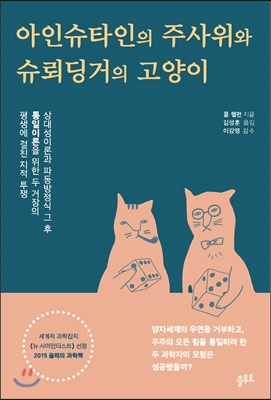
Einstein's Dice and Schrödinger's Cat
 |
Description
Book Introduction
2017 Korea Foundation for the Advancement of Science and Creativity Outstanding Science Book Selection
Einstein and Schrödinger: Two Men Who Changed Physics
What did the two masters do after their great achievements?
After establishing the theory of general relativity, a theory of gravity, Einstein became obsessed with the desire to unify all forces in the world by incorporating electromagnetic force into it.
The four fundamental forces of the universe are gravity, electromagnetism, the strong nuclear force, and the weak nuclear force.
However, the weak and strong forces were not yet known until Einstein began his research.
Einstein spent his entire life struggling to unify gravity and electromagnetism.
Schrödinger, who was 11 years younger than Einstein and had a lifelong correspondence with him and had a great influence on him, was also obsessed with the desire for the unification of forces.
However, Schrödinger insisted that the nuclear force discovered later should also be reflected in the unified theory.
But Einstein stubbornly ignored the existence of nuclear forces and the subatomic particles that were subsequently discovered.
"Einstein's Dice and Schrödinger's Cat" introduces the process by which Einstein developed the theory of relativity and the process by which Schrödinger developed the wave equation, and then introduces the subsequent research of the two scientists who struggled to establish a theory that would replace quantum mechanics based on chance and probability and a unified theory that would integrate all forces in the universe.
The private lives of the two scientists are also meaningfully included here.
Schrödinger's famous womanizing is also introduced, but more than anything, it shows how much the two world wars influenced the lives of the two scientists.
Moreover, by looking at the philosophers who dominated the lives of the two scientists, it becomes understandable why their research had to proceed in the way it did.
Looking at the human side of these two scientists, we are reminded that even geniuses are people.
Finally, we introduce candidates for unified theory, such as the Standard Model, at the present time, and subsequent theories that have inherited the research methods of Einstein and Schrödinger.
Einstein and Schrödinger: Two Men Who Changed Physics
What did the two masters do after their great achievements?
After establishing the theory of general relativity, a theory of gravity, Einstein became obsessed with the desire to unify all forces in the world by incorporating electromagnetic force into it.
The four fundamental forces of the universe are gravity, electromagnetism, the strong nuclear force, and the weak nuclear force.
However, the weak and strong forces were not yet known until Einstein began his research.
Einstein spent his entire life struggling to unify gravity and electromagnetism.
Schrödinger, who was 11 years younger than Einstein and had a lifelong correspondence with him and had a great influence on him, was also obsessed with the desire for the unification of forces.
However, Schrödinger insisted that the nuclear force discovered later should also be reflected in the unified theory.
But Einstein stubbornly ignored the existence of nuclear forces and the subatomic particles that were subsequently discovered.
"Einstein's Dice and Schrödinger's Cat" introduces the process by which Einstein developed the theory of relativity and the process by which Schrödinger developed the wave equation, and then introduces the subsequent research of the two scientists who struggled to establish a theory that would replace quantum mechanics based on chance and probability and a unified theory that would integrate all forces in the universe.
The private lives of the two scientists are also meaningfully included here.
Schrödinger's famous womanizing is also introduced, but more than anything, it shows how much the two world wars influenced the lives of the two scientists.
Moreover, by looking at the philosophers who dominated the lives of the two scientists, it becomes understandable why their research had to proceed in the way it did.
Looking at the human side of these two scientists, we are reminded that even geniuses are people.
Finally, we introduce candidates for unified theory, such as the Standard Model, at the present time, and subsequent theories that have inherited the research methods of Einstein and Schrödinger.
- You can preview some of the book's contents.
Preview
index
Recommendation
Editor's Note (Lee Kang-young)
Acknowledgements
Entering Allies and Enemies
The Creepy Schrödinger's Cat | The Man of Contradictions | Randomness as a Common Enemy | Cracks in the Alliance | A Stained Unity
Chapter 1: The Universe as a Perfect Clock
The Compass and the Dance of the Planets | Strange Parallels | Things Not Supported by the Senses | A Brilliant College Student | 'Lazy Dog' | The Path to Miracles | The Unification of Time and Space
Chapter 2: The Crucible of Gravity
In the capital of a declining empire | General relativity at the Vienna Academy | The happiest thought of my life | Toward universal laws | The race to the top | A system of glory | The introduction of the cosmological constant | The prediction of dark energy | A world-renowned figure | Pure geometry toward a unified theory | An adventure into the fifth dimension
Chapter 3: Matter Waves and Quantum Leaps
Schrödinger and Schopenhauer | Einstein and Spinoza | A Walk with Bohr | The Matrix of Reality | The Final Contribution to Quantum Theory | De Broglie's Matter Waves | The Christmas Miracle | From Physical Waves to Probability Waves | At Bohr's House | God Does Not Play Dice
Chapter 4: In Search of a Unified Theory
How All the Forces of Nature Interlock | Isolated Above the Clouds | Ravi's Onion | On the Shore of Lake Schwielow | The Fierce Wind, the Sea Breeze | The Fires of the Reichstag
Chapter 5: Ghostly Connections and Zombie Cats
Schrödinger Abandoned Germany | Subtle, but Not Malicious | Schrödinger and Princeton | A Ghostly Connection | Einstein's Gunpowder | The Strange Cat | An Offer I Should Have Rejected | The Quantum World and the Universe | Into Another Dimension | Into the Misery of Wrong Choices | Operation Vienna | Waiting for the Establishment of the Institute for Advanced Study in Dublin
Chapter 6 In Princeton and Dublin
A Laughing Stock | Hamilton's Stamp | The Princeton Hermit | With God's Whip | General Unified Theory Using Affine | General Unified Theory Announced | Einstein's Hopes Out of the Grave? | Scientists Drafted for War
Chapter 7: The Publicity Campaign of Physics
De Valera's Fading Light | Deep Comradeship | A Gift from the Devil's Grandmother | The Announcement of a Lifetime | The Dragon Trapped in a Cave | Dublin Ridiculed | Einstein's Rebuttal | The Last Spotlight
Chapter 8: The Last Years of Einstein and Schrödinger
A New Unified Theory | Hope After Humiliation | Letter Exchange Resumed | Spring's Views on Quantum Measurement | Einstein Reaches the Singularity of Life | Back to Vienna | All Being is One | Cats Delve into Culture | Conflicts Surrounding Scientific Legacy
Going beyond Einstein and Schrödinger
The Triumph of the Standard Model | The Unfilled Gaps | Geometry, Symmetry, and the Dream of Unification | Lessons from Faster-than-Light Particles | The Road Ahead
annotation
Further Reading
Original text
Search
Editor's Note (Lee Kang-young)
Acknowledgements
Entering Allies and Enemies
The Creepy Schrödinger's Cat | The Man of Contradictions | Randomness as a Common Enemy | Cracks in the Alliance | A Stained Unity
Chapter 1: The Universe as a Perfect Clock
The Compass and the Dance of the Planets | Strange Parallels | Things Not Supported by the Senses | A Brilliant College Student | 'Lazy Dog' | The Path to Miracles | The Unification of Time and Space
Chapter 2: The Crucible of Gravity
In the capital of a declining empire | General relativity at the Vienna Academy | The happiest thought of my life | Toward universal laws | The race to the top | A system of glory | The introduction of the cosmological constant | The prediction of dark energy | A world-renowned figure | Pure geometry toward a unified theory | An adventure into the fifth dimension
Chapter 3: Matter Waves and Quantum Leaps
Schrödinger and Schopenhauer | Einstein and Spinoza | A Walk with Bohr | The Matrix of Reality | The Final Contribution to Quantum Theory | De Broglie's Matter Waves | The Christmas Miracle | From Physical Waves to Probability Waves | At Bohr's House | God Does Not Play Dice
Chapter 4: In Search of a Unified Theory
How All the Forces of Nature Interlock | Isolated Above the Clouds | Ravi's Onion | On the Shore of Lake Schwielow | The Fierce Wind, the Sea Breeze | The Fires of the Reichstag
Chapter 5: Ghostly Connections and Zombie Cats
Schrödinger Abandoned Germany | Subtle, but Not Malicious | Schrödinger and Princeton | A Ghostly Connection | Einstein's Gunpowder | The Strange Cat | An Offer I Should Have Rejected | The Quantum World and the Universe | Into Another Dimension | Into the Misery of Wrong Choices | Operation Vienna | Waiting for the Establishment of the Institute for Advanced Study in Dublin
Chapter 6 In Princeton and Dublin
A Laughing Stock | Hamilton's Stamp | The Princeton Hermit | With God's Whip | General Unified Theory Using Affine | General Unified Theory Announced | Einstein's Hopes Out of the Grave? | Scientists Drafted for War
Chapter 7: The Publicity Campaign of Physics
De Valera's Fading Light | Deep Comradeship | A Gift from the Devil's Grandmother | The Announcement of a Lifetime | The Dragon Trapped in a Cave | Dublin Ridiculed | Einstein's Rebuttal | The Last Spotlight
Chapter 8: The Last Years of Einstein and Schrödinger
A New Unified Theory | Hope After Humiliation | Letter Exchange Resumed | Spring's Views on Quantum Measurement | Einstein Reaches the Singularity of Life | Back to Vienna | All Being is One | Cats Delve into Culture | Conflicts Surrounding Scientific Legacy
Going beyond Einstein and Schrödinger
The Triumph of the Standard Model | The Unfilled Gaps | Geometry, Symmetry, and the Dream of Unification | Lessons from Faster-than-Light Particles | The Road Ahead
annotation
Further Reading
Original text
Search
Into the book
At the time of their confrontation, both men were Nobel laureates, in the prime of middle age, and clearly past the peak of their research careers.
But the story reported by the world's media was different.
The media still portrayed the story in the familiar format of a showdown between a strong, veteran champion and a trophy-hungry, confident newcomer.
--- p.23
Einstein's college life was marred by disappointment for a different reason.
He never had the opportunity to study the profound theoretical questions that really interested him.
As a result, Einstein ended up neglecting even subjects he should have studied hard for, such as mathematics.
Because it seemed unrelated to his intellectual passion.
Nevertheless, the relationships he formed during his college years ultimately played a key role in his intellectual growth.
--- p.69
The culmination of Einstein's lecture was his bold prediction that starlight is bent by the sun.
This was a verifiable prediction.
He predicted that because the Sun's gravity warps the geometry of space around it, anything passing near it (from the perspective of an outside observer) would move along a curved path.
Even light from a distant star will bend as it passes near the sun.
--- p.110
'Discontinuity' was the most important feature of Bohr's 'planetary' atomic model.
Einstein and Schrödinger considered this discontinuity to be the model's greatest weakness, although the theory was certainly an advance in other areas.
Why do electrons in atoms jump instantly from one orbit to another, when this never happens on planets in our solar system?
--- p.167
Before Einstein, there was virtually no such massive media interest in theoretical physics papers.
Einstein made even the most abstract and out-of-touch theories seem sexy and mysterious, like discoveries that would astonish the world.
The fact that his hypothesis only provides dry equations, lacking experimental evidence to show that it describes the actual physical world, did not stop the press from reporting it.
--- p.230
Einstein could never forgive the cowardly behavior of the Prussian Academy of Sciences.
It was a bitter pain for him to be abandoned by the rest of the Academy, with the exception of von Laue, Schrödinger, and to some extent Planck.
Planck also expressed his support for Einstein privately, but not publicly.
The Academy's refusal to resist the Nazis was one of the reasons why Einstein never set foot on German soil again after the war.
--- p.255
Schrödinger, grateful to Ireland for accepting him and to de Valera for his interest in him, developed a desire to become an expert on all things Irish.
He was fascinated by Celtic designs.
Visitors to Schrödinger's home were able to see miniature models of furniture he had meticulously crafted by hand.
For this furniture model, Schrödinger wove the fabric on an Irish loom.
He also kept a Gaelic introductory book on his desk to learn Gaelic.
But even he, who was good at learning foreign languages, eventually gave up on learning Irish grammar because it was too difficult.
--- p.312
Schrödinger felt thrilled and honored to be able to become such a close friend to Einstein.
For a physicist, there is no greater compliment than to be told that his head is spinning like Einstein's.
And if you had read that praise in a letter written by none other than the great man himself, you would have felt as if you were flying through the sky.
Another time, Einstein called Schrödinger a "clever rascal," which made Schrödinger's heart swell even more.
--- p.366
Einstein's last major public act was signing the Russell-Einstein Manifesto.
This declaration is a world peace request movement started by philosopher Bertrand Russell.
The declaration argued that the next world war would likely involve the use of nuclear weapons, such as hydrogen bombs, which could destroy large cities and annihilate humanity, and called for an end to armed conflict and a peaceful resolution of the dispute.
Einstein signed this manifesto on April 11, 1955, just a week before his death.
--- p.407
The discovery of the Higgs boson filled the last missing puzzle piece in the Standard Model of particle physics.
This standard model is the closest to a unified field theory among the theories we currently have.
The Standard Model also includes a unified explanation of the electromagnetic force and the weak interaction.
These two together are called electroweak interactions.
This standard model also describes the strong interaction.
The strong interaction is the force that holds protons and neutrons together in the nucleus.
Gravity is not involved here and is just spinning around on its own.
Gravity is not part of the standard model.
--- p.431
Physicists must be careful not to announce success prematurely, no matter how tempting it may be.
The researchers who discovered the Higgs boson waited patiently until observations accumulated and other possibilities could be ruled out.
Even if it is a process that takes several months.
This study teaches us a lesson about the nature of patience.
But sometimes researchers act too hastily.
They claim success before other researchers can provide conclusive evidence.
But the story reported by the world's media was different.
The media still portrayed the story in the familiar format of a showdown between a strong, veteran champion and a trophy-hungry, confident newcomer.
--- p.23
Einstein's college life was marred by disappointment for a different reason.
He never had the opportunity to study the profound theoretical questions that really interested him.
As a result, Einstein ended up neglecting even subjects he should have studied hard for, such as mathematics.
Because it seemed unrelated to his intellectual passion.
Nevertheless, the relationships he formed during his college years ultimately played a key role in his intellectual growth.
--- p.69
The culmination of Einstein's lecture was his bold prediction that starlight is bent by the sun.
This was a verifiable prediction.
He predicted that because the Sun's gravity warps the geometry of space around it, anything passing near it (from the perspective of an outside observer) would move along a curved path.
Even light from a distant star will bend as it passes near the sun.
--- p.110
'Discontinuity' was the most important feature of Bohr's 'planetary' atomic model.
Einstein and Schrödinger considered this discontinuity to be the model's greatest weakness, although the theory was certainly an advance in other areas.
Why do electrons in atoms jump instantly from one orbit to another, when this never happens on planets in our solar system?
--- p.167
Before Einstein, there was virtually no such massive media interest in theoretical physics papers.
Einstein made even the most abstract and out-of-touch theories seem sexy and mysterious, like discoveries that would astonish the world.
The fact that his hypothesis only provides dry equations, lacking experimental evidence to show that it describes the actual physical world, did not stop the press from reporting it.
--- p.230
Einstein could never forgive the cowardly behavior of the Prussian Academy of Sciences.
It was a bitter pain for him to be abandoned by the rest of the Academy, with the exception of von Laue, Schrödinger, and to some extent Planck.
Planck also expressed his support for Einstein privately, but not publicly.
The Academy's refusal to resist the Nazis was one of the reasons why Einstein never set foot on German soil again after the war.
--- p.255
Schrödinger, grateful to Ireland for accepting him and to de Valera for his interest in him, developed a desire to become an expert on all things Irish.
He was fascinated by Celtic designs.
Visitors to Schrödinger's home were able to see miniature models of furniture he had meticulously crafted by hand.
For this furniture model, Schrödinger wove the fabric on an Irish loom.
He also kept a Gaelic introductory book on his desk to learn Gaelic.
But even he, who was good at learning foreign languages, eventually gave up on learning Irish grammar because it was too difficult.
--- p.312
Schrödinger felt thrilled and honored to be able to become such a close friend to Einstein.
For a physicist, there is no greater compliment than to be told that his head is spinning like Einstein's.
And if you had read that praise in a letter written by none other than the great man himself, you would have felt as if you were flying through the sky.
Another time, Einstein called Schrödinger a "clever rascal," which made Schrödinger's heart swell even more.
--- p.366
Einstein's last major public act was signing the Russell-Einstein Manifesto.
This declaration is a world peace request movement started by philosopher Bertrand Russell.
The declaration argued that the next world war would likely involve the use of nuclear weapons, such as hydrogen bombs, which could destroy large cities and annihilate humanity, and called for an end to armed conflict and a peaceful resolution of the dispute.
Einstein signed this manifesto on April 11, 1955, just a week before his death.
--- p.407
The discovery of the Higgs boson filled the last missing puzzle piece in the Standard Model of particle physics.
This standard model is the closest to a unified field theory among the theories we currently have.
The Standard Model also includes a unified explanation of the electromagnetic force and the weak interaction.
These two together are called electroweak interactions.
This standard model also describes the strong interaction.
The strong interaction is the force that holds protons and neutrons together in the nucleus.
Gravity is not involved here and is just spinning around on its own.
Gravity is not part of the standard model.
--- p.431
Physicists must be careful not to announce success prematurely, no matter how tempting it may be.
The researchers who discovered the Higgs boson waited patiently until observations accumulated and other possibilities could be ruled out.
Even if it is a process that takes several months.
This study teaches us a lesson about the nature of patience.
But sometimes researchers act too hastily.
They claim success before other researchers can provide conclusive evidence.
--- p.446
Publisher's Review
Einstein and Schrödinger: Two Men Who Changed Physics
Einstein is a scientist who is famous for his special and general theories of relativity, and Schrödinger is a scientist who is famous for his wave equation and 'Schrödinger's cat'.
In 1905, a year called the 'Year of Miracles', the 26-year-old Einstein published four papers.
One is a rewrite of his doctoral thesis, and the other three are papers on the photoelectric effect, Brownian motion, and special relativity, respectively.
All three of these papers were revolutionary and changed the course of modern physics.
In his paper explaining the photoelectric effect, Einstein gave substance to the concept of 'quantum', which had been proposed only as a hypothesis by Max Planck in 1900.
This paper is a great paper that announced the beginning of quantum physics.
But perhaps the greatest achievement in understanding is the special theory of relativity.
In the process of finding an answer to the question that had been on his mind since childhood, 'If I were to run at the speed of light, would light appear to be at a standstill?', the great theory of special relativity was discovered.
And 10 years later, in 1915, he established the general theory of relativity, which explains gravity relativistically.
Austrian physicist Schrödinger developed the wave equation (Schrödinger equation) in 1926 when he was 40 years old.
This equation is a formula that can describe the motion and state of matter with wave properties, and is a great formula that announced the beginning of quantum mechanics by allowing us to describe the quantum world.
This alone has made a tremendous contribution to humanity for these two.
However, "Einstein's Dice and Schrödinger's Cat" focuses on the research process of these two giants after they achieved their historic feats.
What on earth were they doing?
What did the two masters do after their great achievements?
There are two main tasks that Einstein and Schrödinger were obsessed with until their deaths.
One is the dream of a unified theory that would unify all the forces of the universe.
Another dream is to propose a new theory that explains the universe causally and deterministically, replacing quantum mechanics based on chance and probability.
In fact, the two dreams are one.
After establishing the theory of general relativity, a theory of gravity, Einstein became obsessed with the desire to unify all forces in the world by incorporating electromagnetic force into it.
The four fundamental forces of the universe are gravity, electromagnetism, the strong nuclear force, and the weak nuclear force.
However, the weak and strong forces were not yet known until Einstein began his research.
Einstein spent his entire life struggling to unify gravity and electromagnetism.
Schrödinger, who was 11 years younger than Einstein and had a lifelong correspondence with him and had a great influence on him, was also obsessed with the desire for the unification of forces.
However, Schrödinger insisted that the nuclear force discovered later should also be reflected in the unified theory.
But Einstein stubbornly ignored the existence of nuclear forces and the subatomic particles that were subsequently discovered.
Both Einstein and Schrödinger are considered the fathers of quantum mechanics, having opened the door to quantum mechanics.
But strangely enough, both of them had an aversion to quantum mechanics.
In particular, Einstein's aversion was much greater than Schrödinger's, bordering on disgust.
To be precise, what they rejected was not quantum mechanics itself, but quantum mechanics based on chance and probability.
Every effect has a cause! Knowing the cause allows you to accurately determine the effect! Einstein and Schrödinger, who held causal and deterministic philosophies, acknowledged the quantum world, but they strongly disliked the orthodox interpretation of quantum mechanics (the Copenhagen interpretation), which interprets the quantum world as chance, probability, ambiguity, randomness, and uncertainty.
The famous saying, “God does not play dice,” was something Einstein often said throughout his life.
This means that the world is not made up of chance and probability, nor can it be interpreted that way.
Also, the thought experiment of 'Schrödinger's cat', which is so famous that there are even jokes that it is more famous than Schrödinger, is not a story that Schrödinger created to easily explain quantum mechanics as many people understand it, but a story that he created to mock the orthodox interpretation of quantum mechanics through 'a strange story of a dead cat and a living cat mixed together'.
These two men believed that there must be something hidden that we do not yet know, but that can deterministically interpret the quantum world, and they worked to find it.
Was the adventure of the two masters successful?
Unfortunately, neither Einstein nor Schrödinger produced any significant research results after their greatest achievements.
We have not completed a unified theory, nor have we created a theory that transcends quantum mechanics, which is dominated by chance.
Einstein grew old as a "show scientist" at the Institute for Advanced Study in Princeton, and despite proposing his unified theory several times, he failed to incorporate the new scientific findings that were continually being discovered into his own research.
His stubbornness played a major role in causing the physics community to ignore his research results.
As Einstein himself put it, he grew old as a 'lonely old man' and a 'strange chieftain'.
Schrödinger was not much different.
Unlike Einstein, who was able to escape to the United States in time to avoid the war, Schrödinger was unable to quickly escape the horrific European continent.
He continued his research in a precarious manner, and with the help of Eamon de Valera, the Prime Minister of Ireland, which was then a neutral country, he was able to secure a position at the Institute for Advanced Study in Dublin. However, he could not help but feel great pressure to live up to the expectations of de Valera and the Irish people.
However, Schrödinger is famous in other fields besides physics, namely his lecture "What is Life?" and the book of the same name that he published.
Biology seen through the eyes of a physicist had a huge impact on biology at the time.
This book also played a major role in helping James Watson and Francis Crick discover the structure of DNA.
The media war surrounding unification theory
Einstein and Schrödinger maintained a lifelong friendship through exchanges of letters.
Einstein would sometimes send Schrödinger messages like, “You are the only one who can understand what I am saying,” which would make his heart race.
Schrödinger was a genius who had been famous since childhood, but if he had heard these words directly from the greatest genius physicist of his time, no one would have been able to help but be excited.
Schrödinger often showed off his friendship with Einstein by reading letters exchanged between them in front of people.
Schrödinger was greatly influenced by Einstein.
He was focusing on experimental physics, but after hearing Einstein's lecture in 1913, he became very interested in theoretical physics.
Einstein also played a role in the background of his development of the wave equation.
It was also Einstein who recommended Schrödinger for the Nobel Prize when he received it for this equation.
Moreover, Einstein's support was also evident in his appointment as a professor at the University of Berlin and his membership in the prestigious Prussian Academy of Sciences, and Einstein often invited Schrödinger to his summer residence and inspired and guided him through numerous correspondences.
'Schrödinger's cat' was actually a concept developed from an idea that came from correspondence with Einstein.
Einstein also cherished Schrödinger very much.
The two worked together to achieve the dream of destroying the world of 'coincidence' and unifying all the powers of the world.
However, their very strong relationship was shattered in 1947 when Schrödinger made a grand announcement that he had developed his own unified theory, which he called the general unified theory.
This is because the concepts developed through correspondence between the two formed the basis.
At the time, Schrödinger's difficult situation and misjudgment were problematic, but what made the situation bigger was the media's hype.
This is because they showed all kinds of speculation, exaggeration, and rudeness by sensationalizing the story as if it were a story of a seasoned champion and a confident new challenger.
The ‘star quality’ of the two people also played a role in this background.
The public and the media had little interest in whether the two men's research had any real scientific significance.
Rather, whenever the names of the two people, especially Einstein, were mentioned, they would make headlines and get excited.
Even though the scientific community was cold, Einstein remained a superstar until his death.
This part also has great implications for the modern scientific community.
Soon, the general unification theory will be revealed to be neither a unification theory nor a theory at all.
However, this incident led to a break in communication between the two for three years.
Could these two really be wrong?
When the two men set out to unify all the forces of the universe, their goal was to unify gravity and electromagnetism in a geometrically beautiful way, and to express them in a mathematically perfect formula.
So as time went by, I left the real world and fell into the world of pure mathematics.
Their attempts did not attract the attention of scientists during their lifetime and did not bear fruit, but they began to receive attention again through string theory.
As is often the case, Einstein and Schrödinger, even if they were wrong, ended up getting a lot of things right.
《Einstein's Dice and Schrödinger's Cat》 introduces the process by which Einstein developed the theory of relativity and the process by which Schrödinger developed the wave equation, and then introduces the subsequent research of the two scientists who struggled to establish a theory that would replace quantum mechanics based on chance and probability and a unified theory that would integrate all forces in the universe.
The private lives of the two scientists are also meaningfully included here.
Schrödinger's famous womanizing is also introduced, but more than anything, it shows how much the two world wars influenced the lives of the two scientists.
Moreover, by looking at the philosophers who dominated the lives of the two scientists, it becomes understandable why their research had to proceed in the way it did.
Looking at the human side of these two scientists, we are reminded that even geniuses are people.
Finally, we introduce candidates for unified theory, such as the Standard Model, at the present time, and subsequent theories that have inherited the research methods of Einstein and Schrödinger.
Selected as the "2015 Science Book of the Year" by the world-renowned science magazine New Scientist
Praised by influential media outlets such as The Wall Street Journal, Nature, The New York Times, Observer, and Physics World!
The great successes of these two physicists, Einstein and Schrödinger, are taught to all students studying the field, but the failures they faced later in life also deserve attention.
Halpern's compelling account contains a wonderfully human story.
Anyone who is fascinated by this question, which two men pursued together and which still remains unfinished, will find this book fascinating.
-The Wall Street Journal
Halpern, a physicist at the Philadelphia University School of Science, did his best to captivate readers with creative metaphors and a prose style that sparkled with wit.
Negatively curved (hyperbolic) spacetime is usually described as being saddle-shaped, but in this book, for those more interested in gastronomy than horseback riding, it is described as being "curved potato chip-shaped."
Max Planck's quantum concept is described as being 'similar to filling a piggy bank with coins of various denominations, such as pennies, quarters, etc.'
And Schrödinger's wave equation becomes something like a scanner that processes the wave function, reads its energy value in some cases, stores the wave function, and discards the wave function in other cases.
-The New York Times
Physicist Paul Halpern tells the complex story of Albert Einstein, Erwin Schrödinger, and their dream of a unified theory in a concise, humorous way.
-《Nature》
To commemorate the 100th anniversary of the theory of general relativity, this book introduces the contributions of Albert Einstein and Erwin Schrödinger.
Einstein contributed greatly to physics with his theory of relativity, the photoelectric effect, and his explanation of Brownian motion, while Schrödinger contributed greatly to physics with his wave equations, which describe the behavior of quantum objects.
But unlike most books, Paul Halburn goes further and examines what they did after their peak glory.
During this period, the two men spent more time trying to unify quantum physics and relativity than on their own research, which was a breakthrough in physics, but ultimately ended up with no results.
-New Scientist
Despite the vast amount of material to be contained in a single book, the author has thoroughly mastered this difficult task.
Although it contains specific scientific content, it is written in a way that is easily accessible to general readers regardless of their knowledge of mathematics or physics.
The author stays true to the essence of scientific writing by revealing the relationship between two pioneers of quantum physics.
...
There is one more important point worth mentioning.
Popular books on the history of science and mathematics almost inevitably focus on their scientific successes, and thus on theories and concepts that have stood the test of time.
But this book tells the story of concepts that didn't succeed.
The two physicists' efforts to develop a theory that transcends the bizarre worldview of quantum theory ultimately failed, but this book portrays their efforts with unparalleled excitement.
-Review by the Mathematical Association of America (MAA)
Halpern's book is surprisingly rich in specific details about the lives and research of these two masters.
-《Observatory》
If you enjoyed Stephen Hawking's The Theory of Everything and want to learn more, this is a book worth adding to your reading list.
-《Physics World》
Paul Halpern's Einstein's Dice and Schrödinger's Cat tells the story of two eminent scientists, from their upbringing and education to their profound research and, ultimately, the legacies they left behind near the end of their lives.
Halpern doesn't just cover their research, but also details how past philosophers, scientists, and even religious figures have partially influenced their worldview.
The two also had to struggle to survive the political environment surrounding them, especially during World War II.
Despite these adversities, their research is still praised by people today.
Einstein has become a timeless figure, while Schrödinger has become increasingly famous both in physics circles and among the general public in recent years.
Einstein's Dice and Schrödinger's Cat is a must-read for anyone passionate about science, as well as anyone interested in the stories behind the many scientific theories taught today.
-Ire*** (Amazon Reader)
Einstein is a scientist who is famous for his special and general theories of relativity, and Schrödinger is a scientist who is famous for his wave equation and 'Schrödinger's cat'.
In 1905, a year called the 'Year of Miracles', the 26-year-old Einstein published four papers.
One is a rewrite of his doctoral thesis, and the other three are papers on the photoelectric effect, Brownian motion, and special relativity, respectively.
All three of these papers were revolutionary and changed the course of modern physics.
In his paper explaining the photoelectric effect, Einstein gave substance to the concept of 'quantum', which had been proposed only as a hypothesis by Max Planck in 1900.
This paper is a great paper that announced the beginning of quantum physics.
But perhaps the greatest achievement in understanding is the special theory of relativity.
In the process of finding an answer to the question that had been on his mind since childhood, 'If I were to run at the speed of light, would light appear to be at a standstill?', the great theory of special relativity was discovered.
And 10 years later, in 1915, he established the general theory of relativity, which explains gravity relativistically.
Austrian physicist Schrödinger developed the wave equation (Schrödinger equation) in 1926 when he was 40 years old.
This equation is a formula that can describe the motion and state of matter with wave properties, and is a great formula that announced the beginning of quantum mechanics by allowing us to describe the quantum world.
This alone has made a tremendous contribution to humanity for these two.
However, "Einstein's Dice and Schrödinger's Cat" focuses on the research process of these two giants after they achieved their historic feats.
What on earth were they doing?
What did the two masters do after their great achievements?
There are two main tasks that Einstein and Schrödinger were obsessed with until their deaths.
One is the dream of a unified theory that would unify all the forces of the universe.
Another dream is to propose a new theory that explains the universe causally and deterministically, replacing quantum mechanics based on chance and probability.
In fact, the two dreams are one.
After establishing the theory of general relativity, a theory of gravity, Einstein became obsessed with the desire to unify all forces in the world by incorporating electromagnetic force into it.
The four fundamental forces of the universe are gravity, electromagnetism, the strong nuclear force, and the weak nuclear force.
However, the weak and strong forces were not yet known until Einstein began his research.
Einstein spent his entire life struggling to unify gravity and electromagnetism.
Schrödinger, who was 11 years younger than Einstein and had a lifelong correspondence with him and had a great influence on him, was also obsessed with the desire for the unification of forces.
However, Schrödinger insisted that the nuclear force discovered later should also be reflected in the unified theory.
But Einstein stubbornly ignored the existence of nuclear forces and the subatomic particles that were subsequently discovered.
Both Einstein and Schrödinger are considered the fathers of quantum mechanics, having opened the door to quantum mechanics.
But strangely enough, both of them had an aversion to quantum mechanics.
In particular, Einstein's aversion was much greater than Schrödinger's, bordering on disgust.
To be precise, what they rejected was not quantum mechanics itself, but quantum mechanics based on chance and probability.
Every effect has a cause! Knowing the cause allows you to accurately determine the effect! Einstein and Schrödinger, who held causal and deterministic philosophies, acknowledged the quantum world, but they strongly disliked the orthodox interpretation of quantum mechanics (the Copenhagen interpretation), which interprets the quantum world as chance, probability, ambiguity, randomness, and uncertainty.
The famous saying, “God does not play dice,” was something Einstein often said throughout his life.
This means that the world is not made up of chance and probability, nor can it be interpreted that way.
Also, the thought experiment of 'Schrödinger's cat', which is so famous that there are even jokes that it is more famous than Schrödinger, is not a story that Schrödinger created to easily explain quantum mechanics as many people understand it, but a story that he created to mock the orthodox interpretation of quantum mechanics through 'a strange story of a dead cat and a living cat mixed together'.
These two men believed that there must be something hidden that we do not yet know, but that can deterministically interpret the quantum world, and they worked to find it.
Was the adventure of the two masters successful?
Unfortunately, neither Einstein nor Schrödinger produced any significant research results after their greatest achievements.
We have not completed a unified theory, nor have we created a theory that transcends quantum mechanics, which is dominated by chance.
Einstein grew old as a "show scientist" at the Institute for Advanced Study in Princeton, and despite proposing his unified theory several times, he failed to incorporate the new scientific findings that were continually being discovered into his own research.
His stubbornness played a major role in causing the physics community to ignore his research results.
As Einstein himself put it, he grew old as a 'lonely old man' and a 'strange chieftain'.
Schrödinger was not much different.
Unlike Einstein, who was able to escape to the United States in time to avoid the war, Schrödinger was unable to quickly escape the horrific European continent.
He continued his research in a precarious manner, and with the help of Eamon de Valera, the Prime Minister of Ireland, which was then a neutral country, he was able to secure a position at the Institute for Advanced Study in Dublin. However, he could not help but feel great pressure to live up to the expectations of de Valera and the Irish people.
However, Schrödinger is famous in other fields besides physics, namely his lecture "What is Life?" and the book of the same name that he published.
Biology seen through the eyes of a physicist had a huge impact on biology at the time.
This book also played a major role in helping James Watson and Francis Crick discover the structure of DNA.
The media war surrounding unification theory
Einstein and Schrödinger maintained a lifelong friendship through exchanges of letters.
Einstein would sometimes send Schrödinger messages like, “You are the only one who can understand what I am saying,” which would make his heart race.
Schrödinger was a genius who had been famous since childhood, but if he had heard these words directly from the greatest genius physicist of his time, no one would have been able to help but be excited.
Schrödinger often showed off his friendship with Einstein by reading letters exchanged between them in front of people.
Schrödinger was greatly influenced by Einstein.
He was focusing on experimental physics, but after hearing Einstein's lecture in 1913, he became very interested in theoretical physics.
Einstein also played a role in the background of his development of the wave equation.
It was also Einstein who recommended Schrödinger for the Nobel Prize when he received it for this equation.
Moreover, Einstein's support was also evident in his appointment as a professor at the University of Berlin and his membership in the prestigious Prussian Academy of Sciences, and Einstein often invited Schrödinger to his summer residence and inspired and guided him through numerous correspondences.
'Schrödinger's cat' was actually a concept developed from an idea that came from correspondence with Einstein.
Einstein also cherished Schrödinger very much.
The two worked together to achieve the dream of destroying the world of 'coincidence' and unifying all the powers of the world.
However, their very strong relationship was shattered in 1947 when Schrödinger made a grand announcement that he had developed his own unified theory, which he called the general unified theory.
This is because the concepts developed through correspondence between the two formed the basis.
At the time, Schrödinger's difficult situation and misjudgment were problematic, but what made the situation bigger was the media's hype.
This is because they showed all kinds of speculation, exaggeration, and rudeness by sensationalizing the story as if it were a story of a seasoned champion and a confident new challenger.
The ‘star quality’ of the two people also played a role in this background.
The public and the media had little interest in whether the two men's research had any real scientific significance.
Rather, whenever the names of the two people, especially Einstein, were mentioned, they would make headlines and get excited.
Even though the scientific community was cold, Einstein remained a superstar until his death.
This part also has great implications for the modern scientific community.
Soon, the general unification theory will be revealed to be neither a unification theory nor a theory at all.
However, this incident led to a break in communication between the two for three years.
Could these two really be wrong?
When the two men set out to unify all the forces of the universe, their goal was to unify gravity and electromagnetism in a geometrically beautiful way, and to express them in a mathematically perfect formula.
So as time went by, I left the real world and fell into the world of pure mathematics.
Their attempts did not attract the attention of scientists during their lifetime and did not bear fruit, but they began to receive attention again through string theory.
As is often the case, Einstein and Schrödinger, even if they were wrong, ended up getting a lot of things right.
《Einstein's Dice and Schrödinger's Cat》 introduces the process by which Einstein developed the theory of relativity and the process by which Schrödinger developed the wave equation, and then introduces the subsequent research of the two scientists who struggled to establish a theory that would replace quantum mechanics based on chance and probability and a unified theory that would integrate all forces in the universe.
The private lives of the two scientists are also meaningfully included here.
Schrödinger's famous womanizing is also introduced, but more than anything, it shows how much the two world wars influenced the lives of the two scientists.
Moreover, by looking at the philosophers who dominated the lives of the two scientists, it becomes understandable why their research had to proceed in the way it did.
Looking at the human side of these two scientists, we are reminded that even geniuses are people.
Finally, we introduce candidates for unified theory, such as the Standard Model, at the present time, and subsequent theories that have inherited the research methods of Einstein and Schrödinger.
Selected as the "2015 Science Book of the Year" by the world-renowned science magazine New Scientist
Praised by influential media outlets such as The Wall Street Journal, Nature, The New York Times, Observer, and Physics World!
The great successes of these two physicists, Einstein and Schrödinger, are taught to all students studying the field, but the failures they faced later in life also deserve attention.
Halpern's compelling account contains a wonderfully human story.
Anyone who is fascinated by this question, which two men pursued together and which still remains unfinished, will find this book fascinating.
-The Wall Street Journal
Halpern, a physicist at the Philadelphia University School of Science, did his best to captivate readers with creative metaphors and a prose style that sparkled with wit.
Negatively curved (hyperbolic) spacetime is usually described as being saddle-shaped, but in this book, for those more interested in gastronomy than horseback riding, it is described as being "curved potato chip-shaped."
Max Planck's quantum concept is described as being 'similar to filling a piggy bank with coins of various denominations, such as pennies, quarters, etc.'
And Schrödinger's wave equation becomes something like a scanner that processes the wave function, reads its energy value in some cases, stores the wave function, and discards the wave function in other cases.
-The New York Times
Physicist Paul Halpern tells the complex story of Albert Einstein, Erwin Schrödinger, and their dream of a unified theory in a concise, humorous way.
-《Nature》
To commemorate the 100th anniversary of the theory of general relativity, this book introduces the contributions of Albert Einstein and Erwin Schrödinger.
Einstein contributed greatly to physics with his theory of relativity, the photoelectric effect, and his explanation of Brownian motion, while Schrödinger contributed greatly to physics with his wave equations, which describe the behavior of quantum objects.
But unlike most books, Paul Halburn goes further and examines what they did after their peak glory.
During this period, the two men spent more time trying to unify quantum physics and relativity than on their own research, which was a breakthrough in physics, but ultimately ended up with no results.
-New Scientist
Despite the vast amount of material to be contained in a single book, the author has thoroughly mastered this difficult task.
Although it contains specific scientific content, it is written in a way that is easily accessible to general readers regardless of their knowledge of mathematics or physics.
The author stays true to the essence of scientific writing by revealing the relationship between two pioneers of quantum physics.
...
There is one more important point worth mentioning.
Popular books on the history of science and mathematics almost inevitably focus on their scientific successes, and thus on theories and concepts that have stood the test of time.
But this book tells the story of concepts that didn't succeed.
The two physicists' efforts to develop a theory that transcends the bizarre worldview of quantum theory ultimately failed, but this book portrays their efforts with unparalleled excitement.
-Review by the Mathematical Association of America (MAA)
Halpern's book is surprisingly rich in specific details about the lives and research of these two masters.
-《Observatory》
If you enjoyed Stephen Hawking's The Theory of Everything and want to learn more, this is a book worth adding to your reading list.
-《Physics World》
Paul Halpern's Einstein's Dice and Schrödinger's Cat tells the story of two eminent scientists, from their upbringing and education to their profound research and, ultimately, the legacies they left behind near the end of their lives.
Halpern doesn't just cover their research, but also details how past philosophers, scientists, and even religious figures have partially influenced their worldview.
The two also had to struggle to survive the political environment surrounding them, especially during World War II.
Despite these adversities, their research is still praised by people today.
Einstein has become a timeless figure, while Schrödinger has become increasingly famous both in physics circles and among the general public in recent years.
Einstein's Dice and Schrödinger's Cat is a must-read for anyone passionate about science, as well as anyone interested in the stories behind the many scientific theories taught today.
-Ire*** (Amazon Reader)
GOODS SPECIFICS
- Date of publication: December 20, 2016
- Page count, weight, size: 500 pages | 866g | 153*224*28mm
- ISBN13: 9791195618446
- ISBN10: 1195618441
You may also like
카테고리
korean


korean

![ELLE 엘르 스페셜 에디션 A형 : 12월 [2025]](http://librairie.coreenne.fr/cdn/shop/files/b8e27a3de6c9538896439686c6b0e8fb.jpg?v=1766436872&width=3840)


