

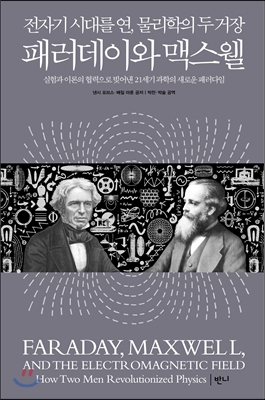
Faraday and Maxwell
 |
Description
Book Introduction
When people think of the invention of electricity that lit up the world, they usually think of Thomas Edison, but Edison only invented the light bulb, and he was able to invent the light bulb thanks to two geniuses from before him.
Faraday, who discovered the existence of electromagnetic fields and experimented with them, and Maxwell, who theorized and applied them, discovered and established the electromagnetic field, thereby providing a technological and theoretical breakthrough that allowed scientists to break free from Newton's worldview.
This book sheds new light on the lives and research of two seemingly different yet similar geniuses to whom modern civilization owes a great debt.
Born and raised in contrasting environments, these two men—Faraday, an experimental physicist who achieved his achievements solely through self-taught experiments, and Maxwell, a theoretical physicist of genius—seem to have nothing in common.
However, because these two men discovered each other, the revolutionary theory of electromagnetic fields was established, and modern physics was able to gain a theoretical foundation.
The greatest strength of this book is that it covers not only the technology, theory, and experimentation of the process, but also the overall context of the times, allowing for a humanistic understanding of the history of science.
Faraday, who discovered the existence of electromagnetic fields and experimented with them, and Maxwell, who theorized and applied them, discovered and established the electromagnetic field, thereby providing a technological and theoretical breakthrough that allowed scientists to break free from Newton's worldview.
This book sheds new light on the lives and research of two seemingly different yet similar geniuses to whom modern civilization owes a great debt.
Born and raised in contrasting environments, these two men—Faraday, an experimental physicist who achieved his achievements solely through self-taught experiments, and Maxwell, a theoretical physicist of genius—seem to have nothing in common.
However, because these two men discovered each other, the revolutionary theory of electromagnetic fields was established, and modern physics was able to gain a theoretical foundation.
The greatest strength of this book is that it covers not only the technology, theory, and experimentation of the process, but also the overall context of the times, allowing for a humanistic understanding of the history of science.
- You can preview some of the book's contents.
Preview
index
1.
trainee
2.
chemistry
3.
history
4.
The power to draw a circle
5.
magnetic induction
6.
The shadow of a vague guess
7.
Faraday's Last Days
8.
What is the principle of this?
9.
Society and Training
10.
virtual fluid
11.
Where jokes don't work
12.
speed of light
13.
A masterpiece of greatness
14.
Life of the whole country
15.
Cavendish
16.
Maxwellists
17.
new era
Image source
The main idea of this book
Search
trainee
2.
chemistry
3.
history
4.
The power to draw a circle
5.
magnetic induction
6.
The shadow of a vague guess
7.
Faraday's Last Days
8.
What is the principle of this?
9.
Society and Training
10.
virtual fluid
11.
Where jokes don't work
12.
speed of light
13.
A masterpiece of greatness
14.
Life of the whole country
15.
Cavendish
16.
Maxwellists
17.
new era
Image source
The main idea of this book
Search
Into the book
Faraday could never be satisfied with merely hearing or reading about such things.
When evaluating other people's experiments, he was only satisfied after repeating or even extending the same experiment himself.
This habit of making ideas his own followed him throughout his life.
Although he repeated his electrolysis experiments countless times in various configurations throughout his life, Faraday's goal at this time was to reproduce this new phenomenon to his own satisfaction. - p. 22
To people of Faraday's time, the idea that gravity acts through lines of force, or is somehow connected to electricity or magnetism, seemed bizarre.
What they thought of as gravity was a linear force acting instantaneously from a distance according to Newton's laws.
Electricity and magnetism were fluids, and light was the vibration of a mysterious substance.
All of this could be explained with elegant mathematics, but if taken seriously, the ideas of a mathematically illiterate person could overturn all the established laws of the physical world.
Looking back today, it must have been a historic moment.
The magnanimous theorist Faraday was foreshadowing a scientific revolution that would bring about not only the theory of electromagnetism but also special relativity, radio, television, and countless other things. - p. 138
Faraday had made a great discovery, but in the 1850s it was not at all clear what it would lead to.
He presented the principles of electric motors and generators and demonstrated the principle of transformers, an indispensable device in modern power supply systems, through iron rings, but this did not lead to any significant results.
Most of the electromagnetic devices created by inventors were limited to satisfying curiosity and had little practical use.
Ultimately, the field was opened up by the efficient vacuum pump developed by Heinrich Geisler and others in the 1870s.
This made possible the production of filament light bulbs, which in turn led to investments in power supply systems that required efficient generators.
Only then could it become a practical business to develop electric motors for all purposes that could operate via the power grid.
And it wasn't until the late 1800s, when Nikola Tesla demonstrated the benefits of high-voltage alternating current power systems, that the need for transformers became apparent. - pp. 151-152
However, with Thomson's encouragement and his own intuition, Maxwell began to become fascinated with Faraday.
He believed that the truth lay in observed results, and that to solve the remaining problems of electricity and magnetism, the first step was to investigate the facts discovered through experiments.
He decided to read Faraday's Experimental Investigations on Electricity in its entirety before diving into mathematical discussions.
He was immediately captivated by Faraday's open intellect and sincerity, and the more he read, the more he recognized the intellectual power contained in the book.
Having spent countless hours in Glenlair's makeshift laboratory, Maxwell was able to appreciate not only the precision of the great scientist's experiments, but also the immense value of the power and delicacy of the reasoning that followed them.
To Maxwell, Faraday's ideas were the bell of truth.
In Faraday he found a kindred spirit and a new source of inspiration.
- Page 214
There were many other requests in his time, some of which laid the foundation for technological advancements.
In the same way that Faraday responded to requests to work on important national projects such as optical lenses and lighthouses, Maxwell also offered his help to the telegraph industry.
The greatest technical challenge of the era was laying a functioning submarine telegraph cable across the Atlantic Ocean, and the thorny problems that arose during the process required special attention.
The first transatlantic submarine cable was laid in 1858, but it stopped working after just a few weeks.
Examination of the recovered parts revealed that the cable was of very poor quality.
So William Thompson was brought in to lead the charge of introducing quality control into the cable production process and supply chain, and the most pressing need was a physical standard for electrical resistance that could be used to check that the cables supplied met the standards.
- Page 271
A characteristic of Maxwell's work, or rather his life, was that everything seemed to proceed at a constant pace.
He was never in a hurry.
He and Catherine, though he didn't know how, spent most of their afternoons riding horses in the park and continued to collect data on color perception from all the guests who came to their house.
The Maxwells installed a large, colored box in the window of their second-floor room, and residents across the street were initially startled by the coffin-like object.
Maxwell also took the time to keep up with the latest academic journals and would pass on any useful information to his students.
(Omitted) “It is difficult to find anything Maxwell touched that did not undergo a significant and unrecognizable change.” - Page 273
It is often said that Faraday and Maxwell built a bridge between Newton and Einstein.
This is true, but by no means complete.
Newton once said that his achievements were "standing on the shoulders of giants."
So when Einstein visited England, reporters naturally had to ask if he was standing on Newton's shoulders.
Einstein's answer was this:
“That’s not quite the right expression.
“I was standing on Maxwell’s shoulders,” he said. If Maxwell had been there, he would have added that he was standing on Faraday’s shoulders.
Their partnership has made significant contributions to physics, and indeed to human knowledge in general, and their achievements are comparable to those of Newton and Einstein. - p. 369
When evaluating other people's experiments, he was only satisfied after repeating or even extending the same experiment himself.
This habit of making ideas his own followed him throughout his life.
Although he repeated his electrolysis experiments countless times in various configurations throughout his life, Faraday's goal at this time was to reproduce this new phenomenon to his own satisfaction. - p. 22
To people of Faraday's time, the idea that gravity acts through lines of force, or is somehow connected to electricity or magnetism, seemed bizarre.
What they thought of as gravity was a linear force acting instantaneously from a distance according to Newton's laws.
Electricity and magnetism were fluids, and light was the vibration of a mysterious substance.
All of this could be explained with elegant mathematics, but if taken seriously, the ideas of a mathematically illiterate person could overturn all the established laws of the physical world.
Looking back today, it must have been a historic moment.
The magnanimous theorist Faraday was foreshadowing a scientific revolution that would bring about not only the theory of electromagnetism but also special relativity, radio, television, and countless other things. - p. 138
Faraday had made a great discovery, but in the 1850s it was not at all clear what it would lead to.
He presented the principles of electric motors and generators and demonstrated the principle of transformers, an indispensable device in modern power supply systems, through iron rings, but this did not lead to any significant results.
Most of the electromagnetic devices created by inventors were limited to satisfying curiosity and had little practical use.
Ultimately, the field was opened up by the efficient vacuum pump developed by Heinrich Geisler and others in the 1870s.
This made possible the production of filament light bulbs, which in turn led to investments in power supply systems that required efficient generators.
Only then could it become a practical business to develop electric motors for all purposes that could operate via the power grid.
And it wasn't until the late 1800s, when Nikola Tesla demonstrated the benefits of high-voltage alternating current power systems, that the need for transformers became apparent. - pp. 151-152
However, with Thomson's encouragement and his own intuition, Maxwell began to become fascinated with Faraday.
He believed that the truth lay in observed results, and that to solve the remaining problems of electricity and magnetism, the first step was to investigate the facts discovered through experiments.
He decided to read Faraday's Experimental Investigations on Electricity in its entirety before diving into mathematical discussions.
He was immediately captivated by Faraday's open intellect and sincerity, and the more he read, the more he recognized the intellectual power contained in the book.
Having spent countless hours in Glenlair's makeshift laboratory, Maxwell was able to appreciate not only the precision of the great scientist's experiments, but also the immense value of the power and delicacy of the reasoning that followed them.
To Maxwell, Faraday's ideas were the bell of truth.
In Faraday he found a kindred spirit and a new source of inspiration.
- Page 214
There were many other requests in his time, some of which laid the foundation for technological advancements.
In the same way that Faraday responded to requests to work on important national projects such as optical lenses and lighthouses, Maxwell also offered his help to the telegraph industry.
The greatest technical challenge of the era was laying a functioning submarine telegraph cable across the Atlantic Ocean, and the thorny problems that arose during the process required special attention.
The first transatlantic submarine cable was laid in 1858, but it stopped working after just a few weeks.
Examination of the recovered parts revealed that the cable was of very poor quality.
So William Thompson was brought in to lead the charge of introducing quality control into the cable production process and supply chain, and the most pressing need was a physical standard for electrical resistance that could be used to check that the cables supplied met the standards.
- Page 271
A characteristic of Maxwell's work, or rather his life, was that everything seemed to proceed at a constant pace.
He was never in a hurry.
He and Catherine, though he didn't know how, spent most of their afternoons riding horses in the park and continued to collect data on color perception from all the guests who came to their house.
The Maxwells installed a large, colored box in the window of their second-floor room, and residents across the street were initially startled by the coffin-like object.
Maxwell also took the time to keep up with the latest academic journals and would pass on any useful information to his students.
(Omitted) “It is difficult to find anything Maxwell touched that did not undergo a significant and unrecognizable change.” - Page 273
It is often said that Faraday and Maxwell built a bridge between Newton and Einstein.
This is true, but by no means complete.
Newton once said that his achievements were "standing on the shoulders of giants."
So when Einstein visited England, reporters naturally had to ask if he was standing on Newton's shoulders.
Einstein's answer was this:
“That’s not quite the right expression.
“I was standing on Maxwell’s shoulders,” he said. If Maxwell had been there, he would have added that he was standing on Faraday’s shoulders.
Their partnership has made significant contributions to physics, and indeed to human knowledge in general, and their achievements are comparable to those of Newton and Einstein. - p. 369
---From the text
Publisher's Review
21st century science and technology began with Faraday and Maxwell!
The beautiful discoveries of self-taught experimental physicist Faraday and genius theoretical physicist Maxwell
“A fascinating and vivid account of two men and their times, and an excellent explanation of the scientific background and significance of their achievements.” -Kirkus Reviews
“A good mix of scientific history and vivid biographies.
… accessible writing and a keen sense of the two men's personalities make this a fascinating look at two scientists who defined an era and paved the way for modern physics.” -Publishers Weekly
“Anyone interested in science and technology, not just electricity, will enjoy this story about ‘two humble, gentle people who tried to change the world.’” -Library Journal
▼ Two scientists who made 21st-century life possible
Today, daily life is impossible without electricity.
From daily necessities like the TV we watch every day, the lights that brighten the darkness, and the refrigerator that stores our food, to the computers essential for work and school, and even the smartphones we can never put down, our days are driven by electrical and electronic devices.
Anything that provides convenience and convenience cannot run without electricity.
When people think of the invention of electricity that lit up the world, they usually think of Thomas Edison, but Edison only invented the light bulb, and he was able to invent the light bulb thanks to two geniuses from before him.
Faraday, who discovered the existence of electromagnetic fields and experimented with them, and Maxwell, who theorized and applied them, discovered and established the electromagnetic field, thereby providing a technological and theoretical breakthrough that allowed scientists to break free from Newton's worldview.
Because of this, Einstein established the theory of relativity, and science and technology were able to develop amazingly in the 20th century.
Faraday had no formal education, but he overcame his social status through self-education. Despite his limited knowledge of mathematics, he gained fame through his remarkable experiments, measurements, and imagination.
Meanwhile, Maxwell, who had shown genius from a young age, explained Faraday's discoveries in mathematical terms and created field theory, laying the foundation for 20th-century physics.
The Maxwellians and other scientists who followed them created modern theories and applied them to open a new era.
This book sheds new light on the lives and research of two seemingly different yet similar geniuses to whom our current civilization owes a great debt.
▼ Depicting 18th-century Britain and science
The science and technology we enjoy and learn originated in the West, so to understand current science, we must understand the era and history in which science was born.
This book vividly depicts the circumstances of 18th-century England and the human side of these two geniuses, making us realize how remarkable their research, effort, and humility were.
For this reason, this book is accessible to general readers interested in science, and is also beneficial to scientists who only know the theory but not the background.
Born and raised in contrasting environments, these two men—Faraday, an experimental physicist who achieved his achievements solely through self-taught experiments, and Maxwell, a theoretical physicist of genius—seem to have nothing in common.
However, because these two men discovered each other, the revolutionary theory of electromagnetic fields was established, and modern physics was able to gain a theoretical foundation.
The greatest strength of this book is that it covers not only the technology, theory, and experimentation of the process, but also the overall context of the times, allowing for a humanistic understanding of the history of science.
▼ The human, all-too-personal stories of scientists
What makes this book so vivid is that it was written by science writers with expertise in physics and engineering.
Not only do they clearly explain the scientific achievements of Faraday and Maxwell, they also realistically portray their personal lives along with the history of science.
It explains in detail the experiments the two scientists conducted to discover the electromagnetic field and establish field theory, making it easier for even general readers without scientific knowledge to understand than other science books.
But even if you skip the part about their scientific achievements and just read their biographies, it is interesting.
Of course, their achievements as scientists are great, but there is also so much to learn from their characters and lives.
Faraday was humble and sincere, and he devoted all his energy to science and experiments, never yielding to any adversity.
And with a heart for the country, he did his best even in things unrelated to his work.
Although he was burdened by his studies and work and sometimes needed to recuperate, he continued to research and experiment as best he could.
Meanwhile, Maxwell was always humorous and gentle, and while doing various tasks, he never forgot to consider those around him and was a person who knew how to teach those who had no opportunity to learn.
He too experienced trials and tribulations, but he overcame them and continued his research steadily and faithfully.
Their achievements shine even brighter because they were not discouraged by hardships and trials, and because they were brilliant scientists with outstanding personalities.
▼ Maxwellists and New Age Scientists
People often talk about Einstein's theory of relativity and special relativity, but many people don't actually know what they are.
So, although the equation “E=mc2” that we see in advertisements or on TV feels familiar, we don’t know exactly where it came from or what it means.
However, this book concisely and clearly explains how Faraday and Maxwell influenced and connected with the scientists of the new era.
Of course, there are some difficult formulas, but the explanations are understandable to even general readers, so it is not boring or dull.
The electromagnetic field, which began with Faraday and Maxwell, gave birth to great scientists such as modern-day Poincaré and Einstein, and through them, a grand unified theory called the Higgs field emerged.
Perhaps we will be able to demonstrate experimentally the unification of all forces and its principles.
Of course it will take time, but you will soon see the results.
Perhaps we may face a completely different paradigm shift in the future.
However, Faraday and Maxwell had already challenged and overcome the Newtonian worldview and paradigm.
Their lives, dedicated to pursuing truth and research, are excellent examples of the path we must take in the future.
The beautiful discoveries of self-taught experimental physicist Faraday and genius theoretical physicist Maxwell
“A fascinating and vivid account of two men and their times, and an excellent explanation of the scientific background and significance of their achievements.” -Kirkus Reviews
“A good mix of scientific history and vivid biographies.
… accessible writing and a keen sense of the two men's personalities make this a fascinating look at two scientists who defined an era and paved the way for modern physics.” -Publishers Weekly
“Anyone interested in science and technology, not just electricity, will enjoy this story about ‘two humble, gentle people who tried to change the world.’” -Library Journal
▼ Two scientists who made 21st-century life possible
Today, daily life is impossible without electricity.
From daily necessities like the TV we watch every day, the lights that brighten the darkness, and the refrigerator that stores our food, to the computers essential for work and school, and even the smartphones we can never put down, our days are driven by electrical and electronic devices.
Anything that provides convenience and convenience cannot run without electricity.
When people think of the invention of electricity that lit up the world, they usually think of Thomas Edison, but Edison only invented the light bulb, and he was able to invent the light bulb thanks to two geniuses from before him.
Faraday, who discovered the existence of electromagnetic fields and experimented with them, and Maxwell, who theorized and applied them, discovered and established the electromagnetic field, thereby providing a technological and theoretical breakthrough that allowed scientists to break free from Newton's worldview.
Because of this, Einstein established the theory of relativity, and science and technology were able to develop amazingly in the 20th century.
Faraday had no formal education, but he overcame his social status through self-education. Despite his limited knowledge of mathematics, he gained fame through his remarkable experiments, measurements, and imagination.
Meanwhile, Maxwell, who had shown genius from a young age, explained Faraday's discoveries in mathematical terms and created field theory, laying the foundation for 20th-century physics.
The Maxwellians and other scientists who followed them created modern theories and applied them to open a new era.
This book sheds new light on the lives and research of two seemingly different yet similar geniuses to whom our current civilization owes a great debt.
▼ Depicting 18th-century Britain and science
The science and technology we enjoy and learn originated in the West, so to understand current science, we must understand the era and history in which science was born.
This book vividly depicts the circumstances of 18th-century England and the human side of these two geniuses, making us realize how remarkable their research, effort, and humility were.
For this reason, this book is accessible to general readers interested in science, and is also beneficial to scientists who only know the theory but not the background.
Born and raised in contrasting environments, these two men—Faraday, an experimental physicist who achieved his achievements solely through self-taught experiments, and Maxwell, a theoretical physicist of genius—seem to have nothing in common.
However, because these two men discovered each other, the revolutionary theory of electromagnetic fields was established, and modern physics was able to gain a theoretical foundation.
The greatest strength of this book is that it covers not only the technology, theory, and experimentation of the process, but also the overall context of the times, allowing for a humanistic understanding of the history of science.
▼ The human, all-too-personal stories of scientists
What makes this book so vivid is that it was written by science writers with expertise in physics and engineering.
Not only do they clearly explain the scientific achievements of Faraday and Maxwell, they also realistically portray their personal lives along with the history of science.
It explains in detail the experiments the two scientists conducted to discover the electromagnetic field and establish field theory, making it easier for even general readers without scientific knowledge to understand than other science books.
But even if you skip the part about their scientific achievements and just read their biographies, it is interesting.
Of course, their achievements as scientists are great, but there is also so much to learn from their characters and lives.
Faraday was humble and sincere, and he devoted all his energy to science and experiments, never yielding to any adversity.
And with a heart for the country, he did his best even in things unrelated to his work.
Although he was burdened by his studies and work and sometimes needed to recuperate, he continued to research and experiment as best he could.
Meanwhile, Maxwell was always humorous and gentle, and while doing various tasks, he never forgot to consider those around him and was a person who knew how to teach those who had no opportunity to learn.
He too experienced trials and tribulations, but he overcame them and continued his research steadily and faithfully.
Their achievements shine even brighter because they were not discouraged by hardships and trials, and because they were brilliant scientists with outstanding personalities.
▼ Maxwellists and New Age Scientists
People often talk about Einstein's theory of relativity and special relativity, but many people don't actually know what they are.
So, although the equation “E=mc2” that we see in advertisements or on TV feels familiar, we don’t know exactly where it came from or what it means.
However, this book concisely and clearly explains how Faraday and Maxwell influenced and connected with the scientists of the new era.
Of course, there are some difficult formulas, but the explanations are understandable to even general readers, so it is not boring or dull.
The electromagnetic field, which began with Faraday and Maxwell, gave birth to great scientists such as modern-day Poincaré and Einstein, and through them, a grand unified theory called the Higgs field emerged.
Perhaps we will be able to demonstrate experimentally the unification of all forces and its principles.
Of course it will take time, but you will soon see the results.
Perhaps we may face a completely different paradigm shift in the future.
However, Faraday and Maxwell had already challenged and overcome the Newtonian worldview and paradigm.
Their lives, dedicated to pursuing truth and research, are excellent examples of the path we must take in the future.
GOODS SPECIFICS
- Date of issue: May 15, 2015
- Format: Hardcover book binding method guide
- Page count, weight, size: 404 pages | 576g | 140*210*28mm
- ISBN13: 9791185435343
- ISBN10: 1185435344
You may also like
카테고리
korean


korean

![ELLE 엘르 스페셜 에디션 A형 : 12월 [2025]](http://librairie.coreenne.fr/cdn/shop/files/b8e27a3de6c9538896439686c6b0e8fb.jpg?v=1766436872&width=3840)


