

Pocket Beetle Encyclopedia
 |
Description
Book Introduction
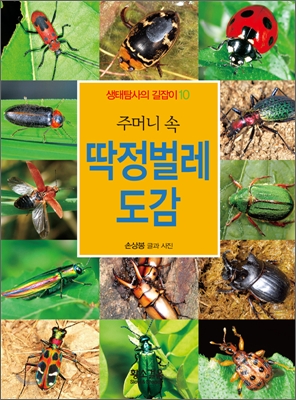
A beetle guide containing 43 families and 440 species of beetles found in Korea.
Rather than relying on existing sources, the author provides vivid information based on his own experiences and observations while searching for beetles.
The structure of the text is based on the Lawrence and Newton classification system, a global classification system, and the taxonomic position (order-kingdom-superfamily-family-subfamily) of each species is organized so that it can be seen at a glance.
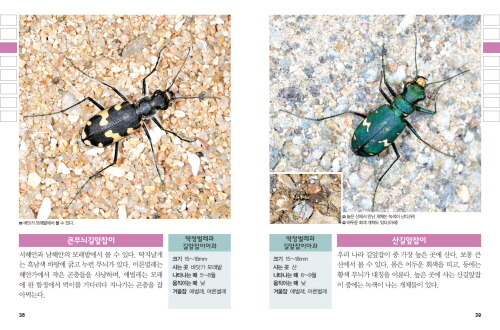
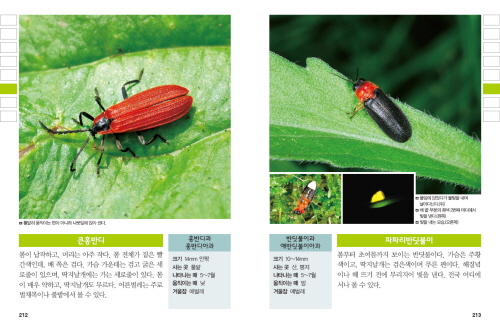
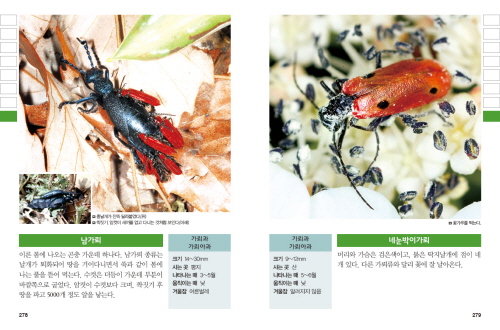
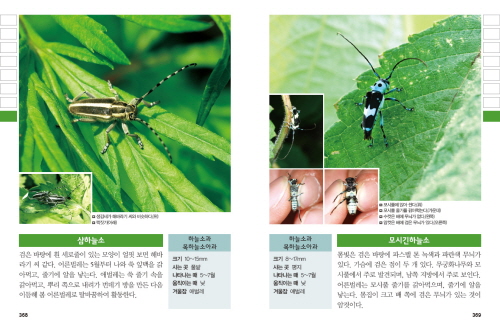
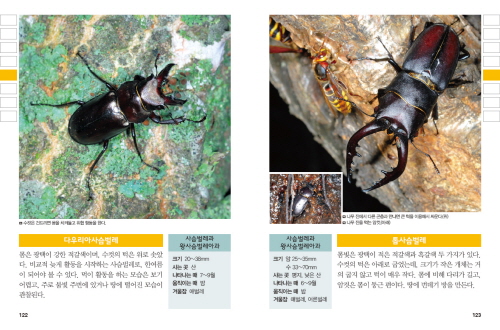
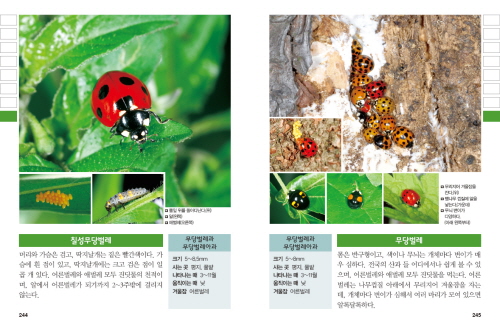
In addition, the book includes ecological photos taken by the author himself, including adult insects, larvae, and pupae.
Rather than relying on existing sources, the author provides vivid information based on his own experiences and observations while searching for beetles.
The structure of the text is based on the Lawrence and Newton classification system, a global classification system, and the taxonomic position (order-kingdom-superfamily-family-subfamily) of each species is organized so that it can be seen at a glance.
In addition, the book includes ecological photos taken by the author himself, including adult insects, larvae, and pupae.
- You can preview some of the book's contents.
Preview
index
Let's go meet the beetle
Understanding Beetles
Structure of a beetle
Where the beetles live
Different appearance from adult insects
Beetle survival strategies
Meet the beetle
Various types of beetles
Primitive beetle suborder
Carnivora
1.
Award
2.
land forces
Polyphagia
1.
Half-wing series
2.
Scarab family
3.
The class of beetles
4.
Dogwood family
5.
Headmaster series
Search
Understanding Beetles
Structure of a beetle
Where the beetles live
Different appearance from adult insects
Beetle survival strategies
Meet the beetle
Various types of beetles
Primitive beetle suborder
Carnivora
1.
Award
2.
land forces
Polyphagia
1.
Half-wing series
2.
Scarab family
3.
The class of beetles
4.
Dogwood family
5.
Headmaster series
Search
Detailed image
Publisher's Review
There are more species of beetles than other insects, so some are colorful, beautiful, and precious, while others are not so pretty and are common.
But the precious, the common, the beautiful, and the not so precious are things that people create.
I hope that through this book, more people will come to understand the ecology of beetles, which live diligently in nature and fulfill their roles, and that more people will come to cherish all beetles.
―From the author's words
1.
The most prolific group on Earth, beetles
Insects that undergo complete metamorphosis from egg, larva, pupa, and adult, and instead of having bones inside their bodies, are covered with a hard exoskeleton like armor, are called beetles.
Beetles are the most abundant group of plants and animals on Earth, making up 25% of the total.
Beetles are probably the animals we encounter most often, whether at home, around the house, or outdoors.
However, we do not really know who the beetles we easily encounter in our daily lives are or how they live.
Even if you try to find out, there are so many different types and many similar ones that it's easy to get confused.
It was absolutely necessary to gather information about beetles separately, as most insect guides are woefully inadequate.
The Pocket Beetle Guide, which introduces a large number of small beetles, is a guide that you can carry around and check out on-site, so it will be of great help in learning about and understanding beetles, which are closely related to us.
2.
Features of the Pocket Beetle Encyclopedia
We have included 43 families and 440 species of beetles found in our country.
Rather than relying on existing sources, this guide primarily includes the author's own experiences and observations from searching for beetles, so it is not rigid or rigid like other guides, but rather full of vivid information.
It also consists of recent vivid ecological photos of not only adult insects but also larvae and pupae.
Until now, there has been no book in Korea that properly followed the world-class classification system of Lawrence and Newton, but the application of this classification system is the most notable feature of 『Pocket Beetle Guide』.
Therefore, the species are arranged in the order of phylogenetic classification, and while most atlases only show the family level, the Pocket Beetle Atlas organizes each species in a way that allows you to see its taxonomic position (order-kingdom-superfamily-family-subfamily) at a glance.
But the precious, the common, the beautiful, and the not so precious are things that people create.
I hope that through this book, more people will come to understand the ecology of beetles, which live diligently in nature and fulfill their roles, and that more people will come to cherish all beetles.
―From the author's words
1.
The most prolific group on Earth, beetles
Insects that undergo complete metamorphosis from egg, larva, pupa, and adult, and instead of having bones inside their bodies, are covered with a hard exoskeleton like armor, are called beetles.
Beetles are the most abundant group of plants and animals on Earth, making up 25% of the total.
Beetles are probably the animals we encounter most often, whether at home, around the house, or outdoors.
However, we do not really know who the beetles we easily encounter in our daily lives are or how they live.
Even if you try to find out, there are so many different types and many similar ones that it's easy to get confused.
It was absolutely necessary to gather information about beetles separately, as most insect guides are woefully inadequate.
The Pocket Beetle Guide, which introduces a large number of small beetles, is a guide that you can carry around and check out on-site, so it will be of great help in learning about and understanding beetles, which are closely related to us.
2.
Features of the Pocket Beetle Encyclopedia
We have included 43 families and 440 species of beetles found in our country.
Rather than relying on existing sources, this guide primarily includes the author's own experiences and observations from searching for beetles, so it is not rigid or rigid like other guides, but rather full of vivid information.
It also consists of recent vivid ecological photos of not only adult insects but also larvae and pupae.
Until now, there has been no book in Korea that properly followed the world-class classification system of Lawrence and Newton, but the application of this classification system is the most notable feature of 『Pocket Beetle Guide』.
Therefore, the species are arranged in the order of phylogenetic classification, and while most atlases only show the family level, the Pocket Beetle Atlas organizes each species in a way that allows you to see its taxonomic position (order-kingdom-superfamily-family-subfamily) at a glance.
GOODS SPECIFICS
- Date of issue: July 20, 2009
- Page count, weight, size: 456 pages | 422g | 112*150*30mm
- ISBN13: 9788989370642
- ISBN10: 8989370647
You may also like
카테고리
korean


korean

![GQ KOREA Mark (Monthly): December [2025]](http://librairie.coreenne.fr/cdn/shop/files/8ef265dbbfbf186523ed75ba7319009d.jpg?v=1765340328&width=3840)


