

Thirteen Ways to Smell the Wood
 |
Description
Book Introduction
The scent of trees is the language of trees, speaking to each other and to other species.
David George Haskell, a top-tier nature writer known as a "peculiar genius," eavesdrops on the language of trees through the sense of smell, the most neglected yet oldest and most primal of senses.
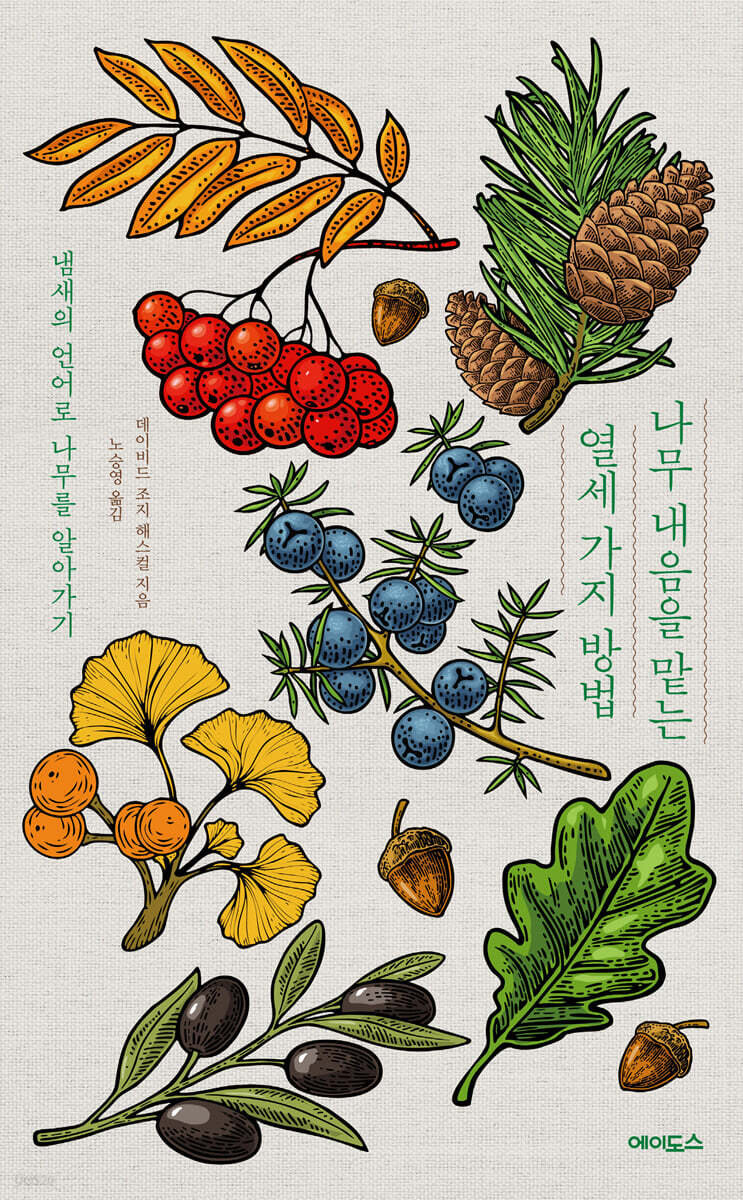
Through thirteen materials including horse chestnut, pine, ginkgo, pine, olive, white oak, and books, he portrays in a sensual and outstanding way how trees and human life are closely intertwined.
The scent of trees is a journey back to childhood memories, a gateway to the deep history of life spanning tens of millions of years, a starting point for encountering human culture and history, and a clue to how we humans connect and communicate with other species.
The scent of trees is a magic that takes us to another time, place, and world.
The author says:
“No life is alone.
“We always live in relationships with other species.”
David George Haskell, a top-tier nature writer known as a "peculiar genius," eavesdrops on the language of trees through the sense of smell, the most neglected yet oldest and most primal of senses.
Through thirteen materials including horse chestnut, pine, ginkgo, pine, olive, white oak, and books, he portrays in a sensual and outstanding way how trees and human life are closely intertwined.
The scent of trees is a journey back to childhood memories, a gateway to the deep history of life spanning tens of millions of years, a starting point for encountering human culture and history, and a clue to how we humans connect and communicate with other species.
The scent of trees is a magic that takes us to another time, place, and world.
The author says:
“No life is alone.
“We always live in relationships with other species.”
- You can preview some of the book's contents.
Preview
index
Preface 008
1.
Western Horse Chestnut 011
2.
American Maple 021
3.
Red Ash Tree 029
4.
Gin and Tonic 039
5.
Ginkgo 049
6.
Ponderosa Pine 059
7.
Pine Tree Hanging from Rearview Mirror 069
8.
Antarctic beech 077
9.
White Oak (American Oak) 087
10.
Laurel 099
11.
Wood smoke 111
12.
123 ml olive oil
13.
Book 137
The Scent of Trees: Six Practices 152
Composer and Violinist's Note: The Music of Trees 161
Acknowledgements 166
Reference 168
1.
Western Horse Chestnut 011
2.
American Maple 021
3.
Red Ash Tree 029
4.
Gin and Tonic 039
5.
Ginkgo 049
6.
Ponderosa Pine 059
7.
Pine Tree Hanging from Rearview Mirror 069
8.
Antarctic beech 077
9.
White Oak (American Oak) 087
10.
Laurel 099
11.
Wood smoke 111
12.
123 ml olive oil
13.
Book 137
The Scent of Trees: Six Practices 152
Composer and Violinist's Note: The Music of Trees 161
Acknowledgements 166
Reference 168
Detailed image

Into the book
As the fragrance of flowers enters us and surrounds us, the trees place a comforting green hand on our anxious foreheads, soothing the neural pathways of pain and weaving their scent into the cracks of our central nervous system.
We breathe in the trees and are healed.
... The fact that we smell and respond to the scent of American maple flowers shows our kinship with insects.
The scent of the American maple tree is not for us, but for insects, including bees.
This intention was engraved into the genes and physiology of the American maple tree by past natural selection.
Even though we diverged from insects over 600 million years ago, our nerves contain the same cellular design.
This is something we inherited from our older ancestral animals.
This similarity allows us to detect and appreciate the signals that American maples send to pollinating bees.
--- p.27
The few molecules spreading out from the leaves are botanical sentences, and the meaning of this plant language is written in the grammar of organic chemistry.
This combination of changes from morning to afternoon, from spring to fall, is a story full of meaning.
Even with the most sophisticated experimental equipment, we can decipher only a tiny fraction of this language: the signals transmitted from roots to microbes to initiate reciprocal bonds, the warnings that a wounded leaf spreads to its neighbors, and the calls for help from a leaf to a predatory insect as part of a coalition against herbivores.
To smell the trees is to participate in this conversation (even if it is in a foreign language in which much is hidden).
But although it is very complex, this language is not completely ingenious.
Because our ancestors lived in forests and grasslands for millions of years, our noses can decipher several meanings in plant scents.
The scent of a healthy tree brings peace of mind.
--- p.36~37
The drama unfolding on the ground through the fragrance of pine trees rises into the air and changes the sky.
Plants around the world release an estimated 1 trillion kilograms of fragrance molecules into the air each year.
Isoprene, the most common molecule in tropical forests, has a faint gasoline-like odor.
In pine forests, pinene is dominant.
The huge breath that the trees exhale into the sky becomes the beginning of rain in the sky.
··· Part of the sky is made up of forests.
··· The joy I feel in the scent of ponderosa pines brings me into the heart of the communication that takes place in the forest.
Trees open their hearts to each other.
The insects overhear and mimic the conversation.
The earth and the sky converse.
We breathe in the trees and are healed.
... The fact that we smell and respond to the scent of American maple flowers shows our kinship with insects.
The scent of the American maple tree is not for us, but for insects, including bees.
This intention was engraved into the genes and physiology of the American maple tree by past natural selection.
Even though we diverged from insects over 600 million years ago, our nerves contain the same cellular design.
This is something we inherited from our older ancestral animals.
This similarity allows us to detect and appreciate the signals that American maples send to pollinating bees.
--- p.27
The few molecules spreading out from the leaves are botanical sentences, and the meaning of this plant language is written in the grammar of organic chemistry.
This combination of changes from morning to afternoon, from spring to fall, is a story full of meaning.
Even with the most sophisticated experimental equipment, we can decipher only a tiny fraction of this language: the signals transmitted from roots to microbes to initiate reciprocal bonds, the warnings that a wounded leaf spreads to its neighbors, and the calls for help from a leaf to a predatory insect as part of a coalition against herbivores.
To smell the trees is to participate in this conversation (even if it is in a foreign language in which much is hidden).
But although it is very complex, this language is not completely ingenious.
Because our ancestors lived in forests and grasslands for millions of years, our noses can decipher several meanings in plant scents.
The scent of a healthy tree brings peace of mind.
--- p.36~37
The drama unfolding on the ground through the fragrance of pine trees rises into the air and changes the sky.
Plants around the world release an estimated 1 trillion kilograms of fragrance molecules into the air each year.
Isoprene, the most common molecule in tropical forests, has a faint gasoline-like odor.
In pine forests, pinene is dominant.
The huge breath that the trees exhale into the sky becomes the beginning of rain in the sky.
··· Part of the sky is made up of forests.
··· The joy I feel in the scent of ponderosa pines brings me into the heart of the communication that takes place in the forest.
Trees open their hearts to each other.
The insects overhear and mimic the conversation.
The earth and the sky converse.
--- p.67~68
Publisher's Review
The scent of trees is a magic that takes us to another time, place, and world.
A world of wondrous scents from a top-class nature writer!
“Part of the sky is made up of forests.
The joy I feel from the scent of trees brings me into the heart of the communication that takes place in the forest.
Trees open their hearts to each other.
The insects overhear and mimic the conversation.
“The earth and the sky converse.” (p. 68)
This is a scientific essay on the subject of 'the smell of trees' written by biologist David George Haskell, known as 'America's greatest nature writer' and 'a peculiar genius' for his delicate observation and knee-slapping expressions.
While the previous work, "Healing Sounds of the Wild," delved into the significance of sound and hearing in the evolution of life, this book focuses on the scent and smell of trees, inviting readers into the wondrous world of tree scents.
Olfaction, the sense that perceives scent molecules, is a sense that is neglected compared to sight and hearing, but it is the oldest and most direct sense.
Before living things evolved eyes and ears, cells already spoke in a molecular language.
Trees talk to each other through scent molecules, attracting fungi, sending warning signals to insects, calling for help, and whispering to microbes.
So to speak, the scent of a tree is the language of the tree.
The scent of trees we smell in the forest, in the city streets, in food and drink, and in books is listening to the language of trees and participating in the conversation shared by living beings.
Childhood memories, healing and comfort, the legacy of tens of millions of years of evolution, the globalization of trade, the tenacity of life, a sense of community, human culture and history, and the connection between humans and other life forms...
The scent of wood is the gateway to all these things.
“The smell takes me inside, into my memories.” (p. 17)
Humans and trees have been closely intertwined over millions of years of evolutionary history.
The ability to decode odorous molecular signals sent between trees and to insects remains in human nerve cells for millions of years.
That's why we feel comfort and relaxation in the air we breathe in the forest.
It is deeply ingrained in human civilization, history, and culture.
Wood has been inseparable from humans in homes, food, drinks, furniture, fire, and books.
The reason we recall childhood memories, find comfort and healing, and feel a sense of community with the scent of trees is because the connection between trees and humans has been with us throughout human history.
The book talks about the scent of trees, which is most directly and strongly connected to human memory and emotions, through thirteen materials related to trees, including horse chestnut, pine, ginkgo, pine, olive oil, wood smoke, and books.
Tree scents go beyond simply sending warnings and signals to each other, insects, and predators.
The sharp scent of horse chestnut trees evokes childhood memories, the scent of pine trees in full bloom in a smoke-filled city center offers comfort and healing, a glass of gin and tonic evokes the globalization of trade, and olive leaves in a stew evoke a warm and cozy meal with family.
The scent of trees is a magic that takes us to another time, place, and world.
No life is alone.
We always live in relationships with other species.
“Stopping and smelling is a way to reclaim a part of our humanity, to return to our bodies and connect with the life around us.
“It’s also a fun thing.” (p. 153)
The scent of trees is memory, connection, culture, and history.
Trees are alive and serve as the central point of communication among living things in a web of communication that encompasses plants, fungi, animals, and microorganisms. Even after death, they continue their life in the afterlife through firewood or books, binding us together in the diverse web we call culture.
We have lived our lives on earth in relationships with non-human beings.
From the moment life emerged on this Earth, no life was alone.
We always live in relationships with other species.
To smell a tree is not only to hear its language, but also to realize our connection to other living beings.
Recovery from a world of disconnection, isolation, destruction, and dulled senses begins with listening to the voices of other beings.
The author says:
“Holiness does not come down to us from on high.
Peace and prosperity are not born solely by human hands.
“The good in life is the fragrance that arises from the living earth, the fruit of the beneficial union of man and tree.” (p. 136)
A world of wondrous scents from a top-class nature writer!
“Part of the sky is made up of forests.
The joy I feel from the scent of trees brings me into the heart of the communication that takes place in the forest.
Trees open their hearts to each other.
The insects overhear and mimic the conversation.
“The earth and the sky converse.” (p. 68)
This is a scientific essay on the subject of 'the smell of trees' written by biologist David George Haskell, known as 'America's greatest nature writer' and 'a peculiar genius' for his delicate observation and knee-slapping expressions.
While the previous work, "Healing Sounds of the Wild," delved into the significance of sound and hearing in the evolution of life, this book focuses on the scent and smell of trees, inviting readers into the wondrous world of tree scents.
Olfaction, the sense that perceives scent molecules, is a sense that is neglected compared to sight and hearing, but it is the oldest and most direct sense.
Before living things evolved eyes and ears, cells already spoke in a molecular language.
Trees talk to each other through scent molecules, attracting fungi, sending warning signals to insects, calling for help, and whispering to microbes.
So to speak, the scent of a tree is the language of the tree.
The scent of trees we smell in the forest, in the city streets, in food and drink, and in books is listening to the language of trees and participating in the conversation shared by living beings.
Childhood memories, healing and comfort, the legacy of tens of millions of years of evolution, the globalization of trade, the tenacity of life, a sense of community, human culture and history, and the connection between humans and other life forms...
The scent of wood is the gateway to all these things.
“The smell takes me inside, into my memories.” (p. 17)
Humans and trees have been closely intertwined over millions of years of evolutionary history.
The ability to decode odorous molecular signals sent between trees and to insects remains in human nerve cells for millions of years.
That's why we feel comfort and relaxation in the air we breathe in the forest.
It is deeply ingrained in human civilization, history, and culture.
Wood has been inseparable from humans in homes, food, drinks, furniture, fire, and books.
The reason we recall childhood memories, find comfort and healing, and feel a sense of community with the scent of trees is because the connection between trees and humans has been with us throughout human history.
The book talks about the scent of trees, which is most directly and strongly connected to human memory and emotions, through thirteen materials related to trees, including horse chestnut, pine, ginkgo, pine, olive oil, wood smoke, and books.
Tree scents go beyond simply sending warnings and signals to each other, insects, and predators.
The sharp scent of horse chestnut trees evokes childhood memories, the scent of pine trees in full bloom in a smoke-filled city center offers comfort and healing, a glass of gin and tonic evokes the globalization of trade, and olive leaves in a stew evoke a warm and cozy meal with family.
The scent of trees is a magic that takes us to another time, place, and world.
No life is alone.
We always live in relationships with other species.
“Stopping and smelling is a way to reclaim a part of our humanity, to return to our bodies and connect with the life around us.
“It’s also a fun thing.” (p. 153)
The scent of trees is memory, connection, culture, and history.
Trees are alive and serve as the central point of communication among living things in a web of communication that encompasses plants, fungi, animals, and microorganisms. Even after death, they continue their life in the afterlife through firewood or books, binding us together in the diverse web we call culture.
We have lived our lives on earth in relationships with non-human beings.
From the moment life emerged on this Earth, no life was alone.
We always live in relationships with other species.
To smell a tree is not only to hear its language, but also to realize our connection to other living beings.
Recovery from a world of disconnection, isolation, destruction, and dulled senses begins with listening to the voices of other beings.
The author says:
“Holiness does not come down to us from on high.
Peace and prosperity are not born solely by human hands.
“The good in life is the fragrance that arises from the living earth, the fruit of the beneficial union of man and tree.” (p. 136)
GOODS SPECIFICS
- Date of issue: April 24, 2024
- Format: Paperback book binding method guide
- Page count, weight, size: 174 pages | 278g | 130*210*15mm
- ISBN13: 9791185415710
- ISBN10: 1185415718
You may also like
카테고리
korean


korean

![GQ KOREA Mark (Monthly): December [2025]](http://librairie.coreenne.fr/cdn/shop/files/8ef265dbbfbf186523ed75ba7319009d.jpg?v=1765340328&width=3840)


