

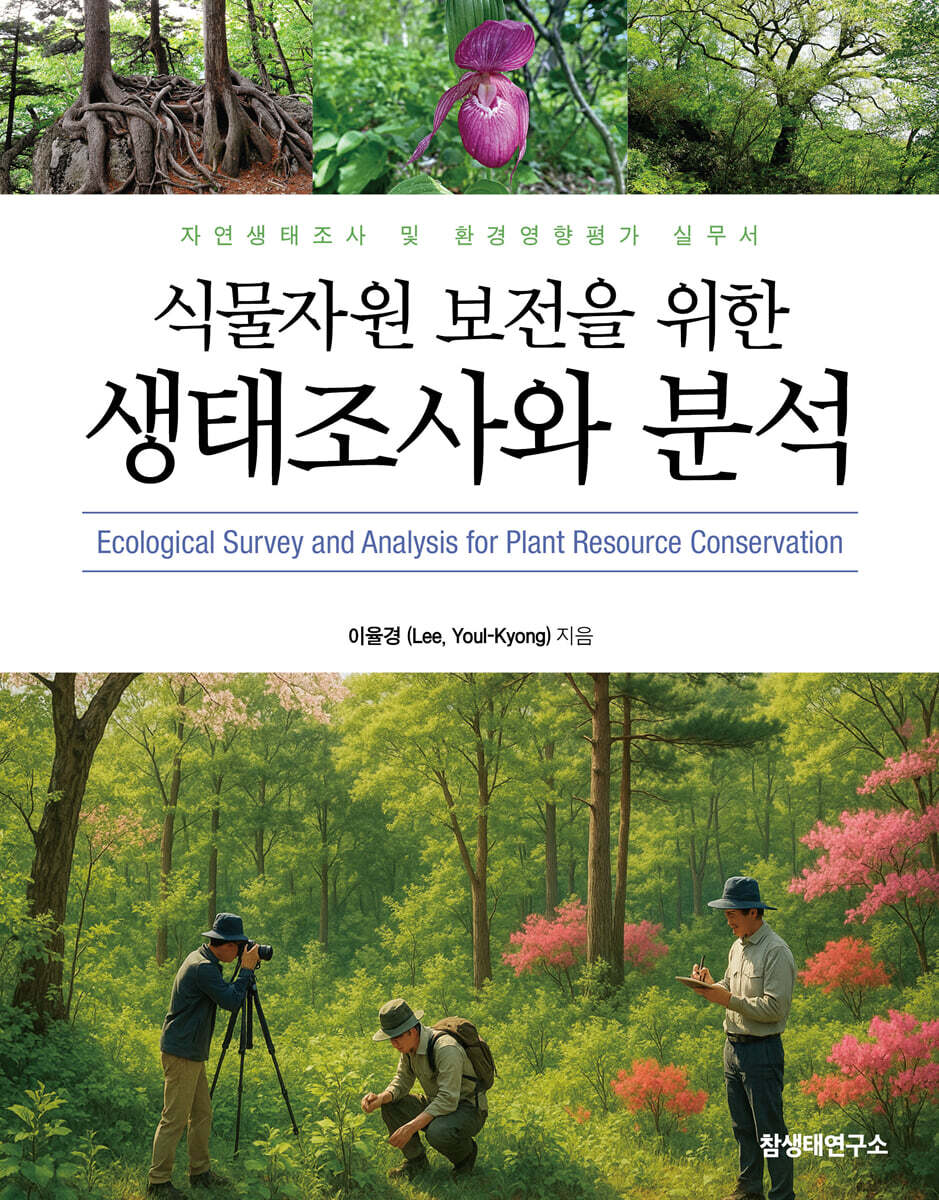
Ecological survey and analysis for plant resource conservation
 |
Description
Book Introduction
Ecological research on the indigenous plant resources covering the surface of the country
It is a fundamental process that is very important for the conservation of the nation's ecological axis and biodiversity.
In the ecosystem covering our country, plant resources (flora, vegetation) play a supporting function.
It is important to understand the ecological principles of these plant resources, accurately grasp and analyze their current status, and then apply them correctly in various natural environment conservation and restoration projects and development projects (environmental impact assessments).
To this end, a comprehensive book covering the principles and methods of plant ecological research, analysis and interpretation, description, impact prediction, and mitigation measures was needed, leading to the writing of this book.
We have tried to organize a large amount of domestic and international data, diverse field experiences, and know-how into information that can be applied to practice.
We used many photos and related drawings to develop the content so that readers could easily understand it.
It is a fundamental process that is very important for the conservation of the nation's ecological axis and biodiversity.
In the ecosystem covering our country, plant resources (flora, vegetation) play a supporting function.
It is important to understand the ecological principles of these plant resources, accurately grasp and analyze their current status, and then apply them correctly in various natural environment conservation and restoration projects and development projects (environmental impact assessments).
To this end, a comprehensive book covering the principles and methods of plant ecological research, analysis and interpretation, description, impact prediction, and mitigation measures was needed, leading to the writing of this book.
We have tried to organize a large amount of domestic and international data, diverse field experiences, and know-how into information that can be applied to practice.
We used many photos and related drawings to develop the content so that readers could easily understand it.
- You can preview some of the book's contents.
Preview
index
Chapter 1: Natural Environment Survey / Flora / Vegetation
1.
Fundamentals of Natural Environment and Plant Ecology Research
01 Research on flora and vegetation, which serve as important habitats for wild animals in natural environments, is very important.
3
02 Ecological surveys in the plant field of the natural ecological environment are to understand the flora and vegetation status.
10
03 In flora and vegetation classification, an understanding of basic units and standard plant names must come first.
12
04 Flora and vegetation surveys should be designed rationally to ensure cost-effectiveness, purpose, and content.
16
2.
Establishing the scope and route of the investigation, and the field investigation table
01 The scope of the investigation is determined by sufficiently reflecting the purpose, characteristics of the region, scope of influence, etc.
20
02 In flora and vegetation research, the selection of the survey route and survey site, and the survey period are important.
22
03 During the on-site investigation, a preventive investigation plan must be established and attention must be paid to accidents such as snake and insect bites.
27
04 For research on flora and vegetation, the most basic source of data is the field survey table.
29
Chapter 2: Plant Distribution / Plant Society of the Korean Peninsula / Vegetation Succession
1.
Distribution, growth, and life forms of plants
01 Climatic factors such as temperature and precipitation are very important in the geographical distribution of plants.
33
02 In our country, topographic rainfall and water use are important for the formation of vegetation at the local and regional levels.
34
03 Frost caused by low temperatures is a major climatic factor that determines the growing period of plants.
36
04 The dormancy and sprouting of plants and their subsequent life forms are related to the characteristics of the habitat, such as climatic factors.
36
05 The life forms and habitats of wetland plants in river wetlands are closely related to the moisture gradient.
41
2.
Plant community characteristics by ecosystem of the Korean Peninsula
01 It is important to understand the characteristics of species distribution, such as the plant geography and plant regions of the Korean Peninsula.
44
02 It is necessary to understand the geographical and climatic characteristics of the Korean Peninsula and the plant communities in each macro-ecological space.
49
3.
Forest management and vegetation succession
01 In our country, the forest management direction of the Korea Forest Service and the forest management direction of the Ministry of Environment are quite different.
68
02 In forest vegetation research, a correct understanding of the concepts of afforestation and suitable land use is necessary.
70
03 Understanding secondary vegetation and succession in vegetation surveys is important for assessing conservation ecological value.
73
04 It is important to understand the concepts of succession and development in vegetation, and it is necessary to understand dry and wet succession.
76
Chapter 3: Ecological Survey and Analysis Methods of Plant Communities
1.
Plant community survey and analysis
01 Ecological estimation techniques for plant communities and populations are divided into census and sample surveys.
85
02 Quantitative surveys of plant populations are mainly intended to determine density, frequency, coverage, biomass, etc.
87
03 The square-plot survey method is suitable for long-term monitoring studies of plant populations and vegetation.
92
04 Cross-sectional surveys are effective in understanding changes in plant populations and vegetation.
99
05 In plant ecology, there is also a lot of research using plant seeds.
102
06 Map production is a common method widely used in research related to vegetation science among plants.
103
07 The structure of plant populations or the degree of forest development can be understood through analysis of tree age and diameter at breast height.
104
08 Cross-sections and crown projections, which are layered structures, are widely used in forestry and landscape architecture research.
109
09 The competitive spatial structure characteristics of a population can be understood through various methods, including Thyssen analysis.
112
2.
Biodiversity and Multivariate Mathematical and Statistical Analysis
01 A correct understanding of the concept and application of biodiversity is necessary.
114
02 In ecological research, mathematical and statistical analysis is a very important process and increases the reliability of research results.
117
03 Cluster analysis uses multivariate statistical data, and classification analysis and sequence analysis are often used.
124
04 Cluster classification analysis is based on the distance between variables, and similarity analysis and TWINSPAN are widely used.
129
05 Sequence analysis methods are divided into indirect gradient analysis and direct gradient analysis depending on the use of environmental variables.
136
3.
Species distribution model analysis
01 Potential habitats of plant and animal species can be estimated using various species distribution models.
143
4.
Use of equipment and software for ecological surveys
01 Using scientific equipment not only increases the reliability of the results but also the efficiency of the investigation.
145
02 More accurate field investigations are possible using GPS-based equipment and satellite or aerial images.
148
03 Geotagging increases the efficiency of analyzing and managing image-related data.
149
04 Tracking and waypoints enable the acquisition of accurate vegetation information and systematic data organization.
150
Chapter 4: Flora Survey/Research
1.
Flora survey and organization
01 The flora survey targets vascular plants and is divided into ferns, gymnosperms, and angiosperms.
157
02 Flora research is based on field surveys and confirmed plant specimens, and specimens require national management.
163
03 The results of the survey are to compile a list of invasive plants and analyze their flora properties and main characteristics.
169
2.
Classification of value attributes by plant species
01 It is important to understand the habitats of important species, including legally protected species such as endangered wild plants.
171
02 Naturalized plants can be classified into several types according to their definition and purpose, and include plants that disrupt the ecosystem.
180
Chapter 5 Vegetation Survey/Research
1.
Concepts and principles of vegetation classification
01 In order to systematically classify vegetation, it is necessary to understand the basic concepts of plant communities.
189
02 Vegetation research has the advantage of classifying all surface areas, evaluating their conservation value, and mapping them.
196
03 The academic classification of vegetation is made up of a vegetation survey table and a table that rearranges plant species.
197
04 Vegetation classification is important in national natural ecosystem management, and it is necessary to establish national standards.
200
2.
Field vegetation survey
01 Phytogeographic surveys and analyses should be cost-effective and based on local vegetation survey tables.
207
02 The survey site must be selected as a feeding area containing homogeneous environmental conditions and flora.
224
03 The minimum area of the vegetation survey square varies depending on the vegetation type and must take into account the species level.
226
04 The naming of plant communities should have universal principles that are easily understood and applied.
227
3.
Survey and preparation of existing vegetation maps
01 There are various types of vegetation maps, but the existing vegetation map is the most commonly used in vegetation research.
231
02 In environmental impact assessments related to rivers, the current vegetation map and vegetation cross-section map must be used separately.
234
03 The current vegetation map spatially categorizes land use on the surface, classifies areas, and allows for observation of changes.
237
04 Determining the resolution, such as the legend and minimum area of representation, is very important in creating a current vegetation map.
240
05 It is recommended that field surveys for creating a current vegetation map be conducted at an appropriate time when dynamic changes can be easily considered and distinguished.
242
06 Using drones, we can obtain the latest orthophotos, enabling more accurate classification and analysis of existing vegetation.
244
07 Using orthophotos and regular vegetation indices, vegetation cover and characteristics can be analyzed more accurately.
251
08 It is recommended to use various smart devices and apps on site to create the current vegetation map.
253
09 It is effective to use GIS programs to create various vegetation maps, including the current vegetation map.
254
10 Thematic maps, such as the current vegetation map, must have essential expression items and be readable.
259
11 Using GIS programs, you can understand the distribution characteristics of existing vegetation in response to environmental factors such as terrain.
262
4.
Assessment of the conservation ecological value of existing vegetation
01 Conservation ecological value assessment of existing vegetation is important for establishing a sustainable environmental plan.
264
02 It is necessary to accurately understand the origin and essential properties of the currently used vegetation conservation levels.
265
03 The conservation ecological value and grade of vegetation requires a lot of field experience and knowledge.
266
04 Vegetation can be evaluated using the MM technique, and the country uses a separate standard to evaluate wetland vegetation.
283
5.
Materials used for creating and analyzing vegetation maps
01 The clinical map and land cover classification map contain vegetation information on land use.
286
02 Ecological/natural maps and urban ecological status maps can be used to evaluate the status and conservation value of vegetation.
289
03 Various materials related to flora and vegetation can be downloaded and used from the websites of various national institutions.
292
Chapter 6: Current Status / Impact Prediction / Mitigation Measures
1.
Basis of the Status Description
01 Basic writing skills are required to describe the results of plant research.
295
02 It is recommended to use tables and graphs to present various research results.
297
03 It is necessary to analyze the environmental conditions of the study area that serve as the basis for plant growth.
299
2.
Description of flora and vegetation
01 The results of the plant survey are to identify, analyze, evaluate, and map the status of vascular plants and existing vegetation.
302
02 The description of the flora includes the status of vascular plants, naturalized plants, ecosystem-disturbing plants, and the presence of important species.
302
03 The results of the vegetation survey are to identify, analyze, and evaluate the current vegetation status and then draw a map.
308
3.
Impact prediction and reduction measures
01 In environmental impact assessment, there are some differences in impact prediction and reduction measures depending on the type of development project.
318
02 The vegetation cover pattern is different depending on land use before and after the development project.
320
03 A conservation plan must be established for trees that are damaged in the developing space, including through transplantation.
321
04 If important plants are inevitably damaged, a detailed conservation plan, including transplantation and monitoring, must be established.
331
05 The spread of invasive plants is expected due to development, and continuous and periodic removal management is required.
338
4.
Conservation and restoration of vegetation
01 Vegetation, etc. is required for rapid stabilization in the slope or bare space that occurs.
341
02 The plan for biotopes (ecotopes) that perform various ecological functions in the conservation and restoration of green spaces and ecological spaces is good.
343
03 Correct understanding of river wetlands and rice paddy wetlands is necessary, and ecological wetlands are mainly planned.
357
04 Does road and rail construction cause damage to plants growing above tunnels? 366
05 Is it necessary to preserve good vegetation even in small areas? 367
06 Let's plant trees that promote biodiversity in landscaping and green space plans.
368
References 370
Appendix 388
Index 428
1.
Fundamentals of Natural Environment and Plant Ecology Research
01 Research on flora and vegetation, which serve as important habitats for wild animals in natural environments, is very important.
3
02 Ecological surveys in the plant field of the natural ecological environment are to understand the flora and vegetation status.
10
03 In flora and vegetation classification, an understanding of basic units and standard plant names must come first.
12
04 Flora and vegetation surveys should be designed rationally to ensure cost-effectiveness, purpose, and content.
16
2.
Establishing the scope and route of the investigation, and the field investigation table
01 The scope of the investigation is determined by sufficiently reflecting the purpose, characteristics of the region, scope of influence, etc.
20
02 In flora and vegetation research, the selection of the survey route and survey site, and the survey period are important.
22
03 During the on-site investigation, a preventive investigation plan must be established and attention must be paid to accidents such as snake and insect bites.
27
04 For research on flora and vegetation, the most basic source of data is the field survey table.
29
Chapter 2: Plant Distribution / Plant Society of the Korean Peninsula / Vegetation Succession
1.
Distribution, growth, and life forms of plants
01 Climatic factors such as temperature and precipitation are very important in the geographical distribution of plants.
33
02 In our country, topographic rainfall and water use are important for the formation of vegetation at the local and regional levels.
34
03 Frost caused by low temperatures is a major climatic factor that determines the growing period of plants.
36
04 The dormancy and sprouting of plants and their subsequent life forms are related to the characteristics of the habitat, such as climatic factors.
36
05 The life forms and habitats of wetland plants in river wetlands are closely related to the moisture gradient.
41
2.
Plant community characteristics by ecosystem of the Korean Peninsula
01 It is important to understand the characteristics of species distribution, such as the plant geography and plant regions of the Korean Peninsula.
44
02 It is necessary to understand the geographical and climatic characteristics of the Korean Peninsula and the plant communities in each macro-ecological space.
49
3.
Forest management and vegetation succession
01 In our country, the forest management direction of the Korea Forest Service and the forest management direction of the Ministry of Environment are quite different.
68
02 In forest vegetation research, a correct understanding of the concepts of afforestation and suitable land use is necessary.
70
03 Understanding secondary vegetation and succession in vegetation surveys is important for assessing conservation ecological value.
73
04 It is important to understand the concepts of succession and development in vegetation, and it is necessary to understand dry and wet succession.
76
Chapter 3: Ecological Survey and Analysis Methods of Plant Communities
1.
Plant community survey and analysis
01 Ecological estimation techniques for plant communities and populations are divided into census and sample surveys.
85
02 Quantitative surveys of plant populations are mainly intended to determine density, frequency, coverage, biomass, etc.
87
03 The square-plot survey method is suitable for long-term monitoring studies of plant populations and vegetation.
92
04 Cross-sectional surveys are effective in understanding changes in plant populations and vegetation.
99
05 In plant ecology, there is also a lot of research using plant seeds.
102
06 Map production is a common method widely used in research related to vegetation science among plants.
103
07 The structure of plant populations or the degree of forest development can be understood through analysis of tree age and diameter at breast height.
104
08 Cross-sections and crown projections, which are layered structures, are widely used in forestry and landscape architecture research.
109
09 The competitive spatial structure characteristics of a population can be understood through various methods, including Thyssen analysis.
112
2.
Biodiversity and Multivariate Mathematical and Statistical Analysis
01 A correct understanding of the concept and application of biodiversity is necessary.
114
02 In ecological research, mathematical and statistical analysis is a very important process and increases the reliability of research results.
117
03 Cluster analysis uses multivariate statistical data, and classification analysis and sequence analysis are often used.
124
04 Cluster classification analysis is based on the distance between variables, and similarity analysis and TWINSPAN are widely used.
129
05 Sequence analysis methods are divided into indirect gradient analysis and direct gradient analysis depending on the use of environmental variables.
136
3.
Species distribution model analysis
01 Potential habitats of plant and animal species can be estimated using various species distribution models.
143
4.
Use of equipment and software for ecological surveys
01 Using scientific equipment not only increases the reliability of the results but also the efficiency of the investigation.
145
02 More accurate field investigations are possible using GPS-based equipment and satellite or aerial images.
148
03 Geotagging increases the efficiency of analyzing and managing image-related data.
149
04 Tracking and waypoints enable the acquisition of accurate vegetation information and systematic data organization.
150
Chapter 4: Flora Survey/Research
1.
Flora survey and organization
01 The flora survey targets vascular plants and is divided into ferns, gymnosperms, and angiosperms.
157
02 Flora research is based on field surveys and confirmed plant specimens, and specimens require national management.
163
03 The results of the survey are to compile a list of invasive plants and analyze their flora properties and main characteristics.
169
2.
Classification of value attributes by plant species
01 It is important to understand the habitats of important species, including legally protected species such as endangered wild plants.
171
02 Naturalized plants can be classified into several types according to their definition and purpose, and include plants that disrupt the ecosystem.
180
Chapter 5 Vegetation Survey/Research
1.
Concepts and principles of vegetation classification
01 In order to systematically classify vegetation, it is necessary to understand the basic concepts of plant communities.
189
02 Vegetation research has the advantage of classifying all surface areas, evaluating their conservation value, and mapping them.
196
03 The academic classification of vegetation is made up of a vegetation survey table and a table that rearranges plant species.
197
04 Vegetation classification is important in national natural ecosystem management, and it is necessary to establish national standards.
200
2.
Field vegetation survey
01 Phytogeographic surveys and analyses should be cost-effective and based on local vegetation survey tables.
207
02 The survey site must be selected as a feeding area containing homogeneous environmental conditions and flora.
224
03 The minimum area of the vegetation survey square varies depending on the vegetation type and must take into account the species level.
226
04 The naming of plant communities should have universal principles that are easily understood and applied.
227
3.
Survey and preparation of existing vegetation maps
01 There are various types of vegetation maps, but the existing vegetation map is the most commonly used in vegetation research.
231
02 In environmental impact assessments related to rivers, the current vegetation map and vegetation cross-section map must be used separately.
234
03 The current vegetation map spatially categorizes land use on the surface, classifies areas, and allows for observation of changes.
237
04 Determining the resolution, such as the legend and minimum area of representation, is very important in creating a current vegetation map.
240
05 It is recommended that field surveys for creating a current vegetation map be conducted at an appropriate time when dynamic changes can be easily considered and distinguished.
242
06 Using drones, we can obtain the latest orthophotos, enabling more accurate classification and analysis of existing vegetation.
244
07 Using orthophotos and regular vegetation indices, vegetation cover and characteristics can be analyzed more accurately.
251
08 It is recommended to use various smart devices and apps on site to create the current vegetation map.
253
09 It is effective to use GIS programs to create various vegetation maps, including the current vegetation map.
254
10 Thematic maps, such as the current vegetation map, must have essential expression items and be readable.
259
11 Using GIS programs, you can understand the distribution characteristics of existing vegetation in response to environmental factors such as terrain.
262
4.
Assessment of the conservation ecological value of existing vegetation
01 Conservation ecological value assessment of existing vegetation is important for establishing a sustainable environmental plan.
264
02 It is necessary to accurately understand the origin and essential properties of the currently used vegetation conservation levels.
265
03 The conservation ecological value and grade of vegetation requires a lot of field experience and knowledge.
266
04 Vegetation can be evaluated using the MM technique, and the country uses a separate standard to evaluate wetland vegetation.
283
5.
Materials used for creating and analyzing vegetation maps
01 The clinical map and land cover classification map contain vegetation information on land use.
286
02 Ecological/natural maps and urban ecological status maps can be used to evaluate the status and conservation value of vegetation.
289
03 Various materials related to flora and vegetation can be downloaded and used from the websites of various national institutions.
292
Chapter 6: Current Status / Impact Prediction / Mitigation Measures
1.
Basis of the Status Description
01 Basic writing skills are required to describe the results of plant research.
295
02 It is recommended to use tables and graphs to present various research results.
297
03 It is necessary to analyze the environmental conditions of the study area that serve as the basis for plant growth.
299
2.
Description of flora and vegetation
01 The results of the plant survey are to identify, analyze, evaluate, and map the status of vascular plants and existing vegetation.
302
02 The description of the flora includes the status of vascular plants, naturalized plants, ecosystem-disturbing plants, and the presence of important species.
302
03 The results of the vegetation survey are to identify, analyze, and evaluate the current vegetation status and then draw a map.
308
3.
Impact prediction and reduction measures
01 In environmental impact assessment, there are some differences in impact prediction and reduction measures depending on the type of development project.
318
02 The vegetation cover pattern is different depending on land use before and after the development project.
320
03 A conservation plan must be established for trees that are damaged in the developing space, including through transplantation.
321
04 If important plants are inevitably damaged, a detailed conservation plan, including transplantation and monitoring, must be established.
331
05 The spread of invasive plants is expected due to development, and continuous and periodic removal management is required.
338
4.
Conservation and restoration of vegetation
01 Vegetation, etc. is required for rapid stabilization in the slope or bare space that occurs.
341
02 The plan for biotopes (ecotopes) that perform various ecological functions in the conservation and restoration of green spaces and ecological spaces is good.
343
03 Correct understanding of river wetlands and rice paddy wetlands is necessary, and ecological wetlands are mainly planned.
357
04 Does road and rail construction cause damage to plants growing above tunnels? 366
05 Is it necessary to preserve good vegetation even in small areas? 367
06 Let's plant trees that promote biodiversity in landscaping and green space plans.
368
References 370
Appendix 388
Index 428
Publisher's Review
『Ecological Survey and Analysis for Plant Resource Conservation』 is a professional practical book that systematically organizes the principles and methods, analysis and interpretation, and application methods of flora and vegetation surveys, which are the core of natural environment surveys and environmental impact assessment practices in Korea.
This book, written by Dr. Lee Yul-kyung, who has extensive research and field experience in the field of plant ecology, is significant in that it provides a simple and concrete explanation of the theory and practical methods of plant resource conservation, which previously existed only as scattered or difficult academic information, in Korean.
This book covers the latest research techniques, from conceptual definitions of flora and vegetation to field survey methods, mathematical and statistical analysis, plant community analysis, species distribution model utilization, GIS, and drone imaging techniques. In particular, it covers all the essential content in practice, from creating maps of existing vegetation, predicting impacts, establishing mitigation measures, and evaluating vegetation conservation grades, during the environmental impact assessment process.
Additionally, it provides actual field photos, various drawings, and examples to help readers understand.
To address the lack of data and fragmented information delivery experienced by those working in environmental impact assessment and natural environment surveys in the field of flora and vegetation, this book systematically reflects not only the guidelines of the Ministry of Environment and the National Institute of Ecology, but also the latest domestic and international research achievements and various field cases.
In particular, along with the theoretical foundation of plant ecology, the characteristics and plant community types of major ecosystems such as forests, river wetlands, and coastal dune vegetation in Korea were specifically organized to increase field applicability and practicality.
Above all, in a reality where development and environmental conservation are in sharp conflict, it clearly explains the necessity and principles of plant resource conservation and emphasizes the importance of ecological surveys for rational development and the establishment of sustainable environmental plans.
This book, which provides both practical guidance and academic value to practitioners, graduate students, environmental impact assessment personnel, natural environment survey organizations, and administrators, will become an essential reference for enhancing the reliability and objectivity of the environmental impact assessment system and protecting the ecological health of our land.
This book, written by Dr. Lee Yul-kyung, who has extensive research and field experience in the field of plant ecology, is significant in that it provides a simple and concrete explanation of the theory and practical methods of plant resource conservation, which previously existed only as scattered or difficult academic information, in Korean.
This book covers the latest research techniques, from conceptual definitions of flora and vegetation to field survey methods, mathematical and statistical analysis, plant community analysis, species distribution model utilization, GIS, and drone imaging techniques. In particular, it covers all the essential content in practice, from creating maps of existing vegetation, predicting impacts, establishing mitigation measures, and evaluating vegetation conservation grades, during the environmental impact assessment process.
Additionally, it provides actual field photos, various drawings, and examples to help readers understand.
To address the lack of data and fragmented information delivery experienced by those working in environmental impact assessment and natural environment surveys in the field of flora and vegetation, this book systematically reflects not only the guidelines of the Ministry of Environment and the National Institute of Ecology, but also the latest domestic and international research achievements and various field cases.
In particular, along with the theoretical foundation of plant ecology, the characteristics and plant community types of major ecosystems such as forests, river wetlands, and coastal dune vegetation in Korea were specifically organized to increase field applicability and practicality.
Above all, in a reality where development and environmental conservation are in sharp conflict, it clearly explains the necessity and principles of plant resource conservation and emphasizes the importance of ecological surveys for rational development and the establishment of sustainable environmental plans.
This book, which provides both practical guidance and academic value to practitioners, graduate students, environmental impact assessment personnel, natural environment survey organizations, and administrators, will become an essential reference for enhancing the reliability and objectivity of the environmental impact assessment system and protecting the ecological health of our land.
GOODS SPECIFICS
- Date of issue: May 23, 2025
- Page count, weight, size: 439 pages | 188*240*30mm
- ISBN13: 9791198245977
- ISBN10: 1198245972
You may also like
카테고리
korean


korean

![ELLE 엘르 스페셜 에디션 A형 : 12월 [2025]](http://librairie.coreenne.fr/cdn/shop/files/b8e27a3de6c9538896439686c6b0e8fb.jpg?v=1766436872&width=3840)


