

A mind that sees life
 |
Description
Book Introduction
A Life Scientist's Humble Tribute to All Living Beings
“Even if you can’t see it, there is life in places you can’t see.
Invisible life and all other life are interconnected.
“Somewhere along the chain of connections, we humans are also wandering.”
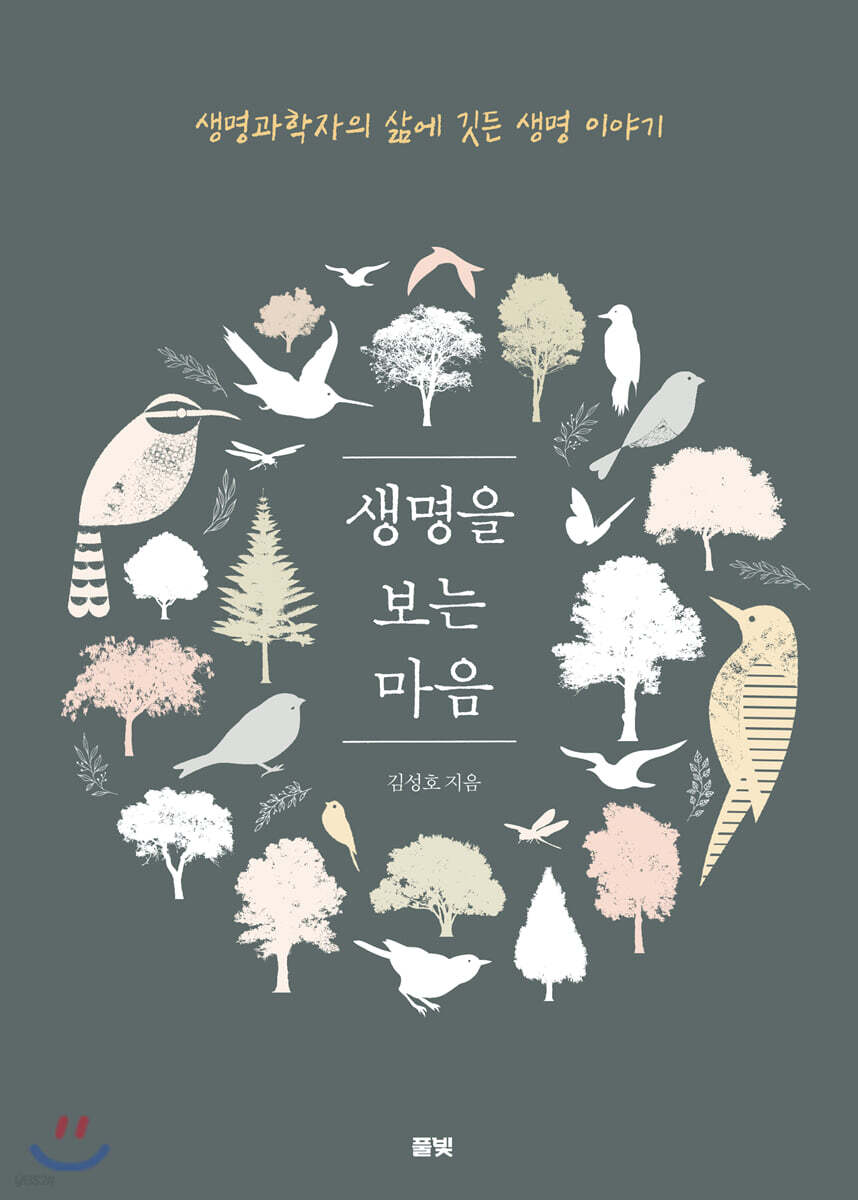
"The Heart that Sees Life: Stories of Life in the Life of a Life Scientist" is a book written by life scientist and ecological writer Kim Seong-ho, recording his 60-year life with nature.
He was so engrossed in birds that he was nicknamed 'Bird Dad' and published many books about his observations and records of them. He also has several books that contain his philosophy on observation and life, but this book is a record of his heart about life, which he observed closely throughout his life and lived with them, with his head, body, and heart filled with sincerity.
The author himself confesses that he poured his entire life, spent with and observing nature, into this book.
Although he himself modestly calls it a "story of life," "The Mind that Sees Life" is a study of all life, encompassing animals, plants, and microorganisms.
However, there is a reason why we do not need to use the term 'research'.
As you open the book and read each sentence, you will be reminded of your childhood, when you played in nature, and you will find yourself rolling around in nature, which has always been there in your heart, even though you could not experience it directly.
Clearly, the genes of humanity that have lived with nature are hiding somewhere in the cells of my body, longing for Mother Nature.
The writings of author Kim Seong-ho, which evoke readers' longing for nature, are ultimately about the power learned from nature and the wisdom gained from nature.
The writing that flows naturally without adding or subtracting is already nature in itself.
“Even if you can’t see it, there is life in places you can’t see.
Invisible life and all other life are interconnected.
“Somewhere along the chain of connections, we humans are also wandering.”
"The Heart that Sees Life: Stories of Life in the Life of a Life Scientist" is a book written by life scientist and ecological writer Kim Seong-ho, recording his 60-year life with nature.
He was so engrossed in birds that he was nicknamed 'Bird Dad' and published many books about his observations and records of them. He also has several books that contain his philosophy on observation and life, but this book is a record of his heart about life, which he observed closely throughout his life and lived with them, with his head, body, and heart filled with sincerity.
The author himself confesses that he poured his entire life, spent with and observing nature, into this book.
Although he himself modestly calls it a "story of life," "The Mind that Sees Life" is a study of all life, encompassing animals, plants, and microorganisms.
However, there is a reason why we do not need to use the term 'research'.
As you open the book and read each sentence, you will be reminded of your childhood, when you played in nature, and you will find yourself rolling around in nature, which has always been there in your heart, even though you could not experience it directly.
Clearly, the genes of humanity that have lived with nature are hiding somewhere in the cells of my body, longing for Mother Nature.
The writings of author Kim Seong-ho, which evoke readers' longing for nature, are ultimately about the power learned from nature and the wisdom gained from nature.
The writing that flows naturally without adding or subtracting is already nature in itself.
- You can preview some of the book's contents.
Preview
index
Opening remarks
Ⅰ Heart toward animals
1.
Encounters with animals
Animal Farm, where life was nurtured | The water world outside the house | Friends and birds met with sight and sound | Excitement and fear, separation and waiting intertwined
2.
Entering the world of birds
A Breathless Wait | The Great Spotted Woodpecker, 50 Days with Them | The Donggobi, A Life of Sublime Care | Filling Up the 10-Year Calendar and Again
3.
Wild birds collide with windows
Birds fly into a world that is visible even when invisible | Lax measures that fail to prevent collisions | Realistic collision prevention methods
4.
pets
Grandfather and the Cow|The Era of 10 Million Pets|Our Third Little Ddolmangi|Goodbye|Together Until the End
5.
Biodiversity and Endangered Species
The types and number of creatures living on Earth | Why must there be diversity? | The reality of the destruction of diversity | What efforts have been made | The paradox that both development and sustainability are possible
6.
The misfortune of wild animals
Animal Accidents on the Road | Ecological Corridors That Provide a Path to Survival | Painful Memories Still Fresh in Our Eyes
7.
The Inconvenient Truth About Animal Festivals
Two Successful Festivals | The Truth Behind Success | Where Are the Ethics of Life? | The Debate on Food and Abuse
8.
Zoo Story
Sad Eyes I Met at the Zoo | In Search of Hope | Where Hope Sprouts
9.
laboratory animals
A Being Who Must Die to Be Meaningful | Raising a Natural but Special Issue | Ethical Justification | The Health of Those Who Enjoy It Through Their Sacrifice
10.
zoonotic diseases
Virus, Who Are You? | Flu is Different from a Bad Cold | Influenza Virus | Avian Flu | The Reality of Preventive Culling | Is Culling the Only Way?
Ⅱ Attitude toward plants
1.
Encountering Plants - A Time of Gratitude and Beauty
The green plains that greeted me|The green fields on the table|More beautiful than flowers|The flowers and trees that accompanied me as I grew up
2.
Plants I Met Through Studying - What Kind of Life Are Plants?
Photosynthesis: The Power to Create Something from Nothing | The Coexistence of Robustness and Flexibility | Decentralization and Typical Performance | Roots: What Matters Is Invisible | Plants Live Long
3.
Plant survival strategies
Strategy 1 - Competition | Strategy 2 - Conformity and Adaptation, Resistance and Overcoming | Strategy 3 - The Struggle for Nutrients | Strategy 4 - Coexistence Beyond Competition | The Key to Mutual Growth
4.
Plants in Crisis
Cycle Breaks | Habitat Loss | Diversity Loss | Genetic Erosion | Seed Wars | Seed Banks and Seed Vaults
Ⅲ A heart for small things
1.
germ
How small can they be? | Discovery of bacteria | Appearance of bacteria | Bacterial proliferation | Distribution of bacteria - habitats | Diversity of bacterial metabolism | Bacteria and disease | The war between bacteria and humans - antibiotics and resistance
2.
fungi
Mold | Alcohol and Yeast | The World of Fungi | Fungi and Humans | My World Expands with Mushrooms
3.
protozoa
Small but Precious Lifeforms|The Starting Point of Our Approach to Life
Ⅰ Heart toward animals
1.
Encounters with animals
Animal Farm, where life was nurtured | The water world outside the house | Friends and birds met with sight and sound | Excitement and fear, separation and waiting intertwined
2.
Entering the world of birds
A Breathless Wait | The Great Spotted Woodpecker, 50 Days with Them | The Donggobi, A Life of Sublime Care | Filling Up the 10-Year Calendar and Again
3.
Wild birds collide with windows
Birds fly into a world that is visible even when invisible | Lax measures that fail to prevent collisions | Realistic collision prevention methods
4.
pets
Grandfather and the Cow|The Era of 10 Million Pets|Our Third Little Ddolmangi|Goodbye|Together Until the End
5.
Biodiversity and Endangered Species
The types and number of creatures living on Earth | Why must there be diversity? | The reality of the destruction of diversity | What efforts have been made | The paradox that both development and sustainability are possible
6.
The misfortune of wild animals
Animal Accidents on the Road | Ecological Corridors That Provide a Path to Survival | Painful Memories Still Fresh in Our Eyes
7.
The Inconvenient Truth About Animal Festivals
Two Successful Festivals | The Truth Behind Success | Where Are the Ethics of Life? | The Debate on Food and Abuse
8.
Zoo Story
Sad Eyes I Met at the Zoo | In Search of Hope | Where Hope Sprouts
9.
laboratory animals
A Being Who Must Die to Be Meaningful | Raising a Natural but Special Issue | Ethical Justification | The Health of Those Who Enjoy It Through Their Sacrifice
10.
zoonotic diseases
Virus, Who Are You? | Flu is Different from a Bad Cold | Influenza Virus | Avian Flu | The Reality of Preventive Culling | Is Culling the Only Way?
Ⅱ Attitude toward plants
1.
Encountering Plants - A Time of Gratitude and Beauty
The green plains that greeted me|The green fields on the table|More beautiful than flowers|The flowers and trees that accompanied me as I grew up
2.
Plants I Met Through Studying - What Kind of Life Are Plants?
Photosynthesis: The Power to Create Something from Nothing | The Coexistence of Robustness and Flexibility | Decentralization and Typical Performance | Roots: What Matters Is Invisible | Plants Live Long
3.
Plant survival strategies
Strategy 1 - Competition | Strategy 2 - Conformity and Adaptation, Resistance and Overcoming | Strategy 3 - The Struggle for Nutrients | Strategy 4 - Coexistence Beyond Competition | The Key to Mutual Growth
4.
Plants in Crisis
Cycle Breaks | Habitat Loss | Diversity Loss | Genetic Erosion | Seed Wars | Seed Banks and Seed Vaults
Ⅲ A heart for small things
1.
germ
How small can they be? | Discovery of bacteria | Appearance of bacteria | Bacterial proliferation | Distribution of bacteria - habitats | Diversity of bacterial metabolism | Bacteria and disease | The war between bacteria and humans - antibiotics and resistance
2.
fungi
Mold | Alcohol and Yeast | The World of Fungi | Fungi and Humans | My World Expands with Mushrooms
3.
protozoa
Small but Precious Lifeforms|The Starting Point of Our Approach to Life
Detailed image

Publisher's Review
A Life Scientist's Humble Tribute to All Living Beings
“Even if you can’t see it, there is life in places you can’t see.
Invisible life and all other life are interconnected.
“Somewhere along the chain of connections, we humans are also wandering.”
"The Heart that Sees Life: Stories of Life in the Life of a Life Scientist" is a book written by life scientist and ecological writer Kim Seong-ho, recording his 60-year life with nature.
He was so engrossed in birds that he was nicknamed 'Bird Dad' and published many books about his observations and records of them. He also has several books that contain his philosophy on observation and life, but this book is a record of his heart about life, which he observed closely throughout his life and lived with them, with his head, body, and heart filled with sincerity.
The author himself confesses that he poured his entire life, spent with and observing nature, into this book.
Although he himself modestly calls it a "story of life," "The Mind that Sees Life" is a study of all life, encompassing animals, plants, and microorganisms.
However, there is a reason why we do not need to use the term 'research'.
As you open the book and read each sentence, you will be reminded of your childhood, when you played in nature, and you will find yourself rolling around in nature, which has always been there in your heart, even though you could not experience it directly.
Clearly, the genes of humanity that have lived with nature are hiding somewhere in the cells of my body, longing for Mother Nature.
The writings of author Kim Seong-ho, which evoke readers' longing for nature, are ultimately about the power learned from nature and the wisdom gained from nature.
The writing that flows naturally without adding or subtracting is already nature in itself.
The heart for animals is divided into ten chapters, the heart for plants is divided into four chapters, and the heart for small things is divided into three chapters.
Life is divided into three areas based on the most important criteria and described.
About animals, it starts with the various animals we met in our childhood and sometimes became friends with, and covers birds, wild birds, companion animals, endangered species, wild animals, animals at animal festivals, zoo animals, laboratory animals, and viruses.
Regarding plants, he starts with the plants in his own experience and then organizes them academically, explaining why plants are in a state of crisis.
Microorganisms are divided into bacteria, fungi, and protozoa, and the relationship we form with these tiny things that exist even though they are invisible is brought to light in a new way.
Sometimes I talk about these lives based on academic knowledge, sometimes on personal research results, and sometimes on observational records.
However, no matter which chapter is opened, there is no dry, third-person research attitude that does not reveal personal experience.
Although he did not meet and experience all life, he did not write here about anything that he had not experienced, observed, tried to understand, and pondered over to solve their problems at least once.
It comes from his philosophy that one cannot dare to speak of life without the core of the mind.
The careful mind and actions of not wanting to harm any life, and the pure heart of wanting to befriend it, can be seen just by looking at one of the photos included in the text.
A single photograph contains the decades and thousands of hours that the artist and the life he or she spent together before taking it.
This passage reminds us that nature is not something to be treated carelessly or enjoyed, but that we are a part of it.
Before all the adjectives, there is only one reason for publishing this book.
Through this book, I hope that at least one person will find a new sense of awe and respect for nature and life that already exists within them.
So, this book is not a book that provides information about life, but rather a passage that allows us to empathize with life and nature.
A scientist's cool-headed thinking, tightly woven with warm empathy.
“It was a time when there was no electricity, so I went to bed early.
If you go to bed early, you wake up early.
The scenery and atmosphere of the early morning in the fields, which were unobstructed in any direction, east, west, south, or north, was special.
The wide-open green, fresh fields that I couldn't see in Seoul where I had been until the day before, the smell of soil that held just the right amount of moisture, the clear morning dew clinging to each rice leaf, the smell of well-rotted rice straw drifting from the old straw mats, the scenery of a reservoir with a not-too-thick mist rising from the water, a group of lotuses already in full bloom and gently spreading their fragrance, a few affectionate thatched houses bowing down respectfully across the reservoir, smoke from morning cooking rising from each chimney, the morning sun the color of a ripe persimmon slowly rising, warmly embracing the thatched houses...
These peaceful images have been woven together into a single picture ever since, and have remained etched in my heart.
“It is a painting that I take out and unfold to soothe my aching heart whenever I go through difficult times while living, living, and living again.” - Main text, pages 208-209
The foundation that shaped Kim Seong-ho, who is now a life scientist and ecological writer, is his experiences at his maternal grandparents' house in the countryside, where he spent much of his childhood.
When he was in elementary and middle school, he would go down as soon as summer and winter vacations started and come back the day before school started.
The animals and plants born and raised inside the house and in the yard nearby, and the diverse and countless living creatures encountered in the vast rice paddies and fields, mountains and streams, freshwater wetlands and marine wetlands outside the house were all beings who shared the vast home called Earth.
It was not just some strange species that I looked at out of curiosity when I was bored, but a friend I spent more time with than my own family, a family I shared affection with, and sometimes a relationship so close that I couldn't tell the difference between myself and it.
Life is born with different appearances and grows together in the bosom of mother nature.
That he and all other beings are together in it.
This is the starting point of Kim Seong-ho's attitude of accepting nature and respecting all life with reverence and awe.
So, as a scholar, his academic attitude toward life is based on his love for life, which is the source, fence, and standard for judgment.
The direction of research is not what is beneficial to humans, but how to approach it so that humans and the entire ecosystem can coexist without harm and continue the cycle.
Therefore, it is more sobering than any other research.
This is because a small part of the human ecosystem cannot be the guiding light for research, and because it applies a fair standard to all living beings without leaning towards anything.
“There are countless birds crashing into something and losing their lives.
The numbers are beyond imagination.
In the United States, it is said that 1 billion horses are sacrificed each year, and in Canada, 25 million horses.
It is estimated that about 8 million animals collide in our country every year.
…every day, a staggering number of birds die by crashing into windows, yet the world turns a blind eye to them.
“Because wild birds colliding with windows do not cause direct harm to humans.” - Main text, pp. 75-76
The problem he has when looking at wild birds is that, even though an average of 20,000 birds die every day around the world after colliding with windows and the like, these accidents are left as they are because they do not pose an immediate danger to humans.
He investigated.
What measures are being taken to prevent wild birds from colliding with windows, and whether they are truly effective.
The results were disappointing, and we looked for ways to prevent a realistic collision.
And this book presents it specifically.
There are many paths.
What matters is the heart that creates the path.
The sincerity that makes the way paves the way properly.
Even in this matter, a word he left behind still rings in my ears.
“Even if the death does not harm humans, if the death is caused by humans, isn’t the responsibility ours?
And the death of a bird will certainly not end with the death of the bird alone.” (Page 84)
Page by page of life, building up to a solid book on life sciences.
If Kim Seong-ho had brought up the weighty word "life" based solely on his childhood memories of living at his maternal grandparents' house in the countryside, no one would have turned a blind eye or paid attention.
In fact, his life was entirely filled with life.
“After following the bird’s back for a few days, I thought I should change my method.
Since the bird didn't come to me, I decided to approach the bird.
I tried to approach the bird by crawling over the camouflage cloth.
It wasn't ineffective, but the efficiency was definitely reduced.
I found a way again.
I chose to hide my body and wait.
The idea was to build a hut that resembled nature.
… He gathered branches scattered around to build a frame, then covered it with reeds and vine stems to complete the hut.
The birds come right up to the hut.
There is a problem.
I sat on a small chair, which was comfortable, but my eye level was not right with the bird floating on the water.
…goes the last way.
Dig the floor inside the hut.
… I dug into the bottom to match the river’s surface, and the icy water seeped in. My clothes quickly got soaked, and I shivered, but there was no other way than to endure it.” - Page 45 of the text
Could he have survived the icy water and come out in less than 30 minutes? Absolutely not.
The smell of dry reeds and wild vines permeating the cold hut was fragrant.
I felt a thrill beyond imagination as I watched wild birds behave naturally at such close range, right at eye level.
Without realizing how time passed, I watched closely as the birds flapped their wings right in front of my nose, kicked the water and soared into the sky, then reappeared and glided down to the surface, caressed each other, the birds that could dive dove into the water and came out with a fish each, and when someone caught a fish, they fought over who would take it, and the birds that could not dive stood on their hands in the shallows with only their butts above the water, rummaged through the riverbed, picked up a clam, and behaved naturally.
He says the whole time was a wonderful experience.
The effort he put into getting closer to a life in order to understand it, which cannot be expressed with words like "careful," can only be expressed with the word "love."
A one-way interest in knowing other beings when my heart feels like it, when my circumstances permit, in a way that is convenient for me.
Humans' attitude toward life is extremely selfish: they confine animals for easy observation by humans, create and maintain a space called a zoo, and carelessly touch and stress animals at animal festivals under the pretense of ecological experience.
Just as loving another person requires concern, understanding, and respect for the other person, Kim Seong-ho personally demonstrates that when approaching all living beings with appearances and attributes completely different from humans, the life of that life, not one's own convenience, must come first.
Even if my body is tired, even if my biological rhythm is disrupted and I am tired, even if I have to give up my daily routine at times, meeting life in a way that does not harm them, his whole life is filled with delicacy and respect for life itself.
The sacred record of his days spent with life with all his heart and body is 『The Heart that Sees Life』.
Some people called this book “an introduction to bioethics,” others said it “poignantly demonstrates the origins of a scientific attitude toward nature,” and still others commented, “Kim Seong-ho’s view of life is the same as his view of biology.”
No matter how it is expressed, they all unanimously agreed that the foundation of all learning is respect for life.
If you want to know the essence of biology, the study of living organisms, and want to examine the various aspects of this study, you must read this book.
A scourge on human selfishness, conveyed through love for life
“I suddenly turned 60.
Looking back, I realize that my life has never been far from the life that exists in nature.
There was a time when I played with all living things at my maternal grandparents' house in the countryside, a time when I majored in biology in college because I loved nothing more than living things, a time when I lived teaching what I studied and researched, and a time when I watched all living things live their lives for a long time, and at the end of it all, I asked myself what my life was like.
In the end, today and every day of the past 60 years were not much different.
This book was written to share the precious memories of each day.” - Opening remarks
Wherever we open the book, it guides us into the embrace of nature, a place we had forgotten.
At the same time, it restores our eyes to see the countless diverse living beings that we previously considered different as equally precious.
However, as Lee Jeong-mo, director of the National Science Museum in Gwacheon, said, “It would be a big mistake to expect only a warm story.
The author continues to pose uncomfortable questions to us with clear knowledge and a balanced perspective on various issues related to life.” Behind the stories of the various creatures he has encountered, there is a warning about the current situation in which biodiversity is being destroyed and endangered species are increasing.
Although the entire world is striving under the grand slogan of "sustainable development," the question of how development and global sustainability can be achieved simultaneously is not overlooked.
While paying tribute to the successful animal festival that revived the dying local economy, he also cautioned that the festival that kills life should be revived as a festival that saves life.
While recognizing that animal testing is an unavoidable choice for human health, we encourage all to work together to respect animal rights to the fullest extent possible.
Rather than accepting culling as an inevitable solution for avian influenza, we propose prioritizing preventative solutions that minimize the current culling methods, taking into account the perspectives of the animals being culled and the people responsible for the culling, who are not considered.
However, it does not stop at mere theory.
He was saddened to see existing zoos failing to perform any of the functions of ecological education, animal research, or species conservation. As a member of the Jeonju Zoo Daulmadang Committee, he took the initiative to transform the cold zoo into a zoo where one could feel the breath of life.
Even when observing protozoa directly or conducting experiments with students, I try to maintain the minimum courtesy of returning the protozoa to their habitat after observation.
Kim Seong-ho's heart toward life is infinitely warm, but precisely because of that, his voice is sharp as he discusses human selfishness, which divides the weight of life based on human standards and changes respect for life accordingly.
A mere human being is not qualified to discuss the greatness of life, but if anyone is qualified to sing of love for life, it must be writer Kim Seong-ho.
Today, I invite you to listen to the song of 『The Heart that Sees Life』, in which the various notes of life unfold on the musical score of science.
“Even if you can’t see it, there is life in places you can’t see.
Invisible life and all other life are interconnected.
“Somewhere along the chain of connections, we humans are also wandering.”
"The Heart that Sees Life: Stories of Life in the Life of a Life Scientist" is a book written by life scientist and ecological writer Kim Seong-ho, recording his 60-year life with nature.
He was so engrossed in birds that he was nicknamed 'Bird Dad' and published many books about his observations and records of them. He also has several books that contain his philosophy on observation and life, but this book is a record of his heart about life, which he observed closely throughout his life and lived with them, with his head, body, and heart filled with sincerity.
The author himself confesses that he poured his entire life, spent with and observing nature, into this book.
Although he himself modestly calls it a "story of life," "The Mind that Sees Life" is a study of all life, encompassing animals, plants, and microorganisms.
However, there is a reason why we do not need to use the term 'research'.
As you open the book and read each sentence, you will be reminded of your childhood, when you played in nature, and you will find yourself rolling around in nature, which has always been there in your heart, even though you could not experience it directly.
Clearly, the genes of humanity that have lived with nature are hiding somewhere in the cells of my body, longing for Mother Nature.
The writings of author Kim Seong-ho, which evoke readers' longing for nature, are ultimately about the power learned from nature and the wisdom gained from nature.
The writing that flows naturally without adding or subtracting is already nature in itself.
The heart for animals is divided into ten chapters, the heart for plants is divided into four chapters, and the heart for small things is divided into three chapters.
Life is divided into three areas based on the most important criteria and described.
About animals, it starts with the various animals we met in our childhood and sometimes became friends with, and covers birds, wild birds, companion animals, endangered species, wild animals, animals at animal festivals, zoo animals, laboratory animals, and viruses.
Regarding plants, he starts with the plants in his own experience and then organizes them academically, explaining why plants are in a state of crisis.
Microorganisms are divided into bacteria, fungi, and protozoa, and the relationship we form with these tiny things that exist even though they are invisible is brought to light in a new way.
Sometimes I talk about these lives based on academic knowledge, sometimes on personal research results, and sometimes on observational records.
However, no matter which chapter is opened, there is no dry, third-person research attitude that does not reveal personal experience.
Although he did not meet and experience all life, he did not write here about anything that he had not experienced, observed, tried to understand, and pondered over to solve their problems at least once.
It comes from his philosophy that one cannot dare to speak of life without the core of the mind.
The careful mind and actions of not wanting to harm any life, and the pure heart of wanting to befriend it, can be seen just by looking at one of the photos included in the text.
A single photograph contains the decades and thousands of hours that the artist and the life he or she spent together before taking it.
This passage reminds us that nature is not something to be treated carelessly or enjoyed, but that we are a part of it.
Before all the adjectives, there is only one reason for publishing this book.
Through this book, I hope that at least one person will find a new sense of awe and respect for nature and life that already exists within them.
So, this book is not a book that provides information about life, but rather a passage that allows us to empathize with life and nature.
A scientist's cool-headed thinking, tightly woven with warm empathy.
“It was a time when there was no electricity, so I went to bed early.
If you go to bed early, you wake up early.
The scenery and atmosphere of the early morning in the fields, which were unobstructed in any direction, east, west, south, or north, was special.
The wide-open green, fresh fields that I couldn't see in Seoul where I had been until the day before, the smell of soil that held just the right amount of moisture, the clear morning dew clinging to each rice leaf, the smell of well-rotted rice straw drifting from the old straw mats, the scenery of a reservoir with a not-too-thick mist rising from the water, a group of lotuses already in full bloom and gently spreading their fragrance, a few affectionate thatched houses bowing down respectfully across the reservoir, smoke from morning cooking rising from each chimney, the morning sun the color of a ripe persimmon slowly rising, warmly embracing the thatched houses...
These peaceful images have been woven together into a single picture ever since, and have remained etched in my heart.
“It is a painting that I take out and unfold to soothe my aching heart whenever I go through difficult times while living, living, and living again.” - Main text, pages 208-209
The foundation that shaped Kim Seong-ho, who is now a life scientist and ecological writer, is his experiences at his maternal grandparents' house in the countryside, where he spent much of his childhood.
When he was in elementary and middle school, he would go down as soon as summer and winter vacations started and come back the day before school started.
The animals and plants born and raised inside the house and in the yard nearby, and the diverse and countless living creatures encountered in the vast rice paddies and fields, mountains and streams, freshwater wetlands and marine wetlands outside the house were all beings who shared the vast home called Earth.
It was not just some strange species that I looked at out of curiosity when I was bored, but a friend I spent more time with than my own family, a family I shared affection with, and sometimes a relationship so close that I couldn't tell the difference between myself and it.
Life is born with different appearances and grows together in the bosom of mother nature.
That he and all other beings are together in it.
This is the starting point of Kim Seong-ho's attitude of accepting nature and respecting all life with reverence and awe.
So, as a scholar, his academic attitude toward life is based on his love for life, which is the source, fence, and standard for judgment.
The direction of research is not what is beneficial to humans, but how to approach it so that humans and the entire ecosystem can coexist without harm and continue the cycle.
Therefore, it is more sobering than any other research.
This is because a small part of the human ecosystem cannot be the guiding light for research, and because it applies a fair standard to all living beings without leaning towards anything.
“There are countless birds crashing into something and losing their lives.
The numbers are beyond imagination.
In the United States, it is said that 1 billion horses are sacrificed each year, and in Canada, 25 million horses.
It is estimated that about 8 million animals collide in our country every year.
…every day, a staggering number of birds die by crashing into windows, yet the world turns a blind eye to them.
“Because wild birds colliding with windows do not cause direct harm to humans.” - Main text, pp. 75-76
The problem he has when looking at wild birds is that, even though an average of 20,000 birds die every day around the world after colliding with windows and the like, these accidents are left as they are because they do not pose an immediate danger to humans.
He investigated.
What measures are being taken to prevent wild birds from colliding with windows, and whether they are truly effective.
The results were disappointing, and we looked for ways to prevent a realistic collision.
And this book presents it specifically.
There are many paths.
What matters is the heart that creates the path.
The sincerity that makes the way paves the way properly.
Even in this matter, a word he left behind still rings in my ears.
“Even if the death does not harm humans, if the death is caused by humans, isn’t the responsibility ours?
And the death of a bird will certainly not end with the death of the bird alone.” (Page 84)
Page by page of life, building up to a solid book on life sciences.
If Kim Seong-ho had brought up the weighty word "life" based solely on his childhood memories of living at his maternal grandparents' house in the countryside, no one would have turned a blind eye or paid attention.
In fact, his life was entirely filled with life.
“After following the bird’s back for a few days, I thought I should change my method.
Since the bird didn't come to me, I decided to approach the bird.
I tried to approach the bird by crawling over the camouflage cloth.
It wasn't ineffective, but the efficiency was definitely reduced.
I found a way again.
I chose to hide my body and wait.
The idea was to build a hut that resembled nature.
… He gathered branches scattered around to build a frame, then covered it with reeds and vine stems to complete the hut.
The birds come right up to the hut.
There is a problem.
I sat on a small chair, which was comfortable, but my eye level was not right with the bird floating on the water.
…goes the last way.
Dig the floor inside the hut.
… I dug into the bottom to match the river’s surface, and the icy water seeped in. My clothes quickly got soaked, and I shivered, but there was no other way than to endure it.” - Page 45 of the text
Could he have survived the icy water and come out in less than 30 minutes? Absolutely not.
The smell of dry reeds and wild vines permeating the cold hut was fragrant.
I felt a thrill beyond imagination as I watched wild birds behave naturally at such close range, right at eye level.
Without realizing how time passed, I watched closely as the birds flapped their wings right in front of my nose, kicked the water and soared into the sky, then reappeared and glided down to the surface, caressed each other, the birds that could dive dove into the water and came out with a fish each, and when someone caught a fish, they fought over who would take it, and the birds that could not dive stood on their hands in the shallows with only their butts above the water, rummaged through the riverbed, picked up a clam, and behaved naturally.
He says the whole time was a wonderful experience.
The effort he put into getting closer to a life in order to understand it, which cannot be expressed with words like "careful," can only be expressed with the word "love."
A one-way interest in knowing other beings when my heart feels like it, when my circumstances permit, in a way that is convenient for me.
Humans' attitude toward life is extremely selfish: they confine animals for easy observation by humans, create and maintain a space called a zoo, and carelessly touch and stress animals at animal festivals under the pretense of ecological experience.
Just as loving another person requires concern, understanding, and respect for the other person, Kim Seong-ho personally demonstrates that when approaching all living beings with appearances and attributes completely different from humans, the life of that life, not one's own convenience, must come first.
Even if my body is tired, even if my biological rhythm is disrupted and I am tired, even if I have to give up my daily routine at times, meeting life in a way that does not harm them, his whole life is filled with delicacy and respect for life itself.
The sacred record of his days spent with life with all his heart and body is 『The Heart that Sees Life』.
Some people called this book “an introduction to bioethics,” others said it “poignantly demonstrates the origins of a scientific attitude toward nature,” and still others commented, “Kim Seong-ho’s view of life is the same as his view of biology.”
No matter how it is expressed, they all unanimously agreed that the foundation of all learning is respect for life.
If you want to know the essence of biology, the study of living organisms, and want to examine the various aspects of this study, you must read this book.
A scourge on human selfishness, conveyed through love for life
“I suddenly turned 60.
Looking back, I realize that my life has never been far from the life that exists in nature.
There was a time when I played with all living things at my maternal grandparents' house in the countryside, a time when I majored in biology in college because I loved nothing more than living things, a time when I lived teaching what I studied and researched, and a time when I watched all living things live their lives for a long time, and at the end of it all, I asked myself what my life was like.
In the end, today and every day of the past 60 years were not much different.
This book was written to share the precious memories of each day.” - Opening remarks
Wherever we open the book, it guides us into the embrace of nature, a place we had forgotten.
At the same time, it restores our eyes to see the countless diverse living beings that we previously considered different as equally precious.
However, as Lee Jeong-mo, director of the National Science Museum in Gwacheon, said, “It would be a big mistake to expect only a warm story.
The author continues to pose uncomfortable questions to us with clear knowledge and a balanced perspective on various issues related to life.” Behind the stories of the various creatures he has encountered, there is a warning about the current situation in which biodiversity is being destroyed and endangered species are increasing.
Although the entire world is striving under the grand slogan of "sustainable development," the question of how development and global sustainability can be achieved simultaneously is not overlooked.
While paying tribute to the successful animal festival that revived the dying local economy, he also cautioned that the festival that kills life should be revived as a festival that saves life.
While recognizing that animal testing is an unavoidable choice for human health, we encourage all to work together to respect animal rights to the fullest extent possible.
Rather than accepting culling as an inevitable solution for avian influenza, we propose prioritizing preventative solutions that minimize the current culling methods, taking into account the perspectives of the animals being culled and the people responsible for the culling, who are not considered.
However, it does not stop at mere theory.
He was saddened to see existing zoos failing to perform any of the functions of ecological education, animal research, or species conservation. As a member of the Jeonju Zoo Daulmadang Committee, he took the initiative to transform the cold zoo into a zoo where one could feel the breath of life.
Even when observing protozoa directly or conducting experiments with students, I try to maintain the minimum courtesy of returning the protozoa to their habitat after observation.
Kim Seong-ho's heart toward life is infinitely warm, but precisely because of that, his voice is sharp as he discusses human selfishness, which divides the weight of life based on human standards and changes respect for life accordingly.
A mere human being is not qualified to discuss the greatness of life, but if anyone is qualified to sing of love for life, it must be writer Kim Seong-ho.
Today, I invite you to listen to the song of 『The Heart that Sees Life』, in which the various notes of life unfold on the musical score of science.
GOODS SPECIFICS
- Publication date: October 30, 2020
- Format: Hardcover book binding method guide
- Page count, weight, size: 336 pages | 596g | 152*212*50mm
- ISBN13: 9791161727783
- ISBN10: 1161727787
You may also like
카테고리
korean


korean

![ELLE 엘르 스페셜 에디션 A형 : 12월 [2025]](http://librairie.coreenne.fr/cdn/shop/files/b8e27a3de6c9538896439686c6b0e8fb.jpg?v=1766436872&width=3840)


