

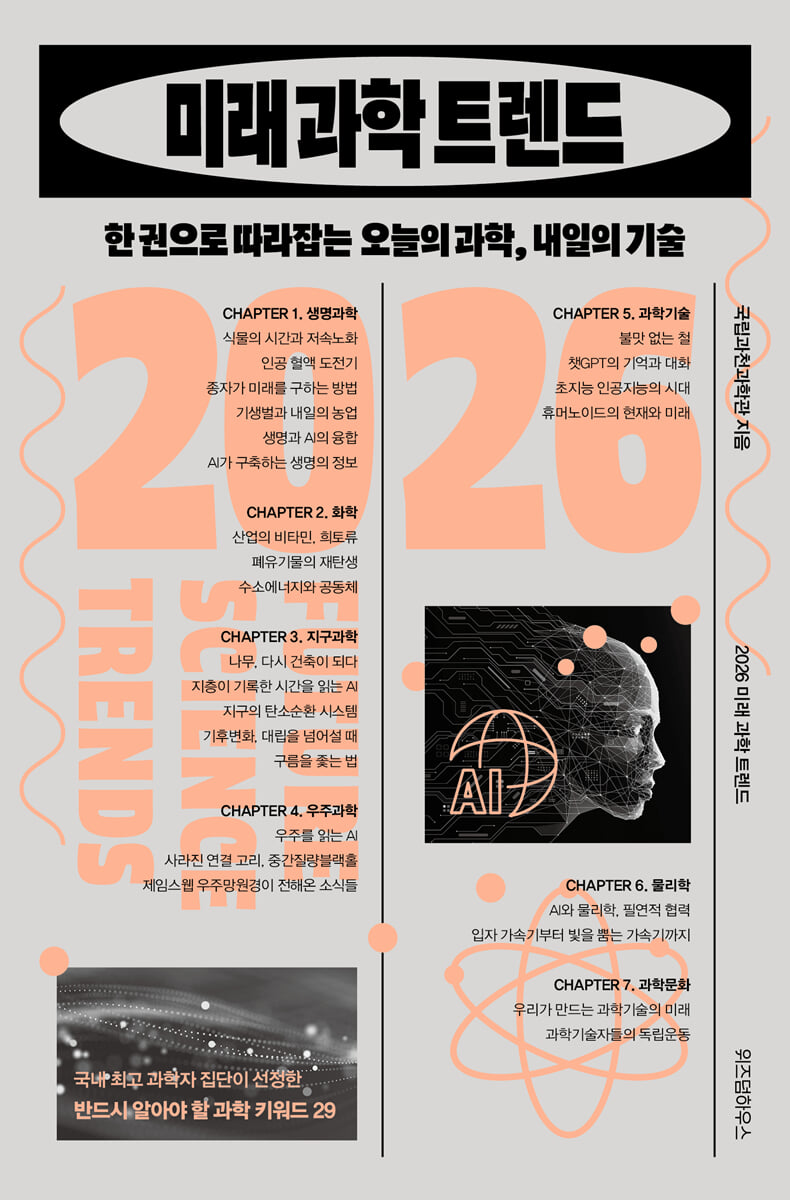
Future Science Trends in 2026
 |
Description
Book Introduction
From artificial intelligence to earth science, you can find the latest key information in almost every field in one volume.
The 'Future Science Trends' series, which is added every year, is characterized by comprehensively covering the light and dark sides of the cutting-edge technologies we face, as well as background knowledge on various scientific fields.
In particular, this "2026 Future Science Trends" is the only book that examines not only the usefulness of AI, which is already deeply embedded in our daily lives, but also how scientists actually utilize artificial intelligence in their laboratories.
It also quickly covered cutting-edge scientific and technological news and pilot operation sites to address the climate crisis.
Read the keywords that will define 2026 in an easy and fun way, including "future science trends" that don't lose their timeliness and expertise.
The 'Future Science Trends' series, which is added every year, is characterized by comprehensively covering the light and dark sides of the cutting-edge technologies we face, as well as background knowledge on various scientific fields.
In particular, this "2026 Future Science Trends" is the only book that examines not only the usefulness of AI, which is already deeply embedded in our daily lives, but also how scientists actually utilize artificial intelligence in their laboratories.
It also quickly covered cutting-edge scientific and technological news and pilot operation sites to address the climate crisis.
Read the keywords that will define 2026 in an easy and fun way, including "future science trends" that don't lose their timeliness and expertise.
- You can preview some of the book's contents.
Preview
index
Foreword | Han Hyung-joo, Director of the National Gwacheon Science Museum
CHAPTER 1.
Life Sciences
Plant Time and Slow Aging
Artificial blood challenger
How Seeds Save the Future
Parasitic bees and tomorrow's agriculture
The convergence of life and AI
Life information built by AI
CHAPTER 2.
chemistry
Vitamins of Industry, Rare Earths
Rebirth of waste organic matter
Hydrogen Energy and Community
CHAPTER 3.
Earth Science
Trees become architecture again
AI that reads the time recorded by the strata
Earth's carbon cycle system
Climate Change: Beyond Conflict
How to Chase the Clouds
CHAPTER 4.
space science
AI that reads the universe
The Missing Link: Intermediate-Mass Black Holes
News from the James Webb Space Telescope
CHAPTER 5.
science and technology
Iron without any burning sensation
ChatGPT's Memories and Conversations
The Age of Superintelligent Artificial Intelligence
The Present and Future of Humanoids
CHAPTER 6.
physics
AI and Physics: An Inevitable Collaboration
From particle accelerators to light-emitting accelerators
CHAPTER 7.
Science and Culture
The future of science and technology we create
Independence movement of scientists and engineers
Appendix_ 2025 Nobel Prize Special Lecture
Regulatory T cells, the brakes of the immune system_Nobel Prize in Physiology or Medicine
MOF, the Nobel Prize in Chemistry that Opened the Door to Psychedelic Chemistry
Quantum Computers and Quantum Tunneling_Nobel Prize in Physics
The seeds of growth lie within us_Nobel Prize in Economics
References and Figure Sources
CHAPTER 1.
Life Sciences
Plant Time and Slow Aging
Artificial blood challenger
How Seeds Save the Future
Parasitic bees and tomorrow's agriculture
The convergence of life and AI
Life information built by AI
CHAPTER 2.
chemistry
Vitamins of Industry, Rare Earths
Rebirth of waste organic matter
Hydrogen Energy and Community
CHAPTER 3.
Earth Science
Trees become architecture again
AI that reads the time recorded by the strata
Earth's carbon cycle system
Climate Change: Beyond Conflict
How to Chase the Clouds
CHAPTER 4.
space science
AI that reads the universe
The Missing Link: Intermediate-Mass Black Holes
News from the James Webb Space Telescope
CHAPTER 5.
science and technology
Iron without any burning sensation
ChatGPT's Memories and Conversations
The Age of Superintelligent Artificial Intelligence
The Present and Future of Humanoids
CHAPTER 6.
physics
AI and Physics: An Inevitable Collaboration
From particle accelerators to light-emitting accelerators
CHAPTER 7.
Science and Culture
The future of science and technology we create
Independence movement of scientists and engineers
Appendix_ 2025 Nobel Prize Special Lecture
Regulatory T cells, the brakes of the immune system_Nobel Prize in Physiology or Medicine
MOF, the Nobel Prize in Chemistry that Opened the Door to Psychedelic Chemistry
Quantum Computers and Quantum Tunneling_Nobel Prize in Physics
The seeds of growth lie within us_Nobel Prize in Economics
References and Figure Sources
Detailed image

Into the book
Genes that appear at night suppress genes that are active and awake during the day, playing a role in cell recovery and regeneration, and repairing damaged DNA, and inducing sleep in humans by secreting melatonin.
In this way, the biological clock mechanisms of plants and humans are very similar, regulating the 24-hour physiological rhythm and are deeply related to sleep, growth, and aging.
Aging is not simply the result of the passage of time, but rather the cumulative result of cellular decline and molecular damage.
Therefore, the field of physiological medicine has recently been paying attention to the connection between the biological clock of plants and aging, and research on this topic is also actively being conducted.
--- From "Time and Slow Aging of Plants"
Up to now, there has been a limitation that thorough separation and disposal are required to recycle waste organic matter as basic raw materials.
However, no matter how carefully you separate and dispose of waste, there are bound to be impurities such as adhesive left behind after removing the label.
Therefore, when waste organic matter is dissolved, it is mixed with over 100 different chemicals, and is only used in industrial boilers or to manufacture low-quality urethane.
To address these issues, South Korea recently launched the 'Plasma-Used Waste Organic Waste to High Value-Added Basic Raw Material Conversion Project Group' in 2022.
The business unit conducted research with the goal of converting various waste organic materials, such as waste oil, waste organic solvents, and waste plastics, into basic raw materials for plastics, such as ethylene and propylene.
And in September 2025, it was announced that a plasma conversion process had been developed that could recycle mixed waste plastics into basic raw materials without separate disposal.
--- From "The Rebirth of Waste Organic Materials"
Geostratigraphy can be considered an extension of biostratigraphy.
It is a science that determines time in absolute numbers, beyond the 'relative time' that fossils tell us.
At one time, I observed rocks with a loupe and hammer, measured angles by hand, and recorded them on site.
But now that role is taken over by electron microscopes, mass spectrometers, and scanners.
Rather than drilling directly into the rock, geologists analyze thousands of meters of data obtained from core samples.
In the 21st century, all of this data has been converted to digital.
Drill cores are scanned in high resolution, and the images are trained by artificial intelligence.
Artificial intelligence can automatically classify the shape, color, particle size, and chemical composition of fossils and read the 'time of the strata'.
Analyses that once took scientists months can now be completed in a single day.
--- From "AI that Reads Time Recorded by the Strata"
Nestled in the Chilean Andes, the Vera Rubin Observatory is currently at the forefront of AI use in astronomy.
The observatory is working on an ambitious project called LSST, which stands for "Space-Time Heritage Survey," which will observe the southern hemisphere sky every night for 10 years to document the changing face of the universe.
The Rubin Observatory observes the universe every day, generating 20 terabytes of data.
This is equivalent to about 4 million high-quality photos taken with a smartphone.
It is expected that a total of 60 petabytes of data will be collected over 10 years, which is more than the data collected from all the digitized books in the world's libraries.
It's literally a wave of starlight coming towards us.
--- From "AI that Reads the Universe"
Today, artificial neural networks are used almost synonymously with artificial intelligence, but until the 2000s, artificial neural networks were a minor subfield of artificial intelligence.
Before that, the mainstream approach to artificial intelligence was for developers to 'explicitly write' programs that perform intelligent tasks.
In contrast, artificial neural networks could 'conceptually' learn how to perform intelligent tasks on their own without explicit programming.
However, the reason why artificial neural networks could not become mainstream was because the learning method had not been specifically invented and there was a lack of computing resources for learning.
--- From "Memories and Conversations of Chat GPT"
Physics has made a crucial contribution to human understanding of the natural world.
However, modern physics research is much more challenging than in the past in terms of the amount and complexity of data and the difficulty of calculations.
Accordingly, AI has become an essential tool for physics researchers, enabling them to process massive amounts of experimental and simulation data in real time and automate research design and complex modeling. The use of AI is becoming a part of physicists' daily work, moving beyond mere assistance to enable fundamental innovations in research. Without the adoption of AI technology, modern physics research will inevitably lose its competitiveness, directly impacting the pace of scientific and technological advancement.
Therefore, the meeting of physics and AI has become a necessity rather than an option.
--- From "AI and Physics: Inevitable Collaboration"
In 2012, the discovery of the Higgs boson at the Large Hadron Collider (LHC) at CERN, the European Organization for Nuclear Research, led to increased public interest in accelerators in Korea as well.
Yet, it's often difficult to understand what accelerators do and why they cost so much.
This has happened repeatedly in the 100-year history of accelerators.
Scientific curiosity alone doesn't easily justify the cost of acquiring massive experimental equipment.
This is also true for the fact that Lawrence obtained research funds by building an accelerator for cancer treatment to continue developing synchrotrons.
So, accelerators started out to solve fundamental questions about how the world is made, and are now expanding into various fields of application, such as medicine, nanotechnology, bio, energy, and semiconductors.
--- From "From Particle Accelerators to Light-Emitting Accelerators"
We now live in an age of science and technology.
Artificial intelligence, robots, autonomous driving, smart cities, metaverse…
It is literally every day that new technologies called ‘innovation’ are being released.
Yet, on the other side of this dazzling technological advancement, our society still faces complex and burdensome problems.
Aging population, climate crisis, social polarization, digital exclusion, youth unemployment, and regional extinction.
None of these problems are easily solved.
So people ask:
Can technology solve these problems?
In this way, the biological clock mechanisms of plants and humans are very similar, regulating the 24-hour physiological rhythm and are deeply related to sleep, growth, and aging.
Aging is not simply the result of the passage of time, but rather the cumulative result of cellular decline and molecular damage.
Therefore, the field of physiological medicine has recently been paying attention to the connection between the biological clock of plants and aging, and research on this topic is also actively being conducted.
--- From "Time and Slow Aging of Plants"
Up to now, there has been a limitation that thorough separation and disposal are required to recycle waste organic matter as basic raw materials.
However, no matter how carefully you separate and dispose of waste, there are bound to be impurities such as adhesive left behind after removing the label.
Therefore, when waste organic matter is dissolved, it is mixed with over 100 different chemicals, and is only used in industrial boilers or to manufacture low-quality urethane.
To address these issues, South Korea recently launched the 'Plasma-Used Waste Organic Waste to High Value-Added Basic Raw Material Conversion Project Group' in 2022.
The business unit conducted research with the goal of converting various waste organic materials, such as waste oil, waste organic solvents, and waste plastics, into basic raw materials for plastics, such as ethylene and propylene.
And in September 2025, it was announced that a plasma conversion process had been developed that could recycle mixed waste plastics into basic raw materials without separate disposal.
--- From "The Rebirth of Waste Organic Materials"
Geostratigraphy can be considered an extension of biostratigraphy.
It is a science that determines time in absolute numbers, beyond the 'relative time' that fossils tell us.
At one time, I observed rocks with a loupe and hammer, measured angles by hand, and recorded them on site.
But now that role is taken over by electron microscopes, mass spectrometers, and scanners.
Rather than drilling directly into the rock, geologists analyze thousands of meters of data obtained from core samples.
In the 21st century, all of this data has been converted to digital.
Drill cores are scanned in high resolution, and the images are trained by artificial intelligence.
Artificial intelligence can automatically classify the shape, color, particle size, and chemical composition of fossils and read the 'time of the strata'.
Analyses that once took scientists months can now be completed in a single day.
--- From "AI that Reads Time Recorded by the Strata"
Nestled in the Chilean Andes, the Vera Rubin Observatory is currently at the forefront of AI use in astronomy.
The observatory is working on an ambitious project called LSST, which stands for "Space-Time Heritage Survey," which will observe the southern hemisphere sky every night for 10 years to document the changing face of the universe.
The Rubin Observatory observes the universe every day, generating 20 terabytes of data.
This is equivalent to about 4 million high-quality photos taken with a smartphone.
It is expected that a total of 60 petabytes of data will be collected over 10 years, which is more than the data collected from all the digitized books in the world's libraries.
It's literally a wave of starlight coming towards us.
--- From "AI that Reads the Universe"
Today, artificial neural networks are used almost synonymously with artificial intelligence, but until the 2000s, artificial neural networks were a minor subfield of artificial intelligence.
Before that, the mainstream approach to artificial intelligence was for developers to 'explicitly write' programs that perform intelligent tasks.
In contrast, artificial neural networks could 'conceptually' learn how to perform intelligent tasks on their own without explicit programming.
However, the reason why artificial neural networks could not become mainstream was because the learning method had not been specifically invented and there was a lack of computing resources for learning.
--- From "Memories and Conversations of Chat GPT"
Physics has made a crucial contribution to human understanding of the natural world.
However, modern physics research is much more challenging than in the past in terms of the amount and complexity of data and the difficulty of calculations.
Accordingly, AI has become an essential tool for physics researchers, enabling them to process massive amounts of experimental and simulation data in real time and automate research design and complex modeling. The use of AI is becoming a part of physicists' daily work, moving beyond mere assistance to enable fundamental innovations in research. Without the adoption of AI technology, modern physics research will inevitably lose its competitiveness, directly impacting the pace of scientific and technological advancement.
Therefore, the meeting of physics and AI has become a necessity rather than an option.
--- From "AI and Physics: Inevitable Collaboration"
In 2012, the discovery of the Higgs boson at the Large Hadron Collider (LHC) at CERN, the European Organization for Nuclear Research, led to increased public interest in accelerators in Korea as well.
Yet, it's often difficult to understand what accelerators do and why they cost so much.
This has happened repeatedly in the 100-year history of accelerators.
Scientific curiosity alone doesn't easily justify the cost of acquiring massive experimental equipment.
This is also true for the fact that Lawrence obtained research funds by building an accelerator for cancer treatment to continue developing synchrotrons.
So, accelerators started out to solve fundamental questions about how the world is made, and are now expanding into various fields of application, such as medicine, nanotechnology, bio, energy, and semiconductors.
--- From "From Particle Accelerators to Light-Emitting Accelerators"
We now live in an age of science and technology.
Artificial intelligence, robots, autonomous driving, smart cities, metaverse…
It is literally every day that new technologies called ‘innovation’ are being released.
Yet, on the other side of this dazzling technological advancement, our society still faces complex and burdensome problems.
Aging population, climate crisis, social polarization, digital exclusion, youth unemployment, and regional extinction.
None of these problems are easily solved.
So people ask:
Can technology solve these problems?
--- From "The Future of Science and Technology We Create"
Publisher's Review
The 'changes,' 'information,' and 'opportunities' brought about by AI are shaped by our choices.
Properly Utilizing Science in the AI Era
* How will AI be used in scientific research? * Can artificial intelligence create life? * The frightening pace of physical AI development * The answer to slow aging found in plant research * Is Korea home to one of only two "seed vaults" in the world? * Hydrogen energy and hydrogen cities * The rebirth of the steel industry * Plastics are now 100% recyclable * Why should we pay attention to accelerator development? * People building tall wooden buildings * The science of cloud observation * The secret to the birth of the universe: black holes
AI has now become a familiar word to everyone, and is being used as a useful tool in everyday life.
So what about science, which requires the most logical reasoning? "2026 Future Science Trends" explores the diverse scientific landscape and the role of AI in the laboratory, using case studies from each field.
CHAPTER 1.
In 'Life Sciences', discussions unfold on AI and 'life', a hotly debated topic and a culmination of cutting-edge science and technology.
It also provides a fascinating look at the science of slow aging, which directly impacts our lives, and the ongoing challenges researchers face in creating artificial blood.
CHAPTER 2.
'Chemistry' and CHAPTER 3.
The main keywords in 'Earth Science' are the development of technology to deal with the 'climate crisis' and big data analysis using artificial intelligence.
The book highlights the research of Korean scientists who have made plastic 100% recyclable, and details policies for high-rise wooden buildings that are excellent at storing carbon and hydrogen energy.
CHAPTER 4.
'Space Science' and CHAPTER 5.
"Science and Technology" delivers vivid news from astronomy labs around the world processing vast amounts of data with AI, from ChatGPT to artificial general intelligence, superintelligence, and even physical AI. CHAPTER 6.
'Physics' also emphasizes the need for 'integrated researchers who are adept at handling physics and AI', stating that it is time to consider scientific methodology and ethics when utilizing artificial intelligence.
It also suggests future research topics utilizing particle accelerators, providing new paths for students dreaming of a career in science.
CHAPTER 7.
In 'Science Culture,' we tell the story of the evolution of science and technology that we have chosen, examine the major trends in the history of science, and even meticulously examine the figures of scientists during the Japanese colonial period.
Meanwhile, the 'Supplement 2025 Nobel Prize Special Lecture' has been delivering news of the Physics, Physiology or Medicine, and Chemistry Nobel Prize winners and providing background information on their achievements in an easy-to-understand manner.
In particular, this issue of "2026 Future Science Trends" includes an explanation of the Nobel Prize in Economics, which states that the economy grows only when science moves beyond theory and transforms into useful knowledge that connects with industrial practice.
This leads readers to experience the co-evolution of science and society in a variety of ways.
From AI to Earth Science, read only the essentials of essential science fields.
Korea's only reader-centered science trend book
From 2021 to 2025, over a five-year period, "Future Science Trends" has identified key scientific keywords that will dominate the year, from basic sciences like astronomy, physics, earth science, and life sciences to cutting-edge, practical fields like chemistry and chemical engineering, computer engineering, and mechanical engineering.
This book's unique strength lies in its ability to grasp the major trends in science and technology that change every year and even predict future trends.
In an age where "everywhere we look is science and technology," how much do we really need to know? New technologies, magically appearing, bring excitement and curiosity, along with a vague fear of the unknown.
To avoid being swayed by media concerns or sensational stories, it is necessary to recognize that technology is a major factor in changing society and to examine it to the point where it becomes familiar.
This is when scientists' communication about 'future scientific trends' shines.
The National Science Museum in Gwacheon is an institution that goes beyond imparting knowledge and helps people develop a scientific worldview.
Researchers here say they do science to "expand people's experiences and build sustainable everyday life on Earth."
They met people from children to adults in person, listened to their stories, and observed their various curiosities up close.
Therefore, as the right person to select the latest scientific information that the public is most curious about and needs, he clearly introduces the current state of science and technology and conveys its meaning without missing anything.
And, with over 60 photos and materials drawn by the authors themselves included, you can obtain information more easily.
The beauty of this book is that it covers a variety of topics in one place.
The interrelated flow of science that forms knowledge can provide students with integrated knowledge and, for those interested in liberal arts, can allow them to reexamine their daily lives.
Another unique aspect of this book is that it faithfully captures the stories of Korea, which plays a leading role in research on global trends as well as hot topics, and that it is told from the ground up in Korea.
After reading the appendix and the 2025 Nobel Prize lecture, you will be able to grasp the future of academia, technology, and even the gaps in the market at a glance.
Properly Utilizing Science in the AI Era
* How will AI be used in scientific research? * Can artificial intelligence create life? * The frightening pace of physical AI development * The answer to slow aging found in plant research * Is Korea home to one of only two "seed vaults" in the world? * Hydrogen energy and hydrogen cities * The rebirth of the steel industry * Plastics are now 100% recyclable * Why should we pay attention to accelerator development? * People building tall wooden buildings * The science of cloud observation * The secret to the birth of the universe: black holes
AI has now become a familiar word to everyone, and is being used as a useful tool in everyday life.
So what about science, which requires the most logical reasoning? "2026 Future Science Trends" explores the diverse scientific landscape and the role of AI in the laboratory, using case studies from each field.
CHAPTER 1.
In 'Life Sciences', discussions unfold on AI and 'life', a hotly debated topic and a culmination of cutting-edge science and technology.
It also provides a fascinating look at the science of slow aging, which directly impacts our lives, and the ongoing challenges researchers face in creating artificial blood.
CHAPTER 2.
'Chemistry' and CHAPTER 3.
The main keywords in 'Earth Science' are the development of technology to deal with the 'climate crisis' and big data analysis using artificial intelligence.
The book highlights the research of Korean scientists who have made plastic 100% recyclable, and details policies for high-rise wooden buildings that are excellent at storing carbon and hydrogen energy.
CHAPTER 4.
'Space Science' and CHAPTER 5.
"Science and Technology" delivers vivid news from astronomy labs around the world processing vast amounts of data with AI, from ChatGPT to artificial general intelligence, superintelligence, and even physical AI. CHAPTER 6.
'Physics' also emphasizes the need for 'integrated researchers who are adept at handling physics and AI', stating that it is time to consider scientific methodology and ethics when utilizing artificial intelligence.
It also suggests future research topics utilizing particle accelerators, providing new paths for students dreaming of a career in science.
CHAPTER 7.
In 'Science Culture,' we tell the story of the evolution of science and technology that we have chosen, examine the major trends in the history of science, and even meticulously examine the figures of scientists during the Japanese colonial period.
Meanwhile, the 'Supplement 2025 Nobel Prize Special Lecture' has been delivering news of the Physics, Physiology or Medicine, and Chemistry Nobel Prize winners and providing background information on their achievements in an easy-to-understand manner.
In particular, this issue of "2026 Future Science Trends" includes an explanation of the Nobel Prize in Economics, which states that the economy grows only when science moves beyond theory and transforms into useful knowledge that connects with industrial practice.
This leads readers to experience the co-evolution of science and society in a variety of ways.
From AI to Earth Science, read only the essentials of essential science fields.
Korea's only reader-centered science trend book
From 2021 to 2025, over a five-year period, "Future Science Trends" has identified key scientific keywords that will dominate the year, from basic sciences like astronomy, physics, earth science, and life sciences to cutting-edge, practical fields like chemistry and chemical engineering, computer engineering, and mechanical engineering.
This book's unique strength lies in its ability to grasp the major trends in science and technology that change every year and even predict future trends.
In an age where "everywhere we look is science and technology," how much do we really need to know? New technologies, magically appearing, bring excitement and curiosity, along with a vague fear of the unknown.
To avoid being swayed by media concerns or sensational stories, it is necessary to recognize that technology is a major factor in changing society and to examine it to the point where it becomes familiar.
This is when scientists' communication about 'future scientific trends' shines.
The National Science Museum in Gwacheon is an institution that goes beyond imparting knowledge and helps people develop a scientific worldview.
Researchers here say they do science to "expand people's experiences and build sustainable everyday life on Earth."
They met people from children to adults in person, listened to their stories, and observed their various curiosities up close.
Therefore, as the right person to select the latest scientific information that the public is most curious about and needs, he clearly introduces the current state of science and technology and conveys its meaning without missing anything.
And, with over 60 photos and materials drawn by the authors themselves included, you can obtain information more easily.
The beauty of this book is that it covers a variety of topics in one place.
The interrelated flow of science that forms knowledge can provide students with integrated knowledge and, for those interested in liberal arts, can allow them to reexamine their daily lives.
Another unique aspect of this book is that it faithfully captures the stories of Korea, which plays a leading role in research on global trends as well as hot topics, and that it is told from the ground up in Korea.
After reading the appendix and the 2025 Nobel Prize lecture, you will be able to grasp the future of academia, technology, and even the gaps in the market at a glance.
GOODS SPECIFICS
- Date of issue: November 26, 2025
- Page count, weight, size: 368 pages | 512g | 135*205*22mm
- ISBN13: 9791171715596
- ISBN10: 1171715595
You may also like
카테고리
korean


korean

![GQ KOREA Mark (Monthly): December [2025]](http://librairie.coreenne.fr/cdn/shop/files/8ef265dbbfbf186523ed75ba7319009d.jpg?v=1765340328&width=3840)


