

A biology story told by a biology major
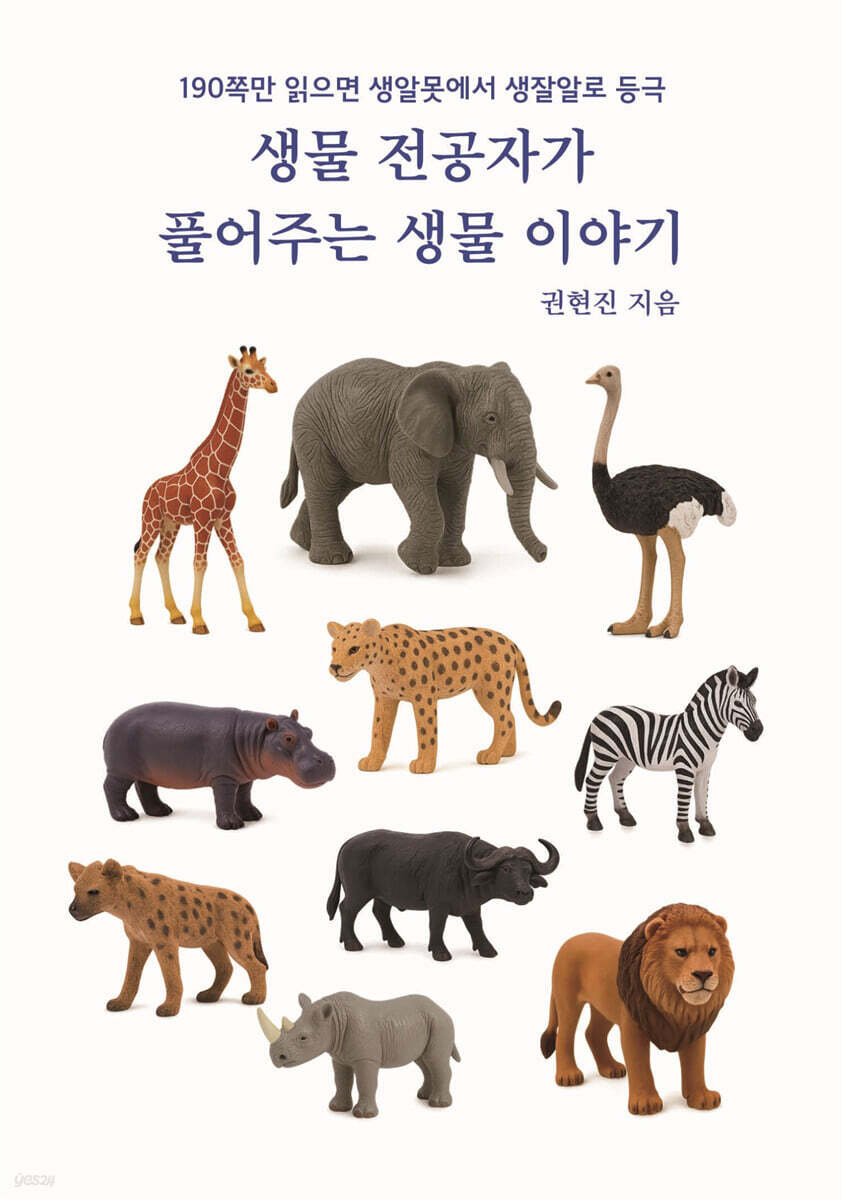 |
Description
Book Introduction
“Biology isn’t difficult anymore!”
A story about living things that everyone from kindergarteners to adults can enjoy.
This is a friendly introductory biology book that was reborn through the Bucketus program and is much easier and more fun than the previously published 『Biology Study and Go to the Goal』.
Knowledge and fun, two birds with one stone. A biology major tells the story of living things.
A story about living things that everyone from kindergarteners to adults can enjoy.
This is a friendly introductory biology book that was reborn through the Bucketus program and is much easier and more fun than the previously published 『Biology Study and Go to the Goal』.
Knowledge and fun, two birds with one stone. A biology major tells the story of living things.
- You can preview some of the book's contents.
Preview
index
Author's Note _2
Prologue _8
Chapter 1 Cell Biology
What is a living thing? _15
What is our body made of? _29
What do cells look like? _49
How do cells divide? _59
Chapter 2 Biochemistry, Genetics, and Immunology
What if we started a mini power plant? - Cellular Respiration _73
Photosynthesis: The Solar Food Factory of Plants _83
How are our genes inherited? _91
Little villain in the shape of a crown - Coronavirus_99
Chapter 3 Human Physiology
Let's learn about female and male reproduction! - We were born to Life Collaborative Project _107
How are signals transmitted within our bodies? _121
Move, breathe, eat, and poop _143
Chapter 4 Ph.
D. in sex education
Ph.D. in sex education _168
Prologue _8
Chapter 1 Cell Biology
What is a living thing? _15
What is our body made of? _29
What do cells look like? _49
How do cells divide? _59
Chapter 2 Biochemistry, Genetics, and Immunology
What if we started a mini power plant? - Cellular Respiration _73
Photosynthesis: The Solar Food Factory of Plants _83
How are our genes inherited? _91
Little villain in the shape of a crown - Coronavirus_99
Chapter 3 Human Physiology
Let's learn about female and male reproduction! - We were born to Life Collaborative Project _107
How are signals transmitted within our bodies? _121
Move, breathe, eat, and poop _143
Chapter 4 Ph.
D. in sex education
Ph.D. in sex education _168
Detailed image

Into the book
What is the charm of living things?
I think that's the process of 'getting to know my true self.'
They say that people live their entire lives without ever completely understanding themselves.
But studying biology can give you at least a fundamental understanding of how the cells, tissues, and organs that make up your body are structured, what their functions are, and why they work the way they do.
I think it acts like a small flashlight that illuminates the way in a dark tunnel, an unknown world called 'me' that is difficult to fully grasp throughout one's life.
This is a fascinating and entertaining story about living things! Why not share this book with those creatures you've been avoiding out of boredom, deepen your love for them, and gain valuable knowledge?
I hope this book will be a small opportunity for you to discover a new charm of living things.
Before getting into the book, I've organized it to feel like you're searching with GPT, the artificial intelligence search engine that changed the world.
And I tried to write it in a conversational style, as if a kind teacher were teaching, while attaching cute illustrations.
There aren't many pictures and the writing style is too stiff, so the content is likely to be stiff and feel like reading a textbook, so let's dive into biology in a friendly way, as if having a conversation.
--- From the "Prologue"
RNA messengers travel through nuclear pores, passageways in the nucleus, into the cytoplasm, the factory area of the cell.
And in the cytoplasm, translation machines called ribosomes read the instructions from the RNA messenger and create the actual workers called proteins.
These protein workers perform various functions in our bodies, including hormones, antibodies, and enzymes.
Ultimately, the master blueprint called DNA creates workers called proteins through messengers called RNA, and these workers create and move our bodies.
So how are these crucial genes passed on to the next generation? Our bodies contain a total of 46 chromosomes, which are like 23 pairs of genetic encyclopedias.
One of these encyclopedias was inherited from my father, the other from my mother.
A man's sperm and a woman's egg are born with only half of this set of chromosomes (23) through a special process called meiosis.
And when a sperm and an egg meet and are fertilized through sexual intercourse between a man and a woman, half of the father's encyclopedia and half of the mother's encyclopedia combine to create a new person with 46 chromosomes.
So if someone asks you, “Do you look like your mom or your dad?” the correct answer is, “I look half mom and half dad!”
As genes are mixed like this every time, new combinations called genetic diversity are created, and every person in the world has unique characteristics.
--- From "How are our genes inherited?"
When you were growing, a message called growth hormone would have been secreted from the pituitary gland and traveled throughout the body through the bloodstream.
This growth hormone sent a message to bone cells, muscle cells, and cells in various other tissues, saying, “Grow quickly! Make proteins and divide!”
That's why our bodies were able to grow taller and larger.
As another example, when you eat delicious food and your blood sugar level rises, your pancreas secretes a hormone called insulin.
This insulin sends the message “Use glucose for energy or store it!” through the blood to cells throughout the body, especially muscle cells and fat cells.
Then, the cells absorb the glucose in the blood and use it for energy or store it in the form of glycogen or fat, thereby regulating blood sugar levels back to normal.
And that's not all.
Have you ever experienced a sudden, frightening situation or a startled surprise, where your heart races and your palms get sweaty? This happens when the hormone adrenaline is secreted from the adrenal glands and spreads throughout the body.
Adrenaline prepares our bodies for emergencies by sending messages to our heart telling us to “run faster!” to our muscles telling us to “use more energy and prepare to escape!” and to our blood vessels telling us to “pump blood to vital organs!”
While the nervous system is responsible for quick, immediate responses like a one-on-one phone call, the endocrine system is responsible for the slow, widespread, and long-term, delicate regulation of important changes in our bodies, such as growth, metabolism, emotions, and reproduction, like a nationally simultaneous radio broadcast.
Our body's sensory system is truly amazing!
Our bodies function as surveillance cameras and antennas for the smart city, detecting all changes in the outside world and within our bodies in real time and reporting them to the central server, the brain.
I think that's the process of 'getting to know my true self.'
They say that people live their entire lives without ever completely understanding themselves.
But studying biology can give you at least a fundamental understanding of how the cells, tissues, and organs that make up your body are structured, what their functions are, and why they work the way they do.
I think it acts like a small flashlight that illuminates the way in a dark tunnel, an unknown world called 'me' that is difficult to fully grasp throughout one's life.
This is a fascinating and entertaining story about living things! Why not share this book with those creatures you've been avoiding out of boredom, deepen your love for them, and gain valuable knowledge?
I hope this book will be a small opportunity for you to discover a new charm of living things.
Before getting into the book, I've organized it to feel like you're searching with GPT, the artificial intelligence search engine that changed the world.
And I tried to write it in a conversational style, as if a kind teacher were teaching, while attaching cute illustrations.
There aren't many pictures and the writing style is too stiff, so the content is likely to be stiff and feel like reading a textbook, so let's dive into biology in a friendly way, as if having a conversation.
--- From the "Prologue"
RNA messengers travel through nuclear pores, passageways in the nucleus, into the cytoplasm, the factory area of the cell.
And in the cytoplasm, translation machines called ribosomes read the instructions from the RNA messenger and create the actual workers called proteins.
These protein workers perform various functions in our bodies, including hormones, antibodies, and enzymes.
Ultimately, the master blueprint called DNA creates workers called proteins through messengers called RNA, and these workers create and move our bodies.
So how are these crucial genes passed on to the next generation? Our bodies contain a total of 46 chromosomes, which are like 23 pairs of genetic encyclopedias.
One of these encyclopedias was inherited from my father, the other from my mother.
A man's sperm and a woman's egg are born with only half of this set of chromosomes (23) through a special process called meiosis.
And when a sperm and an egg meet and are fertilized through sexual intercourse between a man and a woman, half of the father's encyclopedia and half of the mother's encyclopedia combine to create a new person with 46 chromosomes.
So if someone asks you, “Do you look like your mom or your dad?” the correct answer is, “I look half mom and half dad!”
As genes are mixed like this every time, new combinations called genetic diversity are created, and every person in the world has unique characteristics.
--- From "How are our genes inherited?"
When you were growing, a message called growth hormone would have been secreted from the pituitary gland and traveled throughout the body through the bloodstream.
This growth hormone sent a message to bone cells, muscle cells, and cells in various other tissues, saying, “Grow quickly! Make proteins and divide!”
That's why our bodies were able to grow taller and larger.
As another example, when you eat delicious food and your blood sugar level rises, your pancreas secretes a hormone called insulin.
This insulin sends the message “Use glucose for energy or store it!” through the blood to cells throughout the body, especially muscle cells and fat cells.
Then, the cells absorb the glucose in the blood and use it for energy or store it in the form of glycogen or fat, thereby regulating blood sugar levels back to normal.
And that's not all.
Have you ever experienced a sudden, frightening situation or a startled surprise, where your heart races and your palms get sweaty? This happens when the hormone adrenaline is secreted from the adrenal glands and spreads throughout the body.
Adrenaline prepares our bodies for emergencies by sending messages to our heart telling us to “run faster!” to our muscles telling us to “use more energy and prepare to escape!” and to our blood vessels telling us to “pump blood to vital organs!”
While the nervous system is responsible for quick, immediate responses like a one-on-one phone call, the endocrine system is responsible for the slow, widespread, and long-term, delicate regulation of important changes in our bodies, such as growth, metabolism, emotions, and reproduction, like a nationally simultaneous radio broadcast.
Our body's sensory system is truly amazing!
Our bodies function as surveillance cameras and antennas for the smart city, detecting all changes in the outside world and within our bodies in real time and reporting them to the central server, the brain.
--- From "How are signals transmitted in our body?"
GOODS SPECIFICS
- Date of issue: October 22, 2025
- Page count, weight, size: 190 pages | 128*182*8mm
- ISBN13: 9791194741558
You may also like
카테고리
korean


korean

![ELLE 엘르 스페셜 에디션 A형 : 12월 [2025]](http://librairie.coreenne.fr/cdn/shop/files/b8e27a3de6c9538896439686c6b0e8fb.jpg?v=1766436872&width=3840)


