

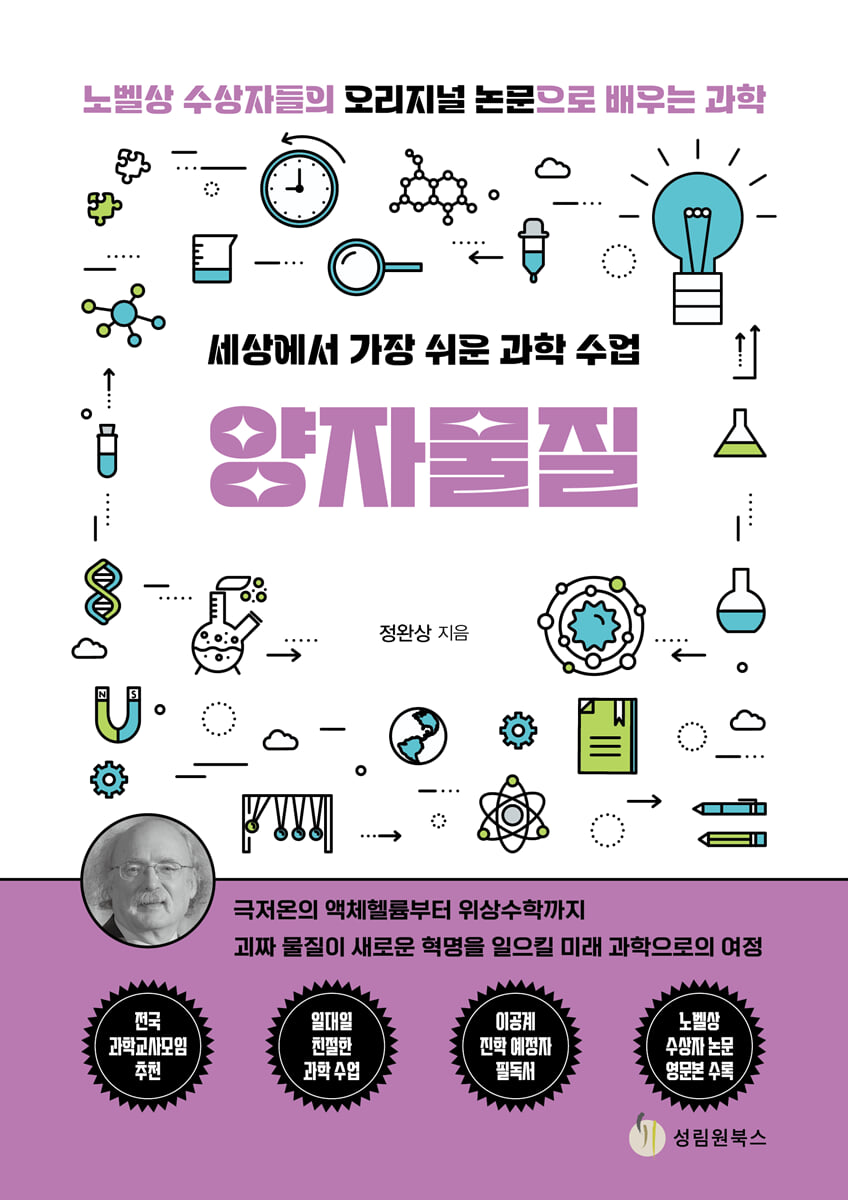
The World's Easiest Science Lesson: Quantum Matter
 |
Description
Book Introduction
From cryogenic liquid helium to topology
Inside the paper of Haldane, the founder of modern topological matter theory!
Into the mysterious world of quantum matter beyond imagination
Let's go on a journey with the papers of Nobel Prize winners!
[Learn Science with Original Papers from Nobel Prize Winners] The 17th book in the series.
Professor Jeong Wan-sang, who has written numerous popular science books, delves into the quantum material content of scientific papers, which can be perceived as difficult, in an easy and fun way.
First, we talked about scientists who liquefied substances such as hydrogen, oxygen, and helium, which we know as gases in our daily lives.
Next, he explained the quantum Hall effect of Klitzing, which is a quantum mechanical interpretation of the Hall effect, which appeared before classical electromagnetic theory.
Along with the history of the microscope, the story behind the invention of quantum magnets and MRI was also covered.
We also explored carbon-based quantum materials such as graphene, fullerene, and carbon nanotubes.
The final chapter introduces the achievements of Thouless, Kosterlitz, and Haldane, who won the 2016 Nobel Prize in Physics for their research on topological matter.
In particular, we looked at Haldane's 1988 paper, which showed that quantum effects occur even in the absence of a magnetic field.
This paper is connected to topology, so only a few are mentioned.
The appendix includes a list of Nobel Prize winners in Physics along with English versions of papers by scholars who have led the research on quantum materials, to help readers delve deeper.
Inside the paper of Haldane, the founder of modern topological matter theory!
Into the mysterious world of quantum matter beyond imagination
Let's go on a journey with the papers of Nobel Prize winners!
[Learn Science with Original Papers from Nobel Prize Winners] The 17th book in the series.
Professor Jeong Wan-sang, who has written numerous popular science books, delves into the quantum material content of scientific papers, which can be perceived as difficult, in an easy and fun way.
First, we talked about scientists who liquefied substances such as hydrogen, oxygen, and helium, which we know as gases in our daily lives.
Next, he explained the quantum Hall effect of Klitzing, which is a quantum mechanical interpretation of the Hall effect, which appeared before classical electromagnetic theory.
Along with the history of the microscope, the story behind the invention of quantum magnets and MRI was also covered.
We also explored carbon-based quantum materials such as graphene, fullerene, and carbon nanotubes.
The final chapter introduces the achievements of Thouless, Kosterlitz, and Haldane, who won the 2016 Nobel Prize in Physics for their research on topological matter.
In particular, we looked at Haldane's 1988 paper, which showed that quantum effects occur even in the absence of a magnetic field.
This paper is connected to topology, so only a few are mentioned.
The appendix includes a list of Nobel Prize winners in Physics along with English versions of papers by scholars who have led the research on quantum materials, to help readers delve deeper.
- You can preview some of the book's contents.
Preview
index
I wish I had a book like this when I first started studying science.
I hope you can understand the original papers of these genius scientists.
A Surprise Interview with Professor Haldane Vishwanath, the Founder of Modern Topological Matter Theory
First Encounter | The Discovery of Liquid Helium and Superfluidity
Liquefaction of gases - at unimaginably low temperatures
The Discovery of Liquid Helium: A Challenge to Extremely Low Temperatures
Superfluid _ liquid with no viscosity
Second Encounter | The History of Microscopy
Optical microscope _ Making small objects larger using light
Transmission electron microscope: Improving resolution with electron beams
Scanning tunneling microscope _ quantum mechanical tunneling of electrons
Third Encounter | Superconductivity Theory
Ohm's Law - The relationship between voltage and current when current flows through a wire
Pouillet's law - another form of Ohm's law
Drude theory: dealing with the movement of electrons in metals
Discovery of superconductivity: current flows without resistance
Superconducting magnets: their magnetic fields grow incredibly large.
Discovery of Diamagnetism - Can a Frog Levitate?
Meissner Effect - What Happens Inside Superconducting Materials?
The emergence of superconductivity theory - from the research of three people
Josephson element - What happens if you put an insulator between superconductors?
Discovery of compound superconductors _ from non-metallic compounds
Fourth Encounter | Quantum Magnet
Basic Principles of Nuclear Magnetic Resonance (MRI)
The invention of MRI: Using nuclear magnetic resonance to see inside the human body
Fifth Encounter | Quantum Hall Effect
Hall Effect - A New Voltage is Measured
Uses of the Hall Effect _ in various machines and everyday devices
Quantum Hall Effect - Electrons Trapped in a Two-Dimensional Quantum Well
Fractional quantum Hall effect _ even for specific fractions
Landau: The Eventful Life and Achievements of a Mathematical Prodigy
Sixth Meeting | Graphene
Graphite - a substance composed solely of carbon
Layered structure of graphite - hexagonal honeycomb shape
Discovery of Graphene _ Using Adhesive Tape
Fullerene - a soccer ball-shaped carbon array
Carbon nanotubes - 100 times stronger than steel
Find new materials using phosphorene!
Seventh Encounter | From Topology to Quantum Matter
Topological Transitions - Are Donuts and Mugs the Same?
Haldane's Research _ Mathematical Intuition and Physical Insight
Topological insulators - weird stuff that's hot on the outside and hard on the inside
Quantum Spin Liquid: The Discovery of Order in the Disordered
Majorana fermion - its own vanishing antiparticle
Quantum Engineering: The Technology That Makes Imagination Real
In addition to the meeting
On a New Action of the Magnet on Electric Currents _Hall's paper, English version
Further experiments with liquid helium.
C. On the change of electric resistance of pure metals at very low temperatures etc. IV.
The resistance of pure mercury at helium temperatures _Onnes's paper, English version
Microscopic Theory of Superconductivity _BCS paper English version
New Method for High-Accuracy Determination of the Fine-Structure Constant Based on Quantized Hall Resistance _English version of Clinching thesis
Model for a Quantum Hall Effect without Landau Levels: Condensed Matter Realization of the “Parity Anomaly” _English version of Haldane's paper
Concluding our meeting with a great paper
Papers referenced for this book
Greek letters used in formulas
Introducing the Nobel Prize winners in Physics
I hope you can understand the original papers of these genius scientists.
A Surprise Interview with Professor Haldane Vishwanath, the Founder of Modern Topological Matter Theory
First Encounter | The Discovery of Liquid Helium and Superfluidity
Liquefaction of gases - at unimaginably low temperatures
The Discovery of Liquid Helium: A Challenge to Extremely Low Temperatures
Superfluid _ liquid with no viscosity
Second Encounter | The History of Microscopy
Optical microscope _ Making small objects larger using light
Transmission electron microscope: Improving resolution with electron beams
Scanning tunneling microscope _ quantum mechanical tunneling of electrons
Third Encounter | Superconductivity Theory
Ohm's Law - The relationship between voltage and current when current flows through a wire
Pouillet's law - another form of Ohm's law
Drude theory: dealing with the movement of electrons in metals
Discovery of superconductivity: current flows without resistance
Superconducting magnets: their magnetic fields grow incredibly large.
Discovery of Diamagnetism - Can a Frog Levitate?
Meissner Effect - What Happens Inside Superconducting Materials?
The emergence of superconductivity theory - from the research of three people
Josephson element - What happens if you put an insulator between superconductors?
Discovery of compound superconductors _ from non-metallic compounds
Fourth Encounter | Quantum Magnet
Basic Principles of Nuclear Magnetic Resonance (MRI)
The invention of MRI: Using nuclear magnetic resonance to see inside the human body
Fifth Encounter | Quantum Hall Effect
Hall Effect - A New Voltage is Measured
Uses of the Hall Effect _ in various machines and everyday devices
Quantum Hall Effect - Electrons Trapped in a Two-Dimensional Quantum Well
Fractional quantum Hall effect _ even for specific fractions
Landau: The Eventful Life and Achievements of a Mathematical Prodigy
Sixth Meeting | Graphene
Graphite - a substance composed solely of carbon
Layered structure of graphite - hexagonal honeycomb shape
Discovery of Graphene _ Using Adhesive Tape
Fullerene - a soccer ball-shaped carbon array
Carbon nanotubes - 100 times stronger than steel
Find new materials using phosphorene!
Seventh Encounter | From Topology to Quantum Matter
Topological Transitions - Are Donuts and Mugs the Same?
Haldane's Research _ Mathematical Intuition and Physical Insight
Topological insulators - weird stuff that's hot on the outside and hard on the inside
Quantum Spin Liquid: The Discovery of Order in the Disordered
Majorana fermion - its own vanishing antiparticle
Quantum Engineering: The Technology That Makes Imagination Real
In addition to the meeting
On a New Action of the Magnet on Electric Currents _Hall's paper, English version
Further experiments with liquid helium.
C. On the change of electric resistance of pure metals at very low temperatures etc. IV.
The resistance of pure mercury at helium temperatures _Onnes's paper, English version
Microscopic Theory of Superconductivity _BCS paper English version
New Method for High-Accuracy Determination of the Fine-Structure Constant Based on Quantized Hall Resistance _English version of Clinching thesis
Model for a Quantum Hall Effect without Landau Levels: Condensed Matter Realization of the “Parity Anomaly” _English version of Haldane's paper
Concluding our meeting with a great paper
Papers referenced for this book
Greek letters used in formulas
Introducing the Nobel Prize winners in Physics
Detailed image

Into the book
Physics: No matter how cold it is, it doesn't seem like the air turns into liquid?
Professor Jeong: It turns into a liquid at an unimaginably low temperature.
By setting these low temperatures in the laboratory, we can create liquid nitrogen or oxygen.
This phenomenon of gas turning into liquid is called liquefaction, and the temperature at which liquefaction occurs is called the liquefaction point.
--- p.20
Superfluidity occurs in liquid helium, and because there is no viscosity, various phenomena occur.
Superfluids experience virtually no friction.
So the liquid helium either rises up the flask and flows outward, or it shoots out of the bottle like a fountain.
--- p.39
Meanwhile, another Dutchman brought microscopy to its peak.
The most famous person in the early development of the microscope was the amateur scientist Leeuwenhoek.
He developed a lens with remarkably high magnification in the late 17th century, which he used to pioneer the field of bacteriology.
--- p.45
Onnes received the 1913 Nobel Prize in Physics for his discoveries of liquid helium and superconductivity.
At that time, he was 60 years old.
It was a reward for struggling with extreme low temperatures for 26 years.
--- p.69
André Geim won the Ig Nobel Prize in 2000 for his work on levitating frogs using superconducting electromagnets.
Water has diamagnetic properties, and these diamagnetic substances exert a repulsive force on magnets.
Most animals, including frogs, contain a lot of water in their bodies.
So the frog can levitate in a strong magnetic field.
--- p.77
MRI mainly uses nuclear magnetic resonance of hydrogen nuclei.
This is because there is a large amount of water containing hydrogen atoms inside the human body.
By resonating hydrogen in water with a strong magnetic field, the inside of the human body can be displayed at the level of screen brightness.
(...) Tumor cells can be identified because they contain more water than normal cells and appear brighter.
--- p.105
We usually think that only objects that are attracted to a magnet are magnetic.
But there are also objects that are the opposite.
A material that slightly repels magnets is a material that is diamagnetic.
Most materials that do not attract magnets, such as gold, silver, and copper, are actually very weak diamagnets.
--- p.132
The graphite that Bernal discovered had a layered structure in which each layer had a hexagonal honeycomb shape.
This single layer is called graphene.
Therefore, graphite is a structure in which multiple layers of graphene are stacked.
--- p.139
In 2007, they obtained powdered graphite from a lump of graphite using adhesive tape.
And they made graphene by looking at it through a microscope and continuing this process until a single layer of graphite was created.
The two shared the Nobel Prize in Physics for this achievement.
--- p.146
Saules is the man who discovered the topological truth hidden between 'order' and 'chaos' in the deep labyrinth of physics.
He borrowed the mathematical concept of phase to explain phenomena that could not be explained by traditional physical theories.
This opened a new chapter in condensed matter physics.
Professor Jeong: It turns into a liquid at an unimaginably low temperature.
By setting these low temperatures in the laboratory, we can create liquid nitrogen or oxygen.
This phenomenon of gas turning into liquid is called liquefaction, and the temperature at which liquefaction occurs is called the liquefaction point.
--- p.20
Superfluidity occurs in liquid helium, and because there is no viscosity, various phenomena occur.
Superfluids experience virtually no friction.
So the liquid helium either rises up the flask and flows outward, or it shoots out of the bottle like a fountain.
--- p.39
Meanwhile, another Dutchman brought microscopy to its peak.
The most famous person in the early development of the microscope was the amateur scientist Leeuwenhoek.
He developed a lens with remarkably high magnification in the late 17th century, which he used to pioneer the field of bacteriology.
--- p.45
Onnes received the 1913 Nobel Prize in Physics for his discoveries of liquid helium and superconductivity.
At that time, he was 60 years old.
It was a reward for struggling with extreme low temperatures for 26 years.
--- p.69
André Geim won the Ig Nobel Prize in 2000 for his work on levitating frogs using superconducting electromagnets.
Water has diamagnetic properties, and these diamagnetic substances exert a repulsive force on magnets.
Most animals, including frogs, contain a lot of water in their bodies.
So the frog can levitate in a strong magnetic field.
--- p.77
MRI mainly uses nuclear magnetic resonance of hydrogen nuclei.
This is because there is a large amount of water containing hydrogen atoms inside the human body.
By resonating hydrogen in water with a strong magnetic field, the inside of the human body can be displayed at the level of screen brightness.
(...) Tumor cells can be identified because they contain more water than normal cells and appear brighter.
--- p.105
We usually think that only objects that are attracted to a magnet are magnetic.
But there are also objects that are the opposite.
A material that slightly repels magnets is a material that is diamagnetic.
Most materials that do not attract magnets, such as gold, silver, and copper, are actually very weak diamagnets.
--- p.132
The graphite that Bernal discovered had a layered structure in which each layer had a hexagonal honeycomb shape.
This single layer is called graphene.
Therefore, graphite is a structure in which multiple layers of graphene are stacked.
--- p.139
In 2007, they obtained powdered graphite from a lump of graphite using adhesive tape.
And they made graphene by looking at it through a microscope and continuing this process until a single layer of graphite was created.
The two shared the Nobel Prize in Physics for this achievement.
--- p.146
Saules is the man who discovered the topological truth hidden between 'order' and 'chaos' in the deep labyrinth of physics.
He borrowed the mathematical concept of phase to explain phenomena that could not be explained by traditional physical theories.
This opened a new chapter in condensed matter physics.
--- p.162
Publisher's Review
★ Recommended by the National Science Teachers Association ★ Friendly, one-on-one science classes
★ A must-read for those planning to pursue a science or engineering degree ★ Includes English versions of papers by Nobel Prize winners
★ Selected books for Park Mun-ho's special lecture on the world of natural science
A difficult physics paper by a Nobel Prize winner
Published in a single book that even high school students can easily understand.
I studied physics, a field not well covered in science series from other publishers.
This is the “Learning Science through Original Papers by Nobel Prize Winners” series from Seonglimwon Books.
This series has been published in 18 volumes, each with a single theme, under the name “The World’s Easiest Science Class ○○○.”
The most notable feature of this series is that it covers papers by Nobel Prize winners.
Professor Jeong Wan-sang, who has studied and taught physics for many years, explained the difficult paper in an easy-to-understand way so that even high school students could understand it.
The book was published by explaining the implications of the paper along with the historical background of how the research began.
This series was selected as a special lecture book for the 'Park Moon-ho's World of Natural Science' meeting hosted by Dr. Park Moon-ho.
Dr. Park Moon-ho said of this series, “There is a publisher who deserves applause for rewriting Nobel Prize papers in a way that even high school students can understand.
“I want to spread the word to every corner of Korea,” he said.
In the laboratories of the pioneers who liquefied gases
Beyond simple cooling technology, we delve into the deep world of matter and electronics.
How low does air have to be for it to become liquid? How do we improve the resolution of a microscope? What happens when current flows without resistance? Can a frog levitate in a magnetic field? What are the fundamental principles of MRI? Why are flexible displays possible? How do smartwatches that monitor your health work? What's the secret to the most precise clock? Let's delve into the Nobel Prize-winning papers that form the basis of all these stories!
We are surrounded by countless substances.
Matter is often made up of gases, liquids, and solids.
However, there are cases that are difficult to imagine, such as flowing fluids that are in a state between solid and liquid, or the air we breathe changing between liquid and solid states.
The story of the scholars who discovered these results through long-term research unfolds in "The World's Easiest Science Lesson: Quantum Matter."
This book explores the diverse world of quantum matter, starting with liquid helium made at extremely low temperatures, electron microscopes for observing quantum matter, superconductivity, where current flows without resistance, MRI using quantum magnets, the quantum Hall effect, the dream material graphene, a thin layer obtained from graphite, and even the bizarre material topological insulator, which is hot on the outside and hard on the inside.
This will be a time to glimpse quantum materials, which will lead future science and technology, while introducing anecdotes of scientists who have researched and discovered new materials and received Nobel Prizes.
As imaginary matter gradually becomes reality, let's delve into the world of quantum matter, focusing on the paper of Haldane, the founder of modern topological matter!
The familiar element called carbon is reborn with a new name.
Became the protagonist of future material
The most common material made entirely of carbon is graphite.
There are records of graphite being used to decorate pottery since the 4th century BC.
Graphite has a hexagonal honeycomb-shaped layered structure, and a single layer of this is called graphene.
John Bernal first discovered this structure.
Andre Geim and Konstantin Novoselov obtained graphene from a lump of graphite using adhesive tape.
This led to the 2010 Nobel Prize in Physics.
Graphene is only 0.2 nanometers thick and conducts electricity more than 100 times better than copper.
Graphene is more than twice as strong as diamond and maintains electrical conductivity even when stretched or folded.
For this reason, graphene has limitless potential in industries such as next-generation semiconductors and displays.
This book covers several quantum materials that are becoming materials of the future, such as graphene.
Let's embark on a journey into the future of science with papers from Nobel Prize winners!
Matter is not simply a 'hard, flowing, and vaporizing' entity.
It can be classified and understood as an invisible map called 'phase'.
Donuts and mugs look completely different from the outside.
But mathematicians say that these two are 'the same'.
Why is that? It's because of topology.
Topology is not interested in numerical values such as the size, angles, or length of shapes.
Instead, it is a discipline that studies the essential properties of a form, such as 'how many holes does an object have?' or 'is it connected without breaks?'
Duncan Haldane shared the 2016 Nobel Prize in Physics with David Thouless and Michael Kosterlitz "for their theoretical discoveries of topological phase transitions and states of topological matter."
In 1988, Haldane published a paper that shook up the conventional wisdom of physicists.
He developed the Haldane model, which states that 'electric current can be quantized even in the absence of a magnetic field.'
The core of Haldane's theory is that conductivity, or the degree of current flow, is determined by the topological structure of the lattice, not by simple quantities such as the number or velocity of electrons.
Using topological concepts, we proved that the quantization of current is determined by factors such as the shape of space, the tortuosity of the path, and the twist of the phase.
In 2004, experimental physicists discovered a remarkable material called graphene.
It was a material with a honeycomb lattice structure assumed by Haldane.
The Haldane model is not just a theory; it is a key to future materials science and information technology.
The 'invisible order' discovered by Haldane is still a path for future technologies, new science, and young researchers.
Let's follow that path together through "The World's Easiest Science Lesson: Quantum Matter"!
★ A must-read for those planning to pursue a science or engineering degree ★ Includes English versions of papers by Nobel Prize winners
★ Selected books for Park Mun-ho's special lecture on the world of natural science
A difficult physics paper by a Nobel Prize winner
Published in a single book that even high school students can easily understand.
I studied physics, a field not well covered in science series from other publishers.
This is the “Learning Science through Original Papers by Nobel Prize Winners” series from Seonglimwon Books.
This series has been published in 18 volumes, each with a single theme, under the name “The World’s Easiest Science Class ○○○.”
The most notable feature of this series is that it covers papers by Nobel Prize winners.
Professor Jeong Wan-sang, who has studied and taught physics for many years, explained the difficult paper in an easy-to-understand way so that even high school students could understand it.
The book was published by explaining the implications of the paper along with the historical background of how the research began.
This series was selected as a special lecture book for the 'Park Moon-ho's World of Natural Science' meeting hosted by Dr. Park Moon-ho.
Dr. Park Moon-ho said of this series, “There is a publisher who deserves applause for rewriting Nobel Prize papers in a way that even high school students can understand.
“I want to spread the word to every corner of Korea,” he said.
In the laboratories of the pioneers who liquefied gases
Beyond simple cooling technology, we delve into the deep world of matter and electronics.
How low does air have to be for it to become liquid? How do we improve the resolution of a microscope? What happens when current flows without resistance? Can a frog levitate in a magnetic field? What are the fundamental principles of MRI? Why are flexible displays possible? How do smartwatches that monitor your health work? What's the secret to the most precise clock? Let's delve into the Nobel Prize-winning papers that form the basis of all these stories!
We are surrounded by countless substances.
Matter is often made up of gases, liquids, and solids.
However, there are cases that are difficult to imagine, such as flowing fluids that are in a state between solid and liquid, or the air we breathe changing between liquid and solid states.
The story of the scholars who discovered these results through long-term research unfolds in "The World's Easiest Science Lesson: Quantum Matter."
This book explores the diverse world of quantum matter, starting with liquid helium made at extremely low temperatures, electron microscopes for observing quantum matter, superconductivity, where current flows without resistance, MRI using quantum magnets, the quantum Hall effect, the dream material graphene, a thin layer obtained from graphite, and even the bizarre material topological insulator, which is hot on the outside and hard on the inside.
This will be a time to glimpse quantum materials, which will lead future science and technology, while introducing anecdotes of scientists who have researched and discovered new materials and received Nobel Prizes.
As imaginary matter gradually becomes reality, let's delve into the world of quantum matter, focusing on the paper of Haldane, the founder of modern topological matter!
The familiar element called carbon is reborn with a new name.
Became the protagonist of future material
The most common material made entirely of carbon is graphite.
There are records of graphite being used to decorate pottery since the 4th century BC.
Graphite has a hexagonal honeycomb-shaped layered structure, and a single layer of this is called graphene.
John Bernal first discovered this structure.
Andre Geim and Konstantin Novoselov obtained graphene from a lump of graphite using adhesive tape.
This led to the 2010 Nobel Prize in Physics.
Graphene is only 0.2 nanometers thick and conducts electricity more than 100 times better than copper.
Graphene is more than twice as strong as diamond and maintains electrical conductivity even when stretched or folded.
For this reason, graphene has limitless potential in industries such as next-generation semiconductors and displays.
This book covers several quantum materials that are becoming materials of the future, such as graphene.
Let's embark on a journey into the future of science with papers from Nobel Prize winners!
Matter is not simply a 'hard, flowing, and vaporizing' entity.
It can be classified and understood as an invisible map called 'phase'.
Donuts and mugs look completely different from the outside.
But mathematicians say that these two are 'the same'.
Why is that? It's because of topology.
Topology is not interested in numerical values such as the size, angles, or length of shapes.
Instead, it is a discipline that studies the essential properties of a form, such as 'how many holes does an object have?' or 'is it connected without breaks?'
Duncan Haldane shared the 2016 Nobel Prize in Physics with David Thouless and Michael Kosterlitz "for their theoretical discoveries of topological phase transitions and states of topological matter."
In 1988, Haldane published a paper that shook up the conventional wisdom of physicists.
He developed the Haldane model, which states that 'electric current can be quantized even in the absence of a magnetic field.'
The core of Haldane's theory is that conductivity, or the degree of current flow, is determined by the topological structure of the lattice, not by simple quantities such as the number or velocity of electrons.
Using topological concepts, we proved that the quantization of current is determined by factors such as the shape of space, the tortuosity of the path, and the twist of the phase.
In 2004, experimental physicists discovered a remarkable material called graphene.
It was a material with a honeycomb lattice structure assumed by Haldane.
The Haldane model is not just a theory; it is a key to future materials science and information technology.
The 'invisible order' discovered by Haldane is still a path for future technologies, new science, and young researchers.
Let's follow that path together through "The World's Easiest Science Lesson: Quantum Matter"!
GOODS SPECIFICS
- Date of issue: October 27, 2025
- Page count, weight, size: 242 pages | 354g | 152*215*14mm
- ISBN13: 9791124072004
- ISBN10: 1124072004
You may also like
카테고리
korean


korean

![ELLE 엘르 스페셜 에디션 A형 : 12월 [2025]](http://librairie.coreenne.fr/cdn/shop/files/b8e27a3de6c9538896439686c6b0e8fb.jpg?v=1766436872&width=3840)


