

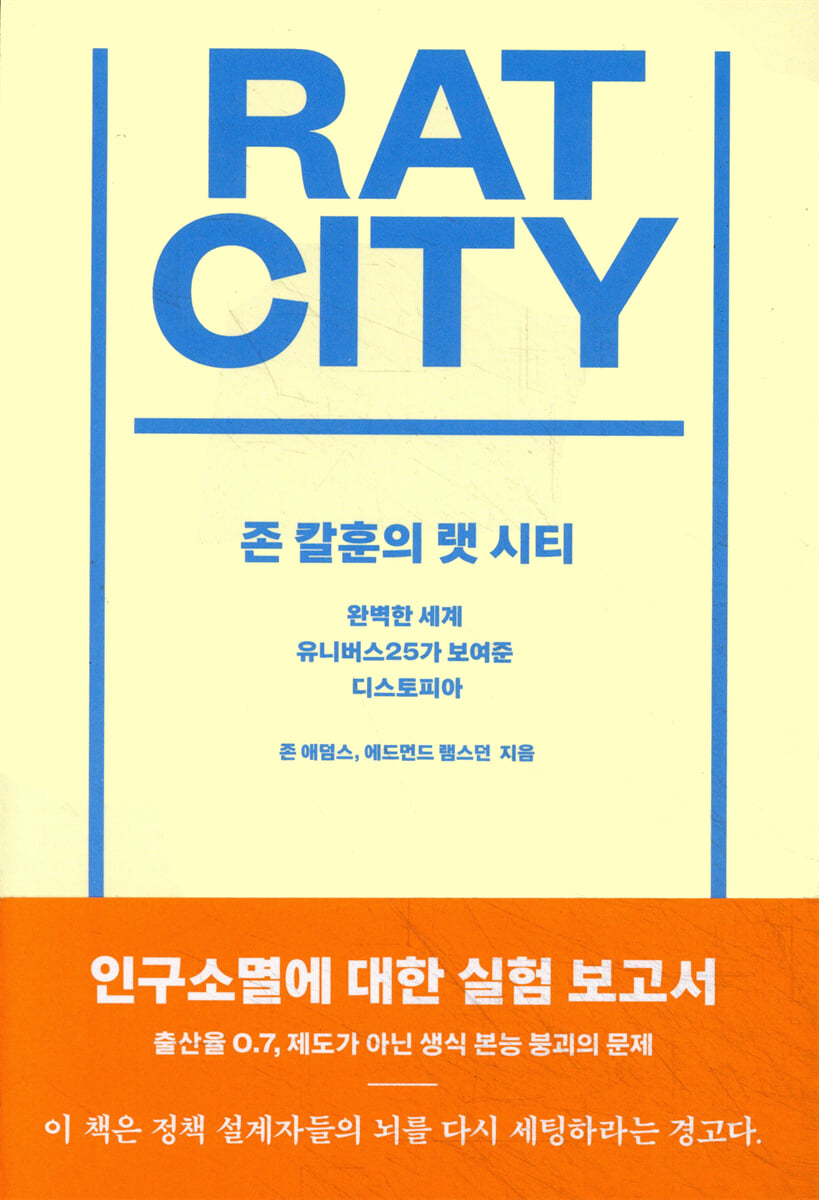
John Calhoun's Rat City
 |
Description
Book Introduction
Experimental Report on Population Extinction
In an era of a birth rate of 0.7, the problem is not the system, but the collapse of the reproductive instinct!
This book is a warning to policymakers to reset their brains.
As Korean culture gains global recognition, Korea's status in many fields has risen dramatically.
Foreigners from all over the world want to come to Korea and try to learn Korean.
The biggest factor in Korea's dazzling rise in status is its people, namely, its talent.
With a globally unparalleled enthusiasm for education, a low illiteracy rate, and robust infrastructure, Korea has achieved such remarkable results despite its small population and limited land area.
However, pessimistic assessments are emerging that this situation will not last long.
It's because of the population.
Why has Korea aged so quickly? Why don't people want to have children? Would better policies simply encourage young people to have and raise children? If we provided more economic support and policy incentives to make childcare easier, would that actually solve the population problem? Population researchers say these superficial approaches and solutions won't solve the population problem.
So, isn't there a more fundamental problem that goes beyond simply economic and social dimensions?
John Calhoun's Rat City covers the life and work of John Calhoun.
John Calhoun was a legendary researcher whose 'Universe' experiment with rats allowed us to examine population and human society issues from a behavioral perspective.
Of course, since rats and humans are not beings that can be substituted one-to-one, the results of the experiment cannot be blindly applied to human society.
Even so, Calhoun's research has significant implications.
In particular, 'Universe 25' cannot be viewed as simply a story about a rat.
It is an experimental fable about the modern city written in the language of science, and it allows us to look into the 'relationship' between the 'space' of life and humans.
In an era of a birth rate of 0.7, the problem is not the system, but the collapse of the reproductive instinct!
This book is a warning to policymakers to reset their brains.
As Korean culture gains global recognition, Korea's status in many fields has risen dramatically.
Foreigners from all over the world want to come to Korea and try to learn Korean.
The biggest factor in Korea's dazzling rise in status is its people, namely, its talent.
With a globally unparalleled enthusiasm for education, a low illiteracy rate, and robust infrastructure, Korea has achieved such remarkable results despite its small population and limited land area.
However, pessimistic assessments are emerging that this situation will not last long.
It's because of the population.
Why has Korea aged so quickly? Why don't people want to have children? Would better policies simply encourage young people to have and raise children? If we provided more economic support and policy incentives to make childcare easier, would that actually solve the population problem? Population researchers say these superficial approaches and solutions won't solve the population problem.
So, isn't there a more fundamental problem that goes beyond simply economic and social dimensions?
John Calhoun's Rat City covers the life and work of John Calhoun.
John Calhoun was a legendary researcher whose 'Universe' experiment with rats allowed us to examine population and human society issues from a behavioral perspective.
Of course, since rats and humans are not beings that can be substituted one-to-one, the results of the experiment cannot be blindly applied to human society.
Even so, Calhoun's research has significant implications.
In particular, 'Universe 25' cannot be viewed as simply a story about a rat.
It is an experimental fable about the modern city written in the language of science, and it allows us to look into the 'relationship' between the 'space' of life and humans.
index
Recommendation
Translator's Preface: The Rat's Curve, Our Curve
preface
Part 1 appearance
Chapter 1: A New World
Chapter 2 Johns Hopkins
Jack Calhoun: Turtle Farm (1917–1934)
Chapter 3 Baltimore
Jack Calhoun: The Spire Full of New Things (1935–1946)
Chapter 4: Rat Control Project
Chapter 5 Towson
Chapter 6: Maximum Human Protoplasm
Chapter 7 Bar Harbor, Walter Reed
Chapter 8: Casey's Barn
Chapter 9: Getting Out of the Sink
Part 2 Immigration
Chapter 10 Personal Space
Chapter 11: Mental Hospital
Chapter 12 Prison
Chapter 13: The Rat Bill
Chapter 14: People Who Dream of Space Flight
Chapter 15: Vertical Slums
Part 3: Enlightenment
Jack Calhoun: The Universe in Orange (NIMH, 1960)
Chapter 16: Poolsville
Chapter 17: The Kessler Phenomenon and the Universe 25
Chapter 18: Popularity Management
Chapter 19: A Prescription for Evolution
Chapter 20 System Errors
Chapter 21: Ecological Equilibrium
The final journey of the end
Acknowledgements
Translator's Note
References
Search
Translator's Preface: The Rat's Curve, Our Curve
preface
Part 1 appearance
Chapter 1: A New World
Chapter 2 Johns Hopkins
Jack Calhoun: Turtle Farm (1917–1934)
Chapter 3 Baltimore
Jack Calhoun: The Spire Full of New Things (1935–1946)
Chapter 4: Rat Control Project
Chapter 5 Towson
Chapter 6: Maximum Human Protoplasm
Chapter 7 Bar Harbor, Walter Reed
Chapter 8: Casey's Barn
Chapter 9: Getting Out of the Sink
Part 2 Immigration
Chapter 10 Personal Space
Chapter 11: Mental Hospital
Chapter 12 Prison
Chapter 13: The Rat Bill
Chapter 14: People Who Dream of Space Flight
Chapter 15: Vertical Slums
Part 3: Enlightenment
Jack Calhoun: The Universe in Orange (NIMH, 1960)
Chapter 16: Poolsville
Chapter 17: The Kessler Phenomenon and the Universe 25
Chapter 18: Popularity Management
Chapter 19: A Prescription for Evolution
Chapter 20 System Errors
Chapter 21: Ecological Equilibrium
The final journey of the end
Acknowledgements
Translator's Note
References
Search
Into the book
Calhoun's study was designed to observe social and behavioral changes that occur when population density increases.
He artificially created extreme overcrowding conditions that would not occur in nature, while providing the rat population with abundant resources and a safe environment.
Through this, we attempted to study how overpopulation affects social structure and individual behavior.
Beyond studying rat behavior, his experiments have provided important clues to understanding the impact of urbanization and population growth on individuals and society as a whole in human society.
Calhoun warned that the abnormal behavior patterns observed in rat societies could lead to similar outcomes in human societies, highlighting how population density and social environment alter individual behavior and social structure.
Therefore, his research goes beyond animal testing and contains important lessons for the future of human society.
Calhoun's research provides a deeper understanding of the impact of population density and social structure on individuals and groups, providing insights needed to build sustainable societies.
--- p.32~33
Watson wanted to establish psychology firmly within the realm of science.
He created an empirical and objective methodology for psychological research, eliminating all subjective feelings, thoughts, and memories.
His method was to completely exclude conscious reporting and focus solely on observable behavior.
He called it behaviorism.
Watson viewed the human mind as a black box, drawing conclusions only from observable behavior.
“Saying you’re cold is meaningless if there’s no physiological correlation.” In other words, the feeling of being cold had to be accompanied by physiological evidence, such as goosebumps, trembling, and blue lips.
Human consciousness was seen as having no need, and should not, to play any role in scientific research.
In The Behaviorist Manifesto, he declared:
“To make human consciousness the center of behavior is to return psychology to the position of pre-Darwinian biology.”
He argued that for psychology to develop into a mature science, the human brain should not be viewed as particularly different or superior to the brains of other animals.
Watson emphasized:
“Behaviorists do not draw a line between man and beast.”
That is, the methods for studying humans should be the same as those for studying rats or dogs, and inferences about mental function derived from animal studies should be equally applicable to humans.
--- p.61~62
Instead of focusing solely on how to reduce the rat population, Calhoun asked the opposite question.
“If it’s difficult to reduce the rat population within a block, why not increase it?” Rats didn’t move voluntarily between blocks, but there was plenty of unused space and plenty of food within the blocks.
So the research team captured rats from the surrounding area and added them to the experimental block.
Calhoun hypothesized that “if we introduce a large number of rats from outside, they might form a second stratum within the existing rat society.”
However, the experimental results were different from expectations.
All the new rats disappeared, and instead of forming a social hierarchy, the population within the block was greatly reduced.
Christian's experiments showed that adding 20% more rats to a stable population resulted in a 60% decrease in the overall population.
This result was a great shock to the research team.
Ironically, the most effective way to get rid of rats was to add more rats.
Christian and Calhoun attributed these results to the social conflict created by the new rats.
Calhoun recalled the time, saying, “Rat society was in shambles because of conflicts between strangers, between strangers and resident rats, and between resident rats.”
Davis also said, “The existing resident population was a stable society where everyone knew who mated with whom and whose children were born.
However, the introduction of foreign rats caused serious psychological disturbances in this society,” he wrote.
These results confirm that forced immigration policies lead to the collapse of rat societies more than poisoning, predation, or disease.
--- p.98~99
In the postwar period, America urgently needed new housing construction.
During the 1940s, the U.S. population grew by 15%, reaching 150 million in 1950.
This was twice the number in 1900.
There was also a massive influx of immigrants, with more than a million immigrants expelled from Europe by the war and 1.5 million black Southerners moving to Detroit, Chicago, New York, Philadelphia, and Baltimore in a second great migration.
Most immigrants, both from outside and inside, headed to the cities.
At the turn of the 20th century, about one-third of Americans lived in cities, but by 1950, that number had increased to two-thirds.
Along with this, the United States has become an increasingly urbanized country, following a power law.
Stewart's concept of population gravity—the idea that populations tend to cluster together in increasingly dense aggregates—seemed to fit the data.
The city attracted people like a powerful magnet.
Stuyvesant Town in New York City is replicated and established as a prototype in housing developments across the United States, including Pruitt-Igo in St. Louis and Cabrini Green in Chicago.
While the city was crowded, the suburbs were expanding endlessly.
On Long Island, Levitt & Sons completed 2,000 new homes, building up to 30 a day using Ford-style mass production methods.
Levittown spread to Pennsylvania, New Jersey, and Maryland, reshaping the American suburban landscape.
To Calhoun, the housing complexes, laboratory cages, high-rise towers, and suburban homes seemed like one gigantic construction project.
“High-rises, low-performing schools, suburbs, factories… a continuum of quality of life, achievement, drunks, and mental hospitals.” Against this backdrop, the pieces of the puzzle began to connect.
He intuitively sensed how the promise of privacy could degenerate into social isolation, and how increasing population density would exacerbate conflict and division.
And I asked myself this:
"What kind of box are we building? And for whom?" --- pp. 143-145
“Like a geomorphic sink where disease spreads through decaying vegetation and stagnant water, the breakdown of behavior symbolizes social stagnation and behavioral pathology.
Maximizing personal rewards from physical proximity can lead to the collapse of entire societies and the chaos of individual behavior.
The breakdown of behavior highlights the pathological problems caused by crowd density.”
According to Calhoun, behavioral breakdown is not a single phenomenon, but a series of processes that lead to breakdown.
It started with the formation of pathological communities, leading to maternal neglect, increased aggression, disruption of mating rituals, sexual hyperactivity, extreme violence, cannibalism of young individuals, and reproductive failure.
This process ultimately resulted in the extinction of the group.
Therefore, the breakdown of behavior is more than just a term; it has become a key concept in understanding social pathology and decline.
What was unique about Calhoun's experiment was that, unlike other stress studies, extreme behaviors occurred without any direct external stimulus.
At the time, stress research often involved brutal experiments.
For example, Selye used methods such as lethal injections, forced exercise, and amputation, while at the Walter Reed Center, Joe Brady locked animals in Skinner boxes, induced anxiety with electric shocks, and then relieved it with drugs.
However, in Calhoun's experiment, no physical pain was inflicted on the rats.
It just didn't stop the rats from interacting at high densities.
As a result, the rats appeared to spontaneously organize the collapse.
--- p.191~192
Osmond and Sommer, based on studies of zoo animals, showed that spatial design in closed environments helped reduce anxiety and tension.
In contrast, we studied how aggression and violence in enclosed spaces are related to the structure of space, referring to the hierarchy and territoriality concepts of chickens.
He experimentally demonstrated that redesigning spatial configurations can reduce or increase the likelihood of conflict.
They found that Calhoun's observations on rats could also apply to humans.
This pattern was particularly evident in environments where there was no opportunity to migrate and where it was difficult to clearly express suffering.
Somer made this comparison explicitly.
“Not only spatial order but also social order collapses in overcrowding.
The result is extreme social chaos, much like what Calhoun observed in his rat colonies.”
Comparing mentally ill people to animals could be criticized as inhumane.
However, Osmond and Sommer found this metaphor to be rather relatable and insightful.
Their research suggests a more innovative treatment approach than conventional approaches.
--- p.249~250
Calhoun measured the frequency of social contact and called it "social velocity" or "social temperature."
This was a concept that measured the frequency and depth of an individual's social interactions.
Through his experiments, he established that the ideal group size for both rats and humans is 8 to 16 adults, with 12 being the optimum.
Calhoun explained this from an evolutionary perspective, arguing that it was a legacy of our primate ancestors surviving in small, semi-isolated groups.
“Modern cultural evolution is merely an overlay on this primordial genetic foundation.”
An ideally sized group provides individuals with social and psychological stability.
If the group is too small, there may be a lack of stimulation, and if it is too large, excessive interaction can lead to frustration, which can lead to violent behavior or social isolation.
Calhoun warned that excessive interaction weakens the strength of the interaction, eventually to the point of meaninglessness.
Additionally, in experiments with rats, it was observed that as the number of individuals increased, a lower hierarchy was formed according to social speed.
Individuals with high social speed were more active and engaged in more rewarding interactions.
In contrast, individuals with low social speed were isolated and had limited movement, eventually forming a lower class.
“The physical environment is meaningless without considering the social organization.
But social organizations cannot exist without a physical environment either,” he said, emphasizing that spatial design and how it is used are more crucial than physical density.
Richard Meyer, drawing on Calhoun's data, said, "Even for animals, privacy is essential for community peace."
--- p.287~288
As director of the Brain Evolution and Behavior Laboratory, McLean saw overpopulation not simply as a social problem but as a problem deeply connected to human neurophysiology.
He studied the effects of environmental stress from overcrowding on human brain function and behavior, trying to explain how these pressures induce responses at a neurological level.
The Trinity Brain hypothesis was closely linked to Calhoun's phenomenon of 'behavioral collapse' and the work of John Christian and Hans Selye.
Based on this research, McClain provided Calhoun with a neuroscientific model explaining the effects of persistent stress on the nervous system.
Through this model, Calhoun was able to explain the process by which higher-order cognitive functions are impaired.
Just as over-activation of the endocrine glands can weaken the immune system and lead to physical illness, long-term social stress can interfere with higher mental functions, gradually causing them to collapse and resulting in the activation of primitive brain structures.
Calhoun believed that social norms and cultural behaviors are the first to be damaged by social stress.
In the experiment, the rats were unable to maintain normal social behaviors, such as mating rituals, maintaining hierarchy, and nest guarding, and displayed increasingly disorganized behavioral patterns.
He said that when social order is maintained and shared continuously, it can be called 'culture', but in crowded environments, these elements are the first to collapse.
Calhoun extended this to MacLean's model, suggesting that the process by which social organization is maintained can also operate at a neurological level.
He called it the 'fourth brain'.
That is, social norms and cultural structures function as extended functions of the brain, and when this structure breaks down, there is a high possibility that an individual's behavior will regress to a more primitive stage.
--- p.339~340
Calhoun believed that if population growth continued, the next revolution would inevitably be a revolution in communications and electronics.
He argued that when the human cerebral cortex exceeds its capacity to process information, “electronic assistants that function like the cerebral cortex” will become necessary.
According to his prediction, by 1988, an 'electronic communication network' would be established, which would enhance human problem-solving abilities.
To emphasize this, he revised the predicted year to 1984, adding a touch of Orwellian dystopian symbolism.
The next leap he proposed was the 'Compassionate Revolution'.
There will come a time when humanity collectively recognizes the need to reduce its population before it reaches a critical mass, and this will unite humanity.
Another possibility existed.
It may be that population decline, rather than population growth, will be the defining characteristic of the future.
This would open a new phase in human evolution, bringing about an era in which each individual's potential would blossom further.
If von Foerster jokingly called November 13, 2026, "Judgment Day," Calhoun reinterpreted it as "Dawn Day," a new beginning for humanity.
All of the concepts were radical and imaginative, typical of the experimental thinking Calhoun pursued.
While he was conceptually envisioning the future of humanity, practical research was also underway.
He finally secured a lab space in the URBS lab and began preparing a new experimental design.
But this time, rather than simply studying behavioral changes in crowded environments, we sought to experiment with the breakdown and evolution of social and cultural systems.
He wanted to create a microcosm of a crowded planet, not a city block or a rat colony.
He recalled how Hu Faker had implemented the 'universe' for the ticks with oranges.
Like Huh Faker, Calhoun was also planning to create a world of rats.
He called it 'universe'.
--- p.341~343
Calhoun's humiliating experience in London gave him a clearer understanding of the implications of his research for human society.
At the beginning of his conference presentation, he mentioned mice but said he was moving towards humans, a connection that drew strong opposition from the conference room.
In fact, in 1962, Ned Hall suggested to John Christian, “Why don’t you apply the techniques you used in mammalian studies to human population studies?”
For example, by analyzing the adrenal glands of people who died violently in overcrowded slums or of criminals.
But Christian refused.
It wasn't because I wasn't interested in human society.
He was a population ecologist specializing in physiology, and his research focused on animals.
The deer population on James Island may have a message about human civilization, but it was not his place to discuss that connection.
Such research was the work of anthropologist Ned Hall.
He focused thoroughly on animal research.
But Calhoun took a completely different path.
Initially, he was a researcher who indirectly provided insights into human society through animal experiments.
However, after the Towson experiment and the Universe 25 experiment, his research direction was completely reversed.
His goal was “to improve human life in overcrowded environments,” and laboratory rodents were merely tools for that purpose.
However, it was not a situation where we could return to the traditional 'normal science' mentioned by Thomas Kuhn.
In the building next door, McLean won academic acclaim for his bold hypothesis that would change the paradigm of human brain research.
By proposing the Trinity Brain Hypothesis, he presented a new perspective on human nature and behavior.
McClain took a risk and succeeded.
Calhoun also decided to take on the challenge.
He believed it could offer important insights for the future of humanity.
His research was not simply animal experiments; he wanted to say something beyond science.
Through this, he hoped to avoid the same fate as the mice of Universe 25.
The question was, how would the world receive him?
--- p.388~390
The institute's overall budget increased again, but it was all focused on biological psychiatry.
While research on social factors was increasingly excluded because it addressed difficult social problems, research on identifying the biological causes of specific mental illnesses and developing new drugs was politically welcomed.
Calhoun was disappointed with these changes.
He criticized NIMH for treating humans as "test tubes" and studying mental health by administering new drugs and observing physiological changes.
In 1982, he expressed these concerns to a New York Times reporter:
“The concept of ‘humanity’ as I understand it no longer aligns with NIMH policy.
“The only mental health research they currently support is one that contributes to the advancement of neuroscience technologies.”
This was no exaggeration.
In 1981, shortly after Meyer took office as ADAMHA director, Calhoun was formally recognized for his research contributions.
However, at the awards ceremony, Meyer declared that the future of mental health research lies in biological psychiatry, and that its center lies in drug treatment, saying, “Mental health is ‘drugs.’
“Nothing else is needed,” he asserted.
By 1986, his words had become reality.
In May of that year, Calhoun discovered a notice of a discussion session Goodwin was hosting at the APA annual meeting.
The topic of discussion was, “Because neuroscience technologies will have a huge impact on clinical research in the future, we should shift budgets from psychosocial research to neuroscience research.”
Calhoun scraped this passage and wrote:
“We no longer need to study how humans find fulfillment in social relationships.
“Only neuroscience can know what a person should be and steer them in that direction.”
The following year, fluoxetine, one of the new drugs Suomi was experimenting with, received FDA approval.
Launched in 1987 under the brand name Prozac, the drug was soon hailed as a "miracle antidepressant" and sold worldwide.
Calhoun had neither a place to study nor anyone to support his research.
It was an ironic situation.
The reason he first started experimenting with controlling the rat population was ultimately because of a 'chemical solution'.
In the 1940s, Kurt Richter developed a rat poison called ANTU, which was only temporarily effective in eradicating rats.
That's why Calhoun and his colleagues took a behavioral ecological approach.
But after 40 years, mental health issues were also being addressed with pharmacological approaches.
On July 30, 1986, Calhoun submitted his resignation to Goodwin.
But two weeks passed and there was no reply.
He wrote bitterly:
“Goodwin has no reason to answer.
1986 is '1984'.
“It’s over (C'est finis).”
He artificially created extreme overcrowding conditions that would not occur in nature, while providing the rat population with abundant resources and a safe environment.
Through this, we attempted to study how overpopulation affects social structure and individual behavior.
Beyond studying rat behavior, his experiments have provided important clues to understanding the impact of urbanization and population growth on individuals and society as a whole in human society.
Calhoun warned that the abnormal behavior patterns observed in rat societies could lead to similar outcomes in human societies, highlighting how population density and social environment alter individual behavior and social structure.
Therefore, his research goes beyond animal testing and contains important lessons for the future of human society.
Calhoun's research provides a deeper understanding of the impact of population density and social structure on individuals and groups, providing insights needed to build sustainable societies.
--- p.32~33
Watson wanted to establish psychology firmly within the realm of science.
He created an empirical and objective methodology for psychological research, eliminating all subjective feelings, thoughts, and memories.
His method was to completely exclude conscious reporting and focus solely on observable behavior.
He called it behaviorism.
Watson viewed the human mind as a black box, drawing conclusions only from observable behavior.
“Saying you’re cold is meaningless if there’s no physiological correlation.” In other words, the feeling of being cold had to be accompanied by physiological evidence, such as goosebumps, trembling, and blue lips.
Human consciousness was seen as having no need, and should not, to play any role in scientific research.
In The Behaviorist Manifesto, he declared:
“To make human consciousness the center of behavior is to return psychology to the position of pre-Darwinian biology.”
He argued that for psychology to develop into a mature science, the human brain should not be viewed as particularly different or superior to the brains of other animals.
Watson emphasized:
“Behaviorists do not draw a line between man and beast.”
That is, the methods for studying humans should be the same as those for studying rats or dogs, and inferences about mental function derived from animal studies should be equally applicable to humans.
--- p.61~62
Instead of focusing solely on how to reduce the rat population, Calhoun asked the opposite question.
“If it’s difficult to reduce the rat population within a block, why not increase it?” Rats didn’t move voluntarily between blocks, but there was plenty of unused space and plenty of food within the blocks.
So the research team captured rats from the surrounding area and added them to the experimental block.
Calhoun hypothesized that “if we introduce a large number of rats from outside, they might form a second stratum within the existing rat society.”
However, the experimental results were different from expectations.
All the new rats disappeared, and instead of forming a social hierarchy, the population within the block was greatly reduced.
Christian's experiments showed that adding 20% more rats to a stable population resulted in a 60% decrease in the overall population.
This result was a great shock to the research team.
Ironically, the most effective way to get rid of rats was to add more rats.
Christian and Calhoun attributed these results to the social conflict created by the new rats.
Calhoun recalled the time, saying, “Rat society was in shambles because of conflicts between strangers, between strangers and resident rats, and between resident rats.”
Davis also said, “The existing resident population was a stable society where everyone knew who mated with whom and whose children were born.
However, the introduction of foreign rats caused serious psychological disturbances in this society,” he wrote.
These results confirm that forced immigration policies lead to the collapse of rat societies more than poisoning, predation, or disease.
--- p.98~99
In the postwar period, America urgently needed new housing construction.
During the 1940s, the U.S. population grew by 15%, reaching 150 million in 1950.
This was twice the number in 1900.
There was also a massive influx of immigrants, with more than a million immigrants expelled from Europe by the war and 1.5 million black Southerners moving to Detroit, Chicago, New York, Philadelphia, and Baltimore in a second great migration.
Most immigrants, both from outside and inside, headed to the cities.
At the turn of the 20th century, about one-third of Americans lived in cities, but by 1950, that number had increased to two-thirds.
Along with this, the United States has become an increasingly urbanized country, following a power law.
Stewart's concept of population gravity—the idea that populations tend to cluster together in increasingly dense aggregates—seemed to fit the data.
The city attracted people like a powerful magnet.
Stuyvesant Town in New York City is replicated and established as a prototype in housing developments across the United States, including Pruitt-Igo in St. Louis and Cabrini Green in Chicago.
While the city was crowded, the suburbs were expanding endlessly.
On Long Island, Levitt & Sons completed 2,000 new homes, building up to 30 a day using Ford-style mass production methods.
Levittown spread to Pennsylvania, New Jersey, and Maryland, reshaping the American suburban landscape.
To Calhoun, the housing complexes, laboratory cages, high-rise towers, and suburban homes seemed like one gigantic construction project.
“High-rises, low-performing schools, suburbs, factories… a continuum of quality of life, achievement, drunks, and mental hospitals.” Against this backdrop, the pieces of the puzzle began to connect.
He intuitively sensed how the promise of privacy could degenerate into social isolation, and how increasing population density would exacerbate conflict and division.
And I asked myself this:
"What kind of box are we building? And for whom?" --- pp. 143-145
“Like a geomorphic sink where disease spreads through decaying vegetation and stagnant water, the breakdown of behavior symbolizes social stagnation and behavioral pathology.
Maximizing personal rewards from physical proximity can lead to the collapse of entire societies and the chaos of individual behavior.
The breakdown of behavior highlights the pathological problems caused by crowd density.”
According to Calhoun, behavioral breakdown is not a single phenomenon, but a series of processes that lead to breakdown.
It started with the formation of pathological communities, leading to maternal neglect, increased aggression, disruption of mating rituals, sexual hyperactivity, extreme violence, cannibalism of young individuals, and reproductive failure.
This process ultimately resulted in the extinction of the group.
Therefore, the breakdown of behavior is more than just a term; it has become a key concept in understanding social pathology and decline.
What was unique about Calhoun's experiment was that, unlike other stress studies, extreme behaviors occurred without any direct external stimulus.
At the time, stress research often involved brutal experiments.
For example, Selye used methods such as lethal injections, forced exercise, and amputation, while at the Walter Reed Center, Joe Brady locked animals in Skinner boxes, induced anxiety with electric shocks, and then relieved it with drugs.
However, in Calhoun's experiment, no physical pain was inflicted on the rats.
It just didn't stop the rats from interacting at high densities.
As a result, the rats appeared to spontaneously organize the collapse.
--- p.191~192
Osmond and Sommer, based on studies of zoo animals, showed that spatial design in closed environments helped reduce anxiety and tension.
In contrast, we studied how aggression and violence in enclosed spaces are related to the structure of space, referring to the hierarchy and territoriality concepts of chickens.
He experimentally demonstrated that redesigning spatial configurations can reduce or increase the likelihood of conflict.
They found that Calhoun's observations on rats could also apply to humans.
This pattern was particularly evident in environments where there was no opportunity to migrate and where it was difficult to clearly express suffering.
Somer made this comparison explicitly.
“Not only spatial order but also social order collapses in overcrowding.
The result is extreme social chaos, much like what Calhoun observed in his rat colonies.”
Comparing mentally ill people to animals could be criticized as inhumane.
However, Osmond and Sommer found this metaphor to be rather relatable and insightful.
Their research suggests a more innovative treatment approach than conventional approaches.
--- p.249~250
Calhoun measured the frequency of social contact and called it "social velocity" or "social temperature."
This was a concept that measured the frequency and depth of an individual's social interactions.
Through his experiments, he established that the ideal group size for both rats and humans is 8 to 16 adults, with 12 being the optimum.
Calhoun explained this from an evolutionary perspective, arguing that it was a legacy of our primate ancestors surviving in small, semi-isolated groups.
“Modern cultural evolution is merely an overlay on this primordial genetic foundation.”
An ideally sized group provides individuals with social and psychological stability.
If the group is too small, there may be a lack of stimulation, and if it is too large, excessive interaction can lead to frustration, which can lead to violent behavior or social isolation.
Calhoun warned that excessive interaction weakens the strength of the interaction, eventually to the point of meaninglessness.
Additionally, in experiments with rats, it was observed that as the number of individuals increased, a lower hierarchy was formed according to social speed.
Individuals with high social speed were more active and engaged in more rewarding interactions.
In contrast, individuals with low social speed were isolated and had limited movement, eventually forming a lower class.
“The physical environment is meaningless without considering the social organization.
But social organizations cannot exist without a physical environment either,” he said, emphasizing that spatial design and how it is used are more crucial than physical density.
Richard Meyer, drawing on Calhoun's data, said, "Even for animals, privacy is essential for community peace."
--- p.287~288
As director of the Brain Evolution and Behavior Laboratory, McLean saw overpopulation not simply as a social problem but as a problem deeply connected to human neurophysiology.
He studied the effects of environmental stress from overcrowding on human brain function and behavior, trying to explain how these pressures induce responses at a neurological level.
The Trinity Brain hypothesis was closely linked to Calhoun's phenomenon of 'behavioral collapse' and the work of John Christian and Hans Selye.
Based on this research, McClain provided Calhoun with a neuroscientific model explaining the effects of persistent stress on the nervous system.
Through this model, Calhoun was able to explain the process by which higher-order cognitive functions are impaired.
Just as over-activation of the endocrine glands can weaken the immune system and lead to physical illness, long-term social stress can interfere with higher mental functions, gradually causing them to collapse and resulting in the activation of primitive brain structures.
Calhoun believed that social norms and cultural behaviors are the first to be damaged by social stress.
In the experiment, the rats were unable to maintain normal social behaviors, such as mating rituals, maintaining hierarchy, and nest guarding, and displayed increasingly disorganized behavioral patterns.
He said that when social order is maintained and shared continuously, it can be called 'culture', but in crowded environments, these elements are the first to collapse.
Calhoun extended this to MacLean's model, suggesting that the process by which social organization is maintained can also operate at a neurological level.
He called it the 'fourth brain'.
That is, social norms and cultural structures function as extended functions of the brain, and when this structure breaks down, there is a high possibility that an individual's behavior will regress to a more primitive stage.
--- p.339~340
Calhoun believed that if population growth continued, the next revolution would inevitably be a revolution in communications and electronics.
He argued that when the human cerebral cortex exceeds its capacity to process information, “electronic assistants that function like the cerebral cortex” will become necessary.
According to his prediction, by 1988, an 'electronic communication network' would be established, which would enhance human problem-solving abilities.
To emphasize this, he revised the predicted year to 1984, adding a touch of Orwellian dystopian symbolism.
The next leap he proposed was the 'Compassionate Revolution'.
There will come a time when humanity collectively recognizes the need to reduce its population before it reaches a critical mass, and this will unite humanity.
Another possibility existed.
It may be that population decline, rather than population growth, will be the defining characteristic of the future.
This would open a new phase in human evolution, bringing about an era in which each individual's potential would blossom further.
If von Foerster jokingly called November 13, 2026, "Judgment Day," Calhoun reinterpreted it as "Dawn Day," a new beginning for humanity.
All of the concepts were radical and imaginative, typical of the experimental thinking Calhoun pursued.
While he was conceptually envisioning the future of humanity, practical research was also underway.
He finally secured a lab space in the URBS lab and began preparing a new experimental design.
But this time, rather than simply studying behavioral changes in crowded environments, we sought to experiment with the breakdown and evolution of social and cultural systems.
He wanted to create a microcosm of a crowded planet, not a city block or a rat colony.
He recalled how Hu Faker had implemented the 'universe' for the ticks with oranges.
Like Huh Faker, Calhoun was also planning to create a world of rats.
He called it 'universe'.
--- p.341~343
Calhoun's humiliating experience in London gave him a clearer understanding of the implications of his research for human society.
At the beginning of his conference presentation, he mentioned mice but said he was moving towards humans, a connection that drew strong opposition from the conference room.
In fact, in 1962, Ned Hall suggested to John Christian, “Why don’t you apply the techniques you used in mammalian studies to human population studies?”
For example, by analyzing the adrenal glands of people who died violently in overcrowded slums or of criminals.
But Christian refused.
It wasn't because I wasn't interested in human society.
He was a population ecologist specializing in physiology, and his research focused on animals.
The deer population on James Island may have a message about human civilization, but it was not his place to discuss that connection.
Such research was the work of anthropologist Ned Hall.
He focused thoroughly on animal research.
But Calhoun took a completely different path.
Initially, he was a researcher who indirectly provided insights into human society through animal experiments.
However, after the Towson experiment and the Universe 25 experiment, his research direction was completely reversed.
His goal was “to improve human life in overcrowded environments,” and laboratory rodents were merely tools for that purpose.
However, it was not a situation where we could return to the traditional 'normal science' mentioned by Thomas Kuhn.
In the building next door, McLean won academic acclaim for his bold hypothesis that would change the paradigm of human brain research.
By proposing the Trinity Brain Hypothesis, he presented a new perspective on human nature and behavior.
McClain took a risk and succeeded.
Calhoun also decided to take on the challenge.
He believed it could offer important insights for the future of humanity.
His research was not simply animal experiments; he wanted to say something beyond science.
Through this, he hoped to avoid the same fate as the mice of Universe 25.
The question was, how would the world receive him?
--- p.388~390
The institute's overall budget increased again, but it was all focused on biological psychiatry.
While research on social factors was increasingly excluded because it addressed difficult social problems, research on identifying the biological causes of specific mental illnesses and developing new drugs was politically welcomed.
Calhoun was disappointed with these changes.
He criticized NIMH for treating humans as "test tubes" and studying mental health by administering new drugs and observing physiological changes.
In 1982, he expressed these concerns to a New York Times reporter:
“The concept of ‘humanity’ as I understand it no longer aligns with NIMH policy.
“The only mental health research they currently support is one that contributes to the advancement of neuroscience technologies.”
This was no exaggeration.
In 1981, shortly after Meyer took office as ADAMHA director, Calhoun was formally recognized for his research contributions.
However, at the awards ceremony, Meyer declared that the future of mental health research lies in biological psychiatry, and that its center lies in drug treatment, saying, “Mental health is ‘drugs.’
“Nothing else is needed,” he asserted.
By 1986, his words had become reality.
In May of that year, Calhoun discovered a notice of a discussion session Goodwin was hosting at the APA annual meeting.
The topic of discussion was, “Because neuroscience technologies will have a huge impact on clinical research in the future, we should shift budgets from psychosocial research to neuroscience research.”
Calhoun scraped this passage and wrote:
“We no longer need to study how humans find fulfillment in social relationships.
“Only neuroscience can know what a person should be and steer them in that direction.”
The following year, fluoxetine, one of the new drugs Suomi was experimenting with, received FDA approval.
Launched in 1987 under the brand name Prozac, the drug was soon hailed as a "miracle antidepressant" and sold worldwide.
Calhoun had neither a place to study nor anyone to support his research.
It was an ironic situation.
The reason he first started experimenting with controlling the rat population was ultimately because of a 'chemical solution'.
In the 1940s, Kurt Richter developed a rat poison called ANTU, which was only temporarily effective in eradicating rats.
That's why Calhoun and his colleagues took a behavioral ecological approach.
But after 40 years, mental health issues were also being addressed with pharmacological approaches.
On July 30, 1986, Calhoun submitted his resignation to Goodwin.
But two weeks passed and there was no reply.
He wrote bitterly:
“Goodwin has no reason to answer.
1986 is '1984'.
“It’s over (C'est finis).”
--- p.454~456
Publisher's Review
Korea, where talent is the driving force for growth
The demographic cliff is looming
We live in an era where anything with the letter K seems to be a sure hit.
As Korean culture gains global recognition, Korea's status in many fields has risen dramatically.
Foreigners from all over the world want to come to Korea and try to learn Korean.
It is hard to imagine that this is a country that went through a difficult time in the 1960s and received foreign aid.
Korea is not a country rich in resources, and its summers are hot and winters are cold, making it a harsh place to live.
More than 70 percent of the country is mountainous, and wide plains are rare.
Historically, there have been many outcries and turmoil between the great powers.
The biggest factor in overcoming all these circumstances and achieving such a remarkable rise in Korea's status is its people, namely, its talent.
With a globally unparalleled enthusiasm for education, a low illiteracy rate, and robust infrastructure, Korea has achieved such remarkable results despite its small population and limited land area.
However, pessimistic assessments are emerging that this situation will not last long.
It's because of the population.
South Korea recorded the world's lowest total fertility rate of 0.72 in 2023.
Total fertility rate refers to the average number of children a woman is expected to have during her childbearing years (ages 15-49).
Naturally, the lower this figure, the more serious the problem of declining birth rates becomes.
Korea will soon enter a super-aged society, and the burden on the current younger generation will only increase.
So why has Korea aged so quickly? Why don't people want to have children? Would better policies simply encourage young people to have and raise children? If we provided more economic support and policy incentives to make childrearing easier, would that actually solve Korea's population problem?
Population researchers say that superficial approaches and solutions like this will not solve the population problem.
So, isn't there a more fundamental problem that goes beyond simply economic and social dimensions?
An experimental fable about the modern city written in the language of science.
Calhoun's Universe 25
Rat City covers the life and work of John Calhoun.
John Calhoun was a legendary researcher whose 'Universe' experiment with rats allowed us to examine population and human society issues from a behavioral perspective.
Of course, since rats and humans are not beings that can be substituted one-to-one, the results of the experiment cannot be blindly applied to human society.
Even so, Calhoun's research has significant implications.
In particular, 'Universe 25' cannot be viewed as simply a story about a rat.
It is an experimental fable about the modern city written in the language of science, and it allows us to look into the 'relationship' between the 'space' of life and humans.
Calhoun wondered what it would be like if rats lived in a utopia called "Universe," where there were no predators or hunger.
Human intervention consisted only of filling feeders and water bottles, adding bedding, and cleaning the environment.
In this kind of environment, wouldn't it be possible to live in a peaceful and ideal relationship?
The first stage, Stage A, is when individuals adapt to their new environment, forming their own territories and building nests to establish their habitats.
It was a 'social adaptation stage'.
Soon, the population grew rapidly and the B phase, or 'expansion phase', began, taking up more and more space.
The population doubled every two months.
Although there were three times as many juvenile rats as adult rats, they were well-reared and well-educated.
However, a subtle change was detected.
This is stage C, or the 'stagnation period'.
What was striking about this period was the breakdown of social order.
The males who had been protecting the females and their young gradually gave up that role, and the females became increasingly aggressive.
There has been an increase in same-sex mating, and more females are abandoning their young after giving birth.
The pup was not properly educated.
Even though there was no shortage of physical space, we were already in the early stages of social collapse.
Young males, frustrated and rejected, gradually retreated to the periphery.
By the end of this stage, the social organization is effectively dead.
The final stage, D, is the 'destruction stage', where rats that were raised in neglect usually had no sense of personal space and lost their desires and impulses.
There was no aggression, no courtship, and no mating.
The asexual and antisocial ones did not fight and therefore had no wounds.
They groomed themselves endlessly, groomed themselves, and did nothing but eat, drink, and sleep.
They sat close to each other, but they did not interact with each other, but rather looked in opposite directions.
The population density peaked and then gradually declined.
The rats that accepted the situation without resistance remained calm and contented, lived healthy lives, and died of natural causes.
It was the optimal way of life for the individual, but it was a fatal disaster for the entire species.
A society that was left with only the 'beautiful ones' eventually slowly died.
Calhoun believed that the last-stage entities were long dead, because "you can't identify with nothing."
If we look closely at the rise and fall of 'Universe 25', we can clearly see points of overlap with today's Korean society.
The problem is that once you reach stage C, there is no turning back.
According to Calhoun's experiments, once they reached stage C, nothing could be done to reverse the behavioral collapse of the rats.
Of course, we are different from rats because we are human, and human society functions differently from rat organizations.
But can we truly relax? Could it be that we've already entered Stage D, with the "beautiful ones" gradually increasing in number? Could it be that, having been accustomed to a life of personal optimality, the human species is gradually becoming extinct?
Why rats?
The "Synchronization of Action" Suggested by Calhoun's Universe 25
The graph on the left is the population curve of the rat population in Calhoun's Universe 25 experiment, and the graph on the right is the population statistics curve of South Korea.
From rapid growth, to a gentle plateau, to a steep, irreversible decline, the two graphs are remarkably similar.
This similarity does not seem to be mere coincidence.
If the current phenomenon of ultra-low birth rates is not just an economic choice but a neuroecological crisis, how can we overcome it?
Calhoun called this a "behavioral sink," suggesting that stagnant social networks could cause the entire human group to collapse.
Calhoun's insights expanded beyond the study of herd behavior to include research that integrated neuroscience, sociology, and history.
This made me think about ways to fill the gap in my actions across fields.
Calhoun's experiment caused a huge stir in the 1980s.
Not only because of the visual shock of being full of rats, but also because the implications of the experiment for human society are dire.
So his research has been cited in the US Congressional Proceedings, NASA and Washington, D.C.
The administration's policy on prison overcrowding was reflected in its advice.
It was unprecedented for an experiment on a single species to influence and change urban design and national policy.
The 'Universe' experiment was a remarkable research process that provided such keen insight that it was once considered a candidate for the Nobel Peace Prize.
The demographic cliff is looming
We live in an era where anything with the letter K seems to be a sure hit.
As Korean culture gains global recognition, Korea's status in many fields has risen dramatically.
Foreigners from all over the world want to come to Korea and try to learn Korean.
It is hard to imagine that this is a country that went through a difficult time in the 1960s and received foreign aid.
Korea is not a country rich in resources, and its summers are hot and winters are cold, making it a harsh place to live.
More than 70 percent of the country is mountainous, and wide plains are rare.
Historically, there have been many outcries and turmoil between the great powers.
The biggest factor in overcoming all these circumstances and achieving such a remarkable rise in Korea's status is its people, namely, its talent.
With a globally unparalleled enthusiasm for education, a low illiteracy rate, and robust infrastructure, Korea has achieved such remarkable results despite its small population and limited land area.
However, pessimistic assessments are emerging that this situation will not last long.
It's because of the population.
South Korea recorded the world's lowest total fertility rate of 0.72 in 2023.
Total fertility rate refers to the average number of children a woman is expected to have during her childbearing years (ages 15-49).
Naturally, the lower this figure, the more serious the problem of declining birth rates becomes.
Korea will soon enter a super-aged society, and the burden on the current younger generation will only increase.
So why has Korea aged so quickly? Why don't people want to have children? Would better policies simply encourage young people to have and raise children? If we provided more economic support and policy incentives to make childrearing easier, would that actually solve Korea's population problem?
Population researchers say that superficial approaches and solutions like this will not solve the population problem.
So, isn't there a more fundamental problem that goes beyond simply economic and social dimensions?
An experimental fable about the modern city written in the language of science.
Calhoun's Universe 25
Rat City covers the life and work of John Calhoun.
John Calhoun was a legendary researcher whose 'Universe' experiment with rats allowed us to examine population and human society issues from a behavioral perspective.
Of course, since rats and humans are not beings that can be substituted one-to-one, the results of the experiment cannot be blindly applied to human society.
Even so, Calhoun's research has significant implications.
In particular, 'Universe 25' cannot be viewed as simply a story about a rat.
It is an experimental fable about the modern city written in the language of science, and it allows us to look into the 'relationship' between the 'space' of life and humans.
Calhoun wondered what it would be like if rats lived in a utopia called "Universe," where there were no predators or hunger.
Human intervention consisted only of filling feeders and water bottles, adding bedding, and cleaning the environment.
In this kind of environment, wouldn't it be possible to live in a peaceful and ideal relationship?
The first stage, Stage A, is when individuals adapt to their new environment, forming their own territories and building nests to establish their habitats.
It was a 'social adaptation stage'.
Soon, the population grew rapidly and the B phase, or 'expansion phase', began, taking up more and more space.
The population doubled every two months.
Although there were three times as many juvenile rats as adult rats, they were well-reared and well-educated.
However, a subtle change was detected.
This is stage C, or the 'stagnation period'.
What was striking about this period was the breakdown of social order.
The males who had been protecting the females and their young gradually gave up that role, and the females became increasingly aggressive.
There has been an increase in same-sex mating, and more females are abandoning their young after giving birth.
The pup was not properly educated.
Even though there was no shortage of physical space, we were already in the early stages of social collapse.
Young males, frustrated and rejected, gradually retreated to the periphery.
By the end of this stage, the social organization is effectively dead.
The final stage, D, is the 'destruction stage', where rats that were raised in neglect usually had no sense of personal space and lost their desires and impulses.
There was no aggression, no courtship, and no mating.
The asexual and antisocial ones did not fight and therefore had no wounds.
They groomed themselves endlessly, groomed themselves, and did nothing but eat, drink, and sleep.
They sat close to each other, but they did not interact with each other, but rather looked in opposite directions.
The population density peaked and then gradually declined.
The rats that accepted the situation without resistance remained calm and contented, lived healthy lives, and died of natural causes.
It was the optimal way of life for the individual, but it was a fatal disaster for the entire species.
A society that was left with only the 'beautiful ones' eventually slowly died.
Calhoun believed that the last-stage entities were long dead, because "you can't identify with nothing."
If we look closely at the rise and fall of 'Universe 25', we can clearly see points of overlap with today's Korean society.
The problem is that once you reach stage C, there is no turning back.
According to Calhoun's experiments, once they reached stage C, nothing could be done to reverse the behavioral collapse of the rats.
Of course, we are different from rats because we are human, and human society functions differently from rat organizations.
But can we truly relax? Could it be that we've already entered Stage D, with the "beautiful ones" gradually increasing in number? Could it be that, having been accustomed to a life of personal optimality, the human species is gradually becoming extinct?
Why rats?
The "Synchronization of Action" Suggested by Calhoun's Universe 25
The graph on the left is the population curve of the rat population in Calhoun's Universe 25 experiment, and the graph on the right is the population statistics curve of South Korea.
From rapid growth, to a gentle plateau, to a steep, irreversible decline, the two graphs are remarkably similar.
This similarity does not seem to be mere coincidence.
If the current phenomenon of ultra-low birth rates is not just an economic choice but a neuroecological crisis, how can we overcome it?
Calhoun called this a "behavioral sink," suggesting that stagnant social networks could cause the entire human group to collapse.
Calhoun's insights expanded beyond the study of herd behavior to include research that integrated neuroscience, sociology, and history.
This made me think about ways to fill the gap in my actions across fields.
Calhoun's experiment caused a huge stir in the 1980s.
Not only because of the visual shock of being full of rats, but also because the implications of the experiment for human society are dire.
So his research has been cited in the US Congressional Proceedings, NASA and Washington, D.C.
The administration's policy on prison overcrowding was reflected in its advice.
It was unprecedented for an experiment on a single species to influence and change urban design and national policy.
The 'Universe' experiment was a remarkable research process that provided such keen insight that it was once considered a candidate for the Nobel Peace Prize.
GOODS SPECIFICS
- Date of issue: September 29, 2025
- Page count, weight, size: 498 pages | 450g | 128*188*24mm
- ISBN13: 9791198805300
- ISBN10: 1198805307
You may also like
카테고리
korean


korean

![ELLE 엘르 스페셜 에디션 A형 : 12월 [2025]](http://librairie.coreenne.fr/cdn/shop/files/b8e27a3de6c9538896439686c6b0e8fb.jpg?v=1766436872&width=3840)


