

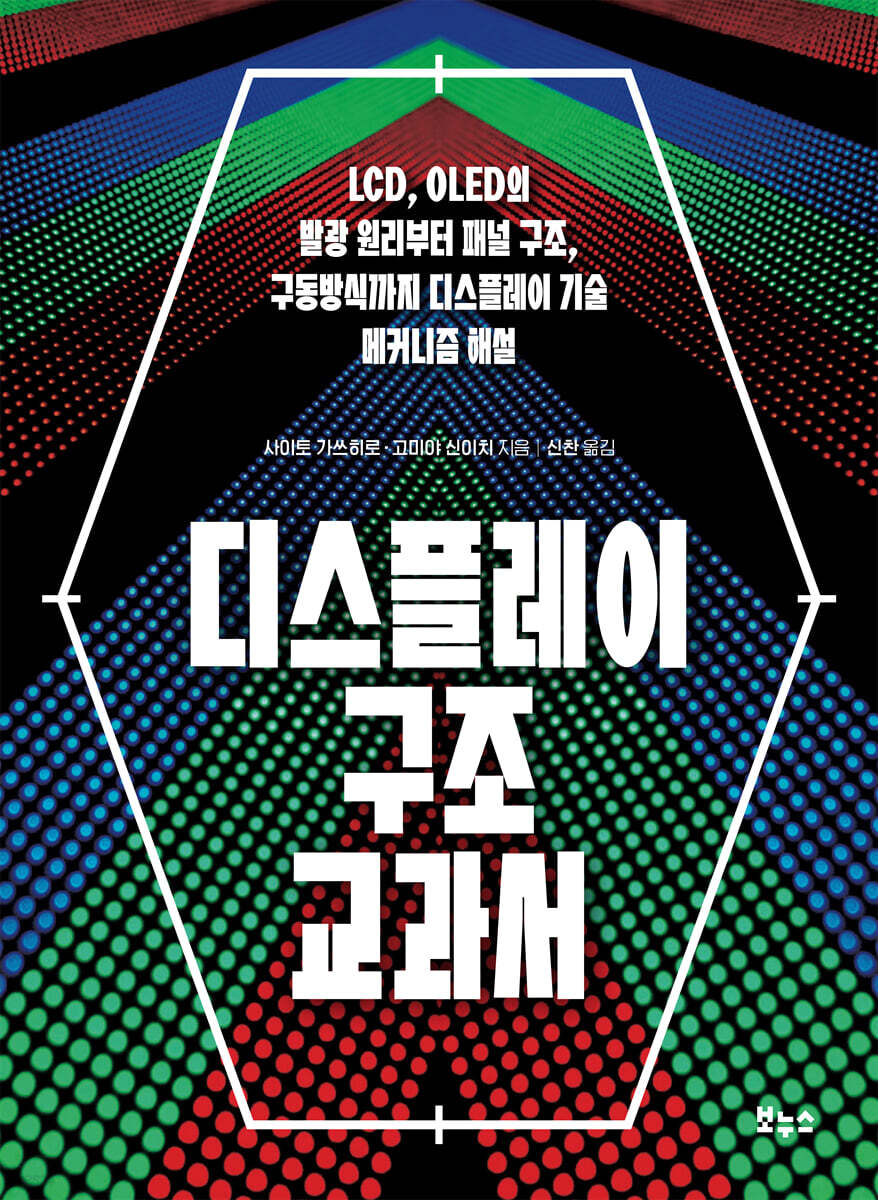
Display Structure Textbook
 |
Description
Book Introduction
We delve into the light-emitting principles, operating principles, and structure of popular LCDs, as well as OLEDs that emit light on their own.
In addition, we also get a glimpse into the infinite possibilities of quantum dot displays, which are attracting attention as a next-generation technology.
This book begins with a fundamental question, "How do OLED molecules emit light?" and delves into the core of the technology.
By explaining the panel structure and operating method, it broadly covers the latest technology trends and market changes, helping readers gain a deeper understanding of the scientific principles hidden behind the screens they encounter every day.
In addition, we also get a glimpse into the infinite possibilities of quantum dot displays, which are attracting attention as a next-generation technology.
This book begins with a fundamental question, "How do OLED molecules emit light?" and delves into the core of the technology.
By explaining the panel structure and operating method, it broadly covers the latest technology trends and market changes, helping readers gain a deeper understanding of the scientific principles hidden behind the screens they encounter every day.
- You can preview some of the book's contents.
Preview
index
To begin with
The latest display market and changes
0-01 Display Market Environment
0-02 Types and Classification of Displays
0-03 Challenges toward high-definition displays
0-04 Development of new display technology
0-05 Competition among global manufacturers
COLUMN display design
Chapter 1: Principles of Organic EL Light Emitting Diodes
1-01 What is Organic EL?
COLUMN Organic Compounds
1-02 What is energy?
1-03 How do neon signs glow?
1-04 How do fluorescent lights glow?
1-05 How does OLED glow?
COLUMN Bioluminescence
Chapter 2 Organic EL Molecular Structure
2-01 Interactions between Molecules and Energy
2-02 Structure of organic EL devices
2-03 Electronic properties required for organic EL molecules
2-04 Types and molecular structures of light-emitting layer molecules
COLUMN luminol reaction
2-05 Phosphorescent luminescent material
COLUMN Can organic matter replace metal?
COLUMN Rare Metals and Rare Earths
Chapter 3: Manufacturing of Organic EL Displays
3-01 Organic EL device manufacturing method
3-02 Method for fabricating devices using polymers
COLUMN cathode manufacturing method
3-03 Principles of Color Display
COLUMN color conversion method
3-04 Principles of Screen Display
3-05 Advantages and Disadvantages of Organic EL Displays
COLUMN Organic EL Stability
COLUMN The Potential of Organic EL Displays
Chapter 4 Properties and Characteristics of Liquid Crystal Molecules
4-01 Decision, liquid, gas, liquid crystal
4-02 Properties of liquid crystals
COLUMN Background to the Discovery of Liquid Crystals
4-03 Orientation of liquid crystal molecules
4-04 Liquid Crystal and Light Transmittance
COLUMN supramolecule
COLUMN Early use of liquid crystals
Chapter 5: Principles of Liquid Crystal Displays
5-01 Understanding through Molecular Shadows
5-02 Strip-type liquid crystal molecular model
COLUMN Operating temperature range of liquid crystal displays
5-03 Screen display using TN cells
5-04 Improvement of liquid crystal displays
5-05 Advantages and Disadvantages of Liquid Crystal Displays
COLUMN The Future of Liquid Crystal Displays
5-06 Electronic Paper
COLUMN 3D video
5-07 Light-emitting diode (LED)
COLUMN CRT TV
5-08 fluorescent display tube
COLUMN liquid crystal lens
Chapter 6 Quantum Dot Displays
6-01 What are quantum dots?
6-02 Luminescence of quantum dots
6-03 Types of quantum dot displays
6-04 Fundamentals and Structure of Quantum Dot Liquid Crystal Displays
6-05 Pros and Cons of Quantum Dot Liquid Crystal Displays
COLUMN Applications of Quantum Dots
Chapter 7 Types and Functions of Display-Related Components
7-01 Common components for all displays
COLUMN Conductivity of semiconductors
7-02 Organic EL display related components
7-03 Liquid crystal display related components
7-04 Other display-related components
Chapter 8: Display-Related Components Market and Supply
8-01 Display Performance Representation
8-02 Display Market Status
Technical characteristics of COLUMN RGB printing method
8-03 Display Market Status
8-04 Panel Manufacturers' Market Share
8-05 Status of display-related component manufacturers
References
Search
The latest display market and changes
0-01 Display Market Environment
0-02 Types and Classification of Displays
0-03 Challenges toward high-definition displays
0-04 Development of new display technology
0-05 Competition among global manufacturers
COLUMN display design
Chapter 1: Principles of Organic EL Light Emitting Diodes
1-01 What is Organic EL?
COLUMN Organic Compounds
1-02 What is energy?
1-03 How do neon signs glow?
1-04 How do fluorescent lights glow?
1-05 How does OLED glow?
COLUMN Bioluminescence
Chapter 2 Organic EL Molecular Structure
2-01 Interactions between Molecules and Energy
2-02 Structure of organic EL devices
2-03 Electronic properties required for organic EL molecules
2-04 Types and molecular structures of light-emitting layer molecules
COLUMN luminol reaction
2-05 Phosphorescent luminescent material
COLUMN Can organic matter replace metal?
COLUMN Rare Metals and Rare Earths
Chapter 3: Manufacturing of Organic EL Displays
3-01 Organic EL device manufacturing method
3-02 Method for fabricating devices using polymers
COLUMN cathode manufacturing method
3-03 Principles of Color Display
COLUMN color conversion method
3-04 Principles of Screen Display
3-05 Advantages and Disadvantages of Organic EL Displays
COLUMN Organic EL Stability
COLUMN The Potential of Organic EL Displays
Chapter 4 Properties and Characteristics of Liquid Crystal Molecules
4-01 Decision, liquid, gas, liquid crystal
4-02 Properties of liquid crystals
COLUMN Background to the Discovery of Liquid Crystals
4-03 Orientation of liquid crystal molecules
4-04 Liquid Crystal and Light Transmittance
COLUMN supramolecule
COLUMN Early use of liquid crystals
Chapter 5: Principles of Liquid Crystal Displays
5-01 Understanding through Molecular Shadows
5-02 Strip-type liquid crystal molecular model
COLUMN Operating temperature range of liquid crystal displays
5-03 Screen display using TN cells
5-04 Improvement of liquid crystal displays
5-05 Advantages and Disadvantages of Liquid Crystal Displays
COLUMN The Future of Liquid Crystal Displays
5-06 Electronic Paper
COLUMN 3D video
5-07 Light-emitting diode (LED)
COLUMN CRT TV
5-08 fluorescent display tube
COLUMN liquid crystal lens
Chapter 6 Quantum Dot Displays
6-01 What are quantum dots?
6-02 Luminescence of quantum dots
6-03 Types of quantum dot displays
6-04 Fundamentals and Structure of Quantum Dot Liquid Crystal Displays
6-05 Pros and Cons of Quantum Dot Liquid Crystal Displays
COLUMN Applications of Quantum Dots
Chapter 7 Types and Functions of Display-Related Components
7-01 Common components for all displays
COLUMN Conductivity of semiconductors
7-02 Organic EL display related components
7-03 Liquid crystal display related components
7-04 Other display-related components
Chapter 8: Display-Related Components Market and Supply
8-01 Display Performance Representation
8-02 Display Market Status
Technical characteristics of COLUMN RGB printing method
8-03 Display Market Status
8-04 Panel Manufacturers' Market Share
8-05 Status of display-related component manufacturers
References
Search
Detailed image

Publisher's Review
From the history of display technology
A complete guide to understanding the operating principles and structure.
Expressing what you see on screen is surprisingly difficult.
Achieving this will require overcoming numerous technical challenges, but current display technology is quite close to achieving the ultimate goal of expressing natural brightness and color.
Black and white CRT TVs have become self-illuminating OLED TVs, boasting an ultra-high resolution of 33 million pixels in a thickness of just over 1 cm.
At one time, PDP and LCD were fierce competitors, but now new technologies such as OLED and quantum dots are emerging and breaking through the limitations of existing technologies.
《Display Structure Textbook》 summarizes the dramatic history of display technology and introduces the principles and structure of the technology in detail.
In other words, it grasps the current state of display technology, from LCD (liquid crystal display) to OLED and micro (mini) LED, and systematically contains related knowledge.
Don't be fooled by the flowery rhetoric.
The essence of display technology discovered from principles
This book goes beyond simply listing technologies. It explains the scientific principles behind each technology and the commercialization process it underwent. It explores the incredible technology embedded in the screens we encounter every day—TVs, smartphones, monitors, and more.
Therefore, this book will help you develop the insight to see through the essence of technology without being fooled by superficial marketing terms.
The first thing that catches the eye is OLED, the current mainstream display technology. OLED refers to a device made of organic materials.
So, the question naturally arises: 'How can organic molecules emit light on their own?'
You might be surprised to learn that organic matter can emit light—think fireflies, glow-in-the-dark mushrooms, and glow-in-the-dark squid.
In fact, living things that emit light are common in nature.
The author points out this point and explains the principle of luminescence in organic matter, and goes beyond organic matter to clearly explain the general principle of luminescence as a change in energy state due to the movement of electrons between the 'highest occupied orbital (HOMO)' and the 'lowest unoccupied orbital (LUMO)'.
Towards 100% energy efficiency
The endless advancement of display technology
We also introduce a technology that maximizes luminous efficiency.
In this state, the 'singlet' that emits fluorescence and the 'triplet' that emits phosphorescence are usually generated in a ratio of 1:3, but there is a limitation that 75% of the energy is wasted.
However, by developing phosphorescent molecules using rare earth elements such as iridium or platinum, the efficiency of converting energy into light can be increased to 100%.
Technologies related to this are currently being developed.
It also explains the multilayer structure of organic EL devices consisting of an electron transport layer, a light-emitting layer, and a hole transport layer, and the electronic properties of the molecules that make up each layer.
This may be somewhat unfamiliar to non-experts, but the rich illustrations and diagrams are a great help in understanding the technology.
You will realize that the advantage of OLED, which allows each pixel to emit light on its own and express perfect black, adding depth to images, comes from this structure.
From LCD to quantum dot
The endless evolution of display technology
《Display Structure Textbook》 does not leave out LCD (liquid crystal display) technology, which is currently the mainstream technology in the market.
Here's an interesting analogy: the LCD screen display is like a "shadow play."
Liquid crystal molecules, which cannot emit light on their own, create shadows in front of the backlight panel that acts as a light source to display the screen.
It controls the transmission of light by using the arrangement (orientation) of liquid crystal molecules that changes when current is applied.
This analogy is an excellent way to intuitively understand complex display technology.
In addition, it compares and analyzes the differences and pros and cons of various liquid crystal panel operation methods such as TN, VA, and IPS, helping readers understand the performance and pros and cons of displays.
For example, you can understand the difference between the TN method, which is mainly used in gaming monitors due to its fast response speed, and the IPS method, which is suitable for professional monitors due to its wide viewing angle and excellent color expression.
The explanation of quantum dots, a technology that has recently received the most attention, continues.
Explains how quantum dots, nanometer-sized particles, dramatically improve color purity and how they can be combined with existing LCD or OLED technology to achieve even better picture quality.
In particular, it clearly explains the structural differences between QLED TV, which improves color reproducibility by placing a quantum dot film (QDEF) on top of a blue LED backlight, and QD-OLED, which uses blue OLED as a light source and converts color with quantum dots, helping to understand what technology has actually been implemented, rather than the complicated marketing terms used by display companies.
Who will take over the display market?
Technical knowledge needed to predict the future
There are concerns about the Korean display industry here and there.
It was once a market leader, but now it has lost its lead to China.
However, the company is still competing with China in the OLED market and is seeking new opportunities by developing new technologies such as micro (mini) LEDs and quantum dots.
How will the display market develop in the future?
The "Display Structure Textbook" will also be a good guide for questions like these.
For those interested in investing in the display industry or reading in-depth articles, this book provides the basic knowledge needed to evaluate companies' technology roadmaps and predict the industry's future.
Of course, this book is not just for investors.
This book will serve as a good introductory text for students studying related fields or practitioners newly entering the field to gain a technical understanding of displays.
I hope this book will help you understand the past and present of display technology and gain the wisdom to predict its future.
A complete guide to understanding the operating principles and structure.
Expressing what you see on screen is surprisingly difficult.
Achieving this will require overcoming numerous technical challenges, but current display technology is quite close to achieving the ultimate goal of expressing natural brightness and color.
Black and white CRT TVs have become self-illuminating OLED TVs, boasting an ultra-high resolution of 33 million pixels in a thickness of just over 1 cm.
At one time, PDP and LCD were fierce competitors, but now new technologies such as OLED and quantum dots are emerging and breaking through the limitations of existing technologies.
《Display Structure Textbook》 summarizes the dramatic history of display technology and introduces the principles and structure of the technology in detail.
In other words, it grasps the current state of display technology, from LCD (liquid crystal display) to OLED and micro (mini) LED, and systematically contains related knowledge.
Don't be fooled by the flowery rhetoric.
The essence of display technology discovered from principles
This book goes beyond simply listing technologies. It explains the scientific principles behind each technology and the commercialization process it underwent. It explores the incredible technology embedded in the screens we encounter every day—TVs, smartphones, monitors, and more.
Therefore, this book will help you develop the insight to see through the essence of technology without being fooled by superficial marketing terms.
The first thing that catches the eye is OLED, the current mainstream display technology. OLED refers to a device made of organic materials.
So, the question naturally arises: 'How can organic molecules emit light on their own?'
You might be surprised to learn that organic matter can emit light—think fireflies, glow-in-the-dark mushrooms, and glow-in-the-dark squid.
In fact, living things that emit light are common in nature.
The author points out this point and explains the principle of luminescence in organic matter, and goes beyond organic matter to clearly explain the general principle of luminescence as a change in energy state due to the movement of electrons between the 'highest occupied orbital (HOMO)' and the 'lowest unoccupied orbital (LUMO)'.
Towards 100% energy efficiency
The endless advancement of display technology
We also introduce a technology that maximizes luminous efficiency.
In this state, the 'singlet' that emits fluorescence and the 'triplet' that emits phosphorescence are usually generated in a ratio of 1:3, but there is a limitation that 75% of the energy is wasted.
However, by developing phosphorescent molecules using rare earth elements such as iridium or platinum, the efficiency of converting energy into light can be increased to 100%.
Technologies related to this are currently being developed.
It also explains the multilayer structure of organic EL devices consisting of an electron transport layer, a light-emitting layer, and a hole transport layer, and the electronic properties of the molecules that make up each layer.
This may be somewhat unfamiliar to non-experts, but the rich illustrations and diagrams are a great help in understanding the technology.
You will realize that the advantage of OLED, which allows each pixel to emit light on its own and express perfect black, adding depth to images, comes from this structure.
From LCD to quantum dot
The endless evolution of display technology
《Display Structure Textbook》 does not leave out LCD (liquid crystal display) technology, which is currently the mainstream technology in the market.
Here's an interesting analogy: the LCD screen display is like a "shadow play."
Liquid crystal molecules, which cannot emit light on their own, create shadows in front of the backlight panel that acts as a light source to display the screen.
It controls the transmission of light by using the arrangement (orientation) of liquid crystal molecules that changes when current is applied.
This analogy is an excellent way to intuitively understand complex display technology.
In addition, it compares and analyzes the differences and pros and cons of various liquid crystal panel operation methods such as TN, VA, and IPS, helping readers understand the performance and pros and cons of displays.
For example, you can understand the difference between the TN method, which is mainly used in gaming monitors due to its fast response speed, and the IPS method, which is suitable for professional monitors due to its wide viewing angle and excellent color expression.
The explanation of quantum dots, a technology that has recently received the most attention, continues.
Explains how quantum dots, nanometer-sized particles, dramatically improve color purity and how they can be combined with existing LCD or OLED technology to achieve even better picture quality.
In particular, it clearly explains the structural differences between QLED TV, which improves color reproducibility by placing a quantum dot film (QDEF) on top of a blue LED backlight, and QD-OLED, which uses blue OLED as a light source and converts color with quantum dots, helping to understand what technology has actually been implemented, rather than the complicated marketing terms used by display companies.
Who will take over the display market?
Technical knowledge needed to predict the future
There are concerns about the Korean display industry here and there.
It was once a market leader, but now it has lost its lead to China.
However, the company is still competing with China in the OLED market and is seeking new opportunities by developing new technologies such as micro (mini) LEDs and quantum dots.
How will the display market develop in the future?
The "Display Structure Textbook" will also be a good guide for questions like these.
For those interested in investing in the display industry or reading in-depth articles, this book provides the basic knowledge needed to evaluate companies' technology roadmaps and predict the industry's future.
Of course, this book is not just for investors.
This book will serve as a good introductory text for students studying related fields or practitioners newly entering the field to gain a technical understanding of displays.
I hope this book will help you understand the past and present of display technology and gain the wisdom to predict its future.
GOODS SPECIFICS
- Date of issue: October 10, 2025
- Page count, weight, size: 195 pages | 442g | 172*235*11mm
- ISBN13: 9788964947685
You may also like
카테고리
korean


korean

![ELLE 엘르 스페셜 에디션 A형 : 12월 [2025]](http://librairie.coreenne.fr/cdn/shop/files/b8e27a3de6c9538896439686c6b0e8fb.jpg?v=1766436872&width=3840)


