

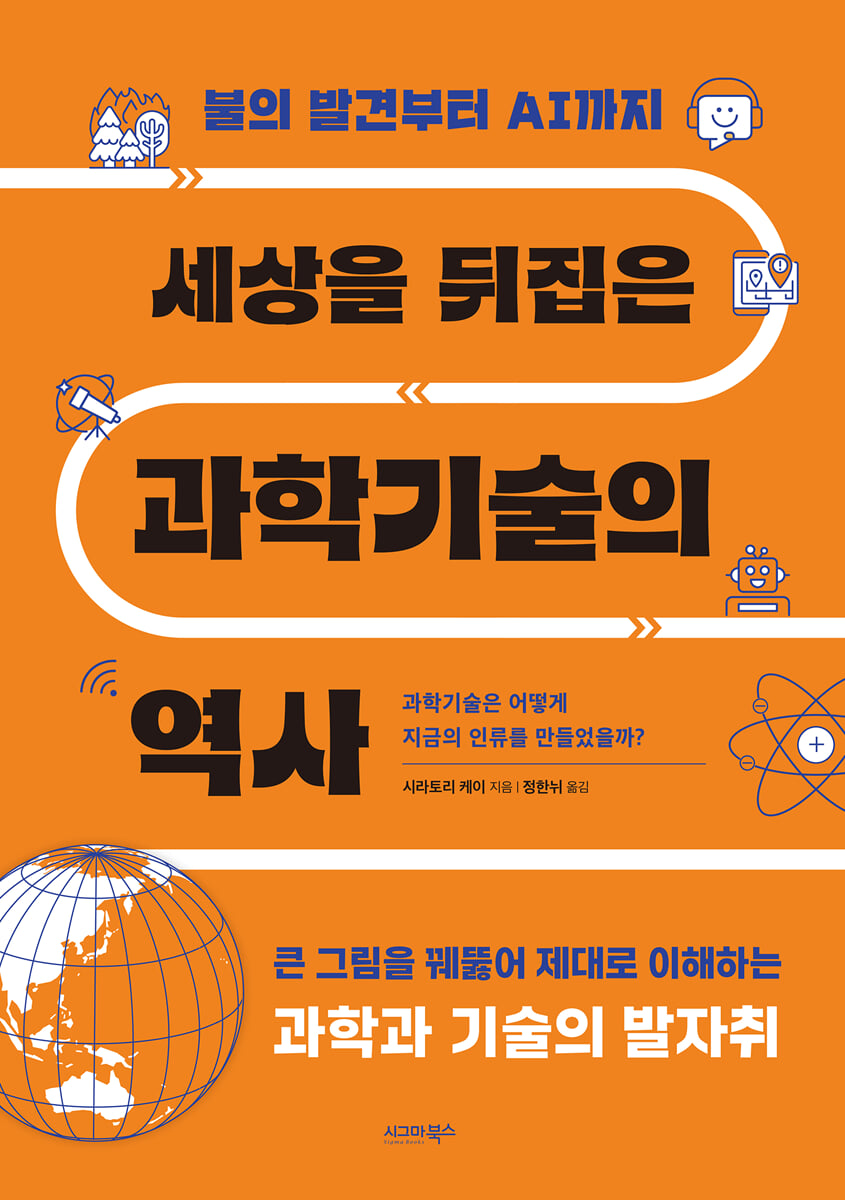
The history of science and technology that turned the world upside down
 |
Description
Book Introduction
How did science and technology create the humanity we know today?
The footsteps of science and technology that penetrate the big picture and understand it properly.
If 'science' is an academic discipline that explores the principles and laws of nature, 'science and technology' refers to methods of applying scientific knowledge to produce results that are beneficial to human society.
Advances in science and technology have greatly changed human lives, enriched them, and contributed to creating a stable society.
While science and technology have transformed society in the blink of an eye, they have also created countless problems.
However, living in a society made up of science and technology, we cannot turn our eyes away from it.
"The History of Science and Technology That Turned the World Upside Down" is a dynamic book that chronicles the vast history of science and technology that humanity has experienced, from the discovery of fire and tools to the age of computers and space.
Each chapter includes a timeline of science and technology history and a world history timeline that allow you to see the flow of the era at a glance.
From the discovery of fire to AI, let's follow the epic journey of science and technology that has unfolded throughout human history!
The footsteps of science and technology that penetrate the big picture and understand it properly.
If 'science' is an academic discipline that explores the principles and laws of nature, 'science and technology' refers to methods of applying scientific knowledge to produce results that are beneficial to human society.
Advances in science and technology have greatly changed human lives, enriched them, and contributed to creating a stable society.
While science and technology have transformed society in the blink of an eye, they have also created countless problems.
However, living in a society made up of science and technology, we cannot turn our eyes away from it.
"The History of Science and Technology That Turned the World Upside Down" is a dynamic book that chronicles the vast history of science and technology that humanity has experienced, from the discovery of fire and tools to the age of computers and space.
Each chapter includes a timeline of science and technology history and a world history timeline that allow you to see the flow of the era at a glance.
From the discovery of fire to AI, let's follow the epic journey of science and technology that has unfolded throughout human history!
- You can preview some of the book's contents.
Preview
index
Entering
letter.
From the Birth of Mankind to the Present - An Overview of the History of Science and Technology
1 The Birth of Humanity, the Invention of Fire and Tools | A Brief Look Back at the History of Technology (1)
2. The Use of Coal and Oil | A Brief History of Technology (2)
3 The Invention of Electricity | A Brief History of Technology (3)
4. The Difference Between Science and Technology
● Prologue Chronology
Chapter 1.
The Beginning of Modern Science - From the 16th to the 17th Centuries
01 Development of astronomy, the oldest natural science, and the invention of the calendar and numbers - Caesar
02 Invention of Numbers and Units - How to concretize abstract concepts
03 From Science to Technology - Observation and Experimentation
04 Galileo, who studied nature through experiments - the father of modern science
05 From Geocentrism to Heliocentrism - Copernicus, Brahe, Kepler
06 Science Begins with Philosophy - Descartes
07 The Giant of Modern Science - Newton
08 Compass, Navigation, and Maps - Mercator
09 Invention of the Telescope - Lippershey, Galileo
Technology that overcomes lens aberrations - Fraunhofer
11. The Invention of the Microscope - The Janssens and their sons, Hooke
12 Papermaking and Printing Technologies - Cai Lun, Gutenberg
13. Invention of Gunpowder and Cannons - Nobel
14 Pioneers of Science and Technology - Da Vinci
15 Discovery of the vacuum, the science of gases - Torricelli, Guericke, Boyle
16 Scientific Considerations of Light: Particle or Wave? - Newton, Huygens
17 Measuring the Speed of Light - Römer
18 Ether Did Not Exist - Michelson, Morley
● Chapter 1 Chronology (13th-17th centuries)
Chapter 2.
The Industrial Revolution and Social Transformation - 18th Century
19 New Power, Steam Engine - Newcomen, Watt
20 Inventions of the Thermometer - Fahrenheit, Celsius, and Kelvin
21 Discoveries of Electricity ① - Franklin, Galvani, Volta
22 The Discovery of Electricity ② - Oersted, Faraday, and Maxwell
23 The Discovery of Electricity ③ - The Alternating Current Generator and the Large-Scale Industrial Revolution
24 New Discovery of the Universe, Nebulae (Galaxies) - Herschel, Laplace
Discovery of the 25 Elements - Lavoisier, Dalton
26 Invention of telecommunications, wireless communication, and the telephone - Morse, Marconi, and Bell
27 Establishment of the concept of thermal energy - Joule
28 The emergence of spectral analysis methods for interpreting the composition of substances - Bunsen and Kirchhoff
● Chapter 2 Chronology (18th-19th centuries)
Chapter 3.
From Modern to Contemporary - 19th Century
Discovery of the 29th Element Period - Newlands, Mendeleev
30 Discovery of electromagnetic waves - Maxwell, Hertz
31 Discovery of Absolute Zero - Boyle, Charles, Gay-Lussac, and Onnes
32. The Invention of Information Recording Technology - Edison
33 Invention of Aerodynamics and Control of Airplanes - Lilienthal, Wright Brothers
● Chapter 3 Chronology (19th-early 20th century)
Chapter 4.
The Dazzling Leap of Science and Technology - The 20th Century
34 The announcement of the theory of relativity, a new perspective on physics - Einstein
35 Invention of the vacuum discharge tube and X-rays - Röntgen, Geissler, Crookes, and Plucker
36 The discovery of radioactivity and the development of nuclear physics - Rutherford, Becquerel, and Curie
37 The emergence of quantum mechanics - Planck, Einstein
38 Completion of Quantum Mechanics - de Broglie, Schrödinger, Heisenberg, Bohr, Pauli
39 Developments in Particle Physics - Dirac, Fermi, Majorana
40 The Emergence of a New Astronomy - Hubble, Hoyle
41 Discovery of Cosmic Background Radiation - Penzias, Wilson
42 The Expanding Universe and Dark Matter and Dark Energy - Rubin, Perlmutter, and Reiss
43 Discovery of Nuclear Fission - Han, Strassmann
Chapter 4 Chronology (20th Century)
Chapter 5.
The development of information science and computers in the late 20th century
44 The invention of the transistor and the development of semiconductor integrated circuits - Shockley, Bardeen, and Brattain
45 Invention of radar, development of antenna, magnetron - Yagi
46 The invention of the laser that changed the landscape of science and technology - Townes, Scholo
47 The Emergence of Computing Theory - Turing, Neumann, Shannon
48 Advances in Space Development Technology - Itokawa, von Braun
49 Advances in aviation technology and the emergence of supersonic aircraft - The Wright Brothers
50 Scientists Who Left Their Marks on Modern Science and Technology - Ogawa, Iijima, and Fukushima
Chapter 5 Chronology (20th Century)
References
letter.
From the Birth of Mankind to the Present - An Overview of the History of Science and Technology
1 The Birth of Humanity, the Invention of Fire and Tools | A Brief Look Back at the History of Technology (1)
2. The Use of Coal and Oil | A Brief History of Technology (2)
3 The Invention of Electricity | A Brief History of Technology (3)
4. The Difference Between Science and Technology
● Prologue Chronology
Chapter 1.
The Beginning of Modern Science - From the 16th to the 17th Centuries
01 Development of astronomy, the oldest natural science, and the invention of the calendar and numbers - Caesar
02 Invention of Numbers and Units - How to concretize abstract concepts
03 From Science to Technology - Observation and Experimentation
04 Galileo, who studied nature through experiments - the father of modern science
05 From Geocentrism to Heliocentrism - Copernicus, Brahe, Kepler
06 Science Begins with Philosophy - Descartes
07 The Giant of Modern Science - Newton
08 Compass, Navigation, and Maps - Mercator
09 Invention of the Telescope - Lippershey, Galileo
Technology that overcomes lens aberrations - Fraunhofer
11. The Invention of the Microscope - The Janssens and their sons, Hooke
12 Papermaking and Printing Technologies - Cai Lun, Gutenberg
13. Invention of Gunpowder and Cannons - Nobel
14 Pioneers of Science and Technology - Da Vinci
15 Discovery of the vacuum, the science of gases - Torricelli, Guericke, Boyle
16 Scientific Considerations of Light: Particle or Wave? - Newton, Huygens
17 Measuring the Speed of Light - Römer
18 Ether Did Not Exist - Michelson, Morley
● Chapter 1 Chronology (13th-17th centuries)
Chapter 2.
The Industrial Revolution and Social Transformation - 18th Century
19 New Power, Steam Engine - Newcomen, Watt
20 Inventions of the Thermometer - Fahrenheit, Celsius, and Kelvin
21 Discoveries of Electricity ① - Franklin, Galvani, Volta
22 The Discovery of Electricity ② - Oersted, Faraday, and Maxwell
23 The Discovery of Electricity ③ - The Alternating Current Generator and the Large-Scale Industrial Revolution
24 New Discovery of the Universe, Nebulae (Galaxies) - Herschel, Laplace
Discovery of the 25 Elements - Lavoisier, Dalton
26 Invention of telecommunications, wireless communication, and the telephone - Morse, Marconi, and Bell
27 Establishment of the concept of thermal energy - Joule
28 The emergence of spectral analysis methods for interpreting the composition of substances - Bunsen and Kirchhoff
● Chapter 2 Chronology (18th-19th centuries)
Chapter 3.
From Modern to Contemporary - 19th Century
Discovery of the 29th Element Period - Newlands, Mendeleev
30 Discovery of electromagnetic waves - Maxwell, Hertz
31 Discovery of Absolute Zero - Boyle, Charles, Gay-Lussac, and Onnes
32. The Invention of Information Recording Technology - Edison
33 Invention of Aerodynamics and Control of Airplanes - Lilienthal, Wright Brothers
● Chapter 3 Chronology (19th-early 20th century)
Chapter 4.
The Dazzling Leap of Science and Technology - The 20th Century
34 The announcement of the theory of relativity, a new perspective on physics - Einstein
35 Invention of the vacuum discharge tube and X-rays - Röntgen, Geissler, Crookes, and Plucker
36 The discovery of radioactivity and the development of nuclear physics - Rutherford, Becquerel, and Curie
37 The emergence of quantum mechanics - Planck, Einstein
38 Completion of Quantum Mechanics - de Broglie, Schrödinger, Heisenberg, Bohr, Pauli
39 Developments in Particle Physics - Dirac, Fermi, Majorana
40 The Emergence of a New Astronomy - Hubble, Hoyle
41 Discovery of Cosmic Background Radiation - Penzias, Wilson
42 The Expanding Universe and Dark Matter and Dark Energy - Rubin, Perlmutter, and Reiss
43 Discovery of Nuclear Fission - Han, Strassmann
Chapter 4 Chronology (20th Century)
Chapter 5.
The development of information science and computers in the late 20th century
44 The invention of the transistor and the development of semiconductor integrated circuits - Shockley, Bardeen, and Brattain
45 Invention of radar, development of antenna, magnetron - Yagi
46 The invention of the laser that changed the landscape of science and technology - Townes, Scholo
47 The Emergence of Computing Theory - Turing, Neumann, Shannon
48 Advances in Space Development Technology - Itokawa, von Braun
49 Advances in aviation technology and the emergence of supersonic aircraft - The Wright Brothers
50 Scientists Who Left Their Marks on Modern Science and Technology - Ogawa, Iijima, and Fukushima
Chapter 5 Chronology (20th Century)
References
Detailed image

Into the book
Another factor that greatly changed human history is fire.
The exact time when humans first began using fire is unknown, but it appears that Peking Man, who lived between 500,000 and 200,000 years ago, knew how to use fire.
After humans learned how to use fire, they began to cook the meat of animals they hunted and eat it.
In addition, humans may have used fire to keep themselves warm in cold weather or to keep animals that threaten humans from approaching their villages in the middle of the night.
--- "Preface.
From the Birth of Mankind to the Present - An Overview of the History of Science and Technology
The Renaissance was also a time when individualism, which valued individual emotions and thoughts, was born, breaking away from the so-called 'servants of God' and establishing individual subjectivity.
Logical and rational thinking, with individuals as the subject, elevated science to a modern academic discipline.
And it is no exaggeration to say that science and technology have been the main drivers of the modernization of society.
--- 「03.
From Science to Technology - Observation and Experimentation
Columbus, famous for discovering the American continent, believed that he had arrived in San Salvador, an island in the Bahamas, which is part of the American continent.
Perhaps this was natural, as the American continent was not on the map at the time.
The American continent was first discovered in Europe by the Spanish explorer Vasco Núñez de Balboa (1475–1519), who crossed the Isthmus of Panama from the Atlantic to the Pacific in 1513.
He is also famous as the discoverer of the Pacific Ocean.
--- 「08.
From "Compass, Navigation, and Maps - Mercator"
The invention of the steam engine, along with the invention of electricity, was a major factor in bringing about great changes in society.
Although not an official distinction, the changes in social structure and industrial technology that began with the invention of the steam engine are called the 'First Industrial Revolution.'
The changes brought about by the use of electrical energy from the late 19th century to the early 20th century are called the 'Second Industrial Revolution', and the changes brought about by the development of computer software and information technology in the mid-20th century are called the 'Third Industrial Revolution'.
--- 「19.
New Power, Steam Engine - Newcomen, Watt
In addition to the representative scientific discoveries such as electromagnetic waves, the speed of light, and black holes, as introduced above, the discoveries recorded in the history of science are vast.
And there are countless inventions such as the steam engine, the internal combustion engine, the airplane, and the computer.
Here we can see that discovery mainly belongs to science, and invention belongs to technology (engineering).
Scientific discoveries have led to inventions as engineering applications have been devised, bringing abundance to human society.
--- 「32.
From "Invention of Information Recording Technology - Edison"
Schrödinger objected to Bohr's wave contraction theory.
He used the famous thought experiment called 'Schrödinger's cat' to criticize Bohr's claim that waves contract when observed.
Let's say you put a cat and radioactive material in a box that is invisible from the outside, and there's a device that activates a sensor and releases poison gas when the radioactive material decays.
Because radioactive material decays randomly, it is impossible to determine whether the cat is alive or dead until the box is opened.
In other words, 'Schrödinger's cat' was a thought experiment presented to criticize the incomplete explanation that 'the act of opening the box determines survival and death.'
--- 「38.
From "The Completion of Quantum Mechanics - De Broglie, Schrödinger, Heisenberg, Bohr, Pauli"
The 'Big Bang' of information technology and information science in the late 20th century brought about tremendous changes in society.
And the person who created the first opportunity was Alan Turing (1912-1954).
Turing, a British-born genius mathematician, is famous for deciphering Germany's Enigma code, which was so powerful that it was considered an unbreakable code during World War II.
Turing is also the person who devised the basic principles of today's computers.
This is the Turing machine, a hypothetical machine proposed by Turing in 1936.
The exact time when humans first began using fire is unknown, but it appears that Peking Man, who lived between 500,000 and 200,000 years ago, knew how to use fire.
After humans learned how to use fire, they began to cook the meat of animals they hunted and eat it.
In addition, humans may have used fire to keep themselves warm in cold weather or to keep animals that threaten humans from approaching their villages in the middle of the night.
--- "Preface.
From the Birth of Mankind to the Present - An Overview of the History of Science and Technology
The Renaissance was also a time when individualism, which valued individual emotions and thoughts, was born, breaking away from the so-called 'servants of God' and establishing individual subjectivity.
Logical and rational thinking, with individuals as the subject, elevated science to a modern academic discipline.
And it is no exaggeration to say that science and technology have been the main drivers of the modernization of society.
--- 「03.
From Science to Technology - Observation and Experimentation
Columbus, famous for discovering the American continent, believed that he had arrived in San Salvador, an island in the Bahamas, which is part of the American continent.
Perhaps this was natural, as the American continent was not on the map at the time.
The American continent was first discovered in Europe by the Spanish explorer Vasco Núñez de Balboa (1475–1519), who crossed the Isthmus of Panama from the Atlantic to the Pacific in 1513.
He is also famous as the discoverer of the Pacific Ocean.
--- 「08.
From "Compass, Navigation, and Maps - Mercator"
The invention of the steam engine, along with the invention of electricity, was a major factor in bringing about great changes in society.
Although not an official distinction, the changes in social structure and industrial technology that began with the invention of the steam engine are called the 'First Industrial Revolution.'
The changes brought about by the use of electrical energy from the late 19th century to the early 20th century are called the 'Second Industrial Revolution', and the changes brought about by the development of computer software and information technology in the mid-20th century are called the 'Third Industrial Revolution'.
--- 「19.
New Power, Steam Engine - Newcomen, Watt
In addition to the representative scientific discoveries such as electromagnetic waves, the speed of light, and black holes, as introduced above, the discoveries recorded in the history of science are vast.
And there are countless inventions such as the steam engine, the internal combustion engine, the airplane, and the computer.
Here we can see that discovery mainly belongs to science, and invention belongs to technology (engineering).
Scientific discoveries have led to inventions as engineering applications have been devised, bringing abundance to human society.
--- 「32.
From "Invention of Information Recording Technology - Edison"
Schrödinger objected to Bohr's wave contraction theory.
He used the famous thought experiment called 'Schrödinger's cat' to criticize Bohr's claim that waves contract when observed.
Let's say you put a cat and radioactive material in a box that is invisible from the outside, and there's a device that activates a sensor and releases poison gas when the radioactive material decays.
Because radioactive material decays randomly, it is impossible to determine whether the cat is alive or dead until the box is opened.
In other words, 'Schrödinger's cat' was a thought experiment presented to criticize the incomplete explanation that 'the act of opening the box determines survival and death.'
--- 「38.
From "The Completion of Quantum Mechanics - De Broglie, Schrödinger, Heisenberg, Bohr, Pauli"
The 'Big Bang' of information technology and information science in the late 20th century brought about tremendous changes in society.
And the person who created the first opportunity was Alan Turing (1912-1954).
Turing, a British-born genius mathematician, is famous for deciphering Germany's Enigma code, which was so powerful that it was considered an unbreakable code during World War II.
Turing is also the person who devised the basic principles of today's computers.
This is the Turing machine, a hypothetical machine proposed by Turing in 1936.
--- 「47.
From "The Emergence of Computing Theory - Turing, Neumann, Shannon"
From "The Emergence of Computing Theory - Turing, Neumann, Shannon"
Publisher's Review
What did mankind think and what did they create?
Technology was born from science,
Technology has once again become the basis for a new science.
Whenever the world turns upside down, science and technology are always there.
Therefore, the history of mankind can be rephrased as the history of science and technology.
If 'science' is an academic discipline that explores the principles and laws of nature, 'science and technology' refers to methods of applying scientific knowledge to produce results that are beneficial to human society.
The emergence of humans on Earth dates back millions of years ago.
The era of civilization using primitive tools such as fire and stone tools has lasted for a long time, and mankind has gradually improved these tools to make them more convenient and better.
Since entering the modern era, the world has rapidly reached a turning point.
The steam engine, which appeared in the 18th century, made mass production possible and laid the foundation for a capitalist society.
Soon, with the commercialization of electrical energy and the emergence of computers in the mid-20th century, human life underwent tremendous changes.
From the Industrial Revolution in the late 18th century to the widespread adoption of AI in 2025, all this has happened in less than 300 years.
When we talk about 'science and technology', we often think of the Industrial Revolution that began in 18th century England.
But strictly speaking, the history of human science and technology has been advancing through countless failures and successes since before then.
This book traces back to the discovery of fire and the invention of stone tools, two of the oldest technologies in human history, and retrace the vast trajectory of the history of science and technology that followed.
By following this story, readers will experience the power of science and technology that has completely transformed human life, and furthermore, they will be able to consider the attitudes we must adopt and guard against in a society built on science and technology.
A deep look into the historical flow of science and technology
Just one introductory book!
The introduction of this book briefly examines the history of mankind from the moment of its birth to the acquisition of scientific and technological tools.
It vividly depicts the footsteps of modern and contemporary science and technology in chronological order, from the beginning of modern science in the 16th and 17th centuries, the Industrial Revolution in the 18th century, the dazzling leap forward in modern science and technology in the 19th and 20th centuries, and the development of information science and computers in the late 20th century.
In addition to the abundant pictorial and photographic materials, each chapter includes a timeline of the history of science and technology and world history at the end, allowing readers to see the flow of the era at a glance, helping with understanding.
We learn about Korean and world history in school, but we don't systematically learn about the history of science and technology.
However, science and technology, which are advancing at an incredible pace, are bringing about abundance, but at the same time, they are causing numerous problems.
Recognizing this, understanding the past and present of science and technology along with the flow of human history is essential for us who live in a society built on science and technology.
I would be delighted if this book, which encompasses the entire history of science and technology, helped people understand how closely science and technology have been intertwined with humanity since time immemorial.
Technology was born from science,
Technology has once again become the basis for a new science.
Whenever the world turns upside down, science and technology are always there.
Therefore, the history of mankind can be rephrased as the history of science and technology.
If 'science' is an academic discipline that explores the principles and laws of nature, 'science and technology' refers to methods of applying scientific knowledge to produce results that are beneficial to human society.
The emergence of humans on Earth dates back millions of years ago.
The era of civilization using primitive tools such as fire and stone tools has lasted for a long time, and mankind has gradually improved these tools to make them more convenient and better.
Since entering the modern era, the world has rapidly reached a turning point.
The steam engine, which appeared in the 18th century, made mass production possible and laid the foundation for a capitalist society.
Soon, with the commercialization of electrical energy and the emergence of computers in the mid-20th century, human life underwent tremendous changes.
From the Industrial Revolution in the late 18th century to the widespread adoption of AI in 2025, all this has happened in less than 300 years.
When we talk about 'science and technology', we often think of the Industrial Revolution that began in 18th century England.
But strictly speaking, the history of human science and technology has been advancing through countless failures and successes since before then.
This book traces back to the discovery of fire and the invention of stone tools, two of the oldest technologies in human history, and retrace the vast trajectory of the history of science and technology that followed.
By following this story, readers will experience the power of science and technology that has completely transformed human life, and furthermore, they will be able to consider the attitudes we must adopt and guard against in a society built on science and technology.
A deep look into the historical flow of science and technology
Just one introductory book!
The introduction of this book briefly examines the history of mankind from the moment of its birth to the acquisition of scientific and technological tools.
It vividly depicts the footsteps of modern and contemporary science and technology in chronological order, from the beginning of modern science in the 16th and 17th centuries, the Industrial Revolution in the 18th century, the dazzling leap forward in modern science and technology in the 19th and 20th centuries, and the development of information science and computers in the late 20th century.
In addition to the abundant pictorial and photographic materials, each chapter includes a timeline of the history of science and technology and world history at the end, allowing readers to see the flow of the era at a glance, helping with understanding.
We learn about Korean and world history in school, but we don't systematically learn about the history of science and technology.
However, science and technology, which are advancing at an incredible pace, are bringing about abundance, but at the same time, they are causing numerous problems.
Recognizing this, understanding the past and present of science and technology along with the flow of human history is essential for us who live in a society built on science and technology.
I would be delighted if this book, which encompasses the entire history of science and technology, helped people understand how closely science and technology have been intertwined with humanity since time immemorial.
GOODS SPECIFICS
- Date of issue: September 22, 2025
- Page count, weight, size: 260 pages | 148*210*16mm
- ISBN13: 9791168623972
- ISBN10: 1168623979
You may also like
카테고리
korean


korean

![ELLE 엘르 스페셜 에디션 A형 : 12월 [2025]](http://librairie.coreenne.fr/cdn/shop/files/b8e27a3de6c9538896439686c6b0e8fb.jpg?v=1766436872&width=3840)


