

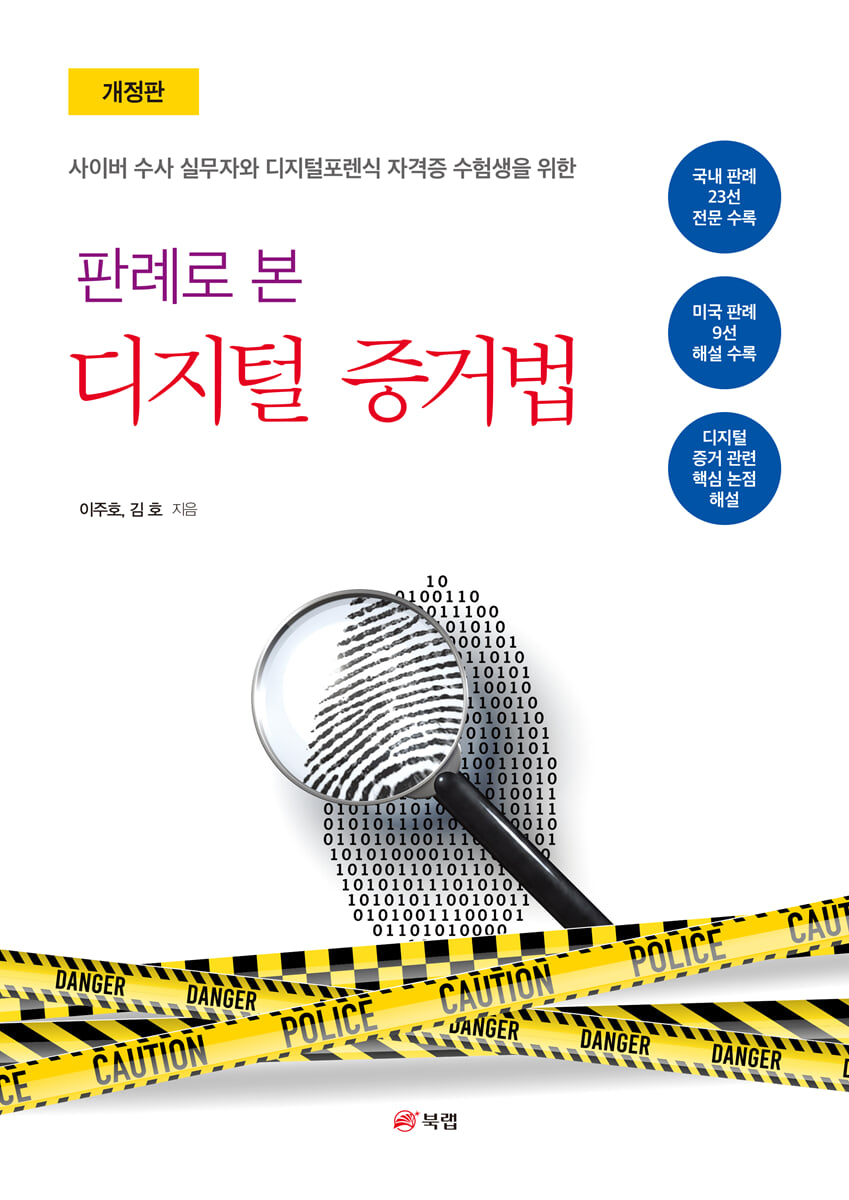
Digital Evidence Law as Seen Through Case Law
 |
Description
Book Introduction
As of 2025, not only has the general investigative environment in society changed rapidly due to the revision of the Criminal Procedure Act, the Prosecutor's Office Act, the Act on the Senior Public Officials' Corruption Investigation Office, and the Police Organization Act over the past several years, but the military organization has also changed as part of the military law reform, with the abolition of the High Military Court and the investigation, indictment, and trial of soldiers and others by courts other than military-affiliated courts, general police, and prosecutors for a limited number of crimes. In this flow of change, the importance of cooperation and collaboration between military police and police, military prosecutors, and prosecutors in the investigation of cases is expected to increase further.
- You can preview some of the book's contents.
Preview
index
preface
Encouragement speech
Recommendation
Chapter 1: Digital Evidence and the Application of the Warrant Principle
Section 1: Concept of Digital Evidence
Section 2. Case law on application of the rule on exclusion of illegally collected evidence
Section 3 Digital Evidence and Expert Rules
Section 4 Requirements for the Admissibility of Digital Evidence
1.
The issue of authenticity of digital evidence
2.
Methods for proving the integrity and identity of digital evidence
3.
The issue of authenticity of digital evidence
Section 5 Standards of Due Process
Section 6 Evidence seized without a warrant through special investigation
Chapter 2: Collecting Digital Evidence
Section 1. Possibility of data seizure
Section 2 Scope of search and seizure
1.
Relevance to criminal charges
2.
Scope of information storage media under Article 313 of the Criminal Procedure Act
3.
Limits of location and subject listed in the warrant
4.
The illegality of the seizure and search of cloud servers beyond the scope of the warrant.
5.
Illegality of arbitrary inspection of electronic information seized and searched by other investigative agencies for investigative purposes
Section 3 Execution of warrants
1.
Copy warrant, such as fax
2.
Method of executing a warrant
Section 4. Participant Issues
1.
Participation of the parties
2.
Expert participation
3.
Determining the timing of ensuring attorney participation
4.
Participation issues regarding third-party storage of information
5.
Whether or not the right to participate is not guaranteed by a posthumous search and seizure warrant
6.
Subject to guarantee of participation rights for storage media transferred to others
Section 5: Selective seizure problem
Section 6: Seizure of voluntarily submitted digital media
Section 7. Scope of collection of evidence submitted by a third party other than the suspect
Section 8 Limitations on the Guarantee of Participation Rights for Public PCs
Chapter 3 Evidential Admissibility of Digital Evidence by Media
Section 1. Evidential ability of video recordings
Section 2 Evidential ability of diskettes and CDs
Section 3 Scope of wiretapping
Section 4 Evidential ability of recorded files
Section 5 Evidence of Packet Interception
Section 6 Text message information on mobile phones
Section 7. Evidential ability of SNS such as X (formerly Twitter)
Section 8 Evidence of Steganographically Encrypted Files
Section 9. Evidence of Files Stored in the Cloud
Chapter 4: US Digital Forensics Case Law
Section 1 Lorraine v.
Markel American Ins.
Co., 241 FRD
534(D.Md.
2007).
Section 2 In re Vee Vinhnee, 336 BR
437, 447(9th Cir.
2005).
Section 3 US
v. Hamilton, 413 F.3d 1138, 1142-1143 (10th Cir.
2005).
Section 4 Gikonyo v.
State, 28v3 SW3d 631(Ark.App.
2008).
Section 5 Krause v.
State, 243 SW3d 95(Tex.App.
Houston 1st Dist.
2007).
Section 6 Rivera-Cruz v.
Latimer, 2008WL2446331(DPR
2008).
Section 7 US
v. Wong, 9th Cir.
2003
Section 8 US
v. Bailey, D.
Neb.
2003
Section 9 California (2016.2.) vs.
New York (February 2016)
Section 10 United States VS Hernández-Mieses (2019)
Section 11 United States vs. Gregoire (8th Cir, 2011)
supplement
1.
Supreme Prosecutors' Office Digital Evidence Collection, Analysis, and Management Regulations
2.
National Police Agency Rules on Handling Digital Evidence, etc.
3.
Regulations on the Digital Forensics Work of the Senior Civil Servants' Corruption Investigation Office
4.
Instructions on Digital Forensic Investigations by Military Investigative Agencies
Encouragement speech
Recommendation
Chapter 1: Digital Evidence and the Application of the Warrant Principle
Section 1: Concept of Digital Evidence
Section 2. Case law on application of the rule on exclusion of illegally collected evidence
Section 3 Digital Evidence and Expert Rules
Section 4 Requirements for the Admissibility of Digital Evidence
1.
The issue of authenticity of digital evidence
2.
Methods for proving the integrity and identity of digital evidence
3.
The issue of authenticity of digital evidence
Section 5 Standards of Due Process
Section 6 Evidence seized without a warrant through special investigation
Chapter 2: Collecting Digital Evidence
Section 1. Possibility of data seizure
Section 2 Scope of search and seizure
1.
Relevance to criminal charges
2.
Scope of information storage media under Article 313 of the Criminal Procedure Act
3.
Limits of location and subject listed in the warrant
4.
The illegality of the seizure and search of cloud servers beyond the scope of the warrant.
5.
Illegality of arbitrary inspection of electronic information seized and searched by other investigative agencies for investigative purposes
Section 3 Execution of warrants
1.
Copy warrant, such as fax
2.
Method of executing a warrant
Section 4. Participant Issues
1.
Participation of the parties
2.
Expert participation
3.
Determining the timing of ensuring attorney participation
4.
Participation issues regarding third-party storage of information
5.
Whether or not the right to participate is not guaranteed by a posthumous search and seizure warrant
6.
Subject to guarantee of participation rights for storage media transferred to others
Section 5: Selective seizure problem
Section 6: Seizure of voluntarily submitted digital media
Section 7. Scope of collection of evidence submitted by a third party other than the suspect
Section 8 Limitations on the Guarantee of Participation Rights for Public PCs
Chapter 3 Evidential Admissibility of Digital Evidence by Media
Section 1. Evidential ability of video recordings
Section 2 Evidential ability of diskettes and CDs
Section 3 Scope of wiretapping
Section 4 Evidential ability of recorded files
Section 5 Evidence of Packet Interception
Section 6 Text message information on mobile phones
Section 7. Evidential ability of SNS such as X (formerly Twitter)
Section 8 Evidence of Steganographically Encrypted Files
Section 9. Evidence of Files Stored in the Cloud
Chapter 4: US Digital Forensics Case Law
Section 1 Lorraine v.
Markel American Ins.
Co., 241 FRD
534(D.Md.
2007).
Section 2 In re Vee Vinhnee, 336 BR
437, 447(9th Cir.
2005).
Section 3 US
v. Hamilton, 413 F.3d 1138, 1142-1143 (10th Cir.
2005).
Section 4 Gikonyo v.
State, 28v3 SW3d 631(Ark.App.
2008).
Section 5 Krause v.
State, 243 SW3d 95(Tex.App.
Houston 1st Dist.
2007).
Section 6 Rivera-Cruz v.
Latimer, 2008WL2446331(DPR
2008).
Section 7 US
v. Wong, 9th Cir.
2003
Section 8 US
v. Bailey, D.
Neb.
2003
Section 9 California (2016.2.) vs.
New York (February 2016)
Section 10 United States VS Hernández-Mieses (2019)
Section 11 United States vs. Gregoire (8th Cir, 2011)
supplement
1.
Supreme Prosecutors' Office Digital Evidence Collection, Analysis, and Management Regulations
2.
National Police Agency Rules on Handling Digital Evidence, etc.
3.
Regulations on the Digital Forensics Work of the Senior Civil Servants' Corruption Investigation Office
4.
Instructions on Digital Forensic Investigations by Military Investigative Agencies
Into the book
Ultimately, these precedents strengthen the principles of due process and human rights protection in the current judicial system and provide important guidance for ensuring that investigative agencies adhere to legal limits.
This can be seen as contributing to enhancing the fairness and transparency of criminal justice and having a positive impact on achieving a balance between uncovering the truth and protecting the rights of suspects.
In particular, it plays a significant role in enhancing the legitimacy of judicial procedures and the accountability of investigative agencies by making it clear that illegal evidence collection can be excluded from court proceedings.
--- p.22
In 2007, the Supreme Court made a landmark ruling regarding digital evidence in a case involving violations of the National Security Act (espionage, infiltration, escape, etc.) (hereinafter referred to as the “Ilsimhoe” case).
Until now, rulings on digital evidence have mainly been related to expert evidence, but starting with the 2007 Ilsimhoe ruling, terms such as "hard copy" and "imaging" began to appear in case law, and case law related to digital evidence began to emerge in earnest, dealing with requirements for the integrity and identity of digital evidence.
--- p.61
In the case where a series of actions, such as seizure, imaging, search, copying, and printing of storage media on-site during the process of seizure and search of electronic information, have been carried out and the seizure and search has been completed, and there is a quasi-appeal requesting the cancellation of individual dispositions at each stage by dividing the entire seizure and search process into stages and individually, whether the entire seizure and search process should be considered as a single procedure and the seizure and search disposition as a whole should be cancelled based on whether the illegality revealed in the process is serious enough to make the entire seizure and search procedure illegal (positive in principle) and the standards for judging the severity of the illegality at this time
--- p.113
However, another Supreme Court ruling (2020.
3. 19.
In Sentence 2019do14341), the evidentiary ability was acknowledged on the grounds that there was a connection with the basic crime. This is a case where it was ruled that if there is material related to a sexual crime other than the charge written on the warrant during the process of seizing and searching the cell phone of a sex crime suspect, it can be used as evidence. In this case, it was determined that there is an objective connection when the charge written on the warrant and the additionally confirmed crime are not only close in time but also have the same motive for the crime, target of the crime, means used, and method.
--- p.161
If the investigative agency selects information related to the facts of the crime through keyword or extension search among the information stored in the information storage medium, and then receives and seizes a file created by copying it in the same bit string format as the information storage medium (hereinafter referred to as an “image file”), the search and seizure procedure for the object of seizure is thus completed, and therefore, the investigative agency does not have to guarantee the suspect, etc. an opportunity to participate in the process of searching, copying, and printing the image file seized as above at the investigative agency office.”
--- p.223
Most of the evidence submitted in trial is in the form of storage media such as CDs or diskettes.
In particular, in modern society, most people use commercial electronic media such as smartphones and laptops for work and daily life, so it is natural that various crimes and lawsuits are loaded on such media.
This can be seen as contributing to enhancing the fairness and transparency of criminal justice and having a positive impact on achieving a balance between uncovering the truth and protecting the rights of suspects.
In particular, it plays a significant role in enhancing the legitimacy of judicial procedures and the accountability of investigative agencies by making it clear that illegal evidence collection can be excluded from court proceedings.
--- p.22
In 2007, the Supreme Court made a landmark ruling regarding digital evidence in a case involving violations of the National Security Act (espionage, infiltration, escape, etc.) (hereinafter referred to as the “Ilsimhoe” case).
Until now, rulings on digital evidence have mainly been related to expert evidence, but starting with the 2007 Ilsimhoe ruling, terms such as "hard copy" and "imaging" began to appear in case law, and case law related to digital evidence began to emerge in earnest, dealing with requirements for the integrity and identity of digital evidence.
--- p.61
In the case where a series of actions, such as seizure, imaging, search, copying, and printing of storage media on-site during the process of seizure and search of electronic information, have been carried out and the seizure and search has been completed, and there is a quasi-appeal requesting the cancellation of individual dispositions at each stage by dividing the entire seizure and search process into stages and individually, whether the entire seizure and search process should be considered as a single procedure and the seizure and search disposition as a whole should be cancelled based on whether the illegality revealed in the process is serious enough to make the entire seizure and search procedure illegal (positive in principle) and the standards for judging the severity of the illegality at this time
--- p.113
However, another Supreme Court ruling (2020.
3. 19.
In Sentence 2019do14341), the evidentiary ability was acknowledged on the grounds that there was a connection with the basic crime. This is a case where it was ruled that if there is material related to a sexual crime other than the charge written on the warrant during the process of seizing and searching the cell phone of a sex crime suspect, it can be used as evidence. In this case, it was determined that there is an objective connection when the charge written on the warrant and the additionally confirmed crime are not only close in time but also have the same motive for the crime, target of the crime, means used, and method.
--- p.161
If the investigative agency selects information related to the facts of the crime through keyword or extension search among the information stored in the information storage medium, and then receives and seizes a file created by copying it in the same bit string format as the information storage medium (hereinafter referred to as an “image file”), the search and seizure procedure for the object of seizure is thus completed, and therefore, the investigative agency does not have to guarantee the suspect, etc. an opportunity to participate in the process of searching, copying, and printing the image file seized as above at the investigative agency office.”
--- p.223
Most of the evidence submitted in trial is in the form of storage media such as CDs or diskettes.
In particular, in modern society, most people use commercial electronic media such as smartphones and laptops for work and daily life, so it is natural that various crimes and lawsuits are loaded on such media.
--- p.286
Publisher's Review
Smartphones are emerging as a 'smoking gun' that holds crucial clues in investigations.
The Digital Evidence Act, the legal basis for search and seizure, is only in its infancy!
What criteria will be used to determine the legal validity of digital evidence?
How can a search and seizure be conducted without violating personal information?
A current digital forensics expert investigator and a military justice expert columnist
Everything about digital forensics explained in an easy-to-understand way through case law.
As of 2025, not only has the general investigative environment in society changed rapidly due to the revision of the Criminal Procedure Act, the Prosecutor's Office Act, the Act on the Senior Public Officials' Corruption Investigation Office, and the Police Organization Act over the past several years, but the military organization has also changed as part of the military law reform, with the abolition of the High Military Court and the investigation, indictment, and trial of soldiers and others by courts other than military-affiliated courts, general police, and prosecutors for a limited number of crimes. In this flow of change, the importance of cooperation and collaboration between military police and police, military prosecutors, and prosecutors in the investigation of cases is expected to increase further.
Fortunately, in order to overcome limitations such as job training on digital evidence, a recently revised casebook has been published by two military law officers belonging to the military police, which organizes the digital evidence law in an easy-to-understand manner. This book is not only of considerable academic value, but is also expected to be of great help not only to military investigative agencies but also to frontline investigation sites such as the police and prosecutors.
- Professor Emeritus, Department of Police Administration, Soonchunhyang University
Oh Yoon-seong
The Digital Evidence Act, the legal basis for search and seizure, is only in its infancy!
What criteria will be used to determine the legal validity of digital evidence?
How can a search and seizure be conducted without violating personal information?
A current digital forensics expert investigator and a military justice expert columnist
Everything about digital forensics explained in an easy-to-understand way through case law.
As of 2025, not only has the general investigative environment in society changed rapidly due to the revision of the Criminal Procedure Act, the Prosecutor's Office Act, the Act on the Senior Public Officials' Corruption Investigation Office, and the Police Organization Act over the past several years, but the military organization has also changed as part of the military law reform, with the abolition of the High Military Court and the investigation, indictment, and trial of soldiers and others by courts other than military-affiliated courts, general police, and prosecutors for a limited number of crimes. In this flow of change, the importance of cooperation and collaboration between military police and police, military prosecutors, and prosecutors in the investigation of cases is expected to increase further.
Fortunately, in order to overcome limitations such as job training on digital evidence, a recently revised casebook has been published by two military law officers belonging to the military police, which organizes the digital evidence law in an easy-to-understand manner. This book is not only of considerable academic value, but is also expected to be of great help not only to military investigative agencies but also to frontline investigation sites such as the police and prosecutors.
- Professor Emeritus, Department of Police Administration, Soonchunhyang University
Oh Yoon-seong
GOODS SPECIFICS
- Date of issue: March 11, 2025
- Page count, weight, size: 376 pages | 703g | 182*257*19mm
- ISBN13: 9791172244606
- ISBN10: 117224460X
You may also like
카테고리
korean


korean

![GQ KOREA Mark (Monthly): December [2025]](http://librairie.coreenne.fr/cdn/shop/files/8ef265dbbfbf186523ed75ba7319009d.jpg?v=1765340328&width=3840)


