

Future Education Trends in Korea
 |
Description
Book Introduction
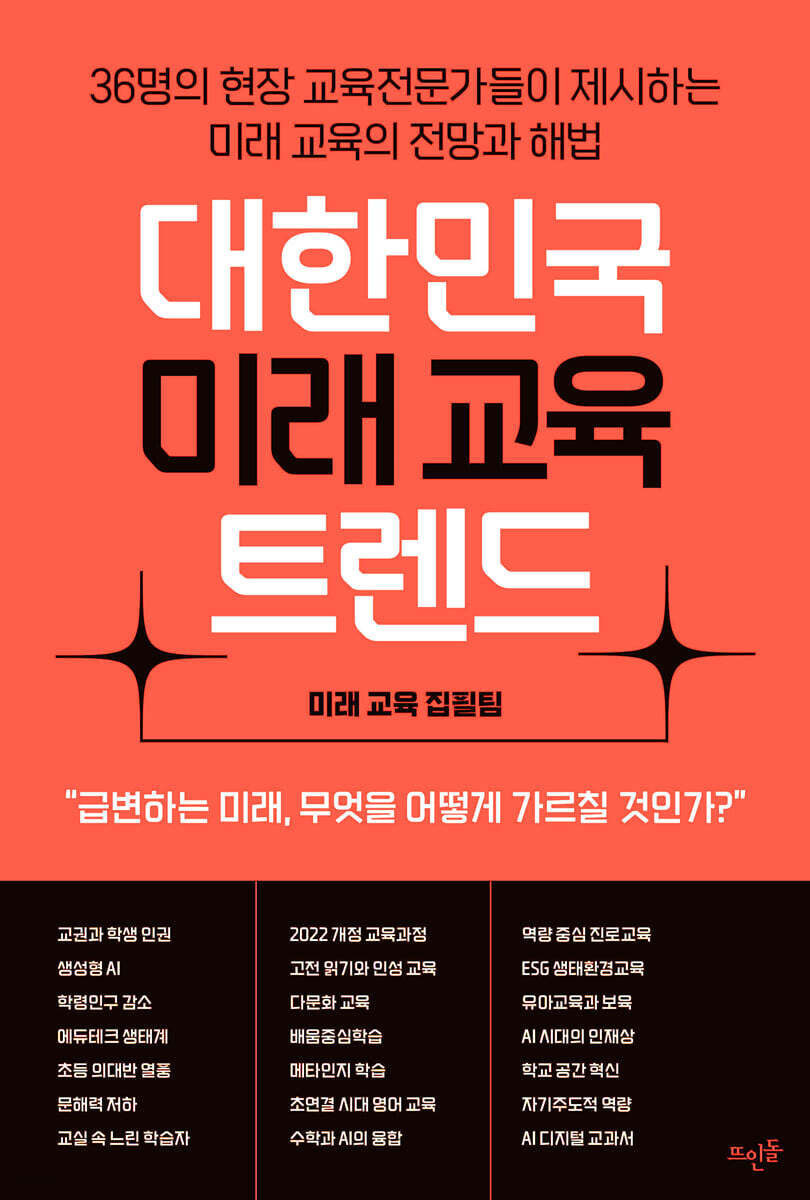
A complete guide that provides practical guidelines for future education! This book is the fruit of an effort to grasp the essence of education in a rapidly changing society—the question of "what to teach and how to teach"—and to come even a little closer to a solution. Thirty-six field education experts from various fields, based on thorough data analysis and extensive experience, have identified the core values and key trends of future education. Through this, we were able to sketch out a blueprint for what kind of education would be appropriate for future society, while not losing sight of its essence. It goes beyond analyzing key issues in future education, such as the 2022 revised curriculum, decline in school-age population, use of ChatGPT in classes, English and math education in the AI era, problems and countermeasures due to declining literacy, slow learners in the classroom, conflict between teachers' authority and students' human rights, growth of the edutech market, craze for elementary school medical classes, innovation in school space, teachers' digital education expertise, and the direction of career education and ecological education. Based on the authors' abundant field experience, it proposes practical teaching and learning methods that can be applied to current education through class cases and lesson plans. The book also provides detailed solutions throughout the book on how to foster core competencies of the future: self-management (self-directedness), knowledge and information processing, creative thinking, aesthetic sensibility, collaborative communication, and community skills. This book will provide readers with a clear roadmap and powerful insights into the future of education. |
- You can preview some of the book's contents.
Preview
index
In publishing a book
Opening remarks
Part 1.
Korean Education Diagnosis
Chapter 1.
Our current educational scene
· Student rights and teachers' authority go hand in hand.
· How to solve school violence
A new era where teachers can fully demonstrate their individual capabilities.
· The Growing EdTech Market: What Is a Desirable Public Education EdTech Ecosystem?
Chapter 2.
Our children now
· Children who go all-in on good deeds and deepening their studies
· Children who are good at studying and children who are not good at studying in elementary school
· Children who cannot read even when they read
· How to teach slow learners in the classroom
Part 2.
Future Education Design in Korea
Chapter 1.
Designing the Future of Education
· What will change with the introduction of the 2022 revised curriculum?
· Learning-centered classes that develop life skills
· The coming future, a story of a small school
· Students who choose to work after graduating from high school
· Transforming corporate ESG management into ESG ecological education in schools
Multicultural education for all
· Character education becomes increasingly important in the AI era.
· Digital textbooks you want on site
· How to develop teachers' digital education expertise
· Future Education: Why Should We Talk About Classics?
Chapter 2. Designing Classes with AI
· Subscribe to Education and Generative AI
· ChatGPT! How can it be utilized in education?
English Education in the AI Era
· How should mathematics education of the future be different?
· Metacognitive learning: the power of learning wisely in the AI era.
· Digital play in kindergarten without space or time constraints
· Changing Jobs in the AI Era, Career Education Needs to Change
Part 3.
Future Education Outlook in Korea
Chapter 1.
Issues and challenges in future education
· With the school-age population declining, where is the teacher supply headed?
· Early Childhood Education and Childcare in Future Education
· Future changes in education as seen through overseas examples
· How will education lead the AI era?
· Real future education started by teachers
· How will the future educational environment change?
Chapter 2.
How should we prepare for the universities of the future?
· What kind of talent do universities want?
· Where is Korean History Headed for College Entrance Exams?
· The talent universities want in the AI era
Special Contribution - Bottom-Up Education Policy Proposals from Field Teachers
Opening remarks
Part 1.
Korean Education Diagnosis
Chapter 1.
Our current educational scene
· Student rights and teachers' authority go hand in hand.
· How to solve school violence
A new era where teachers can fully demonstrate their individual capabilities.
· The Growing EdTech Market: What Is a Desirable Public Education EdTech Ecosystem?
Chapter 2.
Our children now
· Children who go all-in on good deeds and deepening their studies
· Children who are good at studying and children who are not good at studying in elementary school
· Children who cannot read even when they read
· How to teach slow learners in the classroom
Part 2.
Future Education Design in Korea
Chapter 1.
Designing the Future of Education
· What will change with the introduction of the 2022 revised curriculum?
· Learning-centered classes that develop life skills
· The coming future, a story of a small school
· Students who choose to work after graduating from high school
· Transforming corporate ESG management into ESG ecological education in schools
Multicultural education for all
· Character education becomes increasingly important in the AI era.
· Digital textbooks you want on site
· How to develop teachers' digital education expertise
· Future Education: Why Should We Talk About Classics?
Chapter 2. Designing Classes with AI
· Subscribe to Education and Generative AI
· ChatGPT! How can it be utilized in education?
English Education in the AI Era
· How should mathematics education of the future be different?
· Metacognitive learning: the power of learning wisely in the AI era.
· Digital play in kindergarten without space or time constraints
· Changing Jobs in the AI Era, Career Education Needs to Change
Part 3.
Future Education Outlook in Korea
Chapter 1.
Issues and challenges in future education
· With the school-age population declining, where is the teacher supply headed?
· Early Childhood Education and Childcare in Future Education
· Future changes in education as seen through overseas examples
· How will education lead the AI era?
· Real future education started by teachers
· How will the future educational environment change?
Chapter 2.
How should we prepare for the universities of the future?
· What kind of talent do universities want?
· Where is Korean History Headed for College Entrance Exams?
· The talent universities want in the AI era
Special Contribution - Bottom-Up Education Policy Proposals from Field Teachers
Detailed image

Into the book
We must deeply remember that student human rights and teachers' rights are not in conflict.
Students are independent individuals who should enjoy their inherent human rights, and student human rights are a legal concept that seeks to realize the values of international human rights treaties and the Constitution in the field of education.
Moreover, the right to education is a right guaranteed by the Constitution, and the instrumental authority to properly carry out this right is the right to teach.
Teachers' authority is necessary to 'realize students' human rights, including the constitutional right to education.'
Let me emphasize again that student rights and teachers' rights are not in conflict.
--- p.30
Now everyone has the opportunity to go beyond the classroom and school.
This does not mean that students should be abandoned in the classroom.
Rather, it is to go back and forth between classrooms and acquire expertise so that you can meet your students in the classroom in a more capable manner.
From the students' perspective, they will also positively view their teachers as possessing diverse edutech skills and living happily while meeting diverse students from all over the country.
While we teach that we are entering an era where multi-tasking is essential, should teachers themselves be so obsessed with traditional job concepts that they hesitate to engage in activities outside the classroom?
--- p.48~49
'Stand up and watch a movie'.
This is an expression that compares private education and pre-learning in Korea.
When the audience in the front row stands up and starts watching the movie, the audience in the back row also has no choice but to stand up and watch.
Isn't elementary school medical school classes like watching a movie while standing on a chair? Fortunately or unfortunately, there's no evidence that increased private education has improved student capabilities or the nation's standard of living.
Instead, there is much research on the internal and external problems in children and adolescents caused by excessive pre-learning.
Children are branded as losers and outcasts in the midst of the hell of good deeds and the constant competition, and they suffer emotional wounds.
We must not let our children become children who admit their own shortcomings and incompetence.
It is time to take good care of your heart so that you do not fall into the shame of being an immature being who cannot even do this much.
--- p.73~74
The social atmosphere that prioritizes entrance exams and grades is also a major cause of declining literacy.
In today's society, good grades are considered a report card for one's life.
Because the immediate test is the most important for getting good grades, there is no time to develop a long-term perspective.
Students study a tremendous amount to improve their grades, and to keep up with the amount of learning, they complete homework one by one as if completing missions in a game.
The key is to get good results quickly.
But literacy cannot be developed that way.
To develop literacy, you need to read long texts, think for a long time, and organize your thoughts.
This is a method of slowly building up your inner strength little by little, looking further ahead rather than immediately improving your grades.
--- p.88
The term slow learner implies that they are children who are slow but can learn at their own pace.
In a society where only speed and accuracy are important and competition is the top priority, it would be difficult to expect dramatic growth from slow learners.
However, if the child's perspective and environment change and he or she meets a life teacher who understands slow learners, he or she will soon experience a happy school life.
Moreover, by observing teachers who respect each student's pace and extend a warm hand, all students will learn to respect differences and grow together.
How about we all become Forrest Gumps in our classrooms, life coaches for the slow learners?
--- p.108~109
The 2022 revised curriculum brought together experts from various fields, including AI, space, and ecological environments, to discuss and revise the essential human qualities and core competencies for living in a future society.
This can be seen as a reflection of the essential elements that must change as the use of edutech becomes more deeply embedded in school classes following the COVID-19 pandemic.
In particular, the human image of a 'leading person with inclusiveness and creativity' was established, and to this end, six core competencies were proposed: self-management competency (self-initiative), knowledge and information processing competency, creative thinking competency, aesthetic sensibility competency, cooperative communication competency, and community competency.
--- p.114~115
The definition of learning-centered instruction embodies a philosophy about how knowledge, students, teachers, and classes should be viewed in order to develop the capabilities needed by future generations.
In learning-centered classes, knowledge is not something that is completed, but rather something that is created through learning.
Students are independent individuals with the power to grow on their own.
Teachers are facilitators of learning and growth and the ones who make classes educational.
Classes should be connected to life, fostering empathy, communication, and collaborative learning.
--- p.128~129
If there's one thing adults can do for children who are entering society right after graduating from high school, it's to take an interest in them.
From the moment they enter the company, they are confronted with the reality that the world is not easy.
I've been working hard for three years and am trying to pursue further studies, but the company is giving me the benefit of the doubt if I leave work early and attend university classes.
No matter how high-quality education is implemented or how much financial support is provided, students who face the challenges of reality have no choice but to fight alone.
No matter what anyone says, they work silently in their positions and contribute to society.
For these people, the educational community's task is to create an environment that can change the perspectives of adults.
--- p.159
Looking at the current curriculum documents, multicultural students are described as beings who must be embraced and in need of educational support.
The teacher's guide describes multicultural families as experiencing "a sense of alienation due to differences in cultural background and values, and difficulties in communication due to language problems."
And multicultural students are described as those who “have difficulty acquiring language due to the lack of linguistic ability of their foreign parents, and also experience confusion due to differences in values and lifestyle habits between their parents.”
The problem with the category of "multiculturalism," which is used to embrace and support multicultural students, is that it can stigmatize these students as deviant and lead them to think of differences in a hierarchy.
--- p.172~173
Many experts say that AI technology will have conflicting outcomes in future society depending on the intentions, thoughts, and morality of those who use it.
In the face of rapid change, character education, which teaches children what standards and thoughts they should have and how to live, is not something that can or cannot be done, but is absolutely necessary for children's happy lives. It is the most urgent and important education for children who will live in the future in this rapidly changing era.
--- p.192
I believe that the advancement of expertise in digital education should begin from these very points.
I'm talking about the teacher's sensitivity.
If you touch the sensitive sensibilities of teachers and distort their teaching, the desired direction of education will not be realized.
Conversely, if sensitivity is sufficiently satisfied, the classroom will be filled with happy laughter and meaningful educational activities will take place.
Therefore, we must start by changing negative perceptions into positive ones and making difficult digital learning classes more accessible.
People often perceive things they don't know well negatively or feel anxious.
We look at things we know well positively and have expectations.
--- p.202~203
Can we truly teach without ChatGPT? Or will ChatGPT one day replace teachers? In the future, AI will teach within the teacher's plans, and teachers will encourage and assist students to reach deeper levels of learning.
One-on-one, individualized education is not realized in current classroom instruction for various reasons.
However, a change is expected with the emergence of conversational AI services like ChatGPT as AI tutors.
Students will engage in Socratic dialogues through conversational AI like ChatGPT.
Teachers help students organize their thoughts through conversations with AI, rather than asking ChatGPT for answers directly.
For example, you can discuss why you think exams should be eliminated through ChatGPT and Socratic dialogue.
--- p.226
The most notable aspect of English education in the AI era is individual feedback.
By observing learners' writing and speaking, we can analyze frequently repeated mistakes or areas of difficulty and provide a similar practice environment.
For example, if you're learning how to order food, it provides context so you can practice speaking in a variety of restaurants, in addition to the settings in the textbook.
Additionally, by using an AI program that recognizes voices, learners can freely speak as they wish, not just responding to given answers, allowing them to practice speaking in a realistic manner without the assistance of a native speaker or Korean teacher.
From pronunciation checks to individual feedback, a system similar to that of individual native-speaking teaching assistants and Korean teachers will be established.
Learners will be able to receive level-based classes based on AI-based content, experiencing a sense of accomplishment at their own level, and teachers will act as navigators who provide guidance to children on the direction they should take.
--- p.246-247
In the future, the difference that creates competitiveness will be revealed in the ability to ask timely questions to utilize AI, acquire the knowledge that underpins those questions, and know how to learn effectively.
This is why metacognitive learning, the best learning method in the AI era, is attracting attention.
--- p.264
Children will have to live in an age where generative AI can automate and replace repetitive, routine tasks.
Therefore, simple job experience should not be considered career education.
It is important to provide children with guidance on the careers they can actually choose in the future and to develop the skills needed to get into those careers.
To do so, we need to guide children to choose the careers they will need in the future, rather than focusing on experiences.
What is needed is career education that can develop capabilities such as creative thinking, problem-solving skills, and human sensibility and interaction.
--- p.288
The school-age population in South Korea is decreasing really rapidly.
The "Future Population Projections" published by Statistics Korea in 2021 are particularly noteworthy.
According to this, the number of students in public elementary and secondary schools is expected to decrease by 580,000, or 13%, by 2027 compared to 2023.
In 2038, the number of elementary school students is expected to decrease by 880,000 (34%), and the number of middle school students is expected to decrease by 860,000 (46%).
It's a change that's so great it's hard to even guess.
--- p.297
Just because you have children who arrive between 8 and 9 a.m. doesn't mean you need to start school at 8 a.m. for all your children.
Curriculum time should be based on the development and well-being of children, not on parents' commutes.
Additionally, areas that require care must be considered.
As mentioned earlier, care should be provided only when absolutely necessary. While care is absolutely necessary, if it is expanded without restriction, it will certainly lead to abuse.
The children will bear the full brunt of the damage.
--- p.305
The power to imagine and design the future ultimately begins within oneself.
The ability to creatively solve problems based on curiosity, the resilience to overcome unexpected difficulties, the perseverance and dedication to dig deep into a passion, and the self-control to control oneself are some of the non-cognitive elements we should pay more attention to in the classrooms of the future.
The key players in helping learners grow in the educational field and opening up new possibilities for future education methods are neither the Ministry of Education, the Office of Education, nor edutech.
They can never truly speak from their hearts about what the most important thing to focus on in implementing future education is.
Future education, which prioritizes only legitimacy and cutting-edge technology, has never penetrated the educational field.
This is why we desperately need "true future education" initiated by teachers who have longed for educational change with their whole being, even in a harsh educational environment.
--- p.331-332
Colleges don't want 'good' students.
This does not mean that morality is not necessary or that it is not important.
Rather, I want to practice based on deep understanding.
We want individuals who understand that they are not alone but members of a community (school, class, club, group, etc.), and who can follow the rules of the community, resolve conflicts through communication, solve problems through collaboration, respect and care for other members based on their understanding of them, recognize the rewards that come from sharing, have a sense of ownership, and sometimes take on the role of a practical leader.
We want talented people who understand and practice that this is not a world where we live alone, but a world where we live together.
Students are independent individuals who should enjoy their inherent human rights, and student human rights are a legal concept that seeks to realize the values of international human rights treaties and the Constitution in the field of education.
Moreover, the right to education is a right guaranteed by the Constitution, and the instrumental authority to properly carry out this right is the right to teach.
Teachers' authority is necessary to 'realize students' human rights, including the constitutional right to education.'
Let me emphasize again that student rights and teachers' rights are not in conflict.
--- p.30
Now everyone has the opportunity to go beyond the classroom and school.
This does not mean that students should be abandoned in the classroom.
Rather, it is to go back and forth between classrooms and acquire expertise so that you can meet your students in the classroom in a more capable manner.
From the students' perspective, they will also positively view their teachers as possessing diverse edutech skills and living happily while meeting diverse students from all over the country.
While we teach that we are entering an era where multi-tasking is essential, should teachers themselves be so obsessed with traditional job concepts that they hesitate to engage in activities outside the classroom?
--- p.48~49
'Stand up and watch a movie'.
This is an expression that compares private education and pre-learning in Korea.
When the audience in the front row stands up and starts watching the movie, the audience in the back row also has no choice but to stand up and watch.
Isn't elementary school medical school classes like watching a movie while standing on a chair? Fortunately or unfortunately, there's no evidence that increased private education has improved student capabilities or the nation's standard of living.
Instead, there is much research on the internal and external problems in children and adolescents caused by excessive pre-learning.
Children are branded as losers and outcasts in the midst of the hell of good deeds and the constant competition, and they suffer emotional wounds.
We must not let our children become children who admit their own shortcomings and incompetence.
It is time to take good care of your heart so that you do not fall into the shame of being an immature being who cannot even do this much.
--- p.73~74
The social atmosphere that prioritizes entrance exams and grades is also a major cause of declining literacy.
In today's society, good grades are considered a report card for one's life.
Because the immediate test is the most important for getting good grades, there is no time to develop a long-term perspective.
Students study a tremendous amount to improve their grades, and to keep up with the amount of learning, they complete homework one by one as if completing missions in a game.
The key is to get good results quickly.
But literacy cannot be developed that way.
To develop literacy, you need to read long texts, think for a long time, and organize your thoughts.
This is a method of slowly building up your inner strength little by little, looking further ahead rather than immediately improving your grades.
--- p.88
The term slow learner implies that they are children who are slow but can learn at their own pace.
In a society where only speed and accuracy are important and competition is the top priority, it would be difficult to expect dramatic growth from slow learners.
However, if the child's perspective and environment change and he or she meets a life teacher who understands slow learners, he or she will soon experience a happy school life.
Moreover, by observing teachers who respect each student's pace and extend a warm hand, all students will learn to respect differences and grow together.
How about we all become Forrest Gumps in our classrooms, life coaches for the slow learners?
--- p.108~109
The 2022 revised curriculum brought together experts from various fields, including AI, space, and ecological environments, to discuss and revise the essential human qualities and core competencies for living in a future society.
This can be seen as a reflection of the essential elements that must change as the use of edutech becomes more deeply embedded in school classes following the COVID-19 pandemic.
In particular, the human image of a 'leading person with inclusiveness and creativity' was established, and to this end, six core competencies were proposed: self-management competency (self-initiative), knowledge and information processing competency, creative thinking competency, aesthetic sensibility competency, cooperative communication competency, and community competency.
--- p.114~115
The definition of learning-centered instruction embodies a philosophy about how knowledge, students, teachers, and classes should be viewed in order to develop the capabilities needed by future generations.
In learning-centered classes, knowledge is not something that is completed, but rather something that is created through learning.
Students are independent individuals with the power to grow on their own.
Teachers are facilitators of learning and growth and the ones who make classes educational.
Classes should be connected to life, fostering empathy, communication, and collaborative learning.
--- p.128~129
If there's one thing adults can do for children who are entering society right after graduating from high school, it's to take an interest in them.
From the moment they enter the company, they are confronted with the reality that the world is not easy.
I've been working hard for three years and am trying to pursue further studies, but the company is giving me the benefit of the doubt if I leave work early and attend university classes.
No matter how high-quality education is implemented or how much financial support is provided, students who face the challenges of reality have no choice but to fight alone.
No matter what anyone says, they work silently in their positions and contribute to society.
For these people, the educational community's task is to create an environment that can change the perspectives of adults.
--- p.159
Looking at the current curriculum documents, multicultural students are described as beings who must be embraced and in need of educational support.
The teacher's guide describes multicultural families as experiencing "a sense of alienation due to differences in cultural background and values, and difficulties in communication due to language problems."
And multicultural students are described as those who “have difficulty acquiring language due to the lack of linguistic ability of their foreign parents, and also experience confusion due to differences in values and lifestyle habits between their parents.”
The problem with the category of "multiculturalism," which is used to embrace and support multicultural students, is that it can stigmatize these students as deviant and lead them to think of differences in a hierarchy.
--- p.172~173
Many experts say that AI technology will have conflicting outcomes in future society depending on the intentions, thoughts, and morality of those who use it.
In the face of rapid change, character education, which teaches children what standards and thoughts they should have and how to live, is not something that can or cannot be done, but is absolutely necessary for children's happy lives. It is the most urgent and important education for children who will live in the future in this rapidly changing era.
--- p.192
I believe that the advancement of expertise in digital education should begin from these very points.
I'm talking about the teacher's sensitivity.
If you touch the sensitive sensibilities of teachers and distort their teaching, the desired direction of education will not be realized.
Conversely, if sensitivity is sufficiently satisfied, the classroom will be filled with happy laughter and meaningful educational activities will take place.
Therefore, we must start by changing negative perceptions into positive ones and making difficult digital learning classes more accessible.
People often perceive things they don't know well negatively or feel anxious.
We look at things we know well positively and have expectations.
--- p.202~203
Can we truly teach without ChatGPT? Or will ChatGPT one day replace teachers? In the future, AI will teach within the teacher's plans, and teachers will encourage and assist students to reach deeper levels of learning.
One-on-one, individualized education is not realized in current classroom instruction for various reasons.
However, a change is expected with the emergence of conversational AI services like ChatGPT as AI tutors.
Students will engage in Socratic dialogues through conversational AI like ChatGPT.
Teachers help students organize their thoughts through conversations with AI, rather than asking ChatGPT for answers directly.
For example, you can discuss why you think exams should be eliminated through ChatGPT and Socratic dialogue.
--- p.226
The most notable aspect of English education in the AI era is individual feedback.
By observing learners' writing and speaking, we can analyze frequently repeated mistakes or areas of difficulty and provide a similar practice environment.
For example, if you're learning how to order food, it provides context so you can practice speaking in a variety of restaurants, in addition to the settings in the textbook.
Additionally, by using an AI program that recognizes voices, learners can freely speak as they wish, not just responding to given answers, allowing them to practice speaking in a realistic manner without the assistance of a native speaker or Korean teacher.
From pronunciation checks to individual feedback, a system similar to that of individual native-speaking teaching assistants and Korean teachers will be established.
Learners will be able to receive level-based classes based on AI-based content, experiencing a sense of accomplishment at their own level, and teachers will act as navigators who provide guidance to children on the direction they should take.
--- p.246-247
In the future, the difference that creates competitiveness will be revealed in the ability to ask timely questions to utilize AI, acquire the knowledge that underpins those questions, and know how to learn effectively.
This is why metacognitive learning, the best learning method in the AI era, is attracting attention.
--- p.264
Children will have to live in an age where generative AI can automate and replace repetitive, routine tasks.
Therefore, simple job experience should not be considered career education.
It is important to provide children with guidance on the careers they can actually choose in the future and to develop the skills needed to get into those careers.
To do so, we need to guide children to choose the careers they will need in the future, rather than focusing on experiences.
What is needed is career education that can develop capabilities such as creative thinking, problem-solving skills, and human sensibility and interaction.
--- p.288
The school-age population in South Korea is decreasing really rapidly.
The "Future Population Projections" published by Statistics Korea in 2021 are particularly noteworthy.
According to this, the number of students in public elementary and secondary schools is expected to decrease by 580,000, or 13%, by 2027 compared to 2023.
In 2038, the number of elementary school students is expected to decrease by 880,000 (34%), and the number of middle school students is expected to decrease by 860,000 (46%).
It's a change that's so great it's hard to even guess.
--- p.297
Just because you have children who arrive between 8 and 9 a.m. doesn't mean you need to start school at 8 a.m. for all your children.
Curriculum time should be based on the development and well-being of children, not on parents' commutes.
Additionally, areas that require care must be considered.
As mentioned earlier, care should be provided only when absolutely necessary. While care is absolutely necessary, if it is expanded without restriction, it will certainly lead to abuse.
The children will bear the full brunt of the damage.
--- p.305
The power to imagine and design the future ultimately begins within oneself.
The ability to creatively solve problems based on curiosity, the resilience to overcome unexpected difficulties, the perseverance and dedication to dig deep into a passion, and the self-control to control oneself are some of the non-cognitive elements we should pay more attention to in the classrooms of the future.
The key players in helping learners grow in the educational field and opening up new possibilities for future education methods are neither the Ministry of Education, the Office of Education, nor edutech.
They can never truly speak from their hearts about what the most important thing to focus on in implementing future education is.
Future education, which prioritizes only legitimacy and cutting-edge technology, has never penetrated the educational field.
This is why we desperately need "true future education" initiated by teachers who have longed for educational change with their whole being, even in a harsh educational environment.
--- p.331-332
Colleges don't want 'good' students.
This does not mean that morality is not necessary or that it is not important.
Rather, I want to practice based on deep understanding.
We want individuals who understand that they are not alone but members of a community (school, class, club, group, etc.), and who can follow the rules of the community, resolve conflicts through communication, solve problems through collaboration, respect and care for other members based on their understanding of them, recognize the rewards that come from sharing, have a sense of ownership, and sometimes take on the role of a practical leader.
We want talented people who understand and practice that this is not a world where we live alone, but a world where we live together.
--- p.353
Publisher's Review
In a rapidly changing future, “What and how should we teach?”
In 2023, 200,000 teachers, suffering from severe violations of their teachers' rights, took to the streets, calling for the "restoration of public education." ChatGPT emerged and shook up the classroom.
The Ministry of Education declared the "first year of digital education innovation" and said that it would actively utilize AI digital textbooks in the curriculum starting in 2025, and the Ministry of Health and Welfare announced its position that it would reflect the increase in medical school quotas starting with the college entrance exams taken by current second-year high school students.
Meanwhile, the decline in the school-age population has led to 145 elementary schools having no new students, and the government has announced that it will merge schools and reduce the number of new public school teachers hired.
Society is rapidly changing, and with numerous policy changes and conflicts occurring both inside and outside of schools, the future of education is uncertain.
Teachers and parents are anxious and at a loss… … .
Going forward, “What should we teach and how should we teach it?”
This book is the result of an effort to firmly grasp this problem and come even a little closer to a solution.
Thirty-six field education experts from various fields, based on thorough data analysis and extensive field experience, have identified the core values and key trends of future education.
Through this, we were able to sketch out a blueprint for education that adapts to social changes while not losing sight of its essence.
Readers, as the main players in education, will gain a clear roadmap and in-depth insights, grasping the major trends of future education at a glance.
We propose future education that can be started right now in any field concerned about education!
This book began as a project of the Teacher Creators Association (Teacher Creators Association).
The Korean Teachers' Association is an organization formed by current teachers to develop educational digital content.
As befitting of Teahers (Teaher + YouTuber) who run their own channels, they actively communicate with the field and selected the core issues in education that teachers and parents worry about and focus on the most during the educational process, as well as trends that will have a great impact on future education. 36 people, including elementary, middle, and high school teachers, university professors, and kindergarten teachers who have explored and researched the field for a long time, participated in the writing.
· What's changing in the 2022 revised curriculum?
· ChatGPT! How can it be utilized in education?
· How should English and math education change in the AI era?
· What are the problems and countermeasures for declining literacy?
· How to teach 'slow learners' in the classroom?
· The Growing EdTech Market: What Is a Desirable Public Education EdTech Ecosystem?
· What's the problem with the elementary school medical school craze?
· What are competency-based career education and ESG ecological environmental education?
· How can we develop teachers' digital education expertise?
· How will digital education transform school spaces?
· How will the declining school-age population change the educational environment?
· What kind of talent do universities want in the AI era?
· How is the world preparing for the future of education?
The authors go beyond simply analyzing issues. Drawing on their own experience of trial and error, intense reflection, and exploration, they propose specific and practical teaching and learning methods applicable to current education through a variety of classroom examples and teaching plans.
The book also provides detailed solutions throughout the book on how to foster core competencies of the future: self-management (self-directedness), knowledge and information processing, creative thinking, aesthetic sensibility, collaborative communication, and community skills.
Structure of this book
This book is divided into three parts.
Part 1 examines the current educational reality and school environments in South Korea.
In Chapter 1, amidst rampant violations of teachers' rights and growing calls for the abolition of the Student Human Rights Ordinance, we reexamine the legal interpretation of teachers' rights and the Student Human Rights Ordinance, and propose a correct interpretation of students' human rights and revision of the Student Human Rights Ordinance.
We analyze the increasingly serious state of school violence and seek measures to prevent it, while also examining problems in the process of handling school violence and suggesting improvements and alternatives.
It doesn't just cover the dark side of school life.
In the rapidly growing digital education environment brought on by the COVID-19 pandemic, the program also details the activities of teachers who step outside the classroom and provide educational content through various online channels.
It conveys the creative classroom situations of teachers who are warmly competing while sharing their results, and includes voices calling for improvements in the environment inside and outside of schools to promote higher-quality competition.
Chapter 2 examines individual student problems.
We examine the growing educational gap since the COVID-19 pandemic from various angles and explore solutions.
This study analyzes the situation in which academic achievement is declining due to declining literacy skills, identifies the causes of the decline in literacy skills, and proposes a mid- to long-term learning plan to improve literacy skills.
It also conducts a survey of the 'slow learners' in the classroom who need attention and presents a loving plan for customized individual learning for them.
Part 2 analyzes the future direction of change and key issues in education and explores various solutions.
Chapter 1 examines the key values and direction of future education from various perspectives, as AI penetrates deeply into our daily lives, disrupting every aspect of our lives, the global ecosystem cries out in pain, and new orders shake the very foundations of our lives.
We offer learning-centered classes that foster life skills, ESG ecological education, multicultural education, and character education in a three-dimensional manner, and suggest reading classics to create a foundation for basic learning.
Chapter 2 delves into AI digital education, a major trend in future education.
We present various lesson plans to help teachers utilize AI in the classroom to conduct effective classes.
We also consider ways to individually study English and math using ChatGPT, as well as learning directions suited to future society.
Part 3 addresses the issues and challenges of future education.
Chapter 1 examines the changing school system and teacher supply issues due to the declining school-age population, and presents alternatives for education policy and school operation.
We also take a comprehensive look at the integration of early childhood education and childcare, which has been a hot potato for several years, and identify its problems.
We also explore innovative ideas by visiting schools around the world that are preparing for the future of education by transforming their school spaces to fit digital learning.
Chapter 2 examines whether the current entrance exam-focused education direction is appropriate for fostering the talent desired by universities in the AI era and the talent needed by future society.
We explore the competencies that must be nurtured in students who will live in the future society through examples from overseas and the talent profiles of global companies.
At the very end, as a special contribution, we included the research report “Bottom-Up from Field Teachers, Field Teachers” by the “Field Teacher Policy Research Group,” which was voluntarily formed by 80 teachers to improve the dire state of the educational field following the Seo-i Elementary School incident in July 2023.
It contains specific educational policies and solutions to be proposed to the Ministry of Education in four areas: child abuse, problem behavior manual, complaint handling, and school violence.
This report, which contains the vivid experiences and intense concerns of frontline teachers, will serve as a valuable foundation for bringing about policy changes in real-world education.
In 2023, 200,000 teachers, suffering from severe violations of their teachers' rights, took to the streets, calling for the "restoration of public education." ChatGPT emerged and shook up the classroom.
The Ministry of Education declared the "first year of digital education innovation" and said that it would actively utilize AI digital textbooks in the curriculum starting in 2025, and the Ministry of Health and Welfare announced its position that it would reflect the increase in medical school quotas starting with the college entrance exams taken by current second-year high school students.
Meanwhile, the decline in the school-age population has led to 145 elementary schools having no new students, and the government has announced that it will merge schools and reduce the number of new public school teachers hired.
Society is rapidly changing, and with numerous policy changes and conflicts occurring both inside and outside of schools, the future of education is uncertain.
Teachers and parents are anxious and at a loss… … .
Going forward, “What should we teach and how should we teach it?”
This book is the result of an effort to firmly grasp this problem and come even a little closer to a solution.
Thirty-six field education experts from various fields, based on thorough data analysis and extensive field experience, have identified the core values and key trends of future education.
Through this, we were able to sketch out a blueprint for education that adapts to social changes while not losing sight of its essence.
Readers, as the main players in education, will gain a clear roadmap and in-depth insights, grasping the major trends of future education at a glance.
We propose future education that can be started right now in any field concerned about education!
This book began as a project of the Teacher Creators Association (Teacher Creators Association).
The Korean Teachers' Association is an organization formed by current teachers to develop educational digital content.
As befitting of Teahers (Teaher + YouTuber) who run their own channels, they actively communicate with the field and selected the core issues in education that teachers and parents worry about and focus on the most during the educational process, as well as trends that will have a great impact on future education. 36 people, including elementary, middle, and high school teachers, university professors, and kindergarten teachers who have explored and researched the field for a long time, participated in the writing.
· What's changing in the 2022 revised curriculum?
· ChatGPT! How can it be utilized in education?
· How should English and math education change in the AI era?
· What are the problems and countermeasures for declining literacy?
· How to teach 'slow learners' in the classroom?
· The Growing EdTech Market: What Is a Desirable Public Education EdTech Ecosystem?
· What's the problem with the elementary school medical school craze?
· What are competency-based career education and ESG ecological environmental education?
· How can we develop teachers' digital education expertise?
· How will digital education transform school spaces?
· How will the declining school-age population change the educational environment?
· What kind of talent do universities want in the AI era?
· How is the world preparing for the future of education?
The authors go beyond simply analyzing issues. Drawing on their own experience of trial and error, intense reflection, and exploration, they propose specific and practical teaching and learning methods applicable to current education through a variety of classroom examples and teaching plans.
The book also provides detailed solutions throughout the book on how to foster core competencies of the future: self-management (self-directedness), knowledge and information processing, creative thinking, aesthetic sensibility, collaborative communication, and community skills.
Structure of this book
This book is divided into three parts.
Part 1 examines the current educational reality and school environments in South Korea.
In Chapter 1, amidst rampant violations of teachers' rights and growing calls for the abolition of the Student Human Rights Ordinance, we reexamine the legal interpretation of teachers' rights and the Student Human Rights Ordinance, and propose a correct interpretation of students' human rights and revision of the Student Human Rights Ordinance.
We analyze the increasingly serious state of school violence and seek measures to prevent it, while also examining problems in the process of handling school violence and suggesting improvements and alternatives.
It doesn't just cover the dark side of school life.
In the rapidly growing digital education environment brought on by the COVID-19 pandemic, the program also details the activities of teachers who step outside the classroom and provide educational content through various online channels.
It conveys the creative classroom situations of teachers who are warmly competing while sharing their results, and includes voices calling for improvements in the environment inside and outside of schools to promote higher-quality competition.
Chapter 2 examines individual student problems.
We examine the growing educational gap since the COVID-19 pandemic from various angles and explore solutions.
This study analyzes the situation in which academic achievement is declining due to declining literacy skills, identifies the causes of the decline in literacy skills, and proposes a mid- to long-term learning plan to improve literacy skills.
It also conducts a survey of the 'slow learners' in the classroom who need attention and presents a loving plan for customized individual learning for them.
Part 2 analyzes the future direction of change and key issues in education and explores various solutions.
Chapter 1 examines the key values and direction of future education from various perspectives, as AI penetrates deeply into our daily lives, disrupting every aspect of our lives, the global ecosystem cries out in pain, and new orders shake the very foundations of our lives.
We offer learning-centered classes that foster life skills, ESG ecological education, multicultural education, and character education in a three-dimensional manner, and suggest reading classics to create a foundation for basic learning.
Chapter 2 delves into AI digital education, a major trend in future education.
We present various lesson plans to help teachers utilize AI in the classroom to conduct effective classes.
We also consider ways to individually study English and math using ChatGPT, as well as learning directions suited to future society.
Part 3 addresses the issues and challenges of future education.
Chapter 1 examines the changing school system and teacher supply issues due to the declining school-age population, and presents alternatives for education policy and school operation.
We also take a comprehensive look at the integration of early childhood education and childcare, which has been a hot potato for several years, and identify its problems.
We also explore innovative ideas by visiting schools around the world that are preparing for the future of education by transforming their school spaces to fit digital learning.
Chapter 2 examines whether the current entrance exam-focused education direction is appropriate for fostering the talent desired by universities in the AI era and the talent needed by future society.
We explore the competencies that must be nurtured in students who will live in the future society through examples from overseas and the talent profiles of global companies.
At the very end, as a special contribution, we included the research report “Bottom-Up from Field Teachers, Field Teachers” by the “Field Teacher Policy Research Group,” which was voluntarily formed by 80 teachers to improve the dire state of the educational field following the Seo-i Elementary School incident in July 2023.
It contains specific educational policies and solutions to be proposed to the Ministry of Education in four areas: child abuse, problem behavior manual, complaint handling, and school violence.
This report, which contains the vivid experiences and intense concerns of frontline teachers, will serve as a valuable foundation for bringing about policy changes in real-world education.
GOODS SPECIFICS
- Date of issue: November 6, 2023
- Page count, weight, size: 392 pages | 586g | 152*225*20mm
- ISBN13: 9788958079804
You may also like
카테고리
korean


korean

![GQ KOREA Mark (Monthly): December [2025]](http://librairie.coreenne.fr/cdn/shop/files/8ef265dbbfbf186523ed75ba7319009d.jpg?v=1765340328&width=3840)


