

Rorschach assessment
 |
Description
Book Introduction
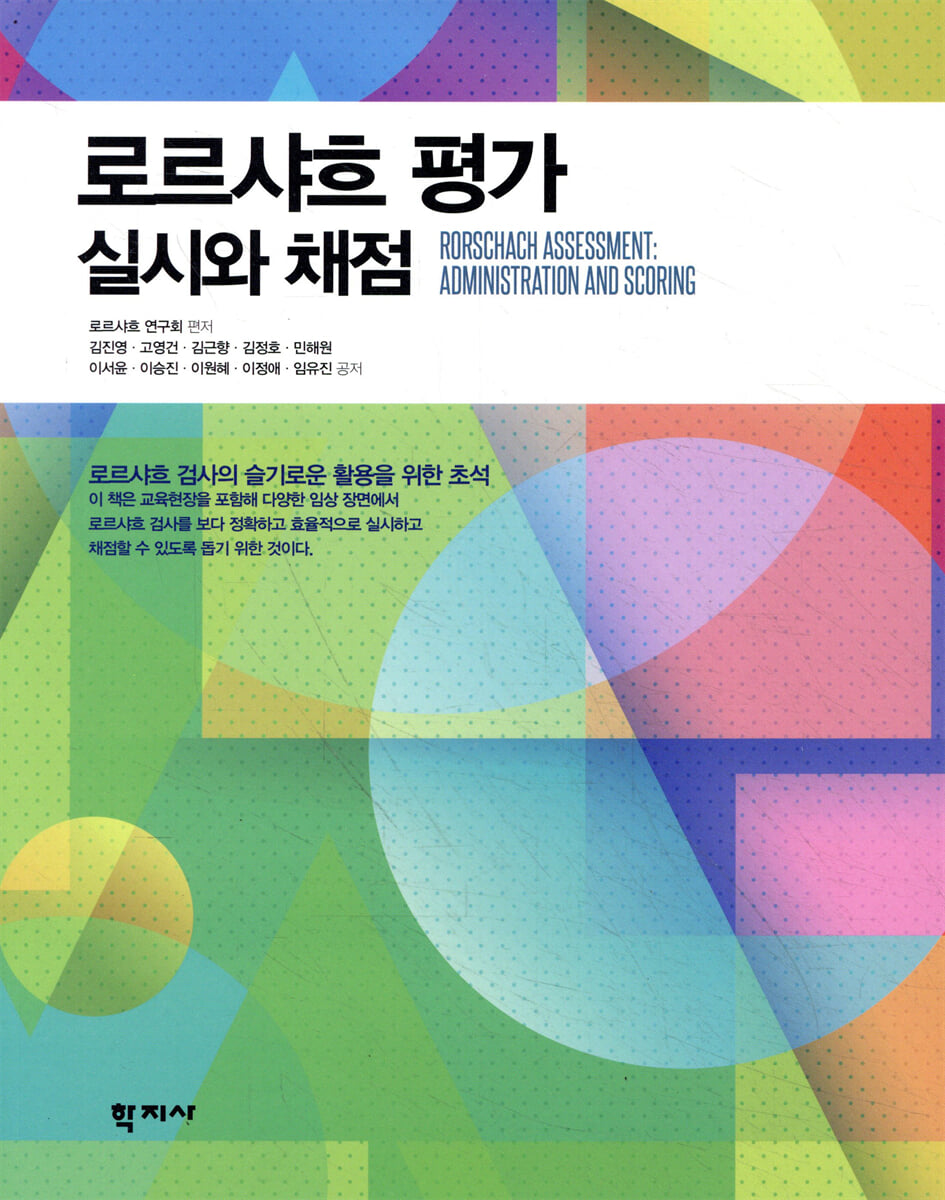
This book was written by the Rorschach Research Group of the Korean Clinical Psychology Association to commemorate the 100th anniversary of the publication of the Rorschach test, one of the representative psychological tests, and to increase the usability of the test.
Overseas, in 1997, John E.
The Rorschach Research Council (RRC) was established under the leadership of Exner, and even after his death, many researchers are actively conducting various studies to develop the Rorschach test.
However, unfortunately, research on the Rorschach test is insufficient in Korea to the point that there are no official standards for it.
Accordingly, the Rorschach Research Group seeks to contribute to clinical practice and society by developing and inheriting the clinical value that only the Rorschach test possesses.
This book refines the standards for administering and scoring the Rorschach test, enabling more efficient administration and scoring of the test in various clinical settings, including educational settings.
Overseas, in 1997, John E.
The Rorschach Research Council (RRC) was established under the leadership of Exner, and even after his death, many researchers are actively conducting various studies to develop the Rorschach test.
However, unfortunately, research on the Rorschach test is insufficient in Korea to the point that there are no official standards for it.
Accordingly, the Rorschach Research Group seeks to contribute to clinical practice and society by developing and inheriting the clinical value that only the Rorschach test possesses.
This book refines the standards for administering and scoring the Rorschach test, enabling more efficient administration and scoring of the test in various clinical settings, including educational settings.
index
preface
Acknowledgements
Part 1: Administering and Scoring the Rorschach Assessment
Chapter 1: Procedure for Conducting the Rorschach Assessment
1.
Considerations Before Conducting an Inspection
1) Are you an evaluator who can administer the Rorschach test?
2) Is the examinee suitable for administering the Rorschach test?
3) Rorschach test administration order and individual administration
2.
Preparing for the inspection
1) Inspection environment
2) Preparation
3) Confirm the examinee's characteristics
3.
Inspection in progress
1) Start inspection
2) Reaction stage
3) Question stage
4) Limit verification
Chapter 2 Scoring the Rorschach Assessment I: Response Domain, Developmental Quality, and Determinants
1.
Reaction area
1) W
2) D
3) Dd
4) S
5) Response area symbol when two or more areas are used
2.
developmental stage
3.
Decisive person
1) Prominence of form expression in decision
2) Exercise (M, FM, m)
3) Colored oils (C, CF, FC, Cn)
4) Achromatic (C′, C′F, FC′)
5) Shading material (T, TF, FT)
6) Shading dimensions (V, VF, FV)
7) Shading diffusion (Y, YF, FY)
8) Form dimension (FD)
9) Paired reactions (2) and reflex reactions (Fr, rF)
10) Form (F)
11) Complex decision: Mixed reaction
Chapter 3 Scoring the Rorschach Assessment II: Morphology, Response Content, Ordinary Responses, and Organizational Activity
1.
Morphology
1) Morphological scoring criteria
2) Morphological scoring by extrapolation
3) Morphological scoring for responses involving multiple targets
2.
Response content
3.
Normal reaction
4.
Organizational activities
Chapter 4 Scoring the Rorschach Assessment III: Special Scores
1.
rare verbal response
1) Distinction between Level 1 and Level 2
2) Deviant language (DV, DR)
3) Inappropriate combinations (INCOM, FABCOM, CONTAM)
4) Inappropriate logic (ALOG)
2.
Perseverative response (PSV)
3.
Special contents
1) Abstract content (AB)
2) Aggressive Movement (AG)
3) Cooperative Action Plan (COP)
4) Pathological content (MOR)
4.
Personalized Response (PER)
5.
Special color phenomenon: color projection (CP)
6.
Human representational response (GHR, PHR)
7.
When multiple special scores apply
Part 2: Learning Check-Up Quiz and Grading Practice
Chapter 5 Learning Check Quiz
Chapter 6 Grading Practice
1.
Practice problems
2.
Practice problems
Americas
Search
Acknowledgements
Part 1: Administering and Scoring the Rorschach Assessment
Chapter 1: Procedure for Conducting the Rorschach Assessment
1.
Considerations Before Conducting an Inspection
1) Are you an evaluator who can administer the Rorschach test?
2) Is the examinee suitable for administering the Rorschach test?
3) Rorschach test administration order and individual administration
2.
Preparing for the inspection
1) Inspection environment
2) Preparation
3) Confirm the examinee's characteristics
3.
Inspection in progress
1) Start inspection
2) Reaction stage
3) Question stage
4) Limit verification
Chapter 2 Scoring the Rorschach Assessment I: Response Domain, Developmental Quality, and Determinants
1.
Reaction area
1) W
2) D
3) Dd
4) S
5) Response area symbol when two or more areas are used
2.
developmental stage
3.
Decisive person
1) Prominence of form expression in decision
2) Exercise (M, FM, m)
3) Colored oils (C, CF, FC, Cn)
4) Achromatic (C′, C′F, FC′)
5) Shading material (T, TF, FT)
6) Shading dimensions (V, VF, FV)
7) Shading diffusion (Y, YF, FY)
8) Form dimension (FD)
9) Paired reactions (2) and reflex reactions (Fr, rF)
10) Form (F)
11) Complex decision: Mixed reaction
Chapter 3 Scoring the Rorschach Assessment II: Morphology, Response Content, Ordinary Responses, and Organizational Activity
1.
Morphology
1) Morphological scoring criteria
2) Morphological scoring by extrapolation
3) Morphological scoring for responses involving multiple targets
2.
Response content
3.
Normal reaction
4.
Organizational activities
Chapter 4 Scoring the Rorschach Assessment III: Special Scores
1.
rare verbal response
1) Distinction between Level 1 and Level 2
2) Deviant language (DV, DR)
3) Inappropriate combinations (INCOM, FABCOM, CONTAM)
4) Inappropriate logic (ALOG)
2.
Perseverative response (PSV)
3.
Special contents
1) Abstract content (AB)
2) Aggressive Movement (AG)
3) Cooperative Action Plan (COP)
4) Pathological content (MOR)
4.
Personalized Response (PER)
5.
Special color phenomenon: color projection (CP)
6.
Human representational response (GHR, PHR)
7.
When multiple special scores apply
Part 2: Learning Check-Up Quiz and Grading Practice
Chapter 5 Learning Check Quiz
Chapter 6 Grading Practice
1.
Practice problems
2.
Practice problems
Americas
Search
GOODS SPECIFICS
- Date of issue: February 28, 2023
- Page count, weight, size: 227 pages | 452g | 188*236*11mm
- ISBN13: 9788999728778
- ISBN10: 8999728773
You may also like
카테고리
korean


korean

![GQ KOREA Mark (Monthly): December [2025]](http://librairie.coreenne.fr/cdn/shop/files/8ef265dbbfbf186523ed75ba7319009d.jpg?v=1765340328&width=3840)


