

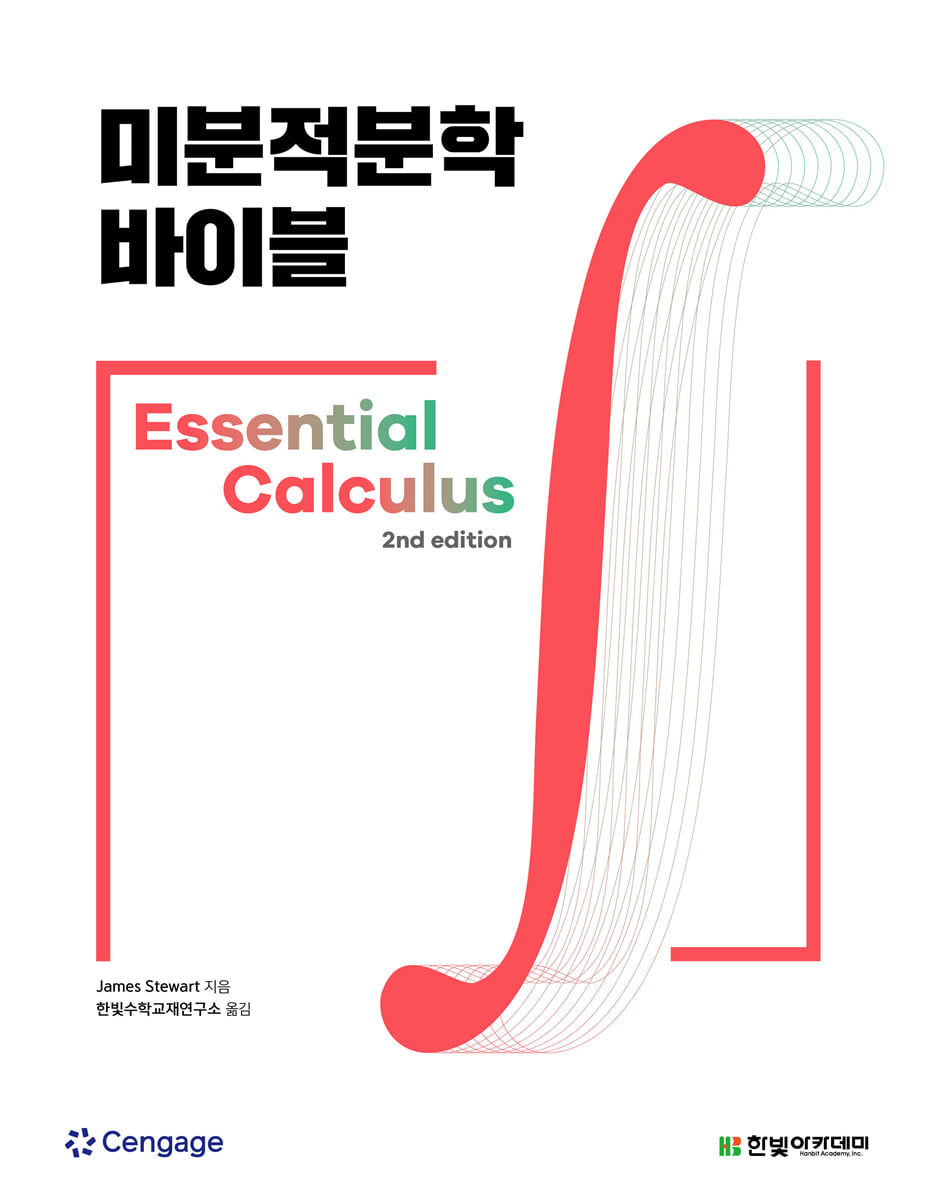
Calculus Bible
 |
Description
Book Introduction
A book that will help you successfully study differential and integral calculus.
Learn the most complete way with verified content!
This is a calculus textbook written by James Stewart, a best-selling author in the field of calculus, and is aimed at students in science and engineering fields.
You can systematically learn the basic and comprehensive contents of differentiation and integration with content that has already been verified as much as the author's reputation.
The content is clear, accurate, and full of relevant, real-world examples.
In particular, this book presents a clear approach to learning calculus by focusing on key concepts.
At the same time, such concepts are supplemented by precise definitions, faithful explanations, and carefully graded problems.
Learn the most complete way with verified content!
This is a calculus textbook written by James Stewart, a best-selling author in the field of calculus, and is aimed at students in science and engineering fields.
You can systematically learn the basic and comprehensive contents of differentiation and integration with content that has already been verified as much as the author's reputation.
The content is clear, accurate, and full of relevant, real-world examples.
In particular, this book presents a clear approach to learning calculus by focusing on key concepts.
At the same time, such concepts are supplemented by precise definitions, faithful explanations, and carefully graded problems.
- You can preview some of the book's contents.
Preview
index
Chapter 1.
Functions and limits
1.1 Definition and expression of functions
1.2 List of essential functions
1.3 Limits of functions
1.4 Limit Calculations
1.5 Continuity
1.6 Limits involving infinity
Review questions
Chapter 2.
derivative
2.1 Differential coefficient and rate of change
2.2 Derivatives as functions
2.3 Basic Differentiation Formulas
2.4 Multiplication and Division Rules
2.5 Chain Law
2.6 Differentiation of implicit functions
2.7 Related ratio
2.8 Linear approximation and differentiation
Review questions
Chapter 3.
Applications of derivatives
3.1 Maximum and Minimum Values
3.2 Mean value theorem
3.3 Derivatives and the shape of their graphs
3.4 Drawing a curve
3.5 Optimization Problem
3.6 Newton's method
3.7 Inverse derivatives
Review questions
Chapter 4.
integral
4.1 Area and distance
4.2 Definite integral
4.3 Calculating definite integrals
4.4 Fundamental Theorem of Calculus
4.5 Substitution method
Review questions
Chapter 5.
Inverse functions: exponential functions, logarithmic functions, inverse trigonometric functions
5.1 Inverse functions
5.2 Natural logarithm function
5.3 Natural exponential function
5.4 General logarithmic and exponential functions
5.5 Exponential Growth and Collapse
5.6 Inverse trigonometric functions
5.7 Hyperbolic functions
5.8 Indefinite Forms and L'Hopital's Rule
Review questions
Chapter 6.
Integration method
6.1 Integration by parts
6.2 Trigonometric integration and trigonometric substitution
6.3 Partial fraction method
6.4 Integral Tables and Computer Algebra
6.5 Approximate integration
6.6 Ideal integral
Review questions
Chapter 7.
Applications of integration
7.1 Area between curves
7.2 Volume
7.3 Volume by cylindrical shell
7.4 Length of the arc
7.5 Surface area of a solid of revolution
7.6 Applications to Physics and Engineering
7.7 Differential Equations
Review questions
Chapter 8.
water supply
8.1 Sequences
8.2 series
8.3 Integral and comparative judgment methods
8.4 Other convergence tests
8.5 Power series
8.6 Expressing a function as a power series
8.7 Taylor series and Maclaurin series
8.8 Applications of Taylor polynomials
Review questions
Chapter 9.
Parametric equations and polar coordinates
9.1 Parametric Curve
9.2 Calculus for parametric curves
9.3 Polar Coordinates
9.4 Area and length in polar coordinates
9.5 Conic sections in polar coordinates
Review questions
Chapter 10.
Vectors and spatial geometry
10.1 Three-dimensional coordinate system
10.2 Vectors
10.3 Inner product
10.4 External product
10.5 Equations of lines and planes
10.6 Column surfaces and quadratic surfaces
10.7 Vector functions and space curves
Length and curvature of arc 10.8
10.9 Motion in Space: Velocity and Acceleration
Review questions
Chapter 11.
partial derivative
11.1 Multivariable functions
11.2 Limits and Continuity
11.3 Partial derivatives
11.4 Tangent planes and linear approximations
11.5 Chain Law
11.6 Directional Derivatives and Slope Vectors
11.7 Maximum and Minimum Values
11.8 Lagrange multipliers
Review questions
Chapter 12.
double integral
12.1 Double integrals in rectangular domains
12.2 Double integrals in general domains
12.3 Double integral in polar coordinates
12.4 Applications of Double Integrals
12.5 Triple Integral
12.6 Triple integral in cylindrical coordinates
12.7 Triple integral in spherical coordinates
12.8 Variable transformation in double integrals
Review questions
Chapter 13.
Vector analysis
13.1 Vector fields
13.2 Line integral
13.3 Fundamental Theorem of Line Integrals
13.4 Green's Theorem
13.5 Rotation and Divergence
13.6 Parametric surfaces and their areas
13.7 Area
13.8 Stokes' theorem
13.9 Divergence Theorem
Review questions
supplement
A Trigonometry
B sigma symbol
C proofs
D integral table
Search
Functions and limits
1.1 Definition and expression of functions
1.2 List of essential functions
1.3 Limits of functions
1.4 Limit Calculations
1.5 Continuity
1.6 Limits involving infinity
Review questions
Chapter 2.
derivative
2.1 Differential coefficient and rate of change
2.2 Derivatives as functions
2.3 Basic Differentiation Formulas
2.4 Multiplication and Division Rules
2.5 Chain Law
2.6 Differentiation of implicit functions
2.7 Related ratio
2.8 Linear approximation and differentiation
Review questions
Chapter 3.
Applications of derivatives
3.1 Maximum and Minimum Values
3.2 Mean value theorem
3.3 Derivatives and the shape of their graphs
3.4 Drawing a curve
3.5 Optimization Problem
3.6 Newton's method
3.7 Inverse derivatives
Review questions
Chapter 4.
integral
4.1 Area and distance
4.2 Definite integral
4.3 Calculating definite integrals
4.4 Fundamental Theorem of Calculus
4.5 Substitution method
Review questions
Chapter 5.
Inverse functions: exponential functions, logarithmic functions, inverse trigonometric functions
5.1 Inverse functions
5.2 Natural logarithm function
5.3 Natural exponential function
5.4 General logarithmic and exponential functions
5.5 Exponential Growth and Collapse
5.6 Inverse trigonometric functions
5.7 Hyperbolic functions
5.8 Indefinite Forms and L'Hopital's Rule
Review questions
Chapter 6.
Integration method
6.1 Integration by parts
6.2 Trigonometric integration and trigonometric substitution
6.3 Partial fraction method
6.4 Integral Tables and Computer Algebra
6.5 Approximate integration
6.6 Ideal integral
Review questions
Chapter 7.
Applications of integration
7.1 Area between curves
7.2 Volume
7.3 Volume by cylindrical shell
7.4 Length of the arc
7.5 Surface area of a solid of revolution
7.6 Applications to Physics and Engineering
7.7 Differential Equations
Review questions
Chapter 8.
water supply
8.1 Sequences
8.2 series
8.3 Integral and comparative judgment methods
8.4 Other convergence tests
8.5 Power series
8.6 Expressing a function as a power series
8.7 Taylor series and Maclaurin series
8.8 Applications of Taylor polynomials
Review questions
Chapter 9.
Parametric equations and polar coordinates
9.1 Parametric Curve
9.2 Calculus for parametric curves
9.3 Polar Coordinates
9.4 Area and length in polar coordinates
9.5 Conic sections in polar coordinates
Review questions
Chapter 10.
Vectors and spatial geometry
10.1 Three-dimensional coordinate system
10.2 Vectors
10.3 Inner product
10.4 External product
10.5 Equations of lines and planes
10.6 Column surfaces and quadratic surfaces
10.7 Vector functions and space curves
Length and curvature of arc 10.8
10.9 Motion in Space: Velocity and Acceleration
Review questions
Chapter 11.
partial derivative
11.1 Multivariable functions
11.2 Limits and Continuity
11.3 Partial derivatives
11.4 Tangent planes and linear approximations
11.5 Chain Law
11.6 Directional Derivatives and Slope Vectors
11.7 Maximum and Minimum Values
11.8 Lagrange multipliers
Review questions
Chapter 12.
double integral
12.1 Double integrals in rectangular domains
12.2 Double integrals in general domains
12.3 Double integral in polar coordinates
12.4 Applications of Double Integrals
12.5 Triple Integral
12.6 Triple integral in cylindrical coordinates
12.7 Triple integral in spherical coordinates
12.8 Variable transformation in double integrals
Review questions
Chapter 13.
Vector analysis
13.1 Vector fields
13.2 Line integral
13.3 Fundamental Theorem of Line Integrals
13.4 Green's Theorem
13.5 Rotation and Divergence
13.6 Parametric surfaces and their areas
13.7 Area
13.8 Stokes' theorem
13.9 Divergence Theorem
Review questions
supplement
A Trigonometry
B sigma symbol
C proofs
D integral table
Search
Publisher's Review
[Book Features]
* We have tried to translate the original text as faithfully and accurately as possible.
* It contains many applications to social sciences including natural sciences, engineering, and medicine, in addition to the traditional curriculum of mathematics.
* Rather than simply describing the contents of differential and integral calculus, it explains the principles for problem solving and their applications in a detailed and friendly manner.
* For engineering students, it cultivates programming skills by providing them with essential calculators or programs such as Maple and Mathematica.
* The extensive content of differential and integral calculus has been decentralized into Volumes I and II to reduce the burden of volume and increase portability.
[What this book covers]
Chapter 1: We will look at how function values change and how they approach limits.
Chapter 2 We study a special type of limit called the derivative.
Chapter 3 Learn how derivatives affect the shape of a function's graph, and in particular how they help determine the locations of a function's maxima and minima.
Chapter 4 starts with the problem of area and distance and formalizes the concept of definite integral, which is the basic concept of integral calculus.
A common theme in the functions covered in Chapter 5 is that functions appear in pairs with their inverse functions.
Chapter 6 We will use basic integral formulas to find the indefinite integral of more complex functions.
Chapter 7 Explores several applications of definite integrals by using them to calculate the area between curves, the volume of solids, the length of curves, the work done by a varying force, the center of gravity of a thin plate, and the force on a dam.
Chapter 8 Integrating a function is done by first expressing the function as a series and then integrating each term of the series.
Chapter 9 We explore two new methods for describing curves.
Chapter 10 introduces vectors and coordinate systems for three-dimensional space.
Chapter 11: Extends the basic concepts of differential calculus to multivariable functions.
Chapter 12 Extends the concept of definite integrals to double and triple integrals of functions of two or three variables.
Chapter 13: Study the differential and integral calculus of vector fields.
* We have tried to translate the original text as faithfully and accurately as possible.
* It contains many applications to social sciences including natural sciences, engineering, and medicine, in addition to the traditional curriculum of mathematics.
* Rather than simply describing the contents of differential and integral calculus, it explains the principles for problem solving and their applications in a detailed and friendly manner.
* For engineering students, it cultivates programming skills by providing them with essential calculators or programs such as Maple and Mathematica.
* The extensive content of differential and integral calculus has been decentralized into Volumes I and II to reduce the burden of volume and increase portability.
[What this book covers]
Chapter 1: We will look at how function values change and how they approach limits.
Chapter 2 We study a special type of limit called the derivative.
Chapter 3 Learn how derivatives affect the shape of a function's graph, and in particular how they help determine the locations of a function's maxima and minima.
Chapter 4 starts with the problem of area and distance and formalizes the concept of definite integral, which is the basic concept of integral calculus.
A common theme in the functions covered in Chapter 5 is that functions appear in pairs with their inverse functions.
Chapter 6 We will use basic integral formulas to find the indefinite integral of more complex functions.
Chapter 7 Explores several applications of definite integrals by using them to calculate the area between curves, the volume of solids, the length of curves, the work done by a varying force, the center of gravity of a thin plate, and the force on a dam.
Chapter 8 Integrating a function is done by first expressing the function as a series and then integrating each term of the series.
Chapter 9 We explore two new methods for describing curves.
Chapter 10 introduces vectors and coordinate systems for three-dimensional space.
Chapter 11: Extends the basic concepts of differential calculus to multivariable functions.
Chapter 12 Extends the concept of definite integrals to double and triple integrals of functions of two or three variables.
Chapter 13: Study the differential and integral calculus of vector fields.
GOODS SPECIFICS
- Date of issue: March 1, 2018
- Page count, weight, size: 948 pages | 210*270*40mm
- ISBN13: 9791156646143
- ISBN10: 1156646146
You may also like
카테고리
korean


korean

![GQ KOREA Mark (Monthly): December [2025]](http://librairie.coreenne.fr/cdn/shop/files/8ef265dbbfbf186523ed75ba7319009d.jpg?v=1765340328&width=3840)


