

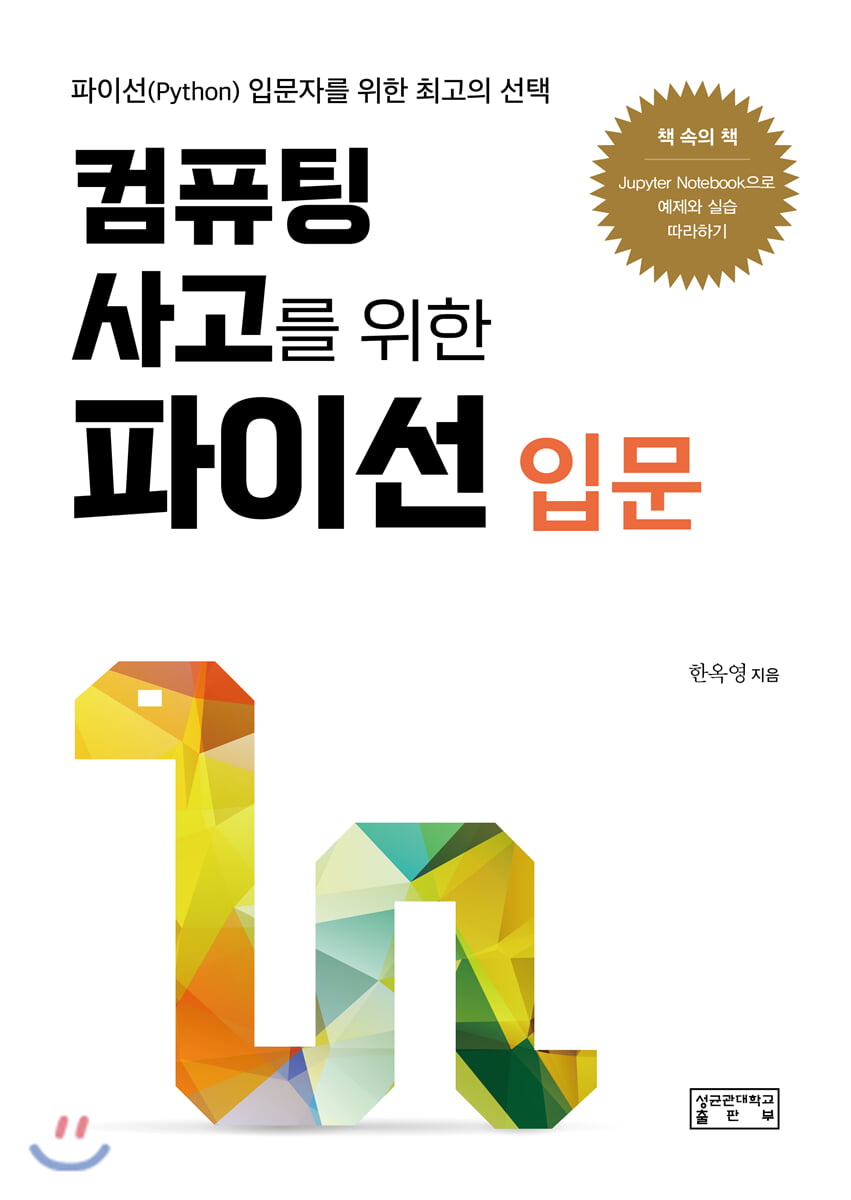
Introduction to Python for Computational Thinking
 |
Description
Book Introduction
Python is a programming language that any data science expert or big data analyst should know.
This book is based on the author's experience teaching essential liberal arts and data science courses, combining theory and practice, and compiling only the essentials in connection with computational thinking.
It is systematically organized so that anyone can easily read, understand the concepts, follow the program, and study.
This book is based on the author's experience teaching essential liberal arts and data science courses, combining theory and practice, and compiling only the essentials in connection with computational thinking.
It is systematically organized so that anyone can easily read, understand the concepts, follow the program, and study.
index
preface
Book structure
Chapter 1: Introduction to Python
01 What is Python? / 02 Installing Python / 03 Running Python / 04 Python Grammar / 05 Python Program Structure / 06 Python's Capabilities
· Practice problems
Chapter 2 Input and Output
01 Standard input function / 02 Standard output function / 03 Turtle input/output processing
· Practice problems
Chapter 3 Variables and Basic Data Types
01 Understanding Variables / 02 Basic Data Types / 03 Creating and Deleting Variables
· Practice problems
Chapter 4 String Data
01 String Data Types / 02 Indexing and Slicing / 03 String Modification / 04 String Formatting
· Practice problems
Chapter 5 Collection Data Types
01 List / 02 Tuple / 03 Dictionary
· Practice problems
Chapter 6 Operators
01 Arithmetic Operators / 02 Relational Operators / 03 Logical Operators
· Practice problems
Chapter 7 Control Statements
01 Sequential statement / 02 Selection statement / 03 Loop statement
· Practice problems
Chapter 8 if statement
01 Simple if statement / 02 if ~ else statement / 03 if ~ elif statement / 04 Nested if statement
· Practice problems
Chapter 9: For Loop
01 for loop grammar / 02 continue loop / 03 break loop / 04 nested for loop
· Practice problems
Chapter 10: While Loop
01 while loop grammar / 02 infinite loop / 03 while ~ else / 04 nested while loop
· Practice problems
Chapter 11 Functions
01 Understanding Functions / 02 Function Arguments / 03 Lambda Functions / 04 Variable Scope
· Practice problems
Chapter 12: Using Modules
01 Understanding Modules / 02 Understanding Packages
· Practice problems
Chapter 13: Tkinter for GUIs
01 Understanding GUI / 02 Image Labe / 03 Button
· Practice problems
Chapter 14 File Input/Output
01 File input / 02 File output
· Practice problems
A Book Within a Book: Follow along with examples and practice exercises using Jupyter Notebooks.
Book structure
Chapter 1: Introduction to Python
01 What is Python? / 02 Installing Python / 03 Running Python / 04 Python Grammar / 05 Python Program Structure / 06 Python's Capabilities
· Practice problems
Chapter 2 Input and Output
01 Standard input function / 02 Standard output function / 03 Turtle input/output processing
· Practice problems
Chapter 3 Variables and Basic Data Types
01 Understanding Variables / 02 Basic Data Types / 03 Creating and Deleting Variables
· Practice problems
Chapter 4 String Data
01 String Data Types / 02 Indexing and Slicing / 03 String Modification / 04 String Formatting
· Practice problems
Chapter 5 Collection Data Types
01 List / 02 Tuple / 03 Dictionary
· Practice problems
Chapter 6 Operators
01 Arithmetic Operators / 02 Relational Operators / 03 Logical Operators
· Practice problems
Chapter 7 Control Statements
01 Sequential statement / 02 Selection statement / 03 Loop statement
· Practice problems
Chapter 8 if statement
01 Simple if statement / 02 if ~ else statement / 03 if ~ elif statement / 04 Nested if statement
· Practice problems
Chapter 9: For Loop
01 for loop grammar / 02 continue loop / 03 break loop / 04 nested for loop
· Practice problems
Chapter 10: While Loop
01 while loop grammar / 02 infinite loop / 03 while ~ else / 04 nested while loop
· Practice problems
Chapter 11 Functions
01 Understanding Functions / 02 Function Arguments / 03 Lambda Functions / 04 Variable Scope
· Practice problems
Chapter 12: Using Modules
01 Understanding Modules / 02 Understanding Packages
· Practice problems
Chapter 13: Tkinter for GUIs
01 Understanding GUI / 02 Image Labe / 03 Button
· Practice problems
Chapter 14 File Input/Output
01 File input / 02 File output
· Practice problems
A Book Within a Book: Follow along with examples and practice exercises using Jupyter Notebooks.
Publisher's Review
Software! It's no longer optional, it's essential.
The great change called the 'Fourth Industrial Revolution' is already unfolding before our eyes.
The world is changing rapidly, and countries around the world are investing heavily in software education.
This can be said to be a variety of processes that appear as the world's paradigm shifts toward a software-centered society.
Our country is no exception, and software-related subjects have already been designated as compulsory subjects in elementary school, and are also designated as required liberal arts subjects in universities.
Understanding software is no longer optional, it's essential! All work in the workplace relies on software, and futurists even predict that many existing jobs will disappear due to software advancements.
Therefore, in these times, the ability to understand and create software is essential.
- Python, the most popular programming language today
To create software, you need to use a programming language.
There are many programming languages in the world, but the one that has recently gained the most attention and is loved by many developers is definitely Python.
This book focuses on making it easy and simple to learn by connecting it to real-life problems if you want to write software using Python.
I hope this will be helpful to all beginners of the program and I have tried to organize it systematically.
Python is a programming language that any data science expert or big data analyst should know.
This book is based on the author's experience teaching essential liberal arts and data science courses, combining theory and practice, and compiling only the essentials in connection with computational thinking.
It is systematically organized so that anyone can easily read, understand the concepts, follow the program, and study.
With this book, anyone can take the first step toward mastering Python.
In particular, it will be of great help to simply follow the examples and exercises in the “Book within a Book” included in the appendix.
- Python for developing computational thinking
Furthermore, we must remember that developing software is not simply about learning the grammar of a programming language, but about training our thought processes.
In other words, in order to solve a problem using software, a fundamental problem-solving thought process is needed to determine how to present the problem-solving process.
This kind of thinking is called 'computational thinking'.
This book details the computational thinking applied to solve each problem, helping you identify which thinking skills you are strengthening through your studies.
★ Explanation based on examples: It is structured so that you can learn Python coding methods on your own through various examples.
In order to develop thinking skills, the thinking skills applied to each were specifically mentioned.
We have also tried to increase the comprehension of the content by including the results of the presented examples and practice codes so that you can learn while checking the results.
Python applies different colors to different purposes, so the expression of colors is important so that you can determine for yourself what purpose the content is used.
★ Use of the spyder program to understand the program's procedures and flow at a glance: We tried to develop algorithmic thinking skills while learning content with line numbers applied.
★ Presenting problems related to real life: We aimed to write examples and practice problems related to real life, not just examples for the sake of simple examples, and structured it so that you can develop programming skills that can be applied to real life, not just study coding.
★ Added practice problems for each unit: This helps develop creative problem-solving skills.
★ Special appendix, a book within a book: This book presents a way to learn Python by following along using Jupyter notebook, which allows you to check the environment in which you can work on a project together and the immediate results of program execution.
The great change called the 'Fourth Industrial Revolution' is already unfolding before our eyes.
The world is changing rapidly, and countries around the world are investing heavily in software education.
This can be said to be a variety of processes that appear as the world's paradigm shifts toward a software-centered society.
Our country is no exception, and software-related subjects have already been designated as compulsory subjects in elementary school, and are also designated as required liberal arts subjects in universities.
Understanding software is no longer optional, it's essential! All work in the workplace relies on software, and futurists even predict that many existing jobs will disappear due to software advancements.
Therefore, in these times, the ability to understand and create software is essential.
- Python, the most popular programming language today
To create software, you need to use a programming language.
There are many programming languages in the world, but the one that has recently gained the most attention and is loved by many developers is definitely Python.
This book focuses on making it easy and simple to learn by connecting it to real-life problems if you want to write software using Python.
I hope this will be helpful to all beginners of the program and I have tried to organize it systematically.
Python is a programming language that any data science expert or big data analyst should know.
This book is based on the author's experience teaching essential liberal arts and data science courses, combining theory and practice, and compiling only the essentials in connection with computational thinking.
It is systematically organized so that anyone can easily read, understand the concepts, follow the program, and study.
With this book, anyone can take the first step toward mastering Python.
In particular, it will be of great help to simply follow the examples and exercises in the “Book within a Book” included in the appendix.
- Python for developing computational thinking
Furthermore, we must remember that developing software is not simply about learning the grammar of a programming language, but about training our thought processes.
In other words, in order to solve a problem using software, a fundamental problem-solving thought process is needed to determine how to present the problem-solving process.
This kind of thinking is called 'computational thinking'.
This book details the computational thinking applied to solve each problem, helping you identify which thinking skills you are strengthening through your studies.
★ Explanation based on examples: It is structured so that you can learn Python coding methods on your own through various examples.
In order to develop thinking skills, the thinking skills applied to each were specifically mentioned.
We have also tried to increase the comprehension of the content by including the results of the presented examples and practice codes so that you can learn while checking the results.
Python applies different colors to different purposes, so the expression of colors is important so that you can determine for yourself what purpose the content is used.
★ Use of the spyder program to understand the program's procedures and flow at a glance: We tried to develop algorithmic thinking skills while learning content with line numbers applied.
★ Presenting problems related to real life: We aimed to write examples and practice problems related to real life, not just examples for the sake of simple examples, and structured it so that you can develop programming skills that can be applied to real life, not just study coding.
★ Added practice problems for each unit: This helps develop creative problem-solving skills.
★ Special appendix, a book within a book: This book presents a way to learn Python by following along using Jupyter notebook, which allows you to check the environment in which you can work on a project together and the immediate results of program execution.
GOODS SPECIFICS
- Date of issue: March 13, 2020
- Page count, weight, size: 400 pages | 176*248*30mm
- ISBN13: 9791155504000
- ISBN10: 1155504003
You may also like
카테고리
korean


korean

![GQ KOREA Mark (Monthly): December [2025]](http://librairie.coreenne.fr/cdn/shop/files/8ef265dbbfbf186523ed75ba7319009d.jpg?v=1765340328&width=3840)


