

Atkins' Principles of Chemistry
 |
Description
Book Introduction
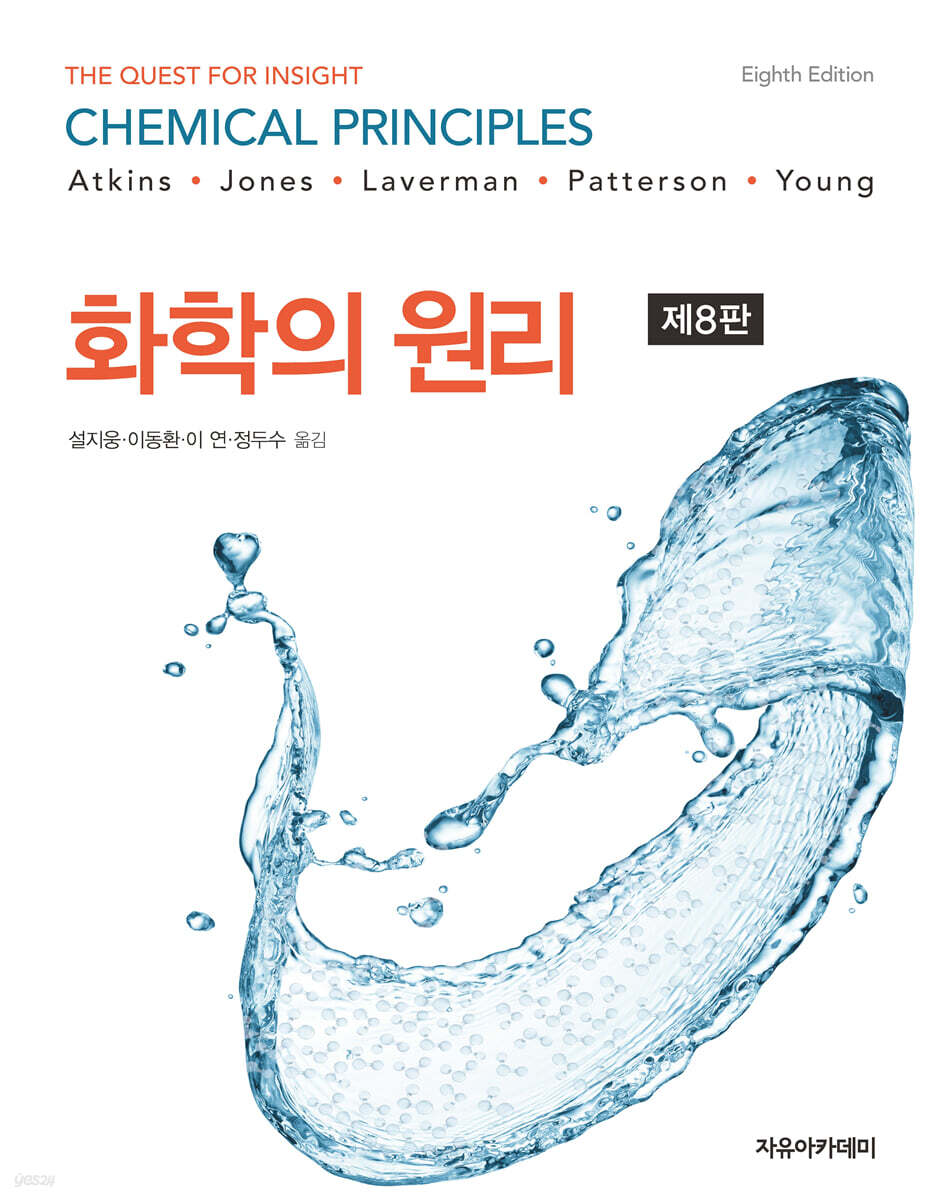
『Atkins Principles of Chemistry』 is a translation of the 8th edition of 『Chemical Principles: The Quest for Insight』, a book co-authored by Atkins, Jones, Laverman, Patterson, and Young. The authors have written it through several revisions to ensure that the basics of chemistry can be effectively understood.
The very first section of the book uniquely summarizes the fundamental concepts of chemistry into a single chapter titled "Basic Knowledge." This will be a great help to students from diverse backgrounds in the current high school curriculum, as it provides a first look at the fundamentals of chemistry they will learn in the future.
The rest of the text is divided into Focus 1, which deals with atoms, and Focus 10, which introduces organic chemistry.
The very first section of the book uniquely summarizes the fundamental concepts of chemistry into a single chapter titled "Basic Knowledge." This will be a great help to students from diverse backgrounds in the current high school curriculum, as it provides a first look at the fundamentals of chemistry they will learn in the future.
The rest of the text is divided into Focus 1, which deals with atoms, and Focus 10, which introduces organic chemistry.
- You can preview some of the book's contents.
Preview
index
grounding
Introduction and Orientation
A Matter and Energy
B elements and atoms
C compound
D nomenclature
E mole and molar mass
Find the F composition
G mixtures and solutions
H chemical reaction equation
I Precipitation reaction
J Acids and Bases
K oxidation-reduction reaction
L reaction stoichiometry
M limiting reactant
Focus 1 Atoms
Topic 1A Exploration of the Atom
Topic 1B Quantum Theory
Topic 1C Wavefunctions and Energy Levels
Topic 1D Hydrogen Atom
Topic 1E Multi-electron Atoms
Topic 1F Periodicity
Focus 1 Integrated Example
Focus 1 Practice Problems
Focus 2 Bonding of Atoms
Topic 2A Ionic Bonding
Topic 2B Covalent Bonding
Topic 2C Exceptions to the Eight-Electron Rule
Topic 2D Bonding Properties
Topic 2E VSEPR model
Topic 2F Valence Bond Theory
Topic 2G molecular orbital theory
Focus 2 Integration Example
Focus 2 Practice Problems
Focus 3 States of Matter
Topic 3A Properties of Gas
Topic 3B Application of the Gas Laws
Topic 3C Motion of Gas Molecules
Topic 3D Intermolecular Forces
Topic 3E Actual Aircraft
Topic 3F Liquid
Topic 3G solid
Focus 3 Integration Example
Focus 3 Practice Problems
Focus 4 Thermodynamics
Topic 4A Internal Energy
Topic 4B Work and Heat
Topic 4C Enthalpy
Topic 4D Thermochemistry
Topic 4E Elements of Enthalpy
Topic 4F Entropy
Topic 4G Molecular Interpretation of Entropy
Topic 4H Absolute Entropy
Topic 4I Overall Change in Entropy
Topic 4J Gibbs Free Energy
Focus 4 Integration Example
Focus 4 Practice Problems
Focus 5 Balance
Topic 5A Steam Pressure
Topic 5B Phase equilibrium of a single-component system
Topic 5C Phase Equilibrium of Binary Systems
Topic 5D Solubility
Topic 5E Generality
Topic 5F Chemical Equilibrium
Topic: Other Forms of 5G Equilibrium Constants
Topic 5H Equilibrium Calculation
Topic 5I: Equilibrium Response to Changing Conditions
Focus 5 Integration Example
Focus 5 Practice Questions
Focus 6 Reaction
Topic 6A Properties of Acids and Bases
Topic 6B Self-Protonation Reaction and pH
Topic 6C Weak Acids and Weak Bases
Topic 6D pH of aqueous solutions
Topic 6E Polyfunctional Acids and Bases
Topic 6F pH of very dilute solutions
Topic 6G Buffer Solution
Topic 6H Acid-Base Titration
Topic 6I Solubility Equilibrium
Topic 6J Sedimentation
Topic 6K Representing oxidation-reduction reactions
Topic 6L Galvanic Cell
Topic 6M Standard Potential
Topic 6N Application of Electrode Potential
Topic 6O Electrolysis
Focus 6 Integration Example
Focus 6 Practice Problems
Focus 7 Reaction Kinetics
Topic 7A Reaction Rate
Topic 7B Integral Rate Law
Topic 7C Reaction Mechanism
Topic 7D Theoretical Model for Reaction Rates
Topic 7E Catalysis
Focus 7 Integration Examples
Focus 7 Practice Questions
Focus 8 Materials
Topic 8A Periodic Trends
Topic 8B Hydrogen
Topic 8C Group 1: Alkali Metals 7
Topic 8D Group 2: Alkaline Earth Metals
Topic 8E Group 13: Boron Group
Topic 8F Group 14: Carbon Group
Topic 8G Group 15: Nitrogen Group
Topic 8H Group 16: Oxygen Group
Topic 8I Group 17: Halogens
Topic 8J Group 18: Noble Gases
Topic 8K d-block elements: an overview
Topic 8L coordination compounds
Electronic structure of Topic 8M d-metal complexes
Focus 8 Integration Examples
Focus 8 Practice Questions
Focus 9 Nuclear Chemistry
Topic 9A Nuclear Decay
Topic 9B Radiation
Topic 9C Nuclear Energy
Focus 9 Integration Examples
Focus 9 Practice Questions
Focus 10 Organic Chemistry
Topic 10A Structure of Aliphatic Hydrocarbons
Topic 10B Reactions of Aliphatic Hydrocarbons
Topic 10C Aromatic Compounds
Topic 10D General Functional Groups
Topic 10E Polymers and Biological Macromolecules
Focus 10 Integration Examples
Focus 10 Practice Questions
supplement
Appendix 1 Symbols, Units, and Mathematical
Appendix 2 Experimental Data
Appendix 3 Nomenclature
Search
Introduction and Orientation
A Matter and Energy
B elements and atoms
C compound
D nomenclature
E mole and molar mass
Find the F composition
G mixtures and solutions
H chemical reaction equation
I Precipitation reaction
J Acids and Bases
K oxidation-reduction reaction
L reaction stoichiometry
M limiting reactant
Focus 1 Atoms
Topic 1A Exploration of the Atom
Topic 1B Quantum Theory
Topic 1C Wavefunctions and Energy Levels
Topic 1D Hydrogen Atom
Topic 1E Multi-electron Atoms
Topic 1F Periodicity
Focus 1 Integrated Example
Focus 1 Practice Problems
Focus 2 Bonding of Atoms
Topic 2A Ionic Bonding
Topic 2B Covalent Bonding
Topic 2C Exceptions to the Eight-Electron Rule
Topic 2D Bonding Properties
Topic 2E VSEPR model
Topic 2F Valence Bond Theory
Topic 2G molecular orbital theory
Focus 2 Integration Example
Focus 2 Practice Problems
Focus 3 States of Matter
Topic 3A Properties of Gas
Topic 3B Application of the Gas Laws
Topic 3C Motion of Gas Molecules
Topic 3D Intermolecular Forces
Topic 3E Actual Aircraft
Topic 3F Liquid
Topic 3G solid
Focus 3 Integration Example
Focus 3 Practice Problems
Focus 4 Thermodynamics
Topic 4A Internal Energy
Topic 4B Work and Heat
Topic 4C Enthalpy
Topic 4D Thermochemistry
Topic 4E Elements of Enthalpy
Topic 4F Entropy
Topic 4G Molecular Interpretation of Entropy
Topic 4H Absolute Entropy
Topic 4I Overall Change in Entropy
Topic 4J Gibbs Free Energy
Focus 4 Integration Example
Focus 4 Practice Problems
Focus 5 Balance
Topic 5A Steam Pressure
Topic 5B Phase equilibrium of a single-component system
Topic 5C Phase Equilibrium of Binary Systems
Topic 5D Solubility
Topic 5E Generality
Topic 5F Chemical Equilibrium
Topic: Other Forms of 5G Equilibrium Constants
Topic 5H Equilibrium Calculation
Topic 5I: Equilibrium Response to Changing Conditions
Focus 5 Integration Example
Focus 5 Practice Questions
Focus 6 Reaction
Topic 6A Properties of Acids and Bases
Topic 6B Self-Protonation Reaction and pH
Topic 6C Weak Acids and Weak Bases
Topic 6D pH of aqueous solutions
Topic 6E Polyfunctional Acids and Bases
Topic 6F pH of very dilute solutions
Topic 6G Buffer Solution
Topic 6H Acid-Base Titration
Topic 6I Solubility Equilibrium
Topic 6J Sedimentation
Topic 6K Representing oxidation-reduction reactions
Topic 6L Galvanic Cell
Topic 6M Standard Potential
Topic 6N Application of Electrode Potential
Topic 6O Electrolysis
Focus 6 Integration Example
Focus 6 Practice Problems
Focus 7 Reaction Kinetics
Topic 7A Reaction Rate
Topic 7B Integral Rate Law
Topic 7C Reaction Mechanism
Topic 7D Theoretical Model for Reaction Rates
Topic 7E Catalysis
Focus 7 Integration Examples
Focus 7 Practice Questions
Focus 8 Materials
Topic 8A Periodic Trends
Topic 8B Hydrogen
Topic 8C Group 1: Alkali Metals 7
Topic 8D Group 2: Alkaline Earth Metals
Topic 8E Group 13: Boron Group
Topic 8F Group 14: Carbon Group
Topic 8G Group 15: Nitrogen Group
Topic 8H Group 16: Oxygen Group
Topic 8I Group 17: Halogens
Topic 8J Group 18: Noble Gases
Topic 8K d-block elements: an overview
Topic 8L coordination compounds
Electronic structure of Topic 8M d-metal complexes
Focus 8 Integration Examples
Focus 8 Practice Questions
Focus 9 Nuclear Chemistry
Topic 9A Nuclear Decay
Topic 9B Radiation
Topic 9C Nuclear Energy
Focus 9 Integration Examples
Focus 9 Practice Questions
Focus 10 Organic Chemistry
Topic 10A Structure of Aliphatic Hydrocarbons
Topic 10B Reactions of Aliphatic Hydrocarbons
Topic 10C Aromatic Compounds
Topic 10D General Functional Groups
Topic 10E Polymers and Biological Macromolecules
Focus 10 Integration Examples
Focus 10 Practice Questions
supplement
Appendix 1 Symbols, Units, and Mathematical
Appendix 2 Experimental Data
Appendix 3 Nomenclature
Search
Publisher's Review
'This textbook is a translation of the 8th edition of 『Chemical Principles: The Quest for Insight』, a book co-authored by Atkins, Jones, Laverman, Patterson, and Young. The authors have revised the book several times to ensure that the basics of chemistry can be effectively understood.
The very first section of the book uniquely summarizes the fundamental concepts of chemistry into a single chapter titled "Basic Knowledge." This will be a great help to students from diverse backgrounds in the current high school curriculum, as it provides a first look at the fundamentals of chemistry they will learn in the future.
The rest of the text is divided into Focus 1, which deals with atoms, and Focus 10, which introduces organic chemistry.
Each Focus summarizes what you will learn before you begin, provides reasons for learning, and provides examples connected to various real-world situations to increase motivation and check your direction.
Additionally, it is structured to help students easily understand through elements such as 'What does this equation mean?', 'Think about it', 'Notes', and 'Supplementary explanation'.
These features allow this book to maintain an appropriate level of difficulty while still maintaining interest, and as the original title suggests, it is an excellent textbook for gaining insight into chemistry.
However, various learning tools within the textbook, which were accessible through the website until the previous edition, have been changed to be included in a separate online learning program (Achieve) operated by the original publisher starting with the 8th edition.
Accordingly, some practice problems using these tools are difficult to use in a translation environment, so they have been omitted from the text. We ask for your understanding.
This textbook is not just a simple translation; it is a paraphrase to correct errors in the original text and clarify ambiguous parts, so there are parts that do not exactly match the original text.
In particular, the '4J.4 Temperature Effect' has been significantly revised, and the author confirms this.
Academic terminology follows the Korean Chemical Society's Chemical Glossary and the Organic and Inorganic Compound Nomenclature. Important concepts and summaries are emphasized in gothic or italic type, and proper nouns such as names are used in their original language.
Despite all efforts to make this a good translation, I believe there may be occasional confusion or mistranslations in terms.
We promise to continue to revise and improve these sections in the future, and if any revisions are made after publication, we will provide them in the data room of the Free Academy website (www.freeaca.com), so please refer to them.
We hope that this textbook will make chemistry more useful and enjoyable for students.
Lastly, I would like to thank the professors and staff of the Free Academy for their hard work.
The very first section of the book uniquely summarizes the fundamental concepts of chemistry into a single chapter titled "Basic Knowledge." This will be a great help to students from diverse backgrounds in the current high school curriculum, as it provides a first look at the fundamentals of chemistry they will learn in the future.
The rest of the text is divided into Focus 1, which deals with atoms, and Focus 10, which introduces organic chemistry.
Each Focus summarizes what you will learn before you begin, provides reasons for learning, and provides examples connected to various real-world situations to increase motivation and check your direction.
Additionally, it is structured to help students easily understand through elements such as 'What does this equation mean?', 'Think about it', 'Notes', and 'Supplementary explanation'.
These features allow this book to maintain an appropriate level of difficulty while still maintaining interest, and as the original title suggests, it is an excellent textbook for gaining insight into chemistry.
However, various learning tools within the textbook, which were accessible through the website until the previous edition, have been changed to be included in a separate online learning program (Achieve) operated by the original publisher starting with the 8th edition.
Accordingly, some practice problems using these tools are difficult to use in a translation environment, so they have been omitted from the text. We ask for your understanding.
This textbook is not just a simple translation; it is a paraphrase to correct errors in the original text and clarify ambiguous parts, so there are parts that do not exactly match the original text.
In particular, the '4J.4 Temperature Effect' has been significantly revised, and the author confirms this.
Academic terminology follows the Korean Chemical Society's Chemical Glossary and the Organic and Inorganic Compound Nomenclature. Important concepts and summaries are emphasized in gothic or italic type, and proper nouns such as names are used in their original language.
Despite all efforts to make this a good translation, I believe there may be occasional confusion or mistranslations in terms.
We promise to continue to revise and improve these sections in the future, and if any revisions are made after publication, we will provide them in the data room of the Free Academy website (www.freeaca.com), so please refer to them.
We hope that this textbook will make chemistry more useful and enjoyable for students.
Lastly, I would like to thank the professors and staff of the Free Academy for their hard work.
GOODS SPECIFICS
- Date of issue: January 5, 2025
- Page count, weight, size: 1,100 pages | 215*275*60mm
- ISBN13: 9791158086527
- ISBN10: 1158086520
You may also like
카테고리
korean


korean

![GQ KOREA Mark (Monthly): December [2025]](http://librairie.coreenne.fr/cdn/shop/files/8ef265dbbfbf186523ed75ba7319009d.jpg?v=1765340328&width=3840)


