

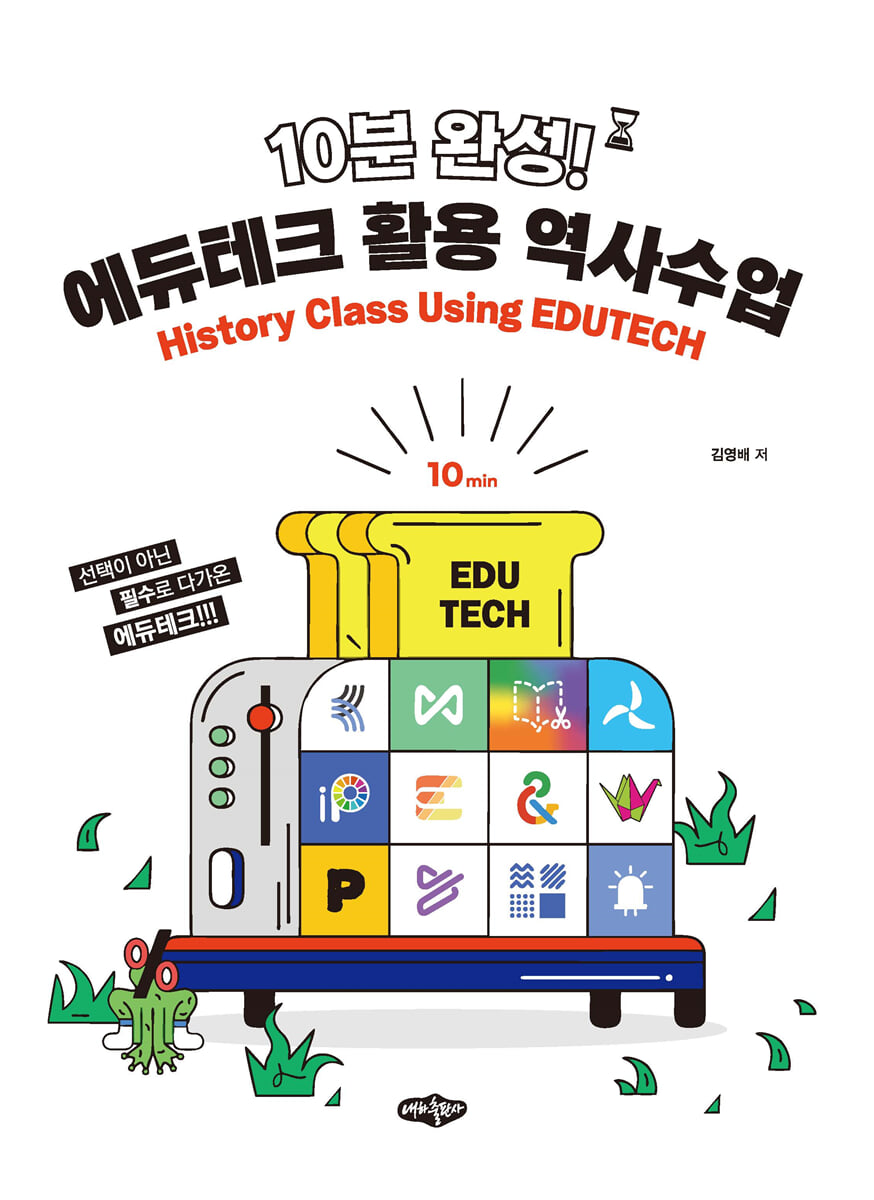
Complete in 10 Minutes! History Class Using EdTech
 |
Description
Book Introduction
EdTech is not a choice, it's a necessity!
Only the key features useful for classes - A useful reference for designing and operating classes using EdTech!
“A change that has already arrived”
Changes in the educational environment have always occurred, but recent changes are different in that they are faster and more extensive than before.
Science and technology are advancing rapidly, and edutech, which applies this technology to education, is constantly emerging and continuously changing and developing.
In the educational field, 'edutech' is now established as an essential educational method rather than an option.
"Capturing the Essence of History Classes in Technology"
EdTech has become a necessity, not an option, in the classroom. But how can we practice history classes that preserve the essence of history education? Amidst the turbulent changes brought about by the digital transformation, what can we do with technology in history classes? This book introduces edTech that can be utilized in various aspects of history classes and illustrates how these technologies can be applied in the classroom through actual classroom examples.
This sought to explore the direction of active instructional design, in which teachers select and use necessary technologies based on their subject expertise.
Additionally, by presenting simple core usage methods rather than specialized usage methods for each edutech, it was designed to be useful even for teachers who are still unfamiliar with edutech and have difficulty adapting to it.
This will be a useful and effective reference for teachers who are considering a more authentic history class that is not immersed in technology, or who are hesitant to use edutech in their classes due to limited access to technology.
Only the key features useful for classes - A useful reference for designing and operating classes using EdTech!
“A change that has already arrived”
Changes in the educational environment have always occurred, but recent changes are different in that they are faster and more extensive than before.
Science and technology are advancing rapidly, and edutech, which applies this technology to education, is constantly emerging and continuously changing and developing.
In the educational field, 'edutech' is now established as an essential educational method rather than an option.
"Capturing the Essence of History Classes in Technology"
EdTech has become a necessity, not an option, in the classroom. But how can we practice history classes that preserve the essence of history education? Amidst the turbulent changes brought about by the digital transformation, what can we do with technology in history classes? This book introduces edTech that can be utilized in various aspects of history classes and illustrates how these technologies can be applied in the classroom through actual classroom examples.
This sought to explore the direction of active instructional design, in which teachers select and use necessary technologies based on their subject expertise.
Additionally, by presenting simple core usage methods rather than specialized usage methods for each edutech, it was designed to be useful even for teachers who are still unfamiliar with edutech and have difficulty adapting to it.
This will be a useful and effective reference for teachers who are considering a more authentic history class that is not immersed in technology, or who are hesitant to use edutech in their classes due to limited access to technology.
- You can preview some of the book's contents.
Preview
index
Chapter 1.
Think
01.
Hallow - History unfolds before my eyes.
02.
South Korea Newspaper Archives - Gaining an Eye for History.
03.
Idrowmind - thoughts, going round and round.
04.
Art & Culture - Visit the world's largest museum.
Chapter 2.
write
05.
Edge - Reading history, writing history.
06.
Four-panel comics - History captured in four pictures.
07.
Canva - Designing history through real-time collaboration.
08.
Kealo Edu - Discussion classes using 'text'.
Chapter 3.
make
09.
Book Creator - Writing and composing history.
10.
Powtoon - Video is the trend for presentations too.
11.
Aiba - History, Born as an Audiobook.
12.
Ibis Paint X - Recognizing History Through Pop Art.
Chapter 4.
use
13.
Mentimeter/Paddlelet - Easy for anyone, anywhere.
14.
Puzzles - quizzes, brain teasers.
15.
Google Forms - Ask and Answer History.
Think
01.
Hallow - History unfolds before my eyes.
02.
South Korea Newspaper Archives - Gaining an Eye for History.
03.
Idrowmind - thoughts, going round and round.
04.
Art & Culture - Visit the world's largest museum.
Chapter 2.
write
05.
Edge - Reading history, writing history.
06.
Four-panel comics - History captured in four pictures.
07.
Canva - Designing history through real-time collaboration.
08.
Kealo Edu - Discussion classes using 'text'.
Chapter 3.
make
09.
Book Creator - Writing and composing history.
10.
Powtoon - Video is the trend for presentations too.
11.
Aiba - History, Born as an Audiobook.
12.
Ibis Paint X - Recognizing History Through Pop Art.
Chapter 4.
use
13.
Mentimeter/Paddlelet - Easy for anyone, anywhere.
14.
Puzzles - quizzes, brain teasers.
15.
Google Forms - Ask and Answer History.
Publisher's Review
Edutech is a compound word of education and technology, and the Ministry of Education defines it as "products and services that incorporate new technologies such as virtual reality, augmented reality, artificial intelligence, and big data into content, solutions, and systems to enhance educational effectiveness."
However, in our society, it is used in a broader sense, referring to all areas of innovation that improve the effectiveness of teaching and learning and provide new learning experiences for students.
“A change that has already arrived”
The COVID-19 pandemic that struck the world in 2019 brought about many changes in our lives.
The education sector has also been severely impacted by the pandemic, struggling to transition to digital education in a short period of time.
Although we have now entered the With Corona era, it seems unlikely that our society will return to its previous way of life even after the pandemic ends.
Rather, it seems that the digital transformation based on advanced technologies will accelerate further.
Digital classroom technologies, as experienced in the COVID-19 era, are no longer mere stopgap measures to overcome social distancing, but are now essential foundations for enhancing educational effectiveness.
This, coupled with the advancement of information and communication technology and the rapid proliferation of smart devices in the Fourth Industrial Revolution, is bringing about a massive, new paradigm shift across the entire field of education.
Changes in the educational environment have always occurred, but recent changes are different in that they are faster and more extensive than before.
Science and technology are advancing rapidly, and edutech, which applies this technology to education, is constantly emerging and continuously changing and evolving.
In the educational field, 'edutech' is now established as an essential educational method rather than an option.
Edtech isn't a panacea.
As such, today's schools are in a situation where they have no choice but to utilize edutech, or must do so.
There is even a sense that the policies of the Ministry of Education and the Office of Education seem to urge the mandatory use of edutech in classes.
Nevertheless, the essence of teaching and learning should be the content of the curriculum, not 'technology'.
If we focus too much on using new technology in our classes, we risk becoming obsessed with the technology itself, forgetting the essential meaning of why we're introducing new technology.
EdTech cannot be a panacea for education, and it should be used as a tool for the original purpose of education.
Many teachers are spending time, money, and effort learning and mastering new programs amidst the flood of edtech.
Furthermore, in a situation where the use of edutech itself is considered a 'good', some classrooms are creating a situation where the use of edutech in class is more important than the content of the class, putting the cart before the horse.
EdTech has become a necessity, not an option, in the classroom. But how can we practice history classes that retain the essence of history education? What is the proper and desirable way to utilize edTech as an educational tool, without being bound by technocratic methodologies that rely on the latest technology and expertise? This book stems from these considerations.
“Then, small-log education?”
This book aims to provide direction for the question, "How can we utilize edutech in history classes to strengthen teachers' teaching skills and support students' academic achievement?"
Teachers don't need to be expert users of the various edtechs currently in the spotlight.
This is especially true given the short life cycle of technologies.
However, by incorporating the strengths and core functions of each edutech into your classroom, you can expect educational effects that transcend the limitations of traditional teaching methods.
In this respect, this book introduces edutech that can be utilized in various scenes of history classes and provides examples of how these edutechs can be used in class through actual teaching processes.
This seeks to explore the direction of active instructional design, where teachers select and use the necessary technologies based on their subject expertise.
Additionally, by presenting simple, core usage methods rather than specialized methods for each edutech, we have designed it so that even teachers who are still unfamiliar with edutech and have difficulty adapting to it can utilize it effectively.
We hope this will be a useful and effective reference for teachers who are considering a more authentic history class that is not immersed in technology, or who are hesitant to use edutech in their classes due to limited access to technology.
Smallog, a new word combining the words "smart" and "analog," signifies the combination of digitally-based smart education and traditional, face-to-face analog education. While the potential of new technologies, including AI, is gaining traction, their clear limitations in education are also becoming apparent. This represents a new discussion on the capabilities and role of teachers as "human beings."
Amidst the turbulent changes of the digital transformation, what can we do with technology in history classes? I'd like to explore these issues with you.
However, in our society, it is used in a broader sense, referring to all areas of innovation that improve the effectiveness of teaching and learning and provide new learning experiences for students.
“A change that has already arrived”
The COVID-19 pandemic that struck the world in 2019 brought about many changes in our lives.
The education sector has also been severely impacted by the pandemic, struggling to transition to digital education in a short period of time.
Although we have now entered the With Corona era, it seems unlikely that our society will return to its previous way of life even after the pandemic ends.
Rather, it seems that the digital transformation based on advanced technologies will accelerate further.
Digital classroom technologies, as experienced in the COVID-19 era, are no longer mere stopgap measures to overcome social distancing, but are now essential foundations for enhancing educational effectiveness.
This, coupled with the advancement of information and communication technology and the rapid proliferation of smart devices in the Fourth Industrial Revolution, is bringing about a massive, new paradigm shift across the entire field of education.
Changes in the educational environment have always occurred, but recent changes are different in that they are faster and more extensive than before.
Science and technology are advancing rapidly, and edutech, which applies this technology to education, is constantly emerging and continuously changing and evolving.
In the educational field, 'edutech' is now established as an essential educational method rather than an option.
Edtech isn't a panacea.
As such, today's schools are in a situation where they have no choice but to utilize edutech, or must do so.
There is even a sense that the policies of the Ministry of Education and the Office of Education seem to urge the mandatory use of edutech in classes.
Nevertheless, the essence of teaching and learning should be the content of the curriculum, not 'technology'.
If we focus too much on using new technology in our classes, we risk becoming obsessed with the technology itself, forgetting the essential meaning of why we're introducing new technology.
EdTech cannot be a panacea for education, and it should be used as a tool for the original purpose of education.
Many teachers are spending time, money, and effort learning and mastering new programs amidst the flood of edtech.
Furthermore, in a situation where the use of edutech itself is considered a 'good', some classrooms are creating a situation where the use of edutech in class is more important than the content of the class, putting the cart before the horse.
EdTech has become a necessity, not an option, in the classroom. But how can we practice history classes that retain the essence of history education? What is the proper and desirable way to utilize edTech as an educational tool, without being bound by technocratic methodologies that rely on the latest technology and expertise? This book stems from these considerations.
“Then, small-log education?”
This book aims to provide direction for the question, "How can we utilize edutech in history classes to strengthen teachers' teaching skills and support students' academic achievement?"
Teachers don't need to be expert users of the various edtechs currently in the spotlight.
This is especially true given the short life cycle of technologies.
However, by incorporating the strengths and core functions of each edutech into your classroom, you can expect educational effects that transcend the limitations of traditional teaching methods.
In this respect, this book introduces edutech that can be utilized in various scenes of history classes and provides examples of how these edutechs can be used in class through actual teaching processes.
This seeks to explore the direction of active instructional design, where teachers select and use the necessary technologies based on their subject expertise.
Additionally, by presenting simple, core usage methods rather than specialized methods for each edutech, we have designed it so that even teachers who are still unfamiliar with edutech and have difficulty adapting to it can utilize it effectively.
We hope this will be a useful and effective reference for teachers who are considering a more authentic history class that is not immersed in technology, or who are hesitant to use edutech in their classes due to limited access to technology.
Smallog, a new word combining the words "smart" and "analog," signifies the combination of digitally-based smart education and traditional, face-to-face analog education. While the potential of new technologies, including AI, is gaining traction, their clear limitations in education are also becoming apparent. This represents a new discussion on the capabilities and role of teachers as "human beings."
Amidst the turbulent changes of the digital transformation, what can we do with technology in history classes? I'd like to explore these issues with you.
GOODS SPECIFICS
- Date of issue: August 1, 2023
- Page count, weight, size: 256 pages | 190*260*20mm
- ISBN13: 9788957175613
- ISBN10: 895717561X
You may also like
카테고리
korean


korean

![GQ KOREA Mark (Monthly): December [2025]](http://librairie.coreenne.fr/cdn/shop/files/8ef265dbbfbf186523ed75ba7319009d.jpg?v=1765340328&width=3840)


