

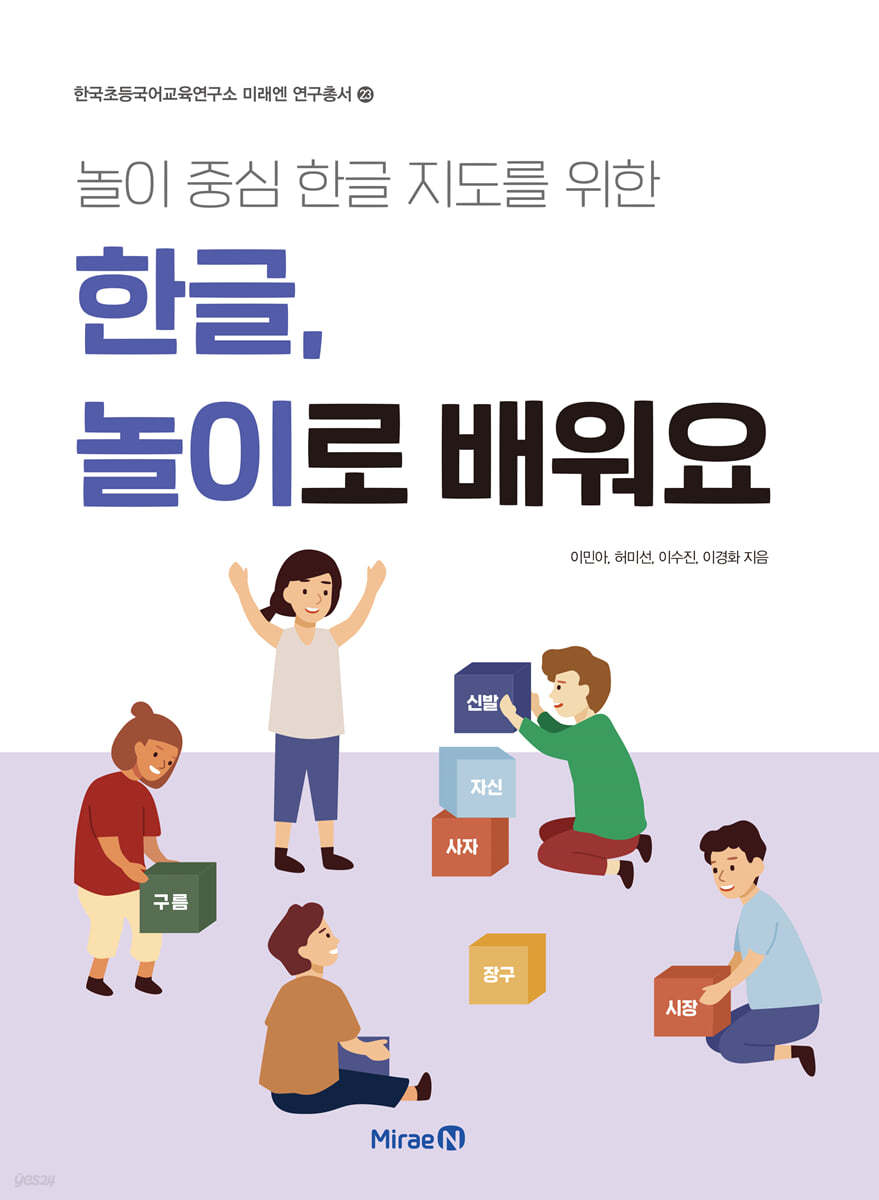
Learn Korean through play
 |
Description
Book Introduction
Children entering elementary school gain confidence in letters and what they can do with them through Korean language education, and develop the qualities to become lifelong readers and writers.
The purpose of this book is to help children develop basic reading and writing skills as well as Korean language comprehension by discovering various experiences they can have with the Korean language at school or at home.
The 'playful Korean language education' discussed in this book is an approach that increases the effectiveness of Korean language education by systematizing play-based learning activities that children can enjoy voluntarily.
This book is largely divided into two parts.
In 'Part 1: Theory of Playful Korean Language Education', the authors discuss why they believe playful Korean language education is an essential approach for the continuous and voluntary learning of characters by kindergarten and elementary school students.
In 'Part 2: Practice of Playful Korean Language Education', play-centered Korean language activities developed according to the principles established in Part 1 are presented in detail.
The purpose of this book is to help children develop basic reading and writing skills as well as Korean language comprehension by discovering various experiences they can have with the Korean language at school or at home.
The 'playful Korean language education' discussed in this book is an approach that increases the effectiveness of Korean language education by systematizing play-based learning activities that children can enjoy voluntarily.
This book is largely divided into two parts.
In 'Part 1: Theory of Playful Korean Language Education', the authors discuss why they believe playful Korean language education is an essential approach for the continuous and voluntary learning of characters by kindergarten and elementary school students.
In 'Part 2: Practice of Playful Korean Language Education', play-centered Korean language activities developed according to the principles established in Part 1 are presented in detail.
index
Part 1: Theory of Playful Korean Language Education
Chapter 1: Why is Korean language education through play necessary?
1.
The meaning of playful Korean language education
2.
The necessity of playful Korean language education
Chapter 2: How is Playful Korean Language Education Different?
1.
The effectiveness of playful Korean language education
2.
Conditions for playful Korean language education
Chapter 3: How should we teach Korean through play?
1.
Types of Play-Based Korean Activities
2.
Development principles for play-centered Korean language activities
3.
List of Play-Based Korean Activities
Part 2: The Reality of Playful Korean Language Education
Chapter 1: Preparing to Study Korean
1.
Rock Paper Scissors Line Drawing - Manipulative Play
2.
Let's grab the land with a line - a game of manipulation
3.
What's the Same? - Manipulative Play
4.
Find the Same Letters - Manipulative Game
Chapter 2: Distinguishing Sounds
5.
Clap your hands as many times as the number of letters! - Body play
6.
Bring as many bean bags as there are letters - physical play
7.
Find words with the same number of sounds - a competitive and cooperative game
8.
Shout out the vowels - competitive and cooperative play
9.
Find common vowels - Distinguishing sounds through manipulative play
10.
Rabbit Hop and Sparrow Chirp - Physical Play
11.
Subtracting Sounds Game - Competitive and Cooperative Play
12.
Find the letters with different sounds - competitive and cooperative play
Chapter 3: Mastering Single-Character Knowledge
13.
Connect the Dots - Manipulative Play
14.
Body-based vowel play - body play
15.
One Heart - A Play of Chance
16.
Find the Hidden Letters - Competitive and Cooperative Game
17.
Making a Colorful Paper Collector - Manipulative Play
18.
Consonant Treasure Hunt - A Game of Chance
19.
Say the consonant names - competitive and cooperative play
20.
Who is the consonant alimmi? - Body play
21.
Do You Love Your Name? - Body Play
22.
Making Clay Consonants - Manipulative Play
Read Chapter 4 carefully
23.
Consonant/vowel board game - chance game
24.
Hangul Dice Game - A Game of Chance
25.
Make letters - physical play
26.
Meet Your Consonant and Vowel Partners - Physical Play
27.
What's the missing vowel? - Quiz Game
28.
Making letters by pulling out single-letter notes - a competitive and cooperative game
29.
Ganadaramabasa - Competitive and cooperative play
30.
Support Detective Play - Physical Play
31.
One-letter puzzle - physical play
32.
Making the Same Word Train - Physical Play
33.
Readable Letter Scraping-Manipulative Play
34.
Upside-down country letter-manipulation game
35.
Board Game Jingo - Play of Chance
36.
Word Jenga - Competitive and Cooperative Game
37.
Magnetic Letters My Way - Manipulation Play
38.
Find the Overlapping - A Game of Chance
39.
To add a support or not? - Competitive and cooperative play
Chapter 5: Building Word Power
40.
Consonant-Vowel Twenty Questions Quiz Game
41.
Speak with your body - Competitive and cooperative play
42.
Word Collector - Competitive and Cooperative Game
43.
Find the objects or people in the picture - Quiz game
44.
Word Chain Game - Competitive and Cooperative Game
45.
Find words that start with the same letter - competitive and cooperative game
46.
Final consonant linking - physical play
47.
Find words by looking at the initial consonants - competitive and cooperative play
48.
Complex Support Bingo! Bingo! - Quiz Game
49.
Opposite Card Game - Chance Game
50.
Balloon Passing Word Game - Physical Play
51.
Who Am I? - Quiz Game
Chapter 6 Writing
52.
Writing Vowels on Your Palm - Quiz Game
53.
Making letters with small objects - Manipulative play
54.
What's Your Name? - Competitive/Cooperative Play
55.
Fill in the Missing Vowels Quiz Game
56.
Collect the letters you wrote - Quiz Game
57.
Board Game Laon - Manipulation Play
58.
Mixing up letter cards to make words - a manipulative game
59.
Word Writing Quiz Game
60.
Writing and communicating on the body - body play
61.
Where did it go? A quiz game to write the missing consonants.
62.
Double Consonant Word Dictation Game - Competitive and Cooperative Game
63.
Word Land Grabbing - Competitive and Cooperative Game
64.
Word Golden Bell Quiz Game
65.
Complete the sentences together - competitive and cooperative play
Chapter 7: Read with Confidence
66.
Go Round - Competitive and Cooperative Play
67.
Run, Run! Word Reading - Physical Play
68.
Word Candy Collection - Competitive and Cooperative Game
69.
We are teacher-body play
70.
Reading the Words in the Box - Competitive and Cooperative Play
71.
Passing the Sentence Note - Physical Play
72.
Find the Hidden Sentence - Physical Play
73.
Challenge! Relay Sentence Reading - Competitive and Cooperative Play
74.
Playing the spaced reading game - competitive and cooperative play
75.
I am an actor-mock play
Chapter 1: Why is Korean language education through play necessary?
1.
The meaning of playful Korean language education
2.
The necessity of playful Korean language education
Chapter 2: How is Playful Korean Language Education Different?
1.
The effectiveness of playful Korean language education
2.
Conditions for playful Korean language education
Chapter 3: How should we teach Korean through play?
1.
Types of Play-Based Korean Activities
2.
Development principles for play-centered Korean language activities
3.
List of Play-Based Korean Activities
Part 2: The Reality of Playful Korean Language Education
Chapter 1: Preparing to Study Korean
1.
Rock Paper Scissors Line Drawing - Manipulative Play
2.
Let's grab the land with a line - a game of manipulation
3.
What's the Same? - Manipulative Play
4.
Find the Same Letters - Manipulative Game
Chapter 2: Distinguishing Sounds
5.
Clap your hands as many times as the number of letters! - Body play
6.
Bring as many bean bags as there are letters - physical play
7.
Find words with the same number of sounds - a competitive and cooperative game
8.
Shout out the vowels - competitive and cooperative play
9.
Find common vowels - Distinguishing sounds through manipulative play
10.
Rabbit Hop and Sparrow Chirp - Physical Play
11.
Subtracting Sounds Game - Competitive and Cooperative Play
12.
Find the letters with different sounds - competitive and cooperative play
Chapter 3: Mastering Single-Character Knowledge
13.
Connect the Dots - Manipulative Play
14.
Body-based vowel play - body play
15.
One Heart - A Play of Chance
16.
Find the Hidden Letters - Competitive and Cooperative Game
17.
Making a Colorful Paper Collector - Manipulative Play
18.
Consonant Treasure Hunt - A Game of Chance
19.
Say the consonant names - competitive and cooperative play
20.
Who is the consonant alimmi? - Body play
21.
Do You Love Your Name? - Body Play
22.
Making Clay Consonants - Manipulative Play
Read Chapter 4 carefully
23.
Consonant/vowel board game - chance game
24.
Hangul Dice Game - A Game of Chance
25.
Make letters - physical play
26.
Meet Your Consonant and Vowel Partners - Physical Play
27.
What's the missing vowel? - Quiz Game
28.
Making letters by pulling out single-letter notes - a competitive and cooperative game
29.
Ganadaramabasa - Competitive and cooperative play
30.
Support Detective Play - Physical Play
31.
One-letter puzzle - physical play
32.
Making the Same Word Train - Physical Play
33.
Readable Letter Scraping-Manipulative Play
34.
Upside-down country letter-manipulation game
35.
Board Game Jingo - Play of Chance
36.
Word Jenga - Competitive and Cooperative Game
37.
Magnetic Letters My Way - Manipulation Play
38.
Find the Overlapping - A Game of Chance
39.
To add a support or not? - Competitive and cooperative play
Chapter 5: Building Word Power
40.
Consonant-Vowel Twenty Questions Quiz Game
41.
Speak with your body - Competitive and cooperative play
42.
Word Collector - Competitive and Cooperative Game
43.
Find the objects or people in the picture - Quiz game
44.
Word Chain Game - Competitive and Cooperative Game
45.
Find words that start with the same letter - competitive and cooperative game
46.
Final consonant linking - physical play
47.
Find words by looking at the initial consonants - competitive and cooperative play
48.
Complex Support Bingo! Bingo! - Quiz Game
49.
Opposite Card Game - Chance Game
50.
Balloon Passing Word Game - Physical Play
51.
Who Am I? - Quiz Game
Chapter 6 Writing
52.
Writing Vowels on Your Palm - Quiz Game
53.
Making letters with small objects - Manipulative play
54.
What's Your Name? - Competitive/Cooperative Play
55.
Fill in the Missing Vowels Quiz Game
56.
Collect the letters you wrote - Quiz Game
57.
Board Game Laon - Manipulation Play
58.
Mixing up letter cards to make words - a manipulative game
59.
Word Writing Quiz Game
60.
Writing and communicating on the body - body play
61.
Where did it go? A quiz game to write the missing consonants.
62.
Double Consonant Word Dictation Game - Competitive and Cooperative Game
63.
Word Land Grabbing - Competitive and Cooperative Game
64.
Word Golden Bell Quiz Game
65.
Complete the sentences together - competitive and cooperative play
Chapter 7: Read with Confidence
66.
Go Round - Competitive and Cooperative Play
67.
Run, Run! Word Reading - Physical Play
68.
Word Candy Collection - Competitive and Cooperative Game
69.
We are teacher-body play
70.
Reading the Words in the Box - Competitive and Cooperative Play
71.
Passing the Sentence Note - Physical Play
72.
Find the Hidden Sentence - Physical Play
73.
Challenge! Relay Sentence Reading - Competitive and Cooperative Play
74.
Playing the spaced reading game - competitive and cooperative play
75.
I am an actor-mock play
Publisher's Review
Teaching Korean is important in itself, but it is also a challenge that allows children to achieve their first sense of accomplishment with letters.
Children entering elementary school gain confidence in letters and what they can do with them through Korean language education, and develop the qualities to become lifelong readers and writers.
The purpose of this book is to help children develop basic reading and writing skills as well as Korean language comprehension by discovering various experiences they can have with the Korean language at school or at home.
The 'playful Korean language education' discussed in this book is an approach that increases the effectiveness of Korean language education by systematizing play-based learning activities that children can enjoy voluntarily.
This book is largely divided into two parts.
In Part 1, Theory of Playful Korean Language Education, the authors discuss why they believe playful Korean language education is an essential approach for the continuous and voluntary learning of characters by kindergarten and elementary school students.
We comprehensively examined the meaning and necessity of playful Korean language education, as well as the effects and conditions of playful Korean language education, and considered ways to develop play-centered Korean language activities.
In Part 2, ‘The Reality of Playful Korean Language Education,’ we present play-centered Korean language activities developed according to the principles established in Part 1.
In order to reflect the elements necessary for a balanced Korean language education, this book has developed play activities divided into ‘Preparing to Study Korean,’ ‘Distinguishing Sounds,’ ‘Acquiring Letter Knowledge,’ ‘Reading Accurately,’ ‘Building Word Power,’ ‘Writing Letters,’ and ‘Reading Confidently.’
The Korean language games introduced in this book were developed based on the authors' experience teaching first grade elementary school students.
We thought about how to achieve maximum educational effectiveness in the classroom with minimal time and effort, and applied the developed game to a first-grade elementary school classroom to see if there were any problems.
To make it easy for anyone to use, the play method was explained as simply as possible, and the play scenes were shown with photos and drawings, and specific materials needed for the play were also included.
So, you can do this not only at school, but also at home with your parents or friends.
The authors' humble hope is that children will embrace Korean language education as a fun and enjoyable activity in their daily lives, free from the burden of studying, and that this will naturally enhance the effectiveness of Korean language education.
Children entering elementary school gain confidence in letters and what they can do with them through Korean language education, and develop the qualities to become lifelong readers and writers.
The purpose of this book is to help children develop basic reading and writing skills as well as Korean language comprehension by discovering various experiences they can have with the Korean language at school or at home.
The 'playful Korean language education' discussed in this book is an approach that increases the effectiveness of Korean language education by systematizing play-based learning activities that children can enjoy voluntarily.
This book is largely divided into two parts.
In Part 1, Theory of Playful Korean Language Education, the authors discuss why they believe playful Korean language education is an essential approach for the continuous and voluntary learning of characters by kindergarten and elementary school students.
We comprehensively examined the meaning and necessity of playful Korean language education, as well as the effects and conditions of playful Korean language education, and considered ways to develop play-centered Korean language activities.
In Part 2, ‘The Reality of Playful Korean Language Education,’ we present play-centered Korean language activities developed according to the principles established in Part 1.
In order to reflect the elements necessary for a balanced Korean language education, this book has developed play activities divided into ‘Preparing to Study Korean,’ ‘Distinguishing Sounds,’ ‘Acquiring Letter Knowledge,’ ‘Reading Accurately,’ ‘Building Word Power,’ ‘Writing Letters,’ and ‘Reading Confidently.’
The Korean language games introduced in this book were developed based on the authors' experience teaching first grade elementary school students.
We thought about how to achieve maximum educational effectiveness in the classroom with minimal time and effort, and applied the developed game to a first-grade elementary school classroom to see if there were any problems.
To make it easy for anyone to use, the play method was explained as simply as possible, and the play scenes were shown with photos and drawings, and specific materials needed for the play were also included.
So, you can do this not only at school, but also at home with your parents or friends.
The authors' humble hope is that children will embrace Korean language education as a fun and enjoyable activity in their daily lives, free from the burden of studying, and that this will naturally enhance the effectiveness of Korean language education.
GOODS SPECIFICS
- Publication date: April 15, 2021
- Page count, weight, size: 246 pages | 188*257*20mm
- ISBN13: 9791164137909
- ISBN10: 1164137905
You may also like
카테고리
korean


korean

![GQ KOREA Mark (Monthly): December [2025]](http://librairie.coreenne.fr/cdn/shop/files/8ef265dbbfbf186523ed75ba7319009d.jpg?v=1765340328&width=3840)


