

ecology
 |
Description
Book Introduction
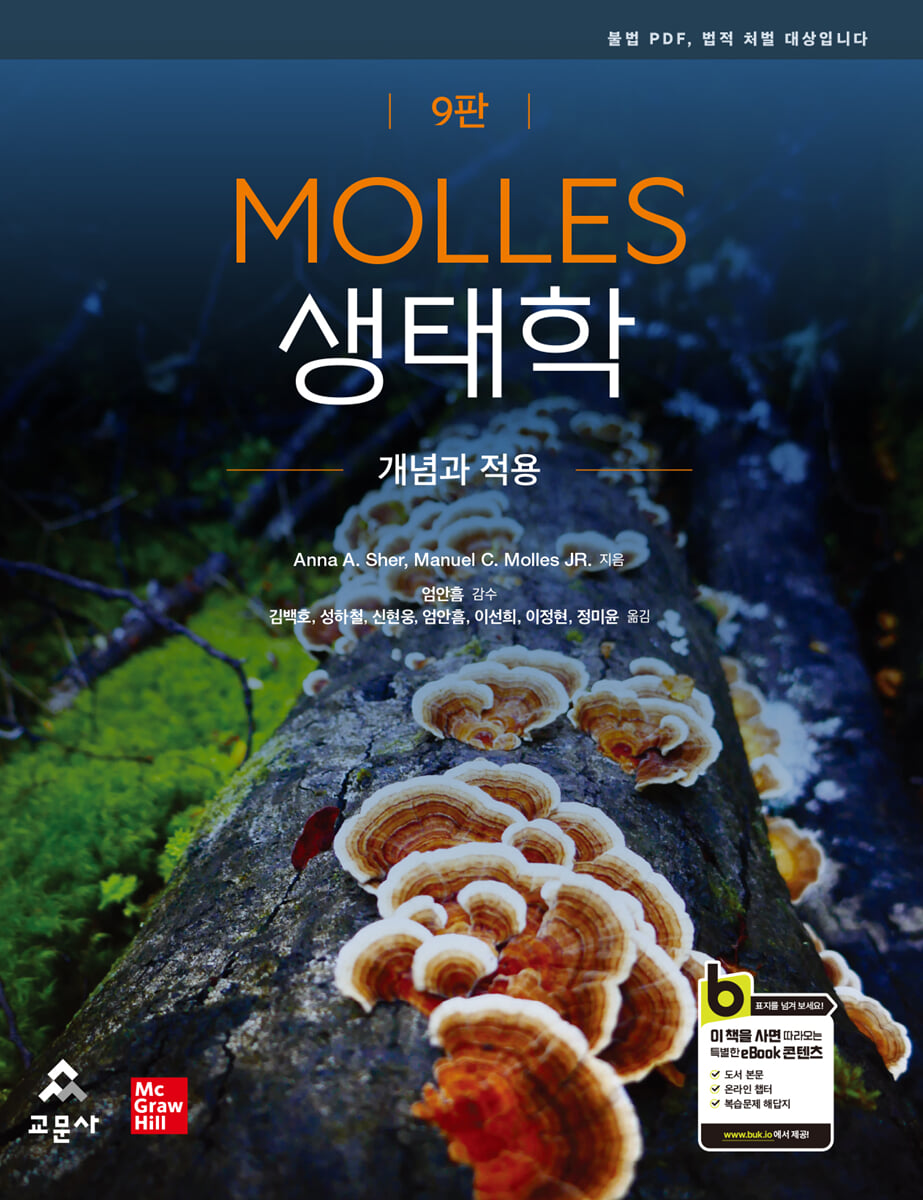
A world-class textbook connecting core ecological concepts and practice.
Ecology studies the interactions between organisms and their environment, and understands and explains the order and changes in ecosystems.
Ecological knowledge is essential to scientifically interpret modern environmental issues such as climate change, biodiversity crisis, and ecosystem restoration.
In response to these needs, 『MOLLES Ecology (9th Edition)』 has established itself as a standard textbook for students learning ecology for the first time at the undergraduate level.
This 9th edition has been completely revised to reflect the latest research findings and environmental issues.
It has a learning-friendly structure that helps students understand key concepts and connect them to real-world examples.
Ecology studies the interactions between organisms and their environment, and understands and explains the order and changes in ecosystems.
Ecological knowledge is essential to scientifically interpret modern environmental issues such as climate change, biodiversity crisis, and ecosystem restoration.
In response to these needs, 『MOLLES Ecology (9th Edition)』 has established itself as a standard textbook for students learning ecology for the first time at the undergraduate level.
This 9th edition has been completely revised to reflect the latest research findings and environmental issues.
It has a learning-friendly structure that helps students understand key concepts and connect them to real-world examples.
index
1 Historical foundations and developing new fields
PART Ⅰ Natural History and Evolution
2 Terrestrial organisms
3 aquatic organisms
4 Population genetics and natural selection
PART Ⅱ Adaptation to the Environment
5 Temperature Relationships
6 Moisture Relationships
7 Energy and Nutrient Relationships
8 Social Relationships
PART Ⅲ POPULATION ECOLOGY
9 Population distribution and abundance
10 Population dynamics
11 Population growth
12 Life
PART IV INTERACTIONS
13 Interspecies interactions and competition
14 Use Interactions: Predation, Herbivory, Parasitism, and Disease
15 Symbiosis
PART V Community and Ecosystem
16 species of abundance and diversity
17 types of interactions and community structure
18 Primary and Secondary Production
19 Nutrient circulation and retention
20 Transition and Safety
PART VI Large-Scale Ecology (※ Online Chapter)
21 Landscape Ecology
22 Geography and Ecology
23 Earth Ecology
※ You can use the book ticket included with the book to read the entire book section of 《PART VI Large-Scale Ecology》.
PART Ⅰ Natural History and Evolution
2 Terrestrial organisms
3 aquatic organisms
4 Population genetics and natural selection
PART Ⅱ Adaptation to the Environment
5 Temperature Relationships
6 Moisture Relationships
7 Energy and Nutrient Relationships
8 Social Relationships
PART Ⅲ POPULATION ECOLOGY
9 Population distribution and abundance
10 Population dynamics
11 Population growth
12 Life
PART IV INTERACTIONS
13 Interspecies interactions and competition
14 Use Interactions: Predation, Herbivory, Parasitism, and Disease
15 Symbiosis
PART V Community and Ecosystem
16 species of abundance and diversity
17 types of interactions and community structure
18 Primary and Secondary Production
19 Nutrient circulation and retention
20 Transition and Safety
PART VI Large-Scale Ecology (※ Online Chapter)
21 Landscape Ecology
22 Geography and Ecology
23 Earth Ecology
※ You can use the book ticket included with the book to read the entire book section of 《PART VI Large-Scale Ecology》.
Publisher's Review
[Features of this book]
1.
Systematic development centered on core concepts
Each chapter begins with learning outcomes and key concepts, then connects the concepts to concrete evidence through real-world research cases.
This helps us intuitively understand complex ecological principles.
2.
Hierarchical structure of ecology
The textbook adopts a systematic structure that goes from individual → population → community → ecosystem → landscape, geography, and global ecology.
It initially covers biomes and environmental adaptation, then expands to population dynamics, interspecies interactions, communities and ecosystems, and finally global ecology.
This structure encourages us to expand our thinking from local phenomena to global patterns.
3.
Enhancement of visual aids and learning aids
It provides a wealth of visual materials, including photographs, line drawings, and graphs, and provides step-by-step explanations of mathematical formulas and models.
At the end of each chapter, application examples, summaries, and review problems are provided to review what you have learned and connect it to real-world problems.
4.
Links to modern environmental issues
Analyzes contemporary environmental issues such as climate change, urban heat islands, biodiversity loss, and ecosystem restoration from an ecological perspective.
By connecting general and applied ecology, learners can extend their scientific knowledge to solve real-world problems.
1.
Systematic development centered on core concepts
Each chapter begins with learning outcomes and key concepts, then connects the concepts to concrete evidence through real-world research cases.
This helps us intuitively understand complex ecological principles.
2.
Hierarchical structure of ecology
The textbook adopts a systematic structure that goes from individual → population → community → ecosystem → landscape, geography, and global ecology.
It initially covers biomes and environmental adaptation, then expands to population dynamics, interspecies interactions, communities and ecosystems, and finally global ecology.
This structure encourages us to expand our thinking from local phenomena to global patterns.
3.
Enhancement of visual aids and learning aids
It provides a wealth of visual materials, including photographs, line drawings, and graphs, and provides step-by-step explanations of mathematical formulas and models.
At the end of each chapter, application examples, summaries, and review problems are provided to review what you have learned and connect it to real-world problems.
4.
Links to modern environmental issues
Analyzes contemporary environmental issues such as climate change, urban heat islands, biodiversity loss, and ecosystem restoration from an ecological perspective.
By connecting general and applied ecology, learners can extend their scientific knowledge to solve real-world problems.
GOODS SPECIFICS
- Date of issue: August 25, 2025
- Page count, weight, size: 552 pages | 215*276*35mm
- ISBN13: 9788936325794
- ISBN10: 8936325795
You may also like
카테고리
korean


korean

![GQ KOREA Mark (Monthly): December [2025]](http://librairie.coreenne.fr/cdn/shop/files/8ef265dbbfbf186523ed75ba7319009d.jpg?v=1765340328&width=3840)


