

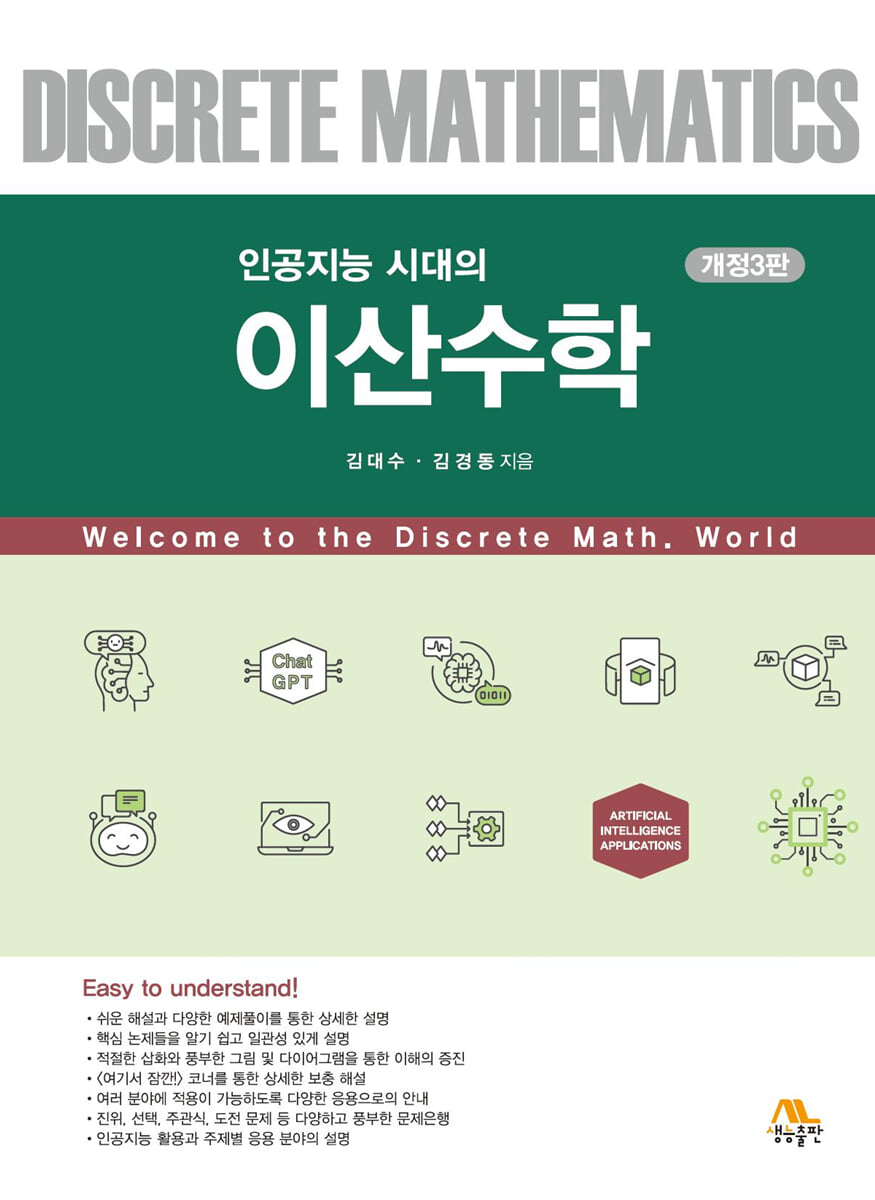
Discrete Mathematics in the Age of Artificial Intelligence
 |
Description
Book Introduction
The world has changed dramatically since the conversational AI ChatGPT was announced a few years ago.
Generative AI can now converse with humans, write essays, draw pictures, compose music, and even write programs.
Discrete mathematics plays a very important role in this context, so in the revised third edition, we have tried to connect artificial intelligence and discrete mathematics under the title “Discrete Mathematics in the Age of Artificial Intelligence” to make discrete mathematics truly meet the needs of the artificial intelligence era.
Generative AI can now converse with humans, write essays, draw pictures, compose music, and even write programs.
Discrete mathematics plays a very important role in this context, so in the revised third edition, we have tried to connect artificial intelligence and discrete mathematics under the title “Discrete Mathematics in the Age of Artificial Intelligence” to make discrete mathematics truly meet the needs of the artificial intelligence era.
index
CHAPTER 01 Overview of Discrete Mathematics
1.1 What is discrete mathematics?
1.2 Discrete and continuous concepts
1.3 Mathematical Modeling
1.4 Modeling for Problem Solving
1.5 Applications of Discrete Mathematics
1.6 Artificial Intelligence and Discrete Mathematics
Summary and Applications to Life
Practice problems
CHAPTER 02 Logic and Propositions
2.1 Logic and Propositions
2.2 Logical operations
2.3 Progressive and Contradictory Propositions
2.4 Logical equivalence relation
2.5 Inference
2.6 Predicate logic
2.7 Logical Language - Prolog
2.8 Applications of Logic and Artificial Intelligence
Summary and Applications to Life
Practice problems
CHAPTER 03 Set Theory and the Digital World of Numbers
3.1 Representation of sets
3.2 Set operations
3.3 Sets and power sets
3.4 Partitioning the set
3.5 Number Representation and Conversion to Base
3.6 Addition and subtraction of binary numbers
3.7 Applications of Set Theory and Artificial Intelligence
Summary and Applications to Life
Practice problems
CHAPTER 04 Proof
4.1 Methodology of Proof
4.2 Various proof methods
4.3 Program Verification
4.4.
Applications of Proof Methods and Artificial Intelligence
Summary and Applications to Life
Practice problems
CHAPTER 05 Relationships
5.1 Relationships and Binary Relationships
5.2 Representation of Relationships
5.3 Composition Relationships
5.4 Nature of Relationships
5.5 Equivalence Relations and Partitions
5.6 Partial order relations
5.7 Applications of Relationships and Artificial Intelligence
Summary and Applications to Life
Practice problems
CHAPTER 06 FUNCTIONS
6.1 Definition of functions
6.2 Function graphs
6.3 Injective functions, surjective functions, and bijective functions
6.4 Various functions
6.5 The Role of Functions in Computer Languages
6.6 Functions widely used in artificial intelligence
6.7 Applications of Functions and Artificial Intelligence
Summary and Applications to Life
Practice problems
CHAPTER 07 Graph
7.1 Basic Concepts of Graphs
7.2 Graph Terminology
7.3 How to Represent Graphs
7.4 Special types of graphs
7.5 Applications of Graphs
7.6 Exploring the Graph
7.7 Graphing and Coloring Problems
7.8 Applications of Graphs and Artificial Intelligence
Summary and Applications to Life
Practice problems
CHAPTER 08 Tree
8.1 Basic Tree Concepts
8.2 Direction Tree
8.3 Binary Tree
8.4 Representation of binary trees
8.5 Exploring Binary Trees
8.6 Generation Trees and Minimum Cost Generation Trees
8.7 Using Trees
8.8 Applications of Trees and Artificial Intelligence
Summary and Applications to Life
Practice problems
CHAPTER 09 Permutations, Discrete Probability, and Recursive Relations
9.1 Number of cases
9.2 Permutations
9.3 Combination
9.4 Discrete Probability and Statistics
9.5 Pigeonhole Principle
9.6 Recursive definitions
9.7 Fibonacci Numbers and the Tower of Hanoi
9.8 Applications of Permutations, Discrete Probability, and Recursive Relations to Artificial Intelligence
Summary and Applications to Life
Practice problems
CHAPTER 10 Matrices and Determinants
10.1 Matrices and Matrix Operations
10.2 Special matrices
10.3 Basic operations on matrices and trapezoids
10.4 Concept of determinant
10.5 General properties of determinants
10.6 Inverse matrix
10.7 Solutions to Linear Equations
10.8 Matrix Operations in Neural Networks
10.9 Applications of Matrices and Determinants and Artificial Intelligence
Summary and Applications to Life
Practice problems
CHAPTER 11 Boolean Algebra
11.1 Boolean expressions
11.2 Boolean expressions
11.3 Simplifying Boolean Functions
11.4 Logic Circuit Design
11.5 Applications of Logic Circuits
11.6 Application of Logic Circuits to Artificial Intelligence
11.7 Applications of Boolean Algebra and Artificial Intelligence
Summary and Applications to Life
Practice problems
CHAPTER 12 Problem Solving Through Algorithms
12.1 What is an algorithm?
12.2 Algorithm Representation and Efficiency
12.3 Algorithm Analysis
12.4 Algorithm Complexity
12.5 Complexity of Recursive Functions
12.6 Search Algorithm
12.7 Sorting Algorithms
12.8 Artificial Intelligence Algorithms
12.9 Applications of Algorithms and Artificial Intelligence
Summary and Applications to Life
Practice problems
CHAPTER 13 Automata, Formal Languages, and Grammar
13.1 What is an automata?
13.2 The Need for Automata Learning and Finite State Systems
13.3 Finite Automata
13.4 Formal Language and Grammar
13.5 Turing Machine Model
13.6 Chomsky Inclusion Relationship
13.7 Applications of Automata and Artificial Intelligence
Summary and Applications to Life
Practice problems
Practice Problem Answers
References
1.1 What is discrete mathematics?
1.2 Discrete and continuous concepts
1.3 Mathematical Modeling
1.4 Modeling for Problem Solving
1.5 Applications of Discrete Mathematics
1.6 Artificial Intelligence and Discrete Mathematics
Summary and Applications to Life
Practice problems
CHAPTER 02 Logic and Propositions
2.1 Logic and Propositions
2.2 Logical operations
2.3 Progressive and Contradictory Propositions
2.4 Logical equivalence relation
2.5 Inference
2.6 Predicate logic
2.7 Logical Language - Prolog
2.8 Applications of Logic and Artificial Intelligence
Summary and Applications to Life
Practice problems
CHAPTER 03 Set Theory and the Digital World of Numbers
3.1 Representation of sets
3.2 Set operations
3.3 Sets and power sets
3.4 Partitioning the set
3.5 Number Representation and Conversion to Base
3.6 Addition and subtraction of binary numbers
3.7 Applications of Set Theory and Artificial Intelligence
Summary and Applications to Life
Practice problems
CHAPTER 04 Proof
4.1 Methodology of Proof
4.2 Various proof methods
4.3 Program Verification
4.4.
Applications of Proof Methods and Artificial Intelligence
Summary and Applications to Life
Practice problems
CHAPTER 05 Relationships
5.1 Relationships and Binary Relationships
5.2 Representation of Relationships
5.3 Composition Relationships
5.4 Nature of Relationships
5.5 Equivalence Relations and Partitions
5.6 Partial order relations
5.7 Applications of Relationships and Artificial Intelligence
Summary and Applications to Life
Practice problems
CHAPTER 06 FUNCTIONS
6.1 Definition of functions
6.2 Function graphs
6.3 Injective functions, surjective functions, and bijective functions
6.4 Various functions
6.5 The Role of Functions in Computer Languages
6.6 Functions widely used in artificial intelligence
6.7 Applications of Functions and Artificial Intelligence
Summary and Applications to Life
Practice problems
CHAPTER 07 Graph
7.1 Basic Concepts of Graphs
7.2 Graph Terminology
7.3 How to Represent Graphs
7.4 Special types of graphs
7.5 Applications of Graphs
7.6 Exploring the Graph
7.7 Graphing and Coloring Problems
7.8 Applications of Graphs and Artificial Intelligence
Summary and Applications to Life
Practice problems
CHAPTER 08 Tree
8.1 Basic Tree Concepts
8.2 Direction Tree
8.3 Binary Tree
8.4 Representation of binary trees
8.5 Exploring Binary Trees
8.6 Generation Trees and Minimum Cost Generation Trees
8.7 Using Trees
8.8 Applications of Trees and Artificial Intelligence
Summary and Applications to Life
Practice problems
CHAPTER 09 Permutations, Discrete Probability, and Recursive Relations
9.1 Number of cases
9.2 Permutations
9.3 Combination
9.4 Discrete Probability and Statistics
9.5 Pigeonhole Principle
9.6 Recursive definitions
9.7 Fibonacci Numbers and the Tower of Hanoi
9.8 Applications of Permutations, Discrete Probability, and Recursive Relations to Artificial Intelligence
Summary and Applications to Life
Practice problems
CHAPTER 10 Matrices and Determinants
10.1 Matrices and Matrix Operations
10.2 Special matrices
10.3 Basic operations on matrices and trapezoids
10.4 Concept of determinant
10.5 General properties of determinants
10.6 Inverse matrix
10.7 Solutions to Linear Equations
10.8 Matrix Operations in Neural Networks
10.9 Applications of Matrices and Determinants and Artificial Intelligence
Summary and Applications to Life
Practice problems
CHAPTER 11 Boolean Algebra
11.1 Boolean expressions
11.2 Boolean expressions
11.3 Simplifying Boolean Functions
11.4 Logic Circuit Design
11.5 Applications of Logic Circuits
11.6 Application of Logic Circuits to Artificial Intelligence
11.7 Applications of Boolean Algebra and Artificial Intelligence
Summary and Applications to Life
Practice problems
CHAPTER 12 Problem Solving Through Algorithms
12.1 What is an algorithm?
12.2 Algorithm Representation and Efficiency
12.3 Algorithm Analysis
12.4 Algorithm Complexity
12.5 Complexity of Recursive Functions
12.6 Search Algorithm
12.7 Sorting Algorithms
12.8 Artificial Intelligence Algorithms
12.9 Applications of Algorithms and Artificial Intelligence
Summary and Applications to Life
Practice problems
CHAPTER 13 Automata, Formal Languages, and Grammar
13.1 What is an automata?
13.2 The Need for Automata Learning and Finite State Systems
13.3 Finite Automata
13.4 Formal Language and Grammar
13.5 Turing Machine Model
13.6 Chomsky Inclusion Relationship
13.7 Applications of Automata and Artificial Intelligence
Summary and Applications to Life
Practice problems
Practice Problem Answers
References
Publisher's Review
What's added or changed in the 3rd edition
First, we have provided an easy-to-understand explanation of various information, including basic concepts related to artificial intelligence, which has recently been attracting attention as a global issue.
In particular, Chapter 1 explains the history and technological development of artificial intelligence, generative artificial intelligence, classification of artificial intelligence, major discrete mathematics topics, and their role in artificial intelligence.
Second, since a significant portion of the mathematics used in artificial intelligence utilizes discrete mathematics, some new sections have been added to broaden the scope of understanding.
Therefore, in addition to the existing discrete mathematics topics, we have made it possible to understand their application to artificial intelligence through explanations and examples.
Third, we have updated and examined the various fields of application related to the topics of each chapter in discrete mathematics, and newly added application examples of discrete mathematics related to artificial intelligence in each chapter, broadening the scope of overall understanding of discrete mathematics in the era of artificial intelligence.
Fourth, the practice problems at the end of each chapter can be used to reinforce artificial intelligence-related problems in discrete mathematics.
By encountering various problems, we have broadened the scope of understanding related to the content of the text.
Features of this book
First, each topic was explained in relatively detail through easy explanations and various example solutions.
Difficult topics are explained in detail, and when necessary, supplementary explanations are provided in the [Pause Here!] corner, providing relatively detailed explanations. We also tried to make the book accessible in a friendly manner through easy and appropriate examples.
Second, the key topics were explained in an easy-to-understand and consistent manner.
We considered the connection between the topics that come before and after the entire book, and adjusted the difficulty level appropriately so that it is not too difficult.
Third, we attempted to enhance understanding through appropriate illustrations and abundant pictures and diagrams.
In particular, we have tried to make it easier to understand by drawing a lot of diagrams.
Fourth, we have covered various and appropriate examples of applications that can be applied to various fields.
It has broadened its scope to include applications in various fields such as computers, electricity, electronics, and networks.
Fifth, by presenting a variety of rich problems, including true-false, multiple-choice, subjective, and challenge questions, the problem-solving approach became more approachable.
Contents of this book
Chapter 1 covered an overview of discrete mathematics, covering concepts of discrete mathematics, discrete concepts, the concept of mathematically mapping real-world problems through mathematical modeling, effective modeling methods for problem solving, and various application fields.
It also covers several key aspects of artificial intelligence and their relationship to discrete mathematics topics.
Chapter 2 examines general issues related to logic and propositions.
We defined logic and propositions, and covered the main logical operations, a priori and contradictory propositions, logical equivalence relations, inference and predicate logic, and universal and existential quantifiers.
It also covers the application of logic and its relationship to artificial intelligence.
Chapter 3 examines various topics related to sets, from the basic definition to partitioning. It covers the definition of sets, the representation of sets, operations on sets such as union and intersection, and partitioning of sets.
It also covered the representation of numbers and changes in bases, addition and subtraction of binary numbers, and the application of sets and their relationship to artificial intelligence.
Chapter 4 examines the general methodology of proof and explores various proof methods, including the step-by-step approach to solving a given problem, mathematical induction, proof of contradiction, and direct proof, as well as the verification of programs.
It also covers the application of proof and its relationship to artificial intelligence.
Chapter 5 examines general issues related to relationships.
It covers the basic concepts of relations and binary relations, expressions of relations, composition relations, properties of relations, equivalence relations and partitions, and partial order relations.
It also covers the application of relationships and their relationship with artificial intelligence.
Chapter 6 covers general topics related to functions, including the definition of a function, the graph of a function, the concept of a surjective function, an injective function, a bijective function, and composite functions, as well as the role of functions in computers.
We also covered the application areas of functions and their relationship with artificial intelligence.
Chapter 7 examines general topics related to graphs.
We covered the basic concepts of graphs, graph representation, special types of graphs, relationships and graphs, applications of graphs, graph exploration, and graph and coloring problems.
We also covered the application areas of graphs and their relationship with artificial intelligence.
Chapter 8 examines general topics related to trees.
We examined various application problems of trees, such as the concept of trees, directed trees, binary trees, representation of binary trees, generation trees and minimum cost, parsing of grammar, and games.
We also covered the application areas of trees and their relationship with artificial intelligence.
Chapter 9 examines general topics related to permutations, discrete probability, and recursive relations.
We looked at basic concepts related to permutations and combinations, discrete probability and statistics, the pigeonhole principle, recursive definitions, Fibonacci numbers, and the Tower of Hanoi problem.
We also covered applications of permutations, discrete probability, recursive relations, and their relationship to artificial intelligence.
In Chapter 10, we learned general topics related to matrices and determinants.
We defined matrices and examined matrix operations, special matrices, basic matrix operations, the concept and properties of determinants, inverse matrices, and solutions to linear equations.
We also covered the applications of matrices, determinants, and their relationship to artificial intelligence.
In Chapter 11, we studied general topics related to Boolean algebra.
We looked at the basic operations of Boolean expressions, the representation of Boolean expressions, the simplification of Boolean functions using Kanow maps, the design of logic circuits, and three applications of logic circuits.
We also covered applications of Boolean algebra and its relationship to artificial intelligence.
Chapter 12 examines general topics related to algorithms.
We looked at the definition and efficiency of algorithms, algorithm analysis and complexity, the complexity of recursive functions, search algorithms, and sorting algorithms.
It also covers the application of algorithms and their relationship with artificial intelligence.
Chapter 13 examines topics related to automata, formal languages, and grammar.
We looked at the basic concepts and necessity of automata, finite state machines, finite automata, formal languages and grammars, Turing machines, and Chomsky inclusion relations.
It also covers the application of automata, formal languages, grammars, and their relationship to artificial intelligence.
First, we have provided an easy-to-understand explanation of various information, including basic concepts related to artificial intelligence, which has recently been attracting attention as a global issue.
In particular, Chapter 1 explains the history and technological development of artificial intelligence, generative artificial intelligence, classification of artificial intelligence, major discrete mathematics topics, and their role in artificial intelligence.
Second, since a significant portion of the mathematics used in artificial intelligence utilizes discrete mathematics, some new sections have been added to broaden the scope of understanding.
Therefore, in addition to the existing discrete mathematics topics, we have made it possible to understand their application to artificial intelligence through explanations and examples.
Third, we have updated and examined the various fields of application related to the topics of each chapter in discrete mathematics, and newly added application examples of discrete mathematics related to artificial intelligence in each chapter, broadening the scope of overall understanding of discrete mathematics in the era of artificial intelligence.
Fourth, the practice problems at the end of each chapter can be used to reinforce artificial intelligence-related problems in discrete mathematics.
By encountering various problems, we have broadened the scope of understanding related to the content of the text.
Features of this book
First, each topic was explained in relatively detail through easy explanations and various example solutions.
Difficult topics are explained in detail, and when necessary, supplementary explanations are provided in the [Pause Here!] corner, providing relatively detailed explanations. We also tried to make the book accessible in a friendly manner through easy and appropriate examples.
Second, the key topics were explained in an easy-to-understand and consistent manner.
We considered the connection between the topics that come before and after the entire book, and adjusted the difficulty level appropriately so that it is not too difficult.
Third, we attempted to enhance understanding through appropriate illustrations and abundant pictures and diagrams.
In particular, we have tried to make it easier to understand by drawing a lot of diagrams.
Fourth, we have covered various and appropriate examples of applications that can be applied to various fields.
It has broadened its scope to include applications in various fields such as computers, electricity, electronics, and networks.
Fifth, by presenting a variety of rich problems, including true-false, multiple-choice, subjective, and challenge questions, the problem-solving approach became more approachable.
Contents of this book
Chapter 1 covered an overview of discrete mathematics, covering concepts of discrete mathematics, discrete concepts, the concept of mathematically mapping real-world problems through mathematical modeling, effective modeling methods for problem solving, and various application fields.
It also covers several key aspects of artificial intelligence and their relationship to discrete mathematics topics.
Chapter 2 examines general issues related to logic and propositions.
We defined logic and propositions, and covered the main logical operations, a priori and contradictory propositions, logical equivalence relations, inference and predicate logic, and universal and existential quantifiers.
It also covers the application of logic and its relationship to artificial intelligence.
Chapter 3 examines various topics related to sets, from the basic definition to partitioning. It covers the definition of sets, the representation of sets, operations on sets such as union and intersection, and partitioning of sets.
It also covered the representation of numbers and changes in bases, addition and subtraction of binary numbers, and the application of sets and their relationship to artificial intelligence.
Chapter 4 examines the general methodology of proof and explores various proof methods, including the step-by-step approach to solving a given problem, mathematical induction, proof of contradiction, and direct proof, as well as the verification of programs.
It also covers the application of proof and its relationship to artificial intelligence.
Chapter 5 examines general issues related to relationships.
It covers the basic concepts of relations and binary relations, expressions of relations, composition relations, properties of relations, equivalence relations and partitions, and partial order relations.
It also covers the application of relationships and their relationship with artificial intelligence.
Chapter 6 covers general topics related to functions, including the definition of a function, the graph of a function, the concept of a surjective function, an injective function, a bijective function, and composite functions, as well as the role of functions in computers.
We also covered the application areas of functions and their relationship with artificial intelligence.
Chapter 7 examines general topics related to graphs.
We covered the basic concepts of graphs, graph representation, special types of graphs, relationships and graphs, applications of graphs, graph exploration, and graph and coloring problems.
We also covered the application areas of graphs and their relationship with artificial intelligence.
Chapter 8 examines general topics related to trees.
We examined various application problems of trees, such as the concept of trees, directed trees, binary trees, representation of binary trees, generation trees and minimum cost, parsing of grammar, and games.
We also covered the application areas of trees and their relationship with artificial intelligence.
Chapter 9 examines general topics related to permutations, discrete probability, and recursive relations.
We looked at basic concepts related to permutations and combinations, discrete probability and statistics, the pigeonhole principle, recursive definitions, Fibonacci numbers, and the Tower of Hanoi problem.
We also covered applications of permutations, discrete probability, recursive relations, and their relationship to artificial intelligence.
In Chapter 10, we learned general topics related to matrices and determinants.
We defined matrices and examined matrix operations, special matrices, basic matrix operations, the concept and properties of determinants, inverse matrices, and solutions to linear equations.
We also covered the applications of matrices, determinants, and their relationship to artificial intelligence.
In Chapter 11, we studied general topics related to Boolean algebra.
We looked at the basic operations of Boolean expressions, the representation of Boolean expressions, the simplification of Boolean functions using Kanow maps, the design of logic circuits, and three applications of logic circuits.
We also covered applications of Boolean algebra and its relationship to artificial intelligence.
Chapter 12 examines general topics related to algorithms.
We looked at the definition and efficiency of algorithms, algorithm analysis and complexity, the complexity of recursive functions, search algorithms, and sorting algorithms.
It also covers the application of algorithms and their relationship with artificial intelligence.
Chapter 13 examines topics related to automata, formal languages, and grammar.
We looked at the basic concepts and necessity of automata, finite state machines, finite automata, formal languages and grammars, Turing machines, and Chomsky inclusion relations.
It also covers the application of automata, formal languages, grammars, and their relationship to artificial intelligence.
GOODS SPECIFICS
- Date of issue: November 24, 2025
- Page count, weight, size: 576 pages | 188*257*35mm
- ISBN13: 9791194630197
- ISBN10: 1194630197
You may also like
카테고리
korean


korean

![GQ KOREA Mark (Monthly): December [2025]](http://librairie.coreenne.fr/cdn/shop/files/8ef265dbbfbf186523ed75ba7319009d.jpg?v=1765340328&width=3840)


