

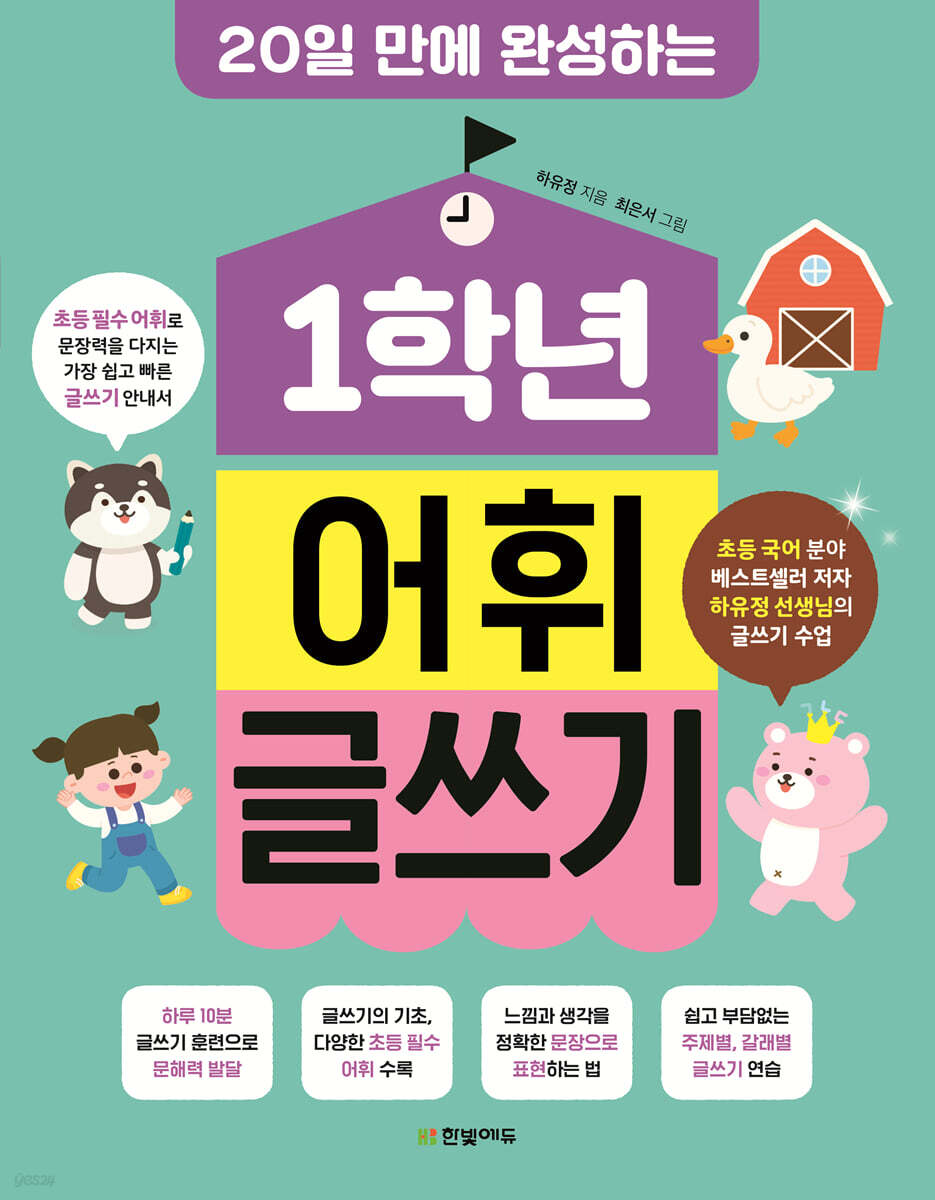
1st grade vocabulary writing
 |
Description
Book Introduction
The core of elementary literacy is 'vocabulary' and 'grammar'.
What's the easiest way to get it right from the start?
Author of the best-selling book "Learning Korean in First Grade"
Teacher Ha Yu-jeong's First Writing Guide
What are the criteria for assessing a first-grade elementary school student's Korean language skills? Vocabulary and writing skills.
Vocabulary is the beginning of elementary literacy, and writing is the completion of language ability that comprehensively demonstrates listening, reading, and speaking.
The new book "First Grade Vocabulary Writing" by Ha Yu-jeong, a "first grade expert," is a book that helps first graders who have just begun writing to easily and systematically build their vocabulary so that they can complete their writing without difficulty.
In the first stage, the writing preparation chapter, you will learn the meanings and usage of various words and complete sentences. In the second stage, the topic writing chapter, you will express your thoughts and feelings about the topic in short sentences.
After practicing writing 4 pages a day for 20 days, you will notice that your vocabulary and sentence structure have grown significantly, and you will even find yourself enjoying the joy of writing.
What's the easiest way to get it right from the start?
Author of the best-selling book "Learning Korean in First Grade"
Teacher Ha Yu-jeong's First Writing Guide
What are the criteria for assessing a first-grade elementary school student's Korean language skills? Vocabulary and writing skills.
Vocabulary is the beginning of elementary literacy, and writing is the completion of language ability that comprehensively demonstrates listening, reading, and speaking.
The new book "First Grade Vocabulary Writing" by Ha Yu-jeong, a "first grade expert," is a book that helps first graders who have just begun writing to easily and systematically build their vocabulary so that they can complete their writing without difficulty.
In the first stage, the writing preparation chapter, you will learn the meanings and usage of various words and complete sentences. In the second stage, the topic writing chapter, you will express your thoughts and feelings about the topic in short sentences.
After practicing writing 4 pages a day for 20 days, you will notice that your vocabulary and sentence structure have grown significantly, and you will even find yourself enjoying the joy of writing.
- You can preview some of the book's contents.
Preview
index
[Preparing to Write: Build Your Vocabulary]
Let's play word games on the 1st day ①
Let's play word games on the 2nd day ②
Day 3: Learn to imitate words
04 Imitate sounds and shapes
05 days I imitate my own feelings
Express your five senses on the 6th
Learn the words that will decorate your face on the 7th.
Express it vividly with the words that decorate it on the 8th.
It shows movement on the 9th
Make sentences with 10 words
[Writing on the topic: Expressing feelings and thoughts]
Point out the sentence on the 11th!
On the 12th, you will have a conversation or express your true feelings.
13th My name is special
14 days of my favorite food
15th My favorite friend
16th My favorite season
17th My favorite game
My favorite subject on the 18th
How do I feel today, the 19th?
Imagine a pleasant moment on the 20th
Appendix 1: Diary Writing
Appendix 2: Writing a Reading Log
Appendix 3 Imaginative Writing
Let's play word games on the 1st day ①
Let's play word games on the 2nd day ②
Day 3: Learn to imitate words
04 Imitate sounds and shapes
05 days I imitate my own feelings
Express your five senses on the 6th
Learn the words that will decorate your face on the 7th.
Express it vividly with the words that decorate it on the 8th.
It shows movement on the 9th
Make sentences with 10 words
[Writing on the topic: Expressing feelings and thoughts]
Point out the sentence on the 11th!
On the 12th, you will have a conversation or express your true feelings.
13th My name is special
14 days of my favorite food
15th My favorite friend
16th My favorite season
17th My favorite game
My favorite subject on the 18th
How do I feel today, the 19th?
Imagine a pleasant moment on the 20th
Appendix 1: Diary Writing
Appendix 2: Writing a Reading Log
Appendix 3 Imaginative Writing
Detailed image
.jpg)
Publisher's Review
After completing the Korean language test and dictation
Customized writing classes for first graders
Do you think it's too early for first graders to start writing? In fact, most elementary school students, not just first graders, find writing challenging.
My parents also said, “I have nothing to say.
I am embarrassed when my child asks, “What should I write?”
In fact, children's heads are filled with a thousand different colorful thoughts and emotions.
Children are ready to write immediately, although they may not have the vocabulary and sentence skills to express the thoughts and feelings that fill them.
Author Ha Yu-jeong has been teaching Korean in elementary school classrooms for a long time.
After the children learned Korean and built a foundation through dictation, I began to ponder the question, "How can we help them express their thoughts without hesitation?"
The author ultimately concluded that what children lack is not thoughts, but the 'vocabulary' to express thoughts, and the 'writing skills' to connect those words into sentences.
This is why the first stage of “First Grade Vocabulary Writing” is comprised of content that develops vocabulary.
Build your vocabulary with colorful expressions
Learn sentence structure by connecting words.
The difference between good and bad writing by elementary school students often comes down to vocabulary.
The more diverse the expressions, the more vivid and interesting the writing becomes.
The content is designed to help students learn a variety of vocabulary with different uses, including vocabulary included in textbooks, words that imitate sounds and shapes, words that express movement, and words that describe things.
Above all, we have included vivid examples and pictures to help you understand vocabulary through context rather than dictionary definitions.
In the latter half of Stage 1, you will practice sentence structure by examining how subjects and predicates match and learning the role of particles that connect words.
Express your feelings and thoughts freely
Fun writing by topic and branch
In the second stage of the topic writing section, full-scale writing training takes place.
Children will write short sentences expressing their own feelings and thoughts using familiar topics they encounter every day, such as school life, family, seasons, friends, and nature.
We covered all the basic writing frameworks that a first-grade student could master, from learning how to use punctuation to express situations and emotions more richly, to being exposed to various writing formats such as poetry, exposition, and thought-provoking writing, to completing a paragraph with a main sentence and supporting sentences.
The final appendix presents topics on ‘diary,’ ‘reading log,’ and ‘imaginative writing,’ which are writing styles that elementary school students frequently use.
Rather than simply learning the format of writing, we have made it a practical exercise where you can directly apply the vocabulary and sentence structure skills you learned in the past to your own writing.
If your child has difficulty with “1st Grade Vocabulary Writing,” we recommend that you once again build a foundation for Korean language skills with “1st Grade Hangul Writing,” “1st Grade Dictation,” and “1st Grade Spelling Writing” from the previously published “1st Grade Series.”
※ Curriculum Linkage ※
1st year, 2nd semester integrated - one day.
The day I spent
1st grade, 2nd semester Korean - A 1.
Tell me how you feel
1st grade, 2nd semester Korean - A3.
I write a picture diary
2nd grade, 1st semester Korean - B6.
Express your thoughts
Customized writing classes for first graders
Do you think it's too early for first graders to start writing? In fact, most elementary school students, not just first graders, find writing challenging.
My parents also said, “I have nothing to say.
I am embarrassed when my child asks, “What should I write?”
In fact, children's heads are filled with a thousand different colorful thoughts and emotions.
Children are ready to write immediately, although they may not have the vocabulary and sentence skills to express the thoughts and feelings that fill them.
Author Ha Yu-jeong has been teaching Korean in elementary school classrooms for a long time.
After the children learned Korean and built a foundation through dictation, I began to ponder the question, "How can we help them express their thoughts without hesitation?"
The author ultimately concluded that what children lack is not thoughts, but the 'vocabulary' to express thoughts, and the 'writing skills' to connect those words into sentences.
This is why the first stage of “First Grade Vocabulary Writing” is comprised of content that develops vocabulary.
Build your vocabulary with colorful expressions
Learn sentence structure by connecting words.
The difference between good and bad writing by elementary school students often comes down to vocabulary.
The more diverse the expressions, the more vivid and interesting the writing becomes.
The content is designed to help students learn a variety of vocabulary with different uses, including vocabulary included in textbooks, words that imitate sounds and shapes, words that express movement, and words that describe things.
Above all, we have included vivid examples and pictures to help you understand vocabulary through context rather than dictionary definitions.
In the latter half of Stage 1, you will practice sentence structure by examining how subjects and predicates match and learning the role of particles that connect words.
Express your feelings and thoughts freely
Fun writing by topic and branch
In the second stage of the topic writing section, full-scale writing training takes place.
Children will write short sentences expressing their own feelings and thoughts using familiar topics they encounter every day, such as school life, family, seasons, friends, and nature.
We covered all the basic writing frameworks that a first-grade student could master, from learning how to use punctuation to express situations and emotions more richly, to being exposed to various writing formats such as poetry, exposition, and thought-provoking writing, to completing a paragraph with a main sentence and supporting sentences.
The final appendix presents topics on ‘diary,’ ‘reading log,’ and ‘imaginative writing,’ which are writing styles that elementary school students frequently use.
Rather than simply learning the format of writing, we have made it a practical exercise where you can directly apply the vocabulary and sentence structure skills you learned in the past to your own writing.
If your child has difficulty with “1st Grade Vocabulary Writing,” we recommend that you once again build a foundation for Korean language skills with “1st Grade Hangul Writing,” “1st Grade Dictation,” and “1st Grade Spelling Writing” from the previously published “1st Grade Series.”
※ Curriculum Linkage ※
1st year, 2nd semester integrated - one day.
The day I spent
1st grade, 2nd semester Korean - A 1.
Tell me how you feel
1st grade, 2nd semester Korean - A3.
I write a picture diary
2nd grade, 1st semester Korean - B6.
Express your thoughts
GOODS SPECIFICS
- Date of issue: November 20, 2025
- Pages, weight, size: 112 pages | 700g | 230*295*8mm
- ISBN13: 9791169214469
- ISBN10: 1169214460
- KC Certification: Certification Type: Safety Confirmation Certification Number: CB064A126-8001r
You may also like
카테고리
korean


korean

![GQ KOREA Mark (Monthly): December [2025]](http://librairie.coreenne.fr/cdn/shop/files/8ef265dbbfbf186523ed75ba7319009d.jpg?v=1765340328&width=3840)


