

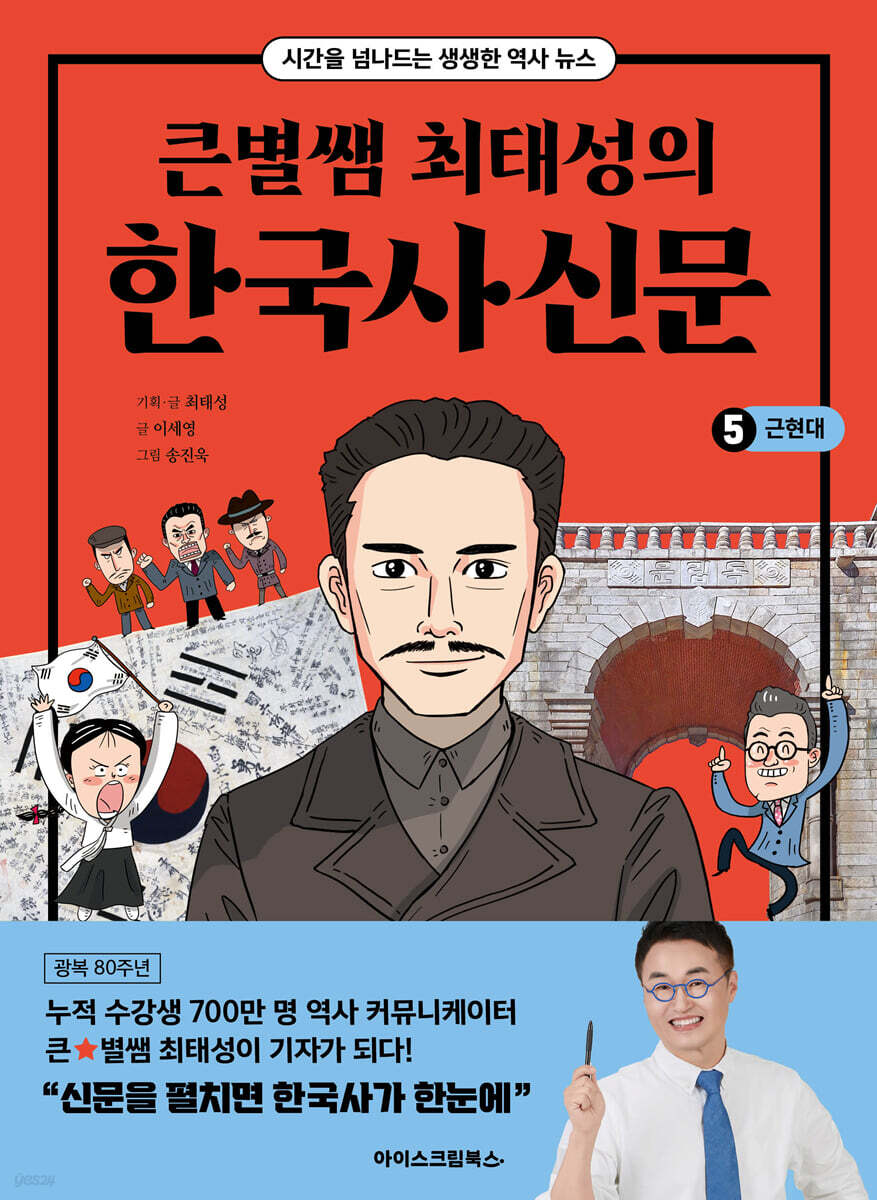
Big Star Teacher Choi Tae-seong's Korean History Newspaper 5: Modern and Contemporary Times
 |
Description
Book Introduction
The '⑤ Modern and Contemporary Times' section contains history from the port opening period to the present day.
It clearly reports on major events from the port opening period, such as the Byeong-in Yangyo, Gapsin Coup, and Donghak Peasant Revolution, to the Japan-Korea Agreement, the March 1st Movement, the establishment of the Provisional Government of the Republic of Korea, the Battle of Cheongsanri, and the liberation on August 15, and in modern times, the Korean War, the April 19 Revolution, the June Democracy Movement, and the first North-South Summit.
Also, the stories of representative figures of the era, such as Emperor Gojong, who stood at the gates of enlightenment, Ahn Jung-geun, who pulled the trigger against Japan, and Yu Gwan-sun, who called for independence, are vividly told through interviews with reporter Daebyeol.
In the column articles that round out each issue of the newspaper, we delve deeply into diverse issues, including politics for the people, students who have shaped history, and our challenge of unification, through the perspective of reporter Daebyeol.
In addition, you can enjoy interesting exhibitions of Joseon products promotion movement and the 625 War photo exhibition presented in a modern advertising format.
It clearly reports on major events from the port opening period, such as the Byeong-in Yangyo, Gapsin Coup, and Donghak Peasant Revolution, to the Japan-Korea Agreement, the March 1st Movement, the establishment of the Provisional Government of the Republic of Korea, the Battle of Cheongsanri, and the liberation on August 15, and in modern times, the Korean War, the April 19 Revolution, the June Democracy Movement, and the first North-South Summit.
Also, the stories of representative figures of the era, such as Emperor Gojong, who stood at the gates of enlightenment, Ahn Jung-geun, who pulled the trigger against Japan, and Yu Gwan-sun, who called for independence, are vividly told through interviews with reporter Daebyeol.
In the column articles that round out each issue of the newspaper, we delve deeply into diverse issues, including politics for the people, students who have shaped history, and our challenge of unification, through the perspective of reporter Daebyeol.
In addition, you can enjoy interesting exhibitions of Joseon products promotion movement and the 625 War photo exhibition presented in a modern advertising format.
- You can preview some of the book's contents.
Preview
index
The First Port Opening Period │ Joseon Opens Its Doors
1. The Erection of the Monument to the Emperor, Firmly Closing the Doors to Joseon
2 Articles: The signing of the Ganghwa Island Treaty opened three ports, including Busan.
3. Meeting Emperor Gojong at the Gate of Enlightenment
Article 4: Yeongnam Confucian Scholars Launch a Mass Petition Movement
5. The Qing army intervened to suppress the Im-o Rebellion.
The Butterfly Effect of the Column 6 Ganghwa Island Treaty
The Second Port Opening Period │ Unleashing a Modern Reform Movement
Article 1: The Gapsin Coup, Concluded in Three Days
2 Interview: Meeting Kim Ok-gyun, who led the Gapsin Coup
Article 3: The Jeonju Treaty of Peace was signed, and the Donghak Peasant Army was disbanded.
4. Interview: Meeting Jeon Bong-jun, Leader of the Donghak Peasant Revolution
Column 5: A History of Past Failures Becoming Future Successes
The Third Port Opening Period │ Shedding the Old System
Article 1: Gabo Reforms implemented, abolishing the caste system
2 Interviews: Reactions from All Sectors to the Gabo Reforms
Article 3: The Eulmi Incident and the Hair Cutting Order: The People's Anger Explodes
4. Meet Yoo In-seok, the leader of the Eulmi Righteous Army.
Article 5: King Gojong secretly takes refuge in the Russian embassy
Column 6: The Price Joseon Must Pay for Relying on Other Countries
The Fourth Korean Empire │ Striving to Establish an Independent Nation
Article 1: Independence Association Holds a People's Joint Meeting
2 Articles Proclaiming the Empire of the Emperor, the Korean Empire
3 Interview: The Story of the Gwangmu Reforms from King Gojong
4. Interview: Public-Private Joint Committee Listens to the Voice of the People
Article 5: Opening of the Gyeongin Line, the emergence of a new mode of transportation
6 The people's politics that blossomed in the square
No. 5 Korean Empire │ Striving to Protect National Sovereignty
Article 1: The Eulsa Treaty, the Korean Empire's loss of diplomatic rights
Article 2: The Jeongmi Uprising spreads nationwide, with many disbanded soldiers joining.
3 Interview: Ahn Jung-geun Pulls the Trigger Against Japan
Article 4: The New People's Association Begins Construction of a Base for the Independence Movement
5. Meet Yang Ki-tak, the man who spearheaded the national debt redemption movement.
Column 6: Remembering the Names of the Eulsa Five Traitors
No. 6: The Japanese Colonial Period │ Fighting Against Japan's Military Rule
Article 1: Joseon's decree on punishment of the dead is implemented, strengthening military rule.
Article 2: Land Survey Project: Widespread Damage to Farmers
3 Interviews: Meet the Leaders of the Anti-Japanese Secret Society
Column 4: Dreams Must Be Verbs
No. 7 Japanese Colonial Period │ The March 1st Movement and the Birth of the Provisional Government of the Republic of Korea
Article 1: Shouts of "Long Live Korean Independence" Spread Nationwide
2 Interview: Meet Yu Gwan-sun, Who Cried Out for Independence
Article 3: The Establishment of the Provisional Government of the Republic of Korea: A New Turning Point in the Independence Movement
4. Interview: Meeting Ahn Chang-ho of the Provisional Government of the Republic of Korea
Column 5: From 'Empire' to 'Republic'
No. 8: The Japanese Colonial Period │ Various Nationalist Movements
Article 1: Japanese colonial rule, under the guise of "cultural rule," suppressed the independence movement.
Article 2 Victory in the Battle of Cheongsanri, Repulsion of the Japanese Army
Interview 3: Kim Won-bong on the Path of Uiyoldan
4 Advertisement We made it, we use it!
Article 4: The Gwangju Student Anti-Japanese Movement Spreads Nationwide
Column 6: Students Become Key Players Who Shape History
No. 9: The Japanese Colonial Period │ Efforts to Protect the Nation Against Japanese Imperialism
Article 1: The Korean Language Society's forced dissolution threatens to halt the compilation of the Korean dictionary.
2 Interview: Meeting Kim Gu, the organizer of the Korean Patriotic Corps
3. Implementing a conscription system and strengthening the wartime mobilization system.
Article 4 August 15, 1945: Liberation
Column 5: This is how Korean was preserved
No. 10 Modern │ The Republic of Korea government is established
Article 1 Divided into North and South along the 38th parallel
Interview 2: Hearing the Lively Voices of the May 10 General Election
Article 3: Establishment of the Republic of Korea government three years after liberation
Column 4: Ideology should not take precedence over people.
No. 11 Modern │ The Flames of War Burn on the Korean Peninsula
Article 1: The outbreak of the Korean War due to North Korea's invasion of the South
Article 2: Successful Incheon Landing Operation, Turning the Tide
3 Interviews: Stories from Hungnam Evacuation Survivors
Article 4: Armistice Agreement Signed, Gunfire Ceases
5 Advertisement 6/25 War Photo Exhibition
Column 6: A Letter from Student Volunteer Army Member Lee Woo-geun
No. 12 Modern │ Awakening a New Era through Citizen Revolution
Article 1: A Democratic Revolution Against Election Fraud
Article 2: Park Chung-hee seizes power through military coup
Article 3: Opening of the Gyeongbu Expressway connecting Seoul and Busan
Column 4: Why is the April 19 Revolution called a revolution?
No. 13 Modern │ Social Changes Beginning Under the Shadow of the Yushin Regime
Article 1: The promulgation of the Yushin Constitution, shaking freedom with power
2 Interview Can't I do whatever I want with my clothes and hair?
3. Subway line opens from Seoul to Cheongnyangni
Article 4 Resistance against the Yushin regime leads to the October 26 Incident
Column 5: Unification, Come on the Wind of Peace
No. 14 Modern │ The Seeds of Democracy Sprouting
Article 1: The May 18th Democratization Movement: Citizens Stand Up to Martial Law
Article 2: The June Democracy Movement Leads to Direct Presidential Election
3 Interviews: The Seoul Olympics, a global festival
Article 4: Adoption of the Inter-Korean Basic Agreement, Ushering in an Era of Reconciliation
Column 5: Is professional baseball just a fun sport?
No. 15 Hyundai │ South Korea, Moving Toward an Advanced Nation
Article 1 Joining the ranks of developed countries by joining the OECD
Article 2: Request for IMF Bailout Amidst Foreign Exchange Crisis
Article 3: Inter-Korean Summit Held, Ushering in a New Era of Reconciliation
4 Interviews: Meet a Czech student immersed in K-culture
Column 5 History is not ashamed of defeat.
1. The Erection of the Monument to the Emperor, Firmly Closing the Doors to Joseon
2 Articles: The signing of the Ganghwa Island Treaty opened three ports, including Busan.
3. Meeting Emperor Gojong at the Gate of Enlightenment
Article 4: Yeongnam Confucian Scholars Launch a Mass Petition Movement
5. The Qing army intervened to suppress the Im-o Rebellion.
The Butterfly Effect of the Column 6 Ganghwa Island Treaty
The Second Port Opening Period │ Unleashing a Modern Reform Movement
Article 1: The Gapsin Coup, Concluded in Three Days
2 Interview: Meeting Kim Ok-gyun, who led the Gapsin Coup
Article 3: The Jeonju Treaty of Peace was signed, and the Donghak Peasant Army was disbanded.
4. Interview: Meeting Jeon Bong-jun, Leader of the Donghak Peasant Revolution
Column 5: A History of Past Failures Becoming Future Successes
The Third Port Opening Period │ Shedding the Old System
Article 1: Gabo Reforms implemented, abolishing the caste system
2 Interviews: Reactions from All Sectors to the Gabo Reforms
Article 3: The Eulmi Incident and the Hair Cutting Order: The People's Anger Explodes
4. Meet Yoo In-seok, the leader of the Eulmi Righteous Army.
Article 5: King Gojong secretly takes refuge in the Russian embassy
Column 6: The Price Joseon Must Pay for Relying on Other Countries
The Fourth Korean Empire │ Striving to Establish an Independent Nation
Article 1: Independence Association Holds a People's Joint Meeting
2 Articles Proclaiming the Empire of the Emperor, the Korean Empire
3 Interview: The Story of the Gwangmu Reforms from King Gojong
4. Interview: Public-Private Joint Committee Listens to the Voice of the People
Article 5: Opening of the Gyeongin Line, the emergence of a new mode of transportation
6 The people's politics that blossomed in the square
No. 5 Korean Empire │ Striving to Protect National Sovereignty
Article 1: The Eulsa Treaty, the Korean Empire's loss of diplomatic rights
Article 2: The Jeongmi Uprising spreads nationwide, with many disbanded soldiers joining.
3 Interview: Ahn Jung-geun Pulls the Trigger Against Japan
Article 4: The New People's Association Begins Construction of a Base for the Independence Movement
5. Meet Yang Ki-tak, the man who spearheaded the national debt redemption movement.
Column 6: Remembering the Names of the Eulsa Five Traitors
No. 6: The Japanese Colonial Period │ Fighting Against Japan's Military Rule
Article 1: Joseon's decree on punishment of the dead is implemented, strengthening military rule.
Article 2: Land Survey Project: Widespread Damage to Farmers
3 Interviews: Meet the Leaders of the Anti-Japanese Secret Society
Column 4: Dreams Must Be Verbs
No. 7 Japanese Colonial Period │ The March 1st Movement and the Birth of the Provisional Government of the Republic of Korea
Article 1: Shouts of "Long Live Korean Independence" Spread Nationwide
2 Interview: Meet Yu Gwan-sun, Who Cried Out for Independence
Article 3: The Establishment of the Provisional Government of the Republic of Korea: A New Turning Point in the Independence Movement
4. Interview: Meeting Ahn Chang-ho of the Provisional Government of the Republic of Korea
Column 5: From 'Empire' to 'Republic'
No. 8: The Japanese Colonial Period │ Various Nationalist Movements
Article 1: Japanese colonial rule, under the guise of "cultural rule," suppressed the independence movement.
Article 2 Victory in the Battle of Cheongsanri, Repulsion of the Japanese Army
Interview 3: Kim Won-bong on the Path of Uiyoldan
4 Advertisement We made it, we use it!
Article 4: The Gwangju Student Anti-Japanese Movement Spreads Nationwide
Column 6: Students Become Key Players Who Shape History
No. 9: The Japanese Colonial Period │ Efforts to Protect the Nation Against Japanese Imperialism
Article 1: The Korean Language Society's forced dissolution threatens to halt the compilation of the Korean dictionary.
2 Interview: Meeting Kim Gu, the organizer of the Korean Patriotic Corps
3. Implementing a conscription system and strengthening the wartime mobilization system.
Article 4 August 15, 1945: Liberation
Column 5: This is how Korean was preserved
No. 10 Modern │ The Republic of Korea government is established
Article 1 Divided into North and South along the 38th parallel
Interview 2: Hearing the Lively Voices of the May 10 General Election
Article 3: Establishment of the Republic of Korea government three years after liberation
Column 4: Ideology should not take precedence over people.
No. 11 Modern │ The Flames of War Burn on the Korean Peninsula
Article 1: The outbreak of the Korean War due to North Korea's invasion of the South
Article 2: Successful Incheon Landing Operation, Turning the Tide
3 Interviews: Stories from Hungnam Evacuation Survivors
Article 4: Armistice Agreement Signed, Gunfire Ceases
5 Advertisement 6/25 War Photo Exhibition
Column 6: A Letter from Student Volunteer Army Member Lee Woo-geun
No. 12 Modern │ Awakening a New Era through Citizen Revolution
Article 1: A Democratic Revolution Against Election Fraud
Article 2: Park Chung-hee seizes power through military coup
Article 3: Opening of the Gyeongbu Expressway connecting Seoul and Busan
Column 4: Why is the April 19 Revolution called a revolution?
No. 13 Modern │ Social Changes Beginning Under the Shadow of the Yushin Regime
Article 1: The promulgation of the Yushin Constitution, shaking freedom with power
2 Interview Can't I do whatever I want with my clothes and hair?
3. Subway line opens from Seoul to Cheongnyangni
Article 4 Resistance against the Yushin regime leads to the October 26 Incident
Column 5: Unification, Come on the Wind of Peace
No. 14 Modern │ The Seeds of Democracy Sprouting
Article 1: The May 18th Democratization Movement: Citizens Stand Up to Martial Law
Article 2: The June Democracy Movement Leads to Direct Presidential Election
3 Interviews: The Seoul Olympics, a global festival
Article 4: Adoption of the Inter-Korean Basic Agreement, Ushering in an Era of Reconciliation
Column 5: Is professional baseball just a fun sport?
No. 15 Hyundai │ South Korea, Moving Toward an Advanced Nation
Article 1 Joining the ranks of developed countries by joining the OECD
Article 2: Request for IMF Bailout Amidst Foreign Exchange Crisis
Article 3: Inter-Korean Summit Held, Ushering in a New Era of Reconciliation
4 Interviews: Meet a Czech student immersed in K-culture
Column 5 History is not ashamed of defeat.
Detailed image

Publisher's Review
“History newspaper delivery~!” If you read it with interest, Korean history will stick in your head!
Big Star Teacher Choi Tae-seong publishes a new concept history book for children.
A Korean history newspaper presented to commemorate the 80th anniversary of liberation
Reading Korean history in newspapers gives me more power to think.
Convey information concisely and clearly, and include diverse perspectives.
This book takes advantage of the newspaper's strengths, conveying the essence of the events in an accessible manner while also raising questions about each topic and encouraging readers to interpret it for themselves.
Young readers can develop historical thinking skills by connecting the past to the present, rather than simply viewing it as "the past."
A history book to read, see, and think about
This book conveys historical events from various angles through a colorful article format, just like an actual newspaper.
1.
Front Page Headline: Presents the core keywords of the day's topic as a title, helping readers get a preview of what will be covered in this chapter.
2.
Big Star Article: A concise news article structured according to the six principles (when, where, who, what, why, and how).
Helps children quickly understand key facts and summarize the development and context of events at a glance.
3.
Big Star Interview: An imaginary interview where you meet historical figures in person and hear their stories.
By vividly conveying the characters' thoughts and emotions, it goes beyond simple information delivery and enables character-centered empathetic learning.
4.
Big Star Column: This is a commentary corner where reporter Big Star provides his own commentary.
It conveys historical significance, background, and connections to the present day in an easy and in-depth manner, using explanations tailored to children's level.
5.
Big Star Advertisement: A fictional advertisement satirically depicting the situation at the time.
It stimulates historical imagination by expressing the times and culture in a playful way, and even provides background knowledge.
6.
Chronological Appendix: Includes a chronological table to help you organize what you've learned in the context of the times.
If you keep it on your desk, it will be effective in understanding the flow of Korean history and the causal relationships between events.
A historical newspaper with witty illustrations and vivid photographs
Witty illustrations help bring historical scenes to life and make complex content visually accessible.
Additionally, various visual materials such as actual artifacts, photographs, and maps are included, adding a sense of historical presence and realism that is difficult to convey through text alone.
History is a window to the future.
《Big Star Teacher Choi Tae-seong's Korean History Newspaper》 is not a simple introduction to history.
It is a living book designed to help children understand history not just as “things of the past,” but as “stories connected to the present.”
Within the clear framework of the newspaper format, children learn, feel, think, and develop a historical attitude that allows them to ask questions.
As we celebrate the 80th anniversary of liberation, this book will be a special gift, helping our children develop a broader perspective and deeper thinking through history.
The latest work by Choi Tae-seong, Korea's top Korean history instructor and history communicator, chosen by 7 million students!
Enjoy reading and learning at the same time through short, intensely written newspaper articles!
80th anniversary of liberation, a new door to Korean history opens for elementary school students!
A Korean history series has been published that allows you to experience the crucial events and scenes in our history as vividly as if they were happening in the present, using the format of a 'newspaper article' and the voice of Big Star, a 'journalist'.
This book, which takes advantage of author Taeseong Choi's strengths in storytelling, allows children to understand the history they need to know more easily and accurately through vivid delivery.
The "Big Star Teacher Choi Tae-seong's Korean History Newspaper" series is a series of historical education books designed to help young readers read the difficult and rigid history of Korea as "interesting articles." It uses the newspaper format to vividly convey major historical events and figures.
Unlike conventional narrative history books, "Big Star Teacher Choi Tae-seong's Korean History Newspaper" unfolds in a short, impactful article style, giving you the vivid feeling of traveling to the scene of an incident in a time machine and reporting directly.
By reconstructing the events of the time into a virtual front-page article, children can spark their imagination and curiosity, and easily understand the complex historical context.
This series is divided into volumes by era, allowing readers to see the flow of Korean history from prehistoric times to modern times at a glance. Each volume contains news articles, interviews, and advertisements appropriately placed by topic.
In particular, readers will have the special experience of organizing their own thoughts through column articles containing the perspectives of reporter Daebyeol Kim on looking at and interpreting history.
For elementary school children who are new to history, this book will be the perfect must-read, not only for textbook-linked learning but also for developing historical thinking and literacy skills.
Big Star Teacher Choi Tae-seong publishes a new concept history book for children.
A Korean history newspaper presented to commemorate the 80th anniversary of liberation
Reading Korean history in newspapers gives me more power to think.
Convey information concisely and clearly, and include diverse perspectives.
This book takes advantage of the newspaper's strengths, conveying the essence of the events in an accessible manner while also raising questions about each topic and encouraging readers to interpret it for themselves.
Young readers can develop historical thinking skills by connecting the past to the present, rather than simply viewing it as "the past."
A history book to read, see, and think about
This book conveys historical events from various angles through a colorful article format, just like an actual newspaper.
1.
Front Page Headline: Presents the core keywords of the day's topic as a title, helping readers get a preview of what will be covered in this chapter.
2.
Big Star Article: A concise news article structured according to the six principles (when, where, who, what, why, and how).
Helps children quickly understand key facts and summarize the development and context of events at a glance.
3.
Big Star Interview: An imaginary interview where you meet historical figures in person and hear their stories.
By vividly conveying the characters' thoughts and emotions, it goes beyond simple information delivery and enables character-centered empathetic learning.
4.
Big Star Column: This is a commentary corner where reporter Big Star provides his own commentary.
It conveys historical significance, background, and connections to the present day in an easy and in-depth manner, using explanations tailored to children's level.
5.
Big Star Advertisement: A fictional advertisement satirically depicting the situation at the time.
It stimulates historical imagination by expressing the times and culture in a playful way, and even provides background knowledge.
6.
Chronological Appendix: Includes a chronological table to help you organize what you've learned in the context of the times.
If you keep it on your desk, it will be effective in understanding the flow of Korean history and the causal relationships between events.
A historical newspaper with witty illustrations and vivid photographs
Witty illustrations help bring historical scenes to life and make complex content visually accessible.
Additionally, various visual materials such as actual artifacts, photographs, and maps are included, adding a sense of historical presence and realism that is difficult to convey through text alone.
History is a window to the future.
《Big Star Teacher Choi Tae-seong's Korean History Newspaper》 is not a simple introduction to history.
It is a living book designed to help children understand history not just as “things of the past,” but as “stories connected to the present.”
Within the clear framework of the newspaper format, children learn, feel, think, and develop a historical attitude that allows them to ask questions.
As we celebrate the 80th anniversary of liberation, this book will be a special gift, helping our children develop a broader perspective and deeper thinking through history.
The latest work by Choi Tae-seong, Korea's top Korean history instructor and history communicator, chosen by 7 million students!
Enjoy reading and learning at the same time through short, intensely written newspaper articles!
80th anniversary of liberation, a new door to Korean history opens for elementary school students!
A Korean history series has been published that allows you to experience the crucial events and scenes in our history as vividly as if they were happening in the present, using the format of a 'newspaper article' and the voice of Big Star, a 'journalist'.
This book, which takes advantage of author Taeseong Choi's strengths in storytelling, allows children to understand the history they need to know more easily and accurately through vivid delivery.
The "Big Star Teacher Choi Tae-seong's Korean History Newspaper" series is a series of historical education books designed to help young readers read the difficult and rigid history of Korea as "interesting articles." It uses the newspaper format to vividly convey major historical events and figures.
Unlike conventional narrative history books, "Big Star Teacher Choi Tae-seong's Korean History Newspaper" unfolds in a short, impactful article style, giving you the vivid feeling of traveling to the scene of an incident in a time machine and reporting directly.
By reconstructing the events of the time into a virtual front-page article, children can spark their imagination and curiosity, and easily understand the complex historical context.
This series is divided into volumes by era, allowing readers to see the flow of Korean history from prehistoric times to modern times at a glance. Each volume contains news articles, interviews, and advertisements appropriately placed by topic.
In particular, readers will have the special experience of organizing their own thoughts through column articles containing the perspectives of reporter Daebyeol Kim on looking at and interpreting history.
For elementary school children who are new to history, this book will be the perfect must-read, not only for textbook-linked learning but also for developing historical thinking and literacy skills.
GOODS SPECIFICS
- Date of issue: November 25, 2025
- Page count, weight, size: 200 pages | 188*257*20mm
- ISBN13: 9791161087757
- ISBN10: 1161087753
- KC Certification: Certification Type: Conformity Confirmation
You may also like
카테고리
korean


korean

![GQ KOREA Mark (Monthly): December [2025]](http://librairie.coreenne.fr/cdn/shop/files/8ef265dbbfbf186523ed75ba7319009d.jpg?v=1765340328&width=3840)


