

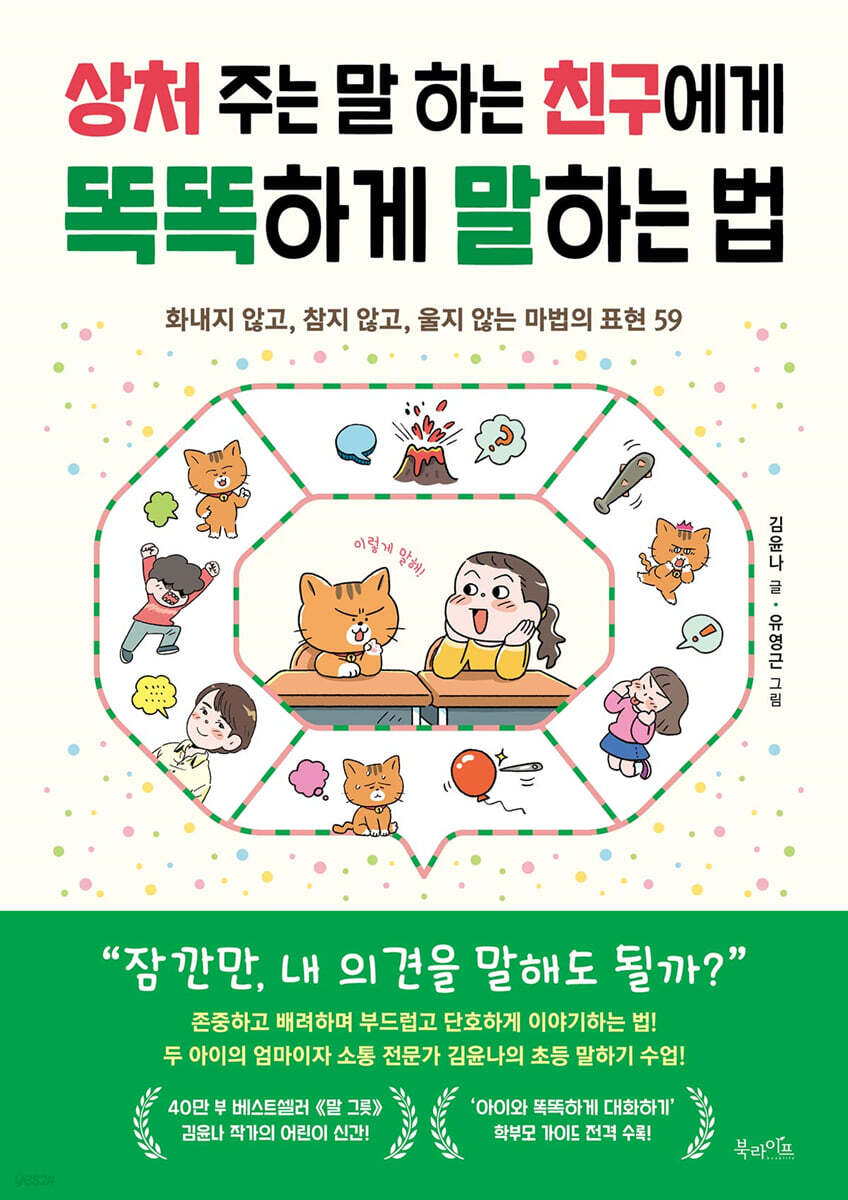
How to Talk Smart to a Friend Who Says Hurtful Things
 |
Description
Book Introduction
59 Smart Quotes to Protect Yourself and Transform Your Relationships in Awkward Situations with Friends! With my mother, a communication expert and author of the 400,000-copy bestseller “The Bowl of Words” A children's speaking solution written with my 4th grade son! Coaching psychologist Kim Yun-na, who taught 400,000 readers how to speak firmly in her 2017 book, "The Bowl of Words," now presents a method for "smart speaking" to young readers who are beginning their first human relationships in the small society of school. The author, who is also a mother of two, discovered '59 ways children get hurt by what their friends say' while talking with her fourth-grade son. And I decided to write a book with my son for elementary school students who have difficulty making friends. In this book, the author provides specific advice, as if giving advice to his son, on how to speak intelligently without getting angry, holding back, or crying. When a friend makes up an unpleasant nickname for you and teases you, what should you say to make them stop? When a friend confesses to you and you want to reject them, what should you say to convey your true feelings while also understanding them? When a friend loses something and starts doubting you, what should you say to protect yourself from hurt feelings? Beyond these, this comic book offers practical, actionable "smart words" for specific situations, such as when a friend doesn't pay back a loan, uses your belongings as if they're their own, tells you not to hang out with them, or ignores you in chat. And then, the expert's solution continues: why such an awkward situation was created, what to think and say in that situation, so that you can intelligently convey your feelings without hurting yourself or your friend. The "Parents' Guide" at the back of the book offers tips on how to handle children in uncomfortable situations and how to encourage honest communication with friends and healthy relationships. By experiencing 59 awkward situations that can arise in school life through this book, and learning smart phrases that can be used immediately along with expert advice on what to say in such situations, children will be able to build healthier real-life friendships. You can learn to express what you want to say gently but firmly without letting negative emotions build up and explode unexpectedly due to not being able to express them properly, or being ambiguously dragged around by friends who speak harshly and aggressively. |
- You can preview some of the book's contents.
Preview
index
Prologue: To Young Readers / To Parents
1.
A playful and teasing remark
1-1.
If your friends are talking and disturbing you during class
1-2.
If your friend makes a nickname for you and teases you
1-3.
If your friend teases you for dating someone of the opposite sex
1-4.
If you are upset because you lost a match because of a friend's prank
1-5.
If a friend teases me about a drawing I drew
1-6.
I feel bad, but if you just let it go as a joke
2.
Words that command and force
2-1.
If you make a decision alone when your friend is doing a group activity
2-2.
If you want to refuse a friend's excessive request
2-3.
If a friend takes the dodgeball I caught
2-4.
If a friend recommends me for something I don't want to do
2-5.
If you feel bad when your friend speaks to you in a commanding manner
2-6.
If you get a confession from a friend and want to reject it
3.
Words of resentment and criticism
3-1.
If my friend blames me for losing the match
3-2.
If you bump into me and talk to me roughly
3-3.
If your friend is upset because he lost a match
3-4.
If you blame me for your mistakes and resent me,
3-5.
If you blame me for not keeping my promise
3-6.
If a friend loses something and suspects me
4.
Words that break promises and rules
4-1.
If your friend keeps breaking promises
4-2.
If you break the rules while playing and get angry
4-3.
If your friend is a pickpocket
4-4.
If you think your friend is lying
4-5.
If you put off doing your own work during group activities
4-6.
If you told your secret to another friend
5.
Words with different opinions
5-1.
If you give advice to a friend and they feel bad
5-2.
If your friend insists that it's his
5-3.
If we decide to play together but have different opinions
5-4.
If both sides insist that their thoughts are correct
5-5.
If your friend insists that he didn't do it
5-6.
If my friends hadn't elected me as president
6.
abusive and offensive words
6-1.
If a friend threatens you with a dangerous object
6-2.
If your friend suddenly gets angry and starts swearing at you while you're joking
6-3.
If your friend curses while playing with you
6-4.
If a friend asks to tease another friend
6-5.
If you get annoyed because things don't go your way
7.
Interfering and ignoring words
7-1.
If your friend brags about how well he did on the test
7-2.
If a friend interrupts me and doesn't listen
7-3.
If a friend compares me to another friend
7-4.
If a friend gets involved in another friend's problem
7-5.
If a friend interferes with my work and nags me
8.
Words that do not ask for consent
8-1.
If a friend uses my stuff as if it were his own
8-2.
If you have your own stuff and borrow mine
8-3.
If I ask to borrow something I treasure
8-4.
If you borrow something and don't return it,
8-5.
If your friend doesn't pay you back the money he borrowed
8-6.
If your friend keeps asking you to buy it for him
9.
Bullying and harassing words
9-1.
If you don't want to include me in the game
9-2.
If my friend judges my appearance and makes fun of me
9-3.
If your friend won't talk to you
9-4.
If my friend talks behind my back
9-5.
If you go around telling me not to play with you
9-6.
If you curse and threaten when no one is around
9-7.
If my friends ignore me in chat
9-8.
If a friend talks behind another friend's back
10.
Apology
10-1.
If you don't know how to express your regret
10-2.
If your friend is angry and you don't know why
10-3.
If you don't want to apologize to your friend
10-4.
If my friend doesn't accept my apology
10-5.
If you are still angry even after receiving an apology
Parents' Guide: Communicating Smartly with Your Child
1.
Speaking out about your discomfort
2.
The ability to say what you want
3.
Take responsibility for your feelings
4.
Building trust experience
5.
Respecting differences
6.
Speaking without swearing
7.
Toxic words in relationships
8.
Balance of ownership and sharing
9.
Dialogue to prevent school violence
10.
A sincere apology
1.
A playful and teasing remark
1-1.
If your friends are talking and disturbing you during class
1-2.
If your friend makes a nickname for you and teases you
1-3.
If your friend teases you for dating someone of the opposite sex
1-4.
If you are upset because you lost a match because of a friend's prank
1-5.
If a friend teases me about a drawing I drew
1-6.
I feel bad, but if you just let it go as a joke
2.
Words that command and force
2-1.
If you make a decision alone when your friend is doing a group activity
2-2.
If you want to refuse a friend's excessive request
2-3.
If a friend takes the dodgeball I caught
2-4.
If a friend recommends me for something I don't want to do
2-5.
If you feel bad when your friend speaks to you in a commanding manner
2-6.
If you get a confession from a friend and want to reject it
3.
Words of resentment and criticism
3-1.
If my friend blames me for losing the match
3-2.
If you bump into me and talk to me roughly
3-3.
If your friend is upset because he lost a match
3-4.
If you blame me for your mistakes and resent me,
3-5.
If you blame me for not keeping my promise
3-6.
If a friend loses something and suspects me
4.
Words that break promises and rules
4-1.
If your friend keeps breaking promises
4-2.
If you break the rules while playing and get angry
4-3.
If your friend is a pickpocket
4-4.
If you think your friend is lying
4-5.
If you put off doing your own work during group activities
4-6.
If you told your secret to another friend
5.
Words with different opinions
5-1.
If you give advice to a friend and they feel bad
5-2.
If your friend insists that it's his
5-3.
If we decide to play together but have different opinions
5-4.
If both sides insist that their thoughts are correct
5-5.
If your friend insists that he didn't do it
5-6.
If my friends hadn't elected me as president
6.
abusive and offensive words
6-1.
If a friend threatens you with a dangerous object
6-2.
If your friend suddenly gets angry and starts swearing at you while you're joking
6-3.
If your friend curses while playing with you
6-4.
If a friend asks to tease another friend
6-5.
If you get annoyed because things don't go your way
7.
Interfering and ignoring words
7-1.
If your friend brags about how well he did on the test
7-2.
If a friend interrupts me and doesn't listen
7-3.
If a friend compares me to another friend
7-4.
If a friend gets involved in another friend's problem
7-5.
If a friend interferes with my work and nags me
8.
Words that do not ask for consent
8-1.
If a friend uses my stuff as if it were his own
8-2.
If you have your own stuff and borrow mine
8-3.
If I ask to borrow something I treasure
8-4.
If you borrow something and don't return it,
8-5.
If your friend doesn't pay you back the money he borrowed
8-6.
If your friend keeps asking you to buy it for him
9.
Bullying and harassing words
9-1.
If you don't want to include me in the game
9-2.
If my friend judges my appearance and makes fun of me
9-3.
If your friend won't talk to you
9-4.
If my friend talks behind my back
9-5.
If you go around telling me not to play with you
9-6.
If you curse and threaten when no one is around
9-7.
If my friends ignore me in chat
9-8.
If a friend talks behind another friend's back
10.
Apology
10-1.
If you don't know how to express your regret
10-2.
If your friend is angry and you don't know why
10-3.
If you don't want to apologize to your friend
10-4.
If my friend doesn't accept my apology
10-5.
If you are still angry even after receiving an apology
Parents' Guide: Communicating Smartly with Your Child
1.
Speaking out about your discomfort
2.
The ability to say what you want
3.
Take responsibility for your feelings
4.
Building trust experience
5.
Respecting differences
6.
Speaking without swearing
7.
Toxic words in relationships
8.
Balance of ownership and sharing
9.
Dialogue to prevent school violence
10.
A sincere apology
Detailed image

Into the book
Your friend probably isn't ignoring you on purpose.
He may have said that because he is impatient or wants to finish it quickly.
But that doesn't mean you have to blindly follow someone who is so outspoken in their opinions.
If you are offended by your friend's attitude or dissatisfied with the role he or she has been given, you should make your opinion clear.
In that case, try starting the conversation by saying, "Wait a minute! Can I express my opinion?"
--- p.31, from “If a friend makes a decision alone when doing group activities”
If you both bump into each other and your friend starts accusing you of everything being your fault, you'll feel embarrassed and wronged.
In such cases, first admit your mistake by saying, "I'm sorry."
I'm sure you were surprised and offended the moment we bumped into each other, but I still apologize first.
Then, it's good to carefully say, "Let's be careful together."
Rather than responding harshly like you would with a friend, it's smarter to speak gently.
--- p.47, from “If you speak harshly to me when we bump into each other”
If you said it out of concern and your friend is upset, it's because you have different opinions.
Or maybe he knew it, but he just didn't want to hear that from other people.
In that case, don't force it any further, just think, 'We both have different opinions,' and let it go.
And if you have something you want to say to a friend, rather than saying, "You have to write it!" or "Write it!", it's better to say, "Let's write it together~" or "How about writing it?"
--- p.73, from “If you give advice to a friend and they feel bad”
I want to have fun with my friends, but we might have different things we want to do.
All the time passes while I'm just thinking, 'What should I do?'
And I even complained, saying, 'I couldn't play because of you.'
In such cases, it is better to decide ‘by turns’ or ‘by majority vote.’
Try suggesting something like, 'Let's play what you want first, and then let's play what I want!'
Another good way is for the participating friends to each suggest a game, and then start with the game that the most friends want.
--- p.77, from “If we decide to play together but have different opinions”
When you're hanging out with friends, if someone curses frequently and harshly, just hearing it can make you feel bad.
In times like this, rather than speaking in a manner that seems like you're teaching your friend, try suggesting something like, "Let's not swear when we play together."
If your friend wants to continue to get along with you, he or she will try not to use profanity.
But if you ignore my suggestion and pretend not to know, it may be difficult to continue hanging out together comfortably.
--- p.91, from “If a friend curses while playing together”
My friend wanted to tell his story quickly, so he couldn't keep up with the conversation.
In times like this, you can say, "Don't interrupt me when I speak, just listen," and tell me what you want.
Listening carefully to what other people say is called 'listening', and it is a very important conversational etiquette for building and maintaining good relationships.
--- p.101, from “If a friend interrupts me and doesn’t listen”
You have to be careful about money being involved in friendships.
You lent money with good intentions, but when the friend you borrowed money from doesn't pay it back, you feel uneasy because you're worried about what to say.
If you do that, your relationship with your friends may become awkward.
If this situation arises, check with your friend directly to see how long you can return it.
Things that are really important to us, like money and time, we need to manage them well ourselves.
--- p.119, from “If a friend doesn’t pay back the money he borrowed”
There are cases where people invite friends to a chat room and then intentionally ignore them to make them feel like they are being ostracized.
If several people are chatting together, they may respond late to what I say.
However, if you feel like your friends are intentionally ignoring you, just say, "I'm going to leave now" and leave the chat room immediately.
If they keep inviting you, you should refuse, turn off your phone, and ask an adult for help.
--- p.137, from “If my friends ignore me in chat”
When you hang out with friends, you might make mistakes.
In that case, you just need to admit your mistake and apologize.
If you just let it go because it's awkward and embarrassing, the resentment will build up and explode someday.
It's also difficult to speak as if nothing happened or as if it's no big deal.
When apologizing, it is better to say 'I'm sorry' along with the reason why you are sorry.
If you say, 'I apologize,' you will convey your sincerity.
He may have said that because he is impatient or wants to finish it quickly.
But that doesn't mean you have to blindly follow someone who is so outspoken in their opinions.
If you are offended by your friend's attitude or dissatisfied with the role he or she has been given, you should make your opinion clear.
In that case, try starting the conversation by saying, "Wait a minute! Can I express my opinion?"
--- p.31, from “If a friend makes a decision alone when doing group activities”
If you both bump into each other and your friend starts accusing you of everything being your fault, you'll feel embarrassed and wronged.
In such cases, first admit your mistake by saying, "I'm sorry."
I'm sure you were surprised and offended the moment we bumped into each other, but I still apologize first.
Then, it's good to carefully say, "Let's be careful together."
Rather than responding harshly like you would with a friend, it's smarter to speak gently.
--- p.47, from “If you speak harshly to me when we bump into each other”
If you said it out of concern and your friend is upset, it's because you have different opinions.
Or maybe he knew it, but he just didn't want to hear that from other people.
In that case, don't force it any further, just think, 'We both have different opinions,' and let it go.
And if you have something you want to say to a friend, rather than saying, "You have to write it!" or "Write it!", it's better to say, "Let's write it together~" or "How about writing it?"
--- p.73, from “If you give advice to a friend and they feel bad”
I want to have fun with my friends, but we might have different things we want to do.
All the time passes while I'm just thinking, 'What should I do?'
And I even complained, saying, 'I couldn't play because of you.'
In such cases, it is better to decide ‘by turns’ or ‘by majority vote.’
Try suggesting something like, 'Let's play what you want first, and then let's play what I want!'
Another good way is for the participating friends to each suggest a game, and then start with the game that the most friends want.
--- p.77, from “If we decide to play together but have different opinions”
When you're hanging out with friends, if someone curses frequently and harshly, just hearing it can make you feel bad.
In times like this, rather than speaking in a manner that seems like you're teaching your friend, try suggesting something like, "Let's not swear when we play together."
If your friend wants to continue to get along with you, he or she will try not to use profanity.
But if you ignore my suggestion and pretend not to know, it may be difficult to continue hanging out together comfortably.
--- p.91, from “If a friend curses while playing together”
My friend wanted to tell his story quickly, so he couldn't keep up with the conversation.
In times like this, you can say, "Don't interrupt me when I speak, just listen," and tell me what you want.
Listening carefully to what other people say is called 'listening', and it is a very important conversational etiquette for building and maintaining good relationships.
--- p.101, from “If a friend interrupts me and doesn’t listen”
You have to be careful about money being involved in friendships.
You lent money with good intentions, but when the friend you borrowed money from doesn't pay it back, you feel uneasy because you're worried about what to say.
If you do that, your relationship with your friends may become awkward.
If this situation arises, check with your friend directly to see how long you can return it.
Things that are really important to us, like money and time, we need to manage them well ourselves.
--- p.119, from “If a friend doesn’t pay back the money he borrowed”
There are cases where people invite friends to a chat room and then intentionally ignore them to make them feel like they are being ostracized.
If several people are chatting together, they may respond late to what I say.
However, if you feel like your friends are intentionally ignoring you, just say, "I'm going to leave now" and leave the chat room immediately.
If they keep inviting you, you should refuse, turn off your phone, and ask an adult for help.
--- p.137, from “If my friends ignore me in chat”
When you hang out with friends, you might make mistakes.
In that case, you just need to admit your mistake and apologize.
If you just let it go because it's awkward and embarrassing, the resentment will build up and explode someday.
It's also difficult to speak as if nothing happened or as if it's no big deal.
When apologizing, it is better to say 'I'm sorry' along with the reason why you are sorry.
If you say, 'I apologize,' you will convey your sincerity.
--- p.143, from “If you don’t know how to express your regret”
Publisher's Review
I don't get hurt and I don't hurt my friends either.
59 Solutions for Smarter Speaking! "Should I Say This in This Situation?"
It is no exaggeration to say that for elementary school students, friendships are almost everything in school life.
Most of the reasons we want to go to school or don't want to go are because of our friends.
Children are faithfully building their first experiences of human relationships by interacting with friends with as many different personalities and speech styles as they have different faces.
Children are growing up and going through a lot of changes.
We may be on good terms today and fight tomorrow, or we may be sulking in the morning and laughing in the afternoon.
In the process, countless words are exchanged, and some words leave wounds on friends' hearts and ruin relationships.
Children are still growing and immature.
Sometimes they ignore the other person's feelings and insist on their own opinions, sometimes they say things that are different from what they really mean, and sometimes they speak harshly and sharply for no reason.
Also, because they don't want to admit their mistakes, they blame others, gossip behind friends' backs, and several people ostracize one friend.
You have no idea how much these words hurt your friend.
If your child is struggling with friendships, try the 59 awkward situations presented in this book to experience indirectly what words can hurt a friend.
Let's learn how to think and what to say when we hear such words so that we can protect our feelings and say what we want to say to our friends.
A friend who speaks intelligently, that is, a friend who confidently says what he wants to say and listens to what others say, is popular anytime, anywhere.
But speaking intelligently is like learning a new instrument; it takes practice.
If you practice speaking intelligently with this book, you will be able to maintain smooth friendships and have an enjoyable school life.
Raising a child who can confidently express his or her own opinions while being considerate of his or her friends
A parent's guide to 'Talking Smartly with Your Child' now included!
At the very back of this book is 'Parents' Guide: Talking Smartly with My Child'.
It contains tips for parents and teachers on how to guide children when they experience uncomfortable situations in their friendships.
Here's how to talk to your child when he or she feels hurt by being forced to talk to a friend.
“Help your child express his or her desires and refusals to family members.
I need to experience that saying no and saying 'I don't want to' doesn't cause any discomfort in the relationship.
Even when your child rejects your parents' request, rather than being upset, accept it naturally and encourage them.” _From the Parents' Guide
When your child has a fight with a friend or has heard hurtful words, rather than focusing on understanding the situation and solving the problem, you should first focus on listening to your child and empathizing with them.
You should not carelessly assume things that your child does not say.
Ask your child how he or she would like to solve the problem and wait for him or her to come up with his or her own alternative.
Then, if you read this book with your child and teach them practical conversation skills, they will more firmly acquire the ability to speak intelligently, and grow into strong individuals who know how to express their thoughts accurately while also being considerate of others.
59 Solutions for Smarter Speaking! "Should I Say This in This Situation?"
It is no exaggeration to say that for elementary school students, friendships are almost everything in school life.
Most of the reasons we want to go to school or don't want to go are because of our friends.
Children are faithfully building their first experiences of human relationships by interacting with friends with as many different personalities and speech styles as they have different faces.
Children are growing up and going through a lot of changes.
We may be on good terms today and fight tomorrow, or we may be sulking in the morning and laughing in the afternoon.
In the process, countless words are exchanged, and some words leave wounds on friends' hearts and ruin relationships.
Children are still growing and immature.
Sometimes they ignore the other person's feelings and insist on their own opinions, sometimes they say things that are different from what they really mean, and sometimes they speak harshly and sharply for no reason.
Also, because they don't want to admit their mistakes, they blame others, gossip behind friends' backs, and several people ostracize one friend.
You have no idea how much these words hurt your friend.
If your child is struggling with friendships, try the 59 awkward situations presented in this book to experience indirectly what words can hurt a friend.
Let's learn how to think and what to say when we hear such words so that we can protect our feelings and say what we want to say to our friends.
A friend who speaks intelligently, that is, a friend who confidently says what he wants to say and listens to what others say, is popular anytime, anywhere.
But speaking intelligently is like learning a new instrument; it takes practice.
If you practice speaking intelligently with this book, you will be able to maintain smooth friendships and have an enjoyable school life.
Raising a child who can confidently express his or her own opinions while being considerate of his or her friends
A parent's guide to 'Talking Smartly with Your Child' now included!
At the very back of this book is 'Parents' Guide: Talking Smartly with My Child'.
It contains tips for parents and teachers on how to guide children when they experience uncomfortable situations in their friendships.
Here's how to talk to your child when he or she feels hurt by being forced to talk to a friend.
“Help your child express his or her desires and refusals to family members.
I need to experience that saying no and saying 'I don't want to' doesn't cause any discomfort in the relationship.
Even when your child rejects your parents' request, rather than being upset, accept it naturally and encourage them.” _From the Parents' Guide
When your child has a fight with a friend or has heard hurtful words, rather than focusing on understanding the situation and solving the problem, you should first focus on listening to your child and empathizing with them.
You should not carelessly assume things that your child does not say.
Ask your child how he or she would like to solve the problem and wait for him or her to come up with his or her own alternative.
Then, if you read this book with your child and teach them practical conversation skills, they will more firmly acquire the ability to speak intelligently, and grow into strong individuals who know how to express their thoughts accurately while also being considerate of others.
GOODS SPECIFICS
- Date of issue: February 26, 2023
- Page count, weight, size: 172 pages | 322g | 152*215*10mm
- ISBN13: 9791191013498
- ISBN10: 1191013499
- KC Certification: Certification Type: Conformity Confirmation
You may also like
카테고리
korean


korean

![GQ KOREA Mark (Monthly): December [2025]](http://librairie.coreenne.fr/cdn/shop/files/8ef265dbbfbf186523ed75ba7319009d.jpg?v=1765340328&width=3840)


