

Elementary Mini Essay Calendar 365
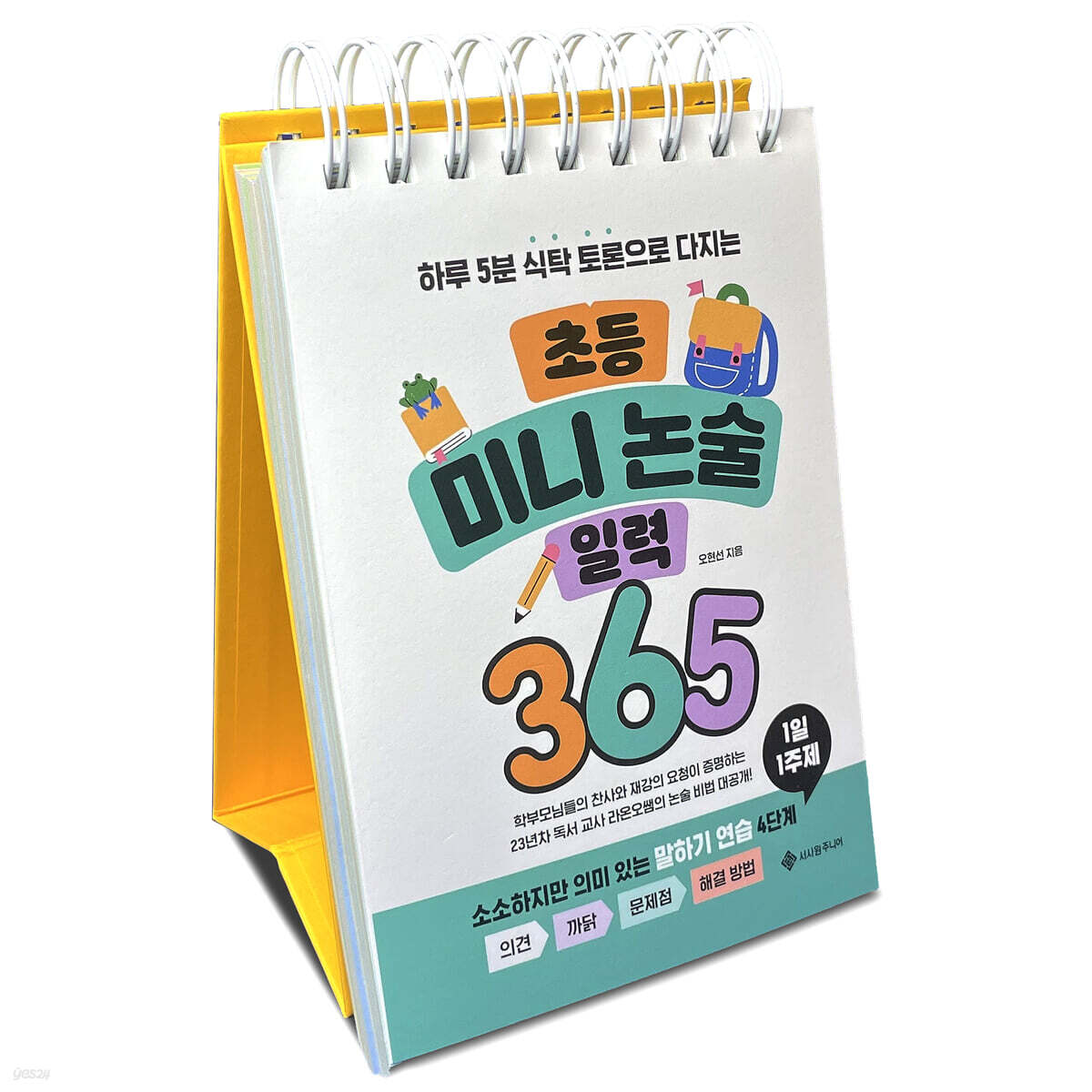 |
Description
Book Introduction
“Do you like dogs or cats?” “If there was a giant, would you like to play with him for a day or not?” “Should I wash my hair in the morning or in the evening?” 365 fun conversation topics for 5 minutes a day! The first elementary school essay begins with small but meaningful speaking practice! "When should we start sending our elementary school students to the essay writing program? Is it okay if they just read a lot of books? Should we send them in the upper grades? These are the questions parents often ask. But more importantly, it is ‘thinking every day in everyday life!’ Children's thinking skills grow as they comfortably exchange opinions on even minor topics. If you are used to doing only what you are told, or if you do not think about and judge for yourself even in small matters, your progress will be slow even if you attend an essay writing academy from the first year. “Children who naturally think and ponder even the smallest things in their daily lives, and who have their opinions respected, learn to write rather late, but they quickly learn and do well.”_From Teacher Laon Oh’s Instagram Teacher Raon Oh, author of Oh Hyeon-seon, who has been meeting children and parents as a reading teacher for 23 years, has been writing a 5-line mini-argument without any burden whenever there is a topic that requires a small exchange of opinions during class. The author's best-selling book, "Tick-Tock! Mini Essay," which captures the exact same method, is helping countless children shake off the fear of writing and enter a world of easy confidence. We've compiled a daily speaking practice calendar based on the enthusiastic responses from readers who said they were happy to have something to talk about when they didn't know what to talk about every day. Because the beginning of an argument is ‘speaking your mind.’ Author Oh Hyeon-seon, known as the "Teacher of Elementary School Teachers," travels around the country giving lectures, shining with the sincerity and ideas of reading education. In this book, you can find the wishes of parents who wish this person were their neighborhood reading teacher. |
- You can preview some of the book's contents.
Preview
index
January tastes
February Imagination
March Learning
April school life
Daily Life in May
June emotions
July Values
August Food
September Reading and Writing
October Friends
November Children and Human Rights
December Social Issues
February Imagination
March Learning
April school life
Daily Life in May
June emotions
July Values
August Food
September Reading and Writing
October Friends
November Children and Human Rights
December Social Issues
Detailed image

Publisher's Review
365 conversation topics in 5 minutes a day!
As we go about our busy lives, we often only have directive conversations with our children, rather than meaningful ones.
This kind of conversation cannot foster the power of thinking.
This book contains 365 topics that can be shared with children every day at the dinner table.
We offer a different theme each month and a different topic each day, encouraging children to think and families to have meaningful conversations every day.
Share rich conversations ranging from lighthearted conversations like, "Do you like Seollal or Chuseok?" or "Is it okay to leave some lunch leftovers?" to thoughtful ones like, "Can people and robots be friends?", "Do we need self-driving cars?", or "Is it okay to pat a stranger's head?"
It will serve as a starting point for broad thinking, from tastes, imagination, and everyday choices to emotions, values, friendships, and social issues.
Step 4 Speaking Skills
1.
What is your opinion? - 2.
Tell me why.
- 3.
What's the problem with doing that? - 4.
By answering the four questions that follow, "How can I solve that?" one by one, you'll learn to speak coherently without even realizing it.
Try to organize your thoughts so that the other person can understand them by answering the questions placed under the topic.
As you talk, your thoughts will become more organized, and as you organize your thoughts, you will experience the magic of wanting to speak naturally.
If you've had fun talking, you can open a notebook and write quietly.
The moment my thoughts become words, that's when I become more myself.
Examples of hilarious, real-life sayings from friends
Don't worry if the topic is unfamiliar or you don't know your stance right away.
Just take note of the two friends' quirky, lively, and sometimes serious opinions.
Read the two children's comments first, then open your own window of thought.
You may nod your head to both different opinions, but you can organize your thoughts in the following order: decide on an opinion that you agree with, state the reason, state the problem, and state a solution.
More stories will follow as you agree or disagree with your friend's ideas.
It would be more fun to talk about the same topic with my actual friend.
Useful and interesting knowledge to know
Each page contains stories that will help you understand the topic or take a stance.
Read slowly to build background knowledge and help you organize your opinions.
If you search and find out more about what you're curious about, the depth and breadth of the story will become much richer.
As I share with my family and friends the knowledge I've gained from "You Know That?" and add to it, my ability to organize my thoughts will grow even more.
As we go about our busy lives, we often only have directive conversations with our children, rather than meaningful ones.
This kind of conversation cannot foster the power of thinking.
This book contains 365 topics that can be shared with children every day at the dinner table.
We offer a different theme each month and a different topic each day, encouraging children to think and families to have meaningful conversations every day.
Share rich conversations ranging from lighthearted conversations like, "Do you like Seollal or Chuseok?" or "Is it okay to leave some lunch leftovers?" to thoughtful ones like, "Can people and robots be friends?", "Do we need self-driving cars?", or "Is it okay to pat a stranger's head?"
It will serve as a starting point for broad thinking, from tastes, imagination, and everyday choices to emotions, values, friendships, and social issues.
Step 4 Speaking Skills
1.
What is your opinion? - 2.
Tell me why.
- 3.
What's the problem with doing that? - 4.
By answering the four questions that follow, "How can I solve that?" one by one, you'll learn to speak coherently without even realizing it.
Try to organize your thoughts so that the other person can understand them by answering the questions placed under the topic.
As you talk, your thoughts will become more organized, and as you organize your thoughts, you will experience the magic of wanting to speak naturally.
If you've had fun talking, you can open a notebook and write quietly.
The moment my thoughts become words, that's when I become more myself.
Examples of hilarious, real-life sayings from friends
Don't worry if the topic is unfamiliar or you don't know your stance right away.
Just take note of the two friends' quirky, lively, and sometimes serious opinions.
Read the two children's comments first, then open your own window of thought.
You may nod your head to both different opinions, but you can organize your thoughts in the following order: decide on an opinion that you agree with, state the reason, state the problem, and state a solution.
More stories will follow as you agree or disagree with your friend's ideas.
It would be more fun to talk about the same topic with my actual friend.
Useful and interesting knowledge to know
Each page contains stories that will help you understand the topic or take a stance.
Read slowly to build background knowledge and help you organize your opinions.
If you search and find out more about what you're curious about, the depth and breadth of the story will become much richer.
As I share with my family and friends the knowledge I've gained from "You Know That?" and add to it, my ability to organize my thoughts will grow even more.
GOODS SPECIFICS
- Date of issue: November 10, 2023
- Format: Springbook book binding method guide
- Page count, weight, size: 384 pages | 518g | 133*208*30mm
- ISBN13: 9791168222267
- ISBN10: 1168222265
You may also like
카테고리
korean


korean

![GQ KOREA Mark (Monthly): December [2025]](http://librairie.coreenne.fr/cdn/shop/files/8ef265dbbfbf186523ed75ba7319009d.jpg?v=1765340328&width=3840)


