

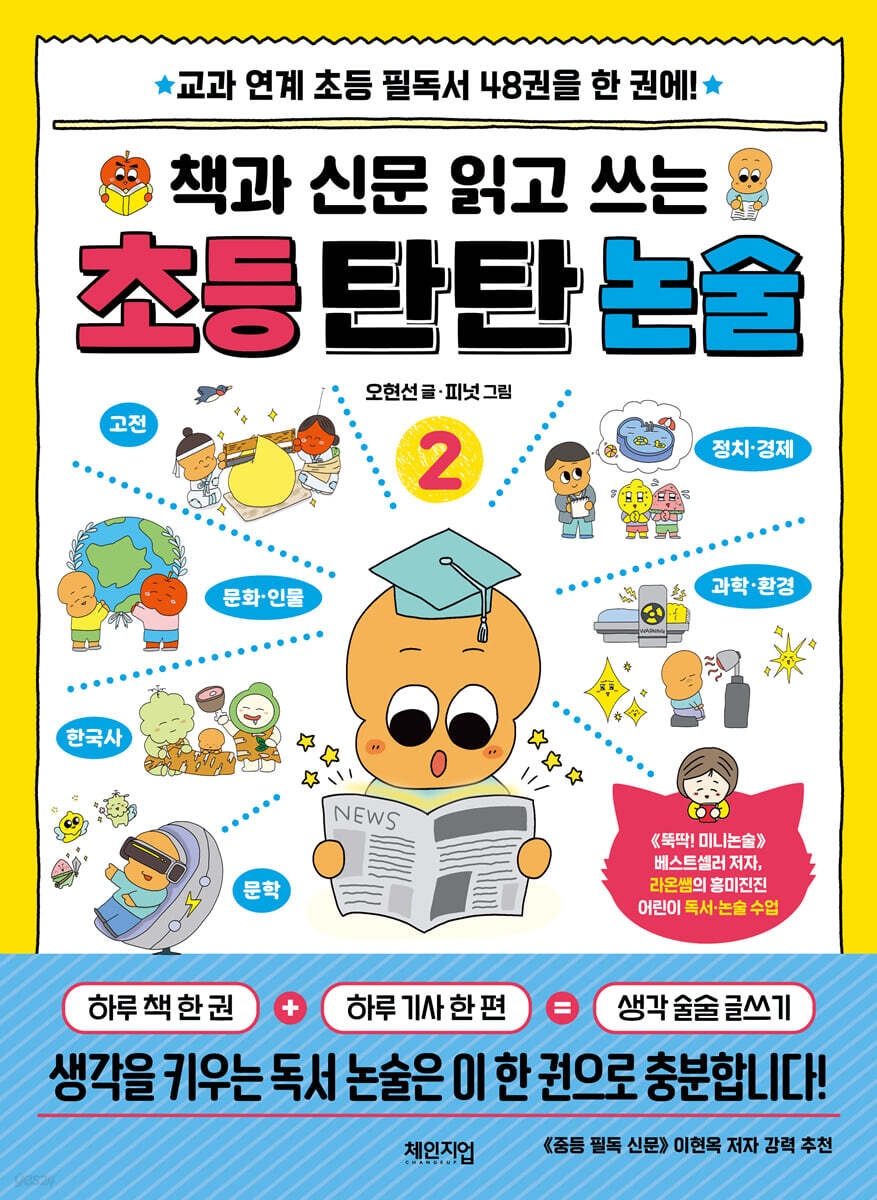
Elementary Solid Argumentation 2: Reading and Writing from Books and Newspapers
 |
Description
Book Introduction
A literacy essay class that connects books to the world, and the world to me.
Thinking and logical skills grow rapidly with required reading materials linked to the curriculum and real-life news.
The children's bestseller "Elementary Solid Argumentation through Reading and Writing Books and Newspapers" is back in two volumes.
Part 2 contains 48 required reading books related to the curriculum, divided into six more detailed topics: literature, Korean history, politics and economy, culture and people, science and environment, and classics.
The book is structured to be read alongside real-life newspaper articles, leading to in-depth discussions and reflections.
After building the essential basic knowledge in “One Page a Day: Elementary School Essential Reading,” you can examine and understand the society we live in today from diverse and in-depth perspectives through vivid newspaper articles that explain the latest news in “News with Essential Reading.”
By comparing what you learn from reading books with the social phenomena in articles, you realize that everything that happens in this world is interconnected.
Furthermore, we feel the joy of learning that it is closely related to the real lives we live.
In particular, in Part 2, we will learn how to express your thoughts on social phenomena in more detail by adding “Discussion and Writing Thoughts” and “Developing Thoughts with Mind Maps.”
By finding answers to essay questions from various angles one by one, you will not only improve your writing skills, but also your thinking, logic, and insight.
It will also be of great help in developing critical thinking skills and social sensitivity.
Thinking and logical skills grow rapidly with required reading materials linked to the curriculum and real-life news.
The children's bestseller "Elementary Solid Argumentation through Reading and Writing Books and Newspapers" is back in two volumes.
Part 2 contains 48 required reading books related to the curriculum, divided into six more detailed topics: literature, Korean history, politics and economy, culture and people, science and environment, and classics.
The book is structured to be read alongside real-life newspaper articles, leading to in-depth discussions and reflections.
After building the essential basic knowledge in “One Page a Day: Elementary School Essential Reading,” you can examine and understand the society we live in today from diverse and in-depth perspectives through vivid newspaper articles that explain the latest news in “News with Essential Reading.”
By comparing what you learn from reading books with the social phenomena in articles, you realize that everything that happens in this world is interconnected.
Furthermore, we feel the joy of learning that it is closely related to the real lives we live.
In particular, in Part 2, we will learn how to express your thoughts on social phenomena in more detail by adding “Discussion and Writing Thoughts” and “Developing Thoughts with Mind Maps.”
By finding answers to essay questions from various angles one by one, you will not only improve your writing skills, but also your thinking, logic, and insight.
It will also be of great help in developing critical thinking skills and social sensitivity.
- You can preview some of the book's contents.
Preview
index
To the children who chose this book
Use it like this
Elementary school curriculum linkage & difficulty level
Chapter 1 Literature
1.
Lucky Pig on the Street Corner
2.
Absolutely not
3.
Last event
4.
Please give me a frinder
5.
Last level up
6.
Real Marae
7.
Charlotte's Web
8.
bicycle thief
Chapter 2 Korean History
1.
Paleolithic Age Heungsu Ai
2.
The Story of Bangudae Petroglyphs
3.
I go to the Silk Road
4.
The shining night of the Cherinseong
5.
Super-organized letter
6.
Train No. 503
7.
A tiger lives in Changgyeonggung Palace
8.
Shoot for unification!
Chapter 3 Politics and Economy
1.
The turbulent market journey of Kang Jik-han
2.
I hate shit school!
3.
Do they sell the economy at convenience stores?
4.
KakaoTalk isn't free?
5.
Dad, what is the law?
6.
Society is Easy! 1 (Democracy and Politics)
7.
Congresswoman Seo Min-joo, busy, busy!
8.
Children Reading the Constitution
Chapter 4 Culture and People
1.
Do you know what a happy child you are?
2.
International organizations that move the world
3.
Stories of World Religions by Kim Na-mi
4.
Children's Copyright Classroom
5.
Learning about the lives of ancient people through Kim Hong-do's genre paintings
6.
The only story
7.
An Yong-bok, who protected our land, Dokdo
8.
Fireworks on November 13th
Chapter 5 Science and Environment
1.
Hot Earth Hot Earth Boiling Earth
2.
Time Cat 3 (Underwater City and Sea Monsters)
3.
The magician light that decorated the world
4.
green man
5.
Mr. Yong's Bustling Science Classroom 3 (Earth and the Moon)
6.
Today's Earthquake Research Institute is still shaking
7.
A fun plant story (with newspapers visible and news audible)
8.
Our Smart Body Manual
Chapter 6 Classics
1.
The Tale of Heungbu and Nolbu
2.
Simcheongjeon
3.
Mrs. Park's Story
4.
The Tale of Hong Gildong
5.
princeling
6.
The Last Leaf
7.
Transformation
8.
Les Misérables
Use it like this
Elementary school curriculum linkage & difficulty level
Chapter 1 Literature
1.
Lucky Pig on the Street Corner
2.
Absolutely not
3.
Last event
4.
Please give me a frinder
5.
Last level up
6.
Real Marae
7.
Charlotte's Web
8.
bicycle thief
Chapter 2 Korean History
1.
Paleolithic Age Heungsu Ai
2.
The Story of Bangudae Petroglyphs
3.
I go to the Silk Road
4.
The shining night of the Cherinseong
5.
Super-organized letter
6.
Train No. 503
7.
A tiger lives in Changgyeonggung Palace
8.
Shoot for unification!
Chapter 3 Politics and Economy
1.
The turbulent market journey of Kang Jik-han
2.
I hate shit school!
3.
Do they sell the economy at convenience stores?
4.
KakaoTalk isn't free?
5.
Dad, what is the law?
6.
Society is Easy! 1 (Democracy and Politics)
7.
Congresswoman Seo Min-joo, busy, busy!
8.
Children Reading the Constitution
Chapter 4 Culture and People
1.
Do you know what a happy child you are?
2.
International organizations that move the world
3.
Stories of World Religions by Kim Na-mi
4.
Children's Copyright Classroom
5.
Learning about the lives of ancient people through Kim Hong-do's genre paintings
6.
The only story
7.
An Yong-bok, who protected our land, Dokdo
8.
Fireworks on November 13th
Chapter 5 Science and Environment
1.
Hot Earth Hot Earth Boiling Earth
2.
Time Cat 3 (Underwater City and Sea Monsters)
3.
The magician light that decorated the world
4.
green man
5.
Mr. Yong's Bustling Science Classroom 3 (Earth and the Moon)
6.
Today's Earthquake Research Institute is still shaking
7.
A fun plant story (with newspapers visible and news audible)
8.
Our Smart Body Manual
Chapter 6 Classics
1.
The Tale of Heungbu and Nolbu
2.
Simcheongjeon
3.
Mrs. Park's Story
4.
The Tale of Hong Gildong
5.
princeling
6.
The Last Leaf
7.
Transformation
8.
Les Misérables
Detailed image

Into the book
By indirectly experiencing the lives of people living in various eras and environments that we have never experienced before, we can broaden our understanding of the world.
As we read literature and follow the characters' concerns, we gain the space to think deeply about ourselves and reflect on the problems around us.
Above all, reading sentences that are beautiful and delicate in expression and contain multiple meanings is, in itself, an act of appreciating a work of art.
So our minds and language become richer.
---From "What is Literature?"
Reading history, we learn about the glory, frustration, failure, and success of our ancestors, which helps us understand the present and predict the future.
You can also prepare in advance.
History records objective facts, but interpretations can vary depending on the viewer.
If you read history books, you will be able to think more broadly and deeply.
---From "Why should we read history books?"
Learning about society, including politics, economics, and law, is the first step toward understanding how the world we live in works.
From childhood, we interact with various members of society and experience phenomena related to politics, economics, and law.
By gaining knowledge about these topics through books, we can understand what rights we can exercise as members of society and what responsibilities we must bear at the same time.
---From "Why should we know about politics and economics?"
Developing an understanding and respect for unfamiliar cultures, as well as those familiar to us, is a crucial skill in the global age.
We can create a richer society through communication and cooperation with people from different cultural backgrounds.
Additionally, through the life stories of great figures in history, you can learn various values such as courage, wisdom, and leadership, and receive help in your own life.
---From "What are the characteristics of a book about culture and people?"
Learning about science is essential to understanding how the world we live in works.
By understanding the principles of the various natural phenomena occurring around us and understanding the advancements in cutting-edge technology, we can not only understand the world but also develop more rational and critical thinking skills.
Additionally, learning about environmental issues helps us realize that we live in a common space called Earth.
It makes us aware of the impact our actions have on the environment and raises awareness of the need to protect it.
---From "Why are science and environment books important?"
Reading the classics is like having a conversation with the wise men of the past.
Through their experiences and thoughts, we can learn important values of life such as justice, courage, friendship, love, and wisdom, and further achieve inner growth.
Classic works that have resonated with many people across time contain common concerns and conflicts, and through them, we can reflect on ourselves and determine the direction of our lives.
As we read literature and follow the characters' concerns, we gain the space to think deeply about ourselves and reflect on the problems around us.
Above all, reading sentences that are beautiful and delicate in expression and contain multiple meanings is, in itself, an act of appreciating a work of art.
So our minds and language become richer.
---From "What is Literature?"
Reading history, we learn about the glory, frustration, failure, and success of our ancestors, which helps us understand the present and predict the future.
You can also prepare in advance.
History records objective facts, but interpretations can vary depending on the viewer.
If you read history books, you will be able to think more broadly and deeply.
---From "Why should we read history books?"
Learning about society, including politics, economics, and law, is the first step toward understanding how the world we live in works.
From childhood, we interact with various members of society and experience phenomena related to politics, economics, and law.
By gaining knowledge about these topics through books, we can understand what rights we can exercise as members of society and what responsibilities we must bear at the same time.
---From "Why should we know about politics and economics?"
Developing an understanding and respect for unfamiliar cultures, as well as those familiar to us, is a crucial skill in the global age.
We can create a richer society through communication and cooperation with people from different cultural backgrounds.
Additionally, through the life stories of great figures in history, you can learn various values such as courage, wisdom, and leadership, and receive help in your own life.
---From "What are the characteristics of a book about culture and people?"
Learning about science is essential to understanding how the world we live in works.
By understanding the principles of the various natural phenomena occurring around us and understanding the advancements in cutting-edge technology, we can not only understand the world but also develop more rational and critical thinking skills.
Additionally, learning about environmental issues helps us realize that we live in a common space called Earth.
It makes us aware of the impact our actions have on the environment and raises awareness of the need to protect it.
---From "Why are science and environment books important?"
Reading the classics is like having a conversation with the wise men of the past.
Through their experiences and thoughts, we can learn important values of life such as justice, courage, friendship, love, and wisdom, and further achieve inner growth.
Classic works that have resonated with many people across time contain common concerns and conflicts, and through them, we can reflect on ourselves and determine the direction of our lives.
---From "What are the characteristics of a classic?"
Publisher's Review
Core competencies for descriptive and argumentative assessments, starting from elementary school!
Reading and writing that simultaneously develops critical thinking and knowledge integration skills.
With the implementation of the revised 2022 curriculum starting this year, the proportion of descriptive and essay-type evaluations has increased.
Beyond simply finding the right answer to a problem, we have entered an era where logical communication skills are assessed by writing down the problem-solving process and thought process.
In this day and age, what our children need is not just writing skills.
Logical writing requires critical thinking skills as well as the ability to connect what you already know.
This book is a reading and writing textbook that can simultaneously develop critical thinking and convergence skills.
Through the carefully selected elementary school textbooks and newspaper articles that explain the latest news in a way that elementary school students can understand, as well as essential reading books linked to the elementary school curriculum by a reading expert with 25 years of experience, children can go beyond simply acquiring knowledge and connect knowledge to knowledge, and further, knowledge to life.
After reading books and newspaper articles, you can improve your literacy and writing skills by solving essay questions that expand your thinking.
In the process, your thinking skills and insight will naturally grow.
Literature, Korean history, politics and economics, culture and people, science and environment, classics
Expand your background knowledge and current affairs knowledge with diverse topics.
《Elementary Solid Argumentation 2: Reading and Writing Books and Newspapers》 covers a total of six topics: literature, Korean history, politics and economics, culture and people, science and environment, and classics.
In Chapter 1, you can deeply empathize with the various emotions felt by characters while reading literature and indirectly experience life in various times and environments.
In Chapter 2, we follow the flow and major events of Korean history to understand the past and present and predict the future.
In Chapter 3, we learn about the principles of circulation in our society by learning about knowledge and cases related to politics, economics, and law.
In Chapter 4, we meet four people who have played a significant role in the development of today's diverse cultures and societies.
In Chapter 5, we gain knowledge and wisdom to create a better future by understanding technological advancements and natural phenomena occurring around us.
Finally, in Chapter 6, we can think about the important values that remain unchanged over time through Korean and Western classics that have been loved by many people for a long time.
In this way, we have organized it so that we can build a solid foundation of background knowledge and current affairs common sense in various fields that are essential for our lives in one volume.
Reading and writing that simultaneously develops critical thinking and knowledge integration skills.
With the implementation of the revised 2022 curriculum starting this year, the proportion of descriptive and essay-type evaluations has increased.
Beyond simply finding the right answer to a problem, we have entered an era where logical communication skills are assessed by writing down the problem-solving process and thought process.
In this day and age, what our children need is not just writing skills.
Logical writing requires critical thinking skills as well as the ability to connect what you already know.
This book is a reading and writing textbook that can simultaneously develop critical thinking and convergence skills.
Through the carefully selected elementary school textbooks and newspaper articles that explain the latest news in a way that elementary school students can understand, as well as essential reading books linked to the elementary school curriculum by a reading expert with 25 years of experience, children can go beyond simply acquiring knowledge and connect knowledge to knowledge, and further, knowledge to life.
After reading books and newspaper articles, you can improve your literacy and writing skills by solving essay questions that expand your thinking.
In the process, your thinking skills and insight will naturally grow.
Literature, Korean history, politics and economics, culture and people, science and environment, classics
Expand your background knowledge and current affairs knowledge with diverse topics.
《Elementary Solid Argumentation 2: Reading and Writing Books and Newspapers》 covers a total of six topics: literature, Korean history, politics and economics, culture and people, science and environment, and classics.
In Chapter 1, you can deeply empathize with the various emotions felt by characters while reading literature and indirectly experience life in various times and environments.
In Chapter 2, we follow the flow and major events of Korean history to understand the past and present and predict the future.
In Chapter 3, we learn about the principles of circulation in our society by learning about knowledge and cases related to politics, economics, and law.
In Chapter 4, we meet four people who have played a significant role in the development of today's diverse cultures and societies.
In Chapter 5, we gain knowledge and wisdom to create a better future by understanding technological advancements and natural phenomena occurring around us.
Finally, in Chapter 6, we can think about the important values that remain unchanged over time through Korean and Western classics that have been loved by many people for a long time.
In this way, we have organized it so that we can build a solid foundation of background knowledge and current affairs common sense in various fields that are essential for our lives in one volume.
GOODS SPECIFICS
- Date of issue: September 17, 2025
- Page count, weight, size: 240 pages | 624g | 188*257*14mm
- ISBN13: 9791191378818
- ISBN10: 1191378810
- KC Certification: Certification Type: Conformity Confirmation
You may also like
카테고리
korean


korean

![GQ KOREA Mark (Monthly): December [2025]](http://librairie.coreenne.fr/cdn/shop/files/8ef265dbbfbf186523ed75ba7319009d.jpg?v=1765340328&width=3840)


