

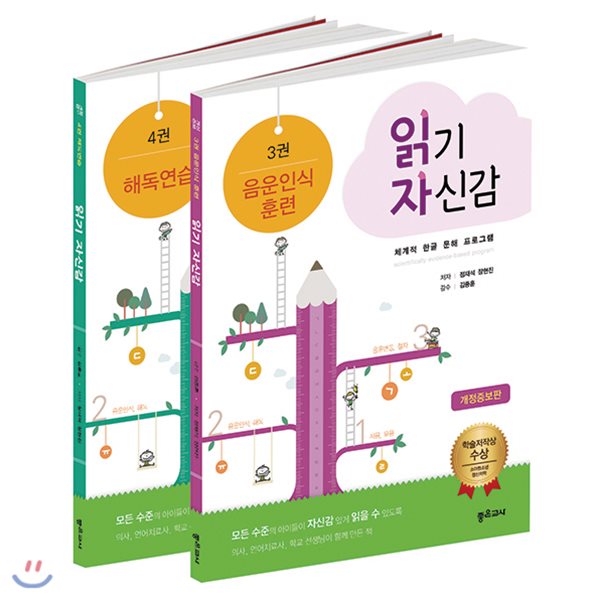
Reading Confidence Set 2
 |
Description
Book Introduction
The Reading Confidence series is based on the latest research in medical and educational psychology and has been developed through application to students at various levels.
This book is designed to be easily accessible to speech therapists, special education teachers, and school teachers using the Direct Instruction method, and also provides basic knowledge, teaching methods, and guidelines for teachers.
Because this program is a phonics-focused literacy program, it is effective not only for students with dyslexia, but also for students with reading difficulties due to emotional or behavioral factors, low intelligence, or language problems.
It can also be used as a Korean language textbook for foreigners, multicultural students, and special education classes.
This book is designed to be easily accessible to speech therapists, special education teachers, and school teachers using the Direct Instruction method, and also provides basic knowledge, teaching methods, and guidelines for teachers.
Because this program is a phonics-focused literacy program, it is effective not only for students with dyslexia, but also for students with reading difficulties due to emotional or behavioral factors, low intelligence, or language problems.
It can also be used as a Korean language textbook for foreigners, multicultural students, and special education classes.
index
Volume 3: Phonological Awareness Training
Volume 4: Decoding Practice
Volume 4: Decoding Practice
Publisher's Review
1.
Why We Need Systematic Literacy Programs
▲ In the 7th curriculum implemented in 2000, the Korean language curriculum adopted the ‘Whole Language Approach.’
This approach starts from the premise that anyone can acquire reading skills naturally by reading meaningful texts without having to teach phonetics separately.
However, recent domestic and international research results and responses from schools indicate that reading is not something that is acquired naturally.
It is also said that there are more students struggling with reading than before.
▲ About 5% of elementary school students cannot read books properly and try to avoid reading and writing.
Contrary to the common belief that dyslexia and illiteracy are rare in our country, most experts believe this is not true and estimate that there are about 250,000 so-called "illiterate students in schools."
▲ The unknown suffering of students and parents who have difficulty reading is considerable.
Most of them suffer from severe learning difficulties and school maladjustment.
It is said that children are often teased by their friends for being stupid, and that they are often reprimanded by their homeroom teachers for not teaching them how to read and write at school.
Some of them were wasting huge amounts of money on unverified private educational institutions.
▲ Many teachers in schools say they have experience with students like this (87.84% with decoding problems, 90.54% with reading comprehension problems, and 58.88% with dyslexia), but the reality is that it is not easy to actually teach them.
▲ Academic circles say that if we discover learning difficulties before the third grade of elementary school and provide guidance based on an intensive and systematic evidence-based literacy program, we can prevent the progression to learning difficulties.
The longer early intervention is delayed, the harder it is to get better.
▲ Most developed countries have evidence-based literacy programs for these students.
In particular, the United States has conducted national research led by Congress, and various systematic evidence-based literacy programs are being utilized in schools.
2.
Features of the Reading Confidence series
▲ The "Reading Confidence" series is a program developed based on the latest research findings in medicine and educational psychology, and has been applied to students at various levels.
▲ Using this program, we have treated over 700 children with dyslexia since 2007, and most of them, even those who could not read or write at all, were able to read.
▲ As a result of teachers directly applying the program to students with severe reading difficulties at schools starting in April 2014, most of them showed reading and writing achievements at or above the average level, and both teachers and parents could feel a clear change.
▲ The "Reading Confidence" series is designed to be easily taught by speech therapists, special education teachers, and school teachers using the direct teaching method, and also provides basic knowledge, teaching methods, and guidelines for teachers.
▲ 『Reading Confidence』 is a pronunciation-centered literacy program.
Therefore, it is effective as a teaching material not only for students with dyslexia, but also for students with reading difficulties due to emotional or behavioral causes, low intelligence, and language problems.
It is also very effective as a Korean language textbook for foreigners, multicultural students, and special education classes.
3.
Expert evaluation and field response
“I’m so grateful that Reading Confidence has come into the world.” (Bae So-young, Professor, Hallym University)
This book is based on research evidence and collaborative field experience.
Meeting and experiencing children who struggle with reading teaches us that learning to read can be harder than we thought, and that teaching it is no easy task either.
It is of utmost importance to learn how to detoxify in the right way at the right time.
If you use this book as a guide to help children find interesting and appropriate content and read it intensively, you will be able to build confidence in their reading comprehension skills.
"As a researcher, I am very pleased with this book." (Eom Hoon, Professor of Korean Language Education, Cheongju National University of Education)
As a researcher who explores the problems of children who struggle with reading and how to help them, I am very pleased with this book.
Our task now is to train teachers with the insight and experience to select the methods and materials presented in this book as needed and apply them appropriately to each child.
"It will have a significant impact on our country's reading teaching and learning materials." (Lee Dae-sik, Professor of Special Education, Gyeongin National University of Education)
I believe that 『Reading Confidence』 has opened up new horizons for Korean reading textbooks in at least the following three respects.
First, it covers almost all the elements necessary for reading early Hangul.
Second, it presents not only methods for learning the elements necessary for early Korean reading, but also methods for teaching them.
Although there have been many Korean language textbooks for learners, there have been few materials for teachers.
Third, the content was composed based on abundant clinical experience.
Fourth, we are implementing a teaching-learning procedure that does not ask learners to answer first, but rather allows them to achieve complete learning through abundant practice following the teacher's demonstration.
With these features alone, I believe that 『Reading Confidence』 will have a great impact on future reading teaching and learning materials in Korea.
"How to Learn Hangul to Suit Your Child's Needs" (Kim Cheong-yeon, Education Reporter, The Hankyoreh)
Leonardo da Vinci, Albert Einstein, and other so-called geniuses were all people who had difficulty reading.
However, when parents find their children having trouble reading, they often criticize them by saying, “It’s because you’re distracted,” and fail to consider that their children may have a developmental weakness in reading.
This book introduces a friendly method of teaching Hangul tailored to the needs of children who have difficulty reading, so that they can slowly learn the Korean letters and vowels and read and write words accurately.
Children who struggle with reading thrive on narrative.
If you teach your child to read slowly and at a level that suits them, they will be able to excel in many fields in the future.
“I was so amazed to see her reading the book over and over again.” (Kim Seon-hee, teacher at Incheon Choeun Elementary School)
At first, the child who stuttered and read differently without realizing it practiced every day for three months with this book.
Then, I was so surprised to see him slowly and confidently start reading the book again.
In fact, there are more children in schools than you might think who are not good at reading books.
But actually teaching children was not as easy as I thought.
I found the answer in the "Reading Confidence" series.
Looking at the child who has now come to love books
"The results started to show as soon as we started" (Eun-Jeong Lim, special education teacher at Seomyeon Elementary School)
As soon as I started the Reading Confidence Program, I started seeing results.
Always “I don’t know.
“I can’t read at all,” said the child, “Ah! Now I think I understand.
I heard a cry, “I can read it.”
My child, who had always been a poor reader throughout his sixth grade years, now has hope that he can become a middle school student who can read.
I recommend this book to teachers and parents who are always concerned about children who have trouble reading.
Reading Confidence Series Volumes 1-6
From consonants and vowels to difficult Korean grammar
Volume 1: Vowel Sounds (Instruction Guide)
Volume 2: Consonant Sounds
Volume 3: Phonological Awareness Training
Volume 4: Decoding
Volume 5: Phonological Change and Fluency Training
Volume 6: Spelling and Vocabulary
Why We Need Systematic Literacy Programs
▲ In the 7th curriculum implemented in 2000, the Korean language curriculum adopted the ‘Whole Language Approach.’
This approach starts from the premise that anyone can acquire reading skills naturally by reading meaningful texts without having to teach phonetics separately.
However, recent domestic and international research results and responses from schools indicate that reading is not something that is acquired naturally.
It is also said that there are more students struggling with reading than before.
▲ About 5% of elementary school students cannot read books properly and try to avoid reading and writing.
Contrary to the common belief that dyslexia and illiteracy are rare in our country, most experts believe this is not true and estimate that there are about 250,000 so-called "illiterate students in schools."
▲ The unknown suffering of students and parents who have difficulty reading is considerable.
Most of them suffer from severe learning difficulties and school maladjustment.
It is said that children are often teased by their friends for being stupid, and that they are often reprimanded by their homeroom teachers for not teaching them how to read and write at school.
Some of them were wasting huge amounts of money on unverified private educational institutions.
▲ Many teachers in schools say they have experience with students like this (87.84% with decoding problems, 90.54% with reading comprehension problems, and 58.88% with dyslexia), but the reality is that it is not easy to actually teach them.
▲ Academic circles say that if we discover learning difficulties before the third grade of elementary school and provide guidance based on an intensive and systematic evidence-based literacy program, we can prevent the progression to learning difficulties.
The longer early intervention is delayed, the harder it is to get better.
▲ Most developed countries have evidence-based literacy programs for these students.
In particular, the United States has conducted national research led by Congress, and various systematic evidence-based literacy programs are being utilized in schools.
2.
Features of the Reading Confidence series
▲ The "Reading Confidence" series is a program developed based on the latest research findings in medicine and educational psychology, and has been applied to students at various levels.
▲ Using this program, we have treated over 700 children with dyslexia since 2007, and most of them, even those who could not read or write at all, were able to read.
▲ As a result of teachers directly applying the program to students with severe reading difficulties at schools starting in April 2014, most of them showed reading and writing achievements at or above the average level, and both teachers and parents could feel a clear change.
▲ The "Reading Confidence" series is designed to be easily taught by speech therapists, special education teachers, and school teachers using the direct teaching method, and also provides basic knowledge, teaching methods, and guidelines for teachers.
▲ 『Reading Confidence』 is a pronunciation-centered literacy program.
Therefore, it is effective as a teaching material not only for students with dyslexia, but also for students with reading difficulties due to emotional or behavioral causes, low intelligence, and language problems.
It is also very effective as a Korean language textbook for foreigners, multicultural students, and special education classes.
3.
Expert evaluation and field response
“I’m so grateful that Reading Confidence has come into the world.” (Bae So-young, Professor, Hallym University)
This book is based on research evidence and collaborative field experience.
Meeting and experiencing children who struggle with reading teaches us that learning to read can be harder than we thought, and that teaching it is no easy task either.
It is of utmost importance to learn how to detoxify in the right way at the right time.
If you use this book as a guide to help children find interesting and appropriate content and read it intensively, you will be able to build confidence in their reading comprehension skills.
"As a researcher, I am very pleased with this book." (Eom Hoon, Professor of Korean Language Education, Cheongju National University of Education)
As a researcher who explores the problems of children who struggle with reading and how to help them, I am very pleased with this book.
Our task now is to train teachers with the insight and experience to select the methods and materials presented in this book as needed and apply them appropriately to each child.
"It will have a significant impact on our country's reading teaching and learning materials." (Lee Dae-sik, Professor of Special Education, Gyeongin National University of Education)
I believe that 『Reading Confidence』 has opened up new horizons for Korean reading textbooks in at least the following three respects.
First, it covers almost all the elements necessary for reading early Hangul.
Second, it presents not only methods for learning the elements necessary for early Korean reading, but also methods for teaching them.
Although there have been many Korean language textbooks for learners, there have been few materials for teachers.
Third, the content was composed based on abundant clinical experience.
Fourth, we are implementing a teaching-learning procedure that does not ask learners to answer first, but rather allows them to achieve complete learning through abundant practice following the teacher's demonstration.
With these features alone, I believe that 『Reading Confidence』 will have a great impact on future reading teaching and learning materials in Korea.
"How to Learn Hangul to Suit Your Child's Needs" (Kim Cheong-yeon, Education Reporter, The Hankyoreh)
Leonardo da Vinci, Albert Einstein, and other so-called geniuses were all people who had difficulty reading.
However, when parents find their children having trouble reading, they often criticize them by saying, “It’s because you’re distracted,” and fail to consider that their children may have a developmental weakness in reading.
This book introduces a friendly method of teaching Hangul tailored to the needs of children who have difficulty reading, so that they can slowly learn the Korean letters and vowels and read and write words accurately.
Children who struggle with reading thrive on narrative.
If you teach your child to read slowly and at a level that suits them, they will be able to excel in many fields in the future.
“I was so amazed to see her reading the book over and over again.” (Kim Seon-hee, teacher at Incheon Choeun Elementary School)
At first, the child who stuttered and read differently without realizing it practiced every day for three months with this book.
Then, I was so surprised to see him slowly and confidently start reading the book again.
In fact, there are more children in schools than you might think who are not good at reading books.
But actually teaching children was not as easy as I thought.
I found the answer in the "Reading Confidence" series.
Looking at the child who has now come to love books
"The results started to show as soon as we started" (Eun-Jeong Lim, special education teacher at Seomyeon Elementary School)
As soon as I started the Reading Confidence Program, I started seeing results.
Always “I don’t know.
“I can’t read at all,” said the child, “Ah! Now I think I understand.
I heard a cry, “I can read it.”
My child, who had always been a poor reader throughout his sixth grade years, now has hope that he can become a middle school student who can read.
I recommend this book to teachers and parents who are always concerned about children who have trouble reading.
Reading Confidence Series Volumes 1-6
From consonants and vowels to difficult Korean grammar
Volume 1: Vowel Sounds (Instruction Guide)
Volume 2: Consonant Sounds
Volume 3: Phonological Awareness Training
Volume 4: Decoding
Volume 5: Phonological Change and Fluency Training
Volume 6: Spelling and Vocabulary
GOODS SPECIFICS
- Date of publication: July 12, 2016
- Page count, weight, size: 432 pages | 1,453g | 215*283*30mm
- ISBN13: 9788991617285
You may also like
카테고리
korean


korean

![GQ KOREA Mark (Monthly): December [2025]](http://librairie.coreenne.fr/cdn/shop/files/8ef265dbbfbf186523ed75ba7319009d.jpg?v=1765340328&width=3840)


