

My first stock study
 |
Description
Book Introduction
“Welcome, is this your first time with stocks?”
Are you curious about the secrets of stocks that only those in the know know?
“Welcome to those of you who are curious about stocks for the first time!”
Investing in stocks is no longer a strange term for young people.
With the number of young people jumping into the stock market, not just the 2030 generation, rapidly increasing, it seems like if you don't know about stocks, you'll end up being naive.
However, those who have not been interested until now are simply overwhelmed by stock data filled with countless numbers and complex graphs.
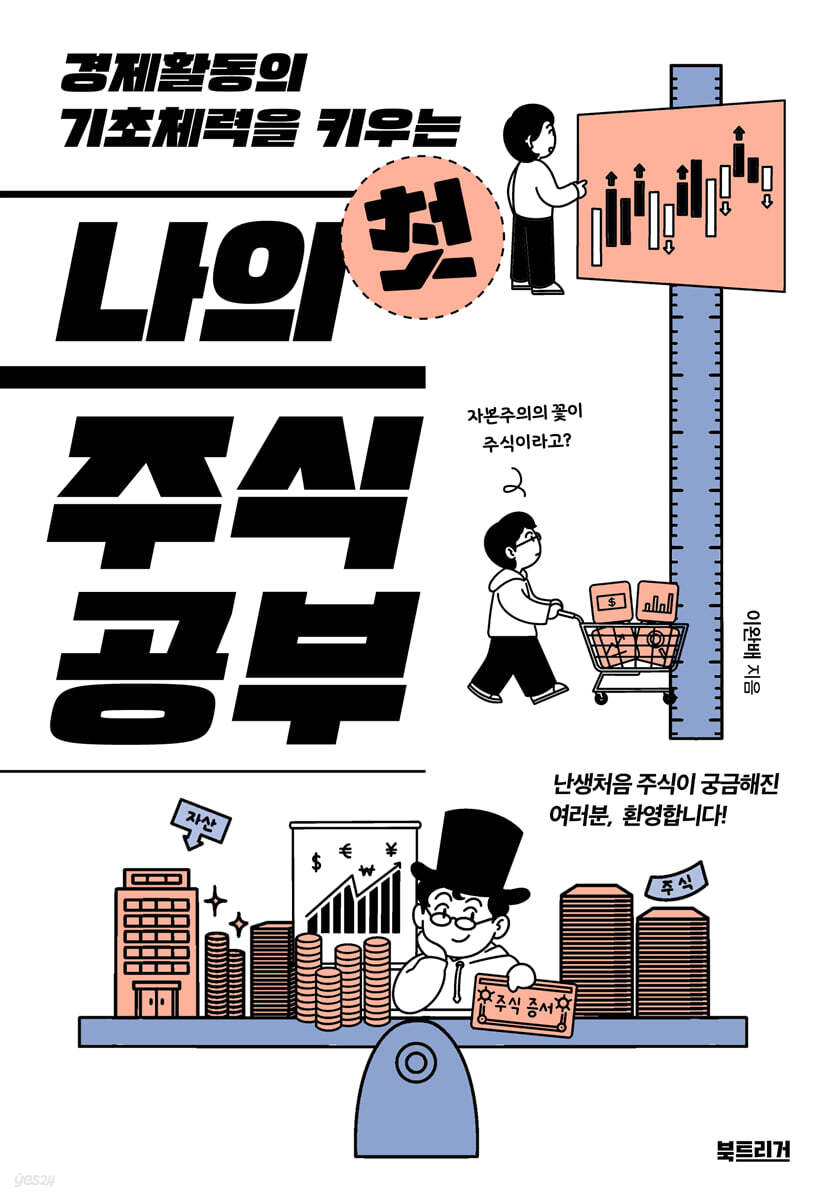
Stocks—how on earth should you study them? Lee Wan-bae, a longtime securities reporter for a general daily newspaper, wrote "My First Stock Study" to share with young people the knowledge of stocks, a topic so basic that no one shares it.
How did joint-stock companies come into existence? Where is the stock market located? What does it mean to make money with stocks? This book provides step-by-step answers to questions readers who know nothing about stocks might have, explaining the fundamentals of how stocks work.
We'll look at cryptic stock terms like listing, dividends, price-to-earnings ratio (PER), and price-to-book ratio (PBR), and even teach you how to read stock charts.
In addition, we critically examine the dark side of the stock market, such as the side effects of shareholder primacy and stock price manipulation by operatives, and the dangers that blind faith in stocks poses to our society.
Are you curious about the secrets of stocks that only those in the know know?
“Welcome to those of you who are curious about stocks for the first time!”
Investing in stocks is no longer a strange term for young people.
With the number of young people jumping into the stock market, not just the 2030 generation, rapidly increasing, it seems like if you don't know about stocks, you'll end up being naive.
However, those who have not been interested until now are simply overwhelmed by stock data filled with countless numbers and complex graphs.
Stocks—how on earth should you study them? Lee Wan-bae, a longtime securities reporter for a general daily newspaper, wrote "My First Stock Study" to share with young people the knowledge of stocks, a topic so basic that no one shares it.
How did joint-stock companies come into existence? Where is the stock market located? What does it mean to make money with stocks? This book provides step-by-step answers to questions readers who know nothing about stocks might have, explaining the fundamentals of how stocks work.
We'll look at cryptic stock terms like listing, dividends, price-to-earnings ratio (PER), and price-to-book ratio (PBR), and even teach you how to read stock charts.
In addition, we critically examine the dark side of the stock market, such as the side effects of shareholder primacy and stock price manipulation by operatives, and the dangers that blind faith in stocks poses to our society.
- You can preview some of the book's contents.
Preview
index
1st Period _ Understanding Stock Market Concepts for a 'Stock Idiot'
.
The Birth of a Company Anyone Can Invest in _ The Reality of a Joint Stock Company
.
Let's Visit the Stock Market _ Understanding the Stock Market
.
Making Money with Stocks? _Dividends and Market Capitalization
.
How Stock Prices Rise and Fall: The Principles of Supply and Demand
.
Invitation to shareholders _ General meeting of shareholders
2nd Period _ Unraveling Cryptographic Stock Terms
.
The Secret Behind the "Woo" in Stock Names: Preferred Stock and Dividends
.
Go for Dividends or Lean on Growth? Value Stocks vs. Growth Stocks
.
Not a certificate of merit, but a listing _ stock listing
.
Are there ants in the stock market? _Individuals, foreigners, and institutional investors
.
Secrets Hidden in Stick Figures _ Stick Charts and Graphs
3rd Period _ Smart Stock Shopping
.
Where and How to Buy Stocks: Commissions and Direct/Indirect Investments
.
If you are curious about the company's information, please refer to the public notice and company briefing session.
.
Which stocks should I buy? _ Stock valuation criteria
.
Criteria for Choosing a Good Company 1: Sales and Profit
.
Criteria for Selecting a Good Company 2: Assets and Liabilities
.
Representative indicator to aid judgment 1 - Price-to-earnings ratio (PER)
.
Representative indicator to aid judgment 2 - Price-to-book ratio (PBR)
4th Period: Exploring the Dark Side of the Stock Market
.
What kind of operation is the operational force planning? _The conspiracy of the operational force
.
The Side Effects of Shareholder Primacy: Enron and Fraudulent Accounting
.
How to Control a Business with Little Capital: Cross-shareholding and Circular Shareholding
.
Can you sell stocks you don't own? _Short Selling and Speculation
★ Conceptual Stock Terminology Summary
.
The Birth of a Company Anyone Can Invest in _ The Reality of a Joint Stock Company
.
Let's Visit the Stock Market _ Understanding the Stock Market
.
Making Money with Stocks? _Dividends and Market Capitalization
.
How Stock Prices Rise and Fall: The Principles of Supply and Demand
.
Invitation to shareholders _ General meeting of shareholders
2nd Period _ Unraveling Cryptographic Stock Terms
.
The Secret Behind the "Woo" in Stock Names: Preferred Stock and Dividends
.
Go for Dividends or Lean on Growth? Value Stocks vs. Growth Stocks
.
Not a certificate of merit, but a listing _ stock listing
.
Are there ants in the stock market? _Individuals, foreigners, and institutional investors
.
Secrets Hidden in Stick Figures _ Stick Charts and Graphs
3rd Period _ Smart Stock Shopping
.
Where and How to Buy Stocks: Commissions and Direct/Indirect Investments
.
If you are curious about the company's information, please refer to the public notice and company briefing session.
.
Which stocks should I buy? _ Stock valuation criteria
.
Criteria for Choosing a Good Company 1: Sales and Profit
.
Criteria for Selecting a Good Company 2: Assets and Liabilities
.
Representative indicator to aid judgment 1 - Price-to-earnings ratio (PER)
.
Representative indicator to aid judgment 2 - Price-to-book ratio (PBR)
4th Period: Exploring the Dark Side of the Stock Market
.
What kind of operation is the operational force planning? _The conspiracy of the operational force
.
The Side Effects of Shareholder Primacy: Enron and Fraudulent Accounting
.
How to Control a Business with Little Capital: Cross-shareholding and Circular Shareholding
.
Can you sell stocks you don't own? _Short Selling and Speculation
★ Conceptual Stock Terminology Summary
Detailed image

Into the book
When we talk about voting, we usually think of democratic principles.
The principle of one person, one vote, based on the idea of natural human rights.
The principle of one person, one vote is that everyone has equal rights to vote.
In a democratic society, most voting is done like this.
But in a joint stock company, democratic principles do not apply.
Let's say that when creating an Indian trading company, one person invests 50 million won and the other five people invest 10 million won each, raising a capital of 100 million won.
Do all six of these people have equal rights at this point? No.
In a corporation, instead of one vote per person, the person who pays more money gets more votes.
This method is called the 'one dollar, one vote principle'.
If you pay 1 won, you get 1 vote, if you pay 10 won, you get 10 votes, if you pay 100 million won, you get 100 million votes, and so on.
In other words, we must remember that corporations operate in a way that is quite different from democracy, where those who pay more have more rights and influence, contrary to the egalitarian democratic principles we know.
--- p.18 From “1st Period _ Understanding Stock Concepts for a ‘Stock Idiot’”
We learned two ways to make money investing in stocks.
The goal is to receive dividends or profit from price differences.
But these two methods have something in common.
Both are possible only if the company does well in business and makes a lot of money.
In other words, making money through stock investment is only possible if the business of the company you invested in prospers.
…believing ridiculous rumors or trying to make money by buying and selling stocks at amazing times is not the essence of stock investing.
That's not called investing, it's called speculation.
However, many people cannot resist the temptation of making a lot of money in an instant and fall into speculation.
You must remember this one fact today.
The essence of stock investing is to invest in companies that are likely to do well, whether for dividends or capital gains.
--- pp.35~36 From 「1st Period _ Understanding Stock Concepts for a 'Stock Idiot'」
There is one important word here that you must know.
It is ‘listing’.
This isn't the "award" you receive for excelling in school! "Listing" here means "registering stocks or other assets as tradable goods on an exchange (the Korea Exchange is the only one in Korea) with certain qualifications and conditions."
Simply put, 'listing stocks' means that a stock passes the exchange's screening and is registered as one of 2,000 stocks.
The English word for listing is 'listing', which also has the same meaning as 'putting stocks on a list'.
--- pp.84~85 From 「2nd Period _Unraveling Stock Terms Like Codes」
So, what stocks are cheap? … When trying to determine whether a stock is cheap or expensive, the most foolish thing to do is to look only at the price.
What matters more than the outward numbers is the intrinsic value.
Even if LG Household & Health Care's stock price is 1.6 million won, if the stock is worth around 20 million won, the company's stock price is incredibly cheap.
Because they are selling something worth 20 million won for 1.6 million won.
On the other hand, if we bought Samsung Electronics stock for 50,000 won, but its actual value is only around 1,000 won, we would have been ripped off.
--- pp.129~130 From 「3rd Period _ Smart 'Stock Shopping'」
The debt ratio is a figure that compares a company's total assets to its total liabilities, and is a standard for determining whether a company has sufficient ability to repay its debt.
If a company's assets are 10 billion won and its debt is 10 billion won, the debt ratio is 100%.
On the other hand, if a company has assets of 10 billion won but only 5 billion won in debt, its debt ratio is 50%.
A company like this is safe even if it has some debt.
However, if you have assets of 10 billion won but debt of 20 billion won, it is a bit risky.
The story is that the debt ratio is 200%, so if a management crisis occurs, the company may go bankrupt while trying to pay off its debt.
So, it is safe to keep the debt ratio within 100%.
If the debt exceeds the assets (the debt ratio is higher than 100%), you should consider the company as something to be hesitant to invest in.
--- p.148 From "3rd Period _ Smart 'Stock Shopping'"
Companies that believe in shareholder primacy rip off consumers and subject workers to murderous working conditions.
Environmental protection? There's no reason to care about that.
Because professional managers are only interested in looking good to shareholders.
Because of these side effects, a new theory called 'Stakeholder Capitalism' emerged, rather than shareholder primacy, mainly in Germany and Northern Europe.
Stakeholder capitalism states that “shareholders are not the only owners of a company.
“We have the view that both workers and consumers who have a stake in the company deserve to be owners.”
So, in countries that support stakeholder capitalism, important issues are decided not at general shareholders' meetings, but at gatherings where representatives of shareholders, workers, and consumers all gather.
If we only pursue shareholder interests, the rights of workers and consumers will be violated, so we supplement the perspectives of consumers and workers in this way.
The principle of one person, one vote, based on the idea of natural human rights.
The principle of one person, one vote is that everyone has equal rights to vote.
In a democratic society, most voting is done like this.
But in a joint stock company, democratic principles do not apply.
Let's say that when creating an Indian trading company, one person invests 50 million won and the other five people invest 10 million won each, raising a capital of 100 million won.
Do all six of these people have equal rights at this point? No.
In a corporation, instead of one vote per person, the person who pays more money gets more votes.
This method is called the 'one dollar, one vote principle'.
If you pay 1 won, you get 1 vote, if you pay 10 won, you get 10 votes, if you pay 100 million won, you get 100 million votes, and so on.
In other words, we must remember that corporations operate in a way that is quite different from democracy, where those who pay more have more rights and influence, contrary to the egalitarian democratic principles we know.
--- p.18 From “1st Period _ Understanding Stock Concepts for a ‘Stock Idiot’”
We learned two ways to make money investing in stocks.
The goal is to receive dividends or profit from price differences.
But these two methods have something in common.
Both are possible only if the company does well in business and makes a lot of money.
In other words, making money through stock investment is only possible if the business of the company you invested in prospers.
…believing ridiculous rumors or trying to make money by buying and selling stocks at amazing times is not the essence of stock investing.
That's not called investing, it's called speculation.
However, many people cannot resist the temptation of making a lot of money in an instant and fall into speculation.
You must remember this one fact today.
The essence of stock investing is to invest in companies that are likely to do well, whether for dividends or capital gains.
--- pp.35~36 From 「1st Period _ Understanding Stock Concepts for a 'Stock Idiot'」
There is one important word here that you must know.
It is ‘listing’.
This isn't the "award" you receive for excelling in school! "Listing" here means "registering stocks or other assets as tradable goods on an exchange (the Korea Exchange is the only one in Korea) with certain qualifications and conditions."
Simply put, 'listing stocks' means that a stock passes the exchange's screening and is registered as one of 2,000 stocks.
The English word for listing is 'listing', which also has the same meaning as 'putting stocks on a list'.
--- pp.84~85 From 「2nd Period _Unraveling Stock Terms Like Codes」
So, what stocks are cheap? … When trying to determine whether a stock is cheap or expensive, the most foolish thing to do is to look only at the price.
What matters more than the outward numbers is the intrinsic value.
Even if LG Household & Health Care's stock price is 1.6 million won, if the stock is worth around 20 million won, the company's stock price is incredibly cheap.
Because they are selling something worth 20 million won for 1.6 million won.
On the other hand, if we bought Samsung Electronics stock for 50,000 won, but its actual value is only around 1,000 won, we would have been ripped off.
--- pp.129~130 From 「3rd Period _ Smart 'Stock Shopping'」
The debt ratio is a figure that compares a company's total assets to its total liabilities, and is a standard for determining whether a company has sufficient ability to repay its debt.
If a company's assets are 10 billion won and its debt is 10 billion won, the debt ratio is 100%.
On the other hand, if a company has assets of 10 billion won but only 5 billion won in debt, its debt ratio is 50%.
A company like this is safe even if it has some debt.
However, if you have assets of 10 billion won but debt of 20 billion won, it is a bit risky.
The story is that the debt ratio is 200%, so if a management crisis occurs, the company may go bankrupt while trying to pay off its debt.
So, it is safe to keep the debt ratio within 100%.
If the debt exceeds the assets (the debt ratio is higher than 100%), you should consider the company as something to be hesitant to invest in.
--- p.148 From "3rd Period _ Smart 'Stock Shopping'"
Companies that believe in shareholder primacy rip off consumers and subject workers to murderous working conditions.
Environmental protection? There's no reason to care about that.
Because professional managers are only interested in looking good to shareholders.
Because of these side effects, a new theory called 'Stakeholder Capitalism' emerged, rather than shareholder primacy, mainly in Germany and Northern Europe.
Stakeholder capitalism states that “shareholders are not the only owners of a company.
“We have the view that both workers and consumers who have a stake in the company deserve to be owners.”
So, in countries that support stakeholder capitalism, important issues are decided not at general shareholders' meetings, but at gatherings where representatives of shareholders, workers, and consumers all gather.
If we only pursue shareholder interests, the rights of workers and consumers will be violated, so we supplement the perspectives of consumers and workers in this way.
--- pp.188~189 From 「4th Period_Uncovering the Dark Shadows of the Stock Market」
Publisher's Review
Teenagers' sharp economic sense,
For a sound financial life!
Reporter Lee Wan-bae tells the story of the capitalist economy.
The minimum knowledge required to understand capitalism
Whether you invest in stocks or not, you need to know about stocks!
A stock book for teenagers? You might first wonder what kind of student would be interested in stocks already.
If I start studying stocks too early, won't I become someone who only cares about money from a young age? Isn't making money through stock investing just a windfall? These are probably the concerns.
However, the author emphasizes that “regardless of whether you invest in stocks or not, understanding the basics of stocks is helpful in many ways, as the stock system is the root of the capitalism we live in.”
In fact, our lives are entangled, knowingly or unknowingly, with the system called stocks.
Many workers belong to corporations and earn wages to make a living, and consumers purchase goods and services that corporations put on the market.
Even adults who shout, “I’ll never invest in stocks!” are actually indirectly investing in stocks through pension funds like the National Pension Service or Civil Servant Pension, or financial products like insurance.
Like it or not, we live in a society where we have to know what stocks are.
Even the author, who worked as a stock reporter for a general daily newspaper for a long time, once had a time when he was a rookie reporter who was embarrassed to say that he specialized in covering stocks.
The author, who could not properly understand a single line of the securities company reports piled up in his office, started running around in every possible way to properly learn about stocks.
Having experienced that time, I know better than anyone what those who don't even know the first thing about stocks are curious about.
Do you believe the stock market is located in Yeouido? When you think of "listing," do you think of "excellence awards" rather than KOSPI or KOSDAQ? "My First Stock Study" is a book tailored to those who appreciate it.
To lead a sound economic life, you need to study finance properly!
The basics of carefully selected stocks, just the amount needed, no more, no less
What especially confuses beginners in the stock market are the unfamiliar terms, the plethora of indicators, and the dazzling graphs.
In the world of stocks, corporate value, stock price movements, and market indicators are displayed in a prescribed manner to encourage people to make rational decisions.
Therefore, for those who are new to stocks and want to obtain corporate information and analyze the market, knowledge of basic stock terminology and agreed-upon symbols is essential.
The author's writing principle is to explain the principles of the stock market as simply as possible.
Because the terminology used in the stock market is very difficult and the financial structure is complex, many people may invest without even knowing it.
Consisting of four lessons, most of this book focuses on learning the minimum terminology and concepts you need to know before starting to trade stocks.
In the first period, you can learn the basic concepts of stocks.
We will examine the true nature of a joint-stock company through the process of its birth, and learn about the two principles of making money with stocks: dividends and capital gains.
I also open an order window and check how the stock price goes up and down one by one.
In the second period, we go a step further and examine the classification of stocks, such as preferred stocks, common stocks, value stocks, and growth stocks. We also learn about the principles of dividends, the differences between KOSPI and KOSDAQ, and the characteristics of individual, foreign, and institutional investors.
You will also learn how to read bar charts and graphs.
Next is the real thing.
In the third period, we explore what 'smart stock investment' is.
The author warns against the current situation in which poor economic knowledge leads to blind stock investment.
In order to foster a healthy stock market, which is full of talk and trouble, economic entities must, above all, make rational decisions based on accurate information.
The author provides detailed, easy-to-use methods that can be applied immediately when picking stocks.
We provide helpful information on how to check a company's public disclosure information, analyze sales, profits, assets, and liabilities, and use the price-to-earnings ratio (PER) and price-to-book ratio (PBR) as judgment indicators.
In a time when stocks are often compared to gambling, the author never fails to offer this advice.
"We must always remember that stock investment is about becoming a partner with a company, not a gamble to make a quick buck."
Even stocks, the 'flower of capitalism,' aren't perfect!
What shadows are lurking in the stock market?
Stocks are often called the 'flower of capitalism'.
This is because businesspeople can easily raise funds through stock offerings, and individual investors can diversify their risks and achieve investment returns.
It may seem obvious now, but the emergence of stocks, a new financial technique that emerged in the 17th century, enabled the raising of large amounts of capital, thereby fueling the creation of large corporations.
But stocks, which played a crucial role in the growth of capitalism, are not a perfect system.
In the fourth period, the author examines the various shadows currently lurking in the stock market.
We examine the negative effects of stocks, which sometimes degenerate into a marketplace for irrational speculation and create social problems by deceiving consumers and disregarding workers.
In particular, he criticized the 'operational forces' that artificially manipulate stock prices as being like poisonous mushrooms in the stock market that turn it into a speculative market.
But why do these types of stock manipulations work? It's because of the psychology of people hoping to make a quick fortune through stock investing.
The author criticizes the greed that seeks to turn one's life around through stocks, and strongly explains why stocks should not be approached from a speculative perspective.
The 'shareholder-first principle' that 'shareholders are the owners of the company' also has considerable side effects.
This is because companies that believe in shareholder primacy may make decisions that harm the interests of consumers and workers just to look good to shareholders.
In addition, the author examines how the distorted governance structure of circular and cross-shareholding investments, chronic problems of Korean conglomerates, has distorted the stock market, and critically explains the short-selling system, which is inherently disadvantageous to individual investors.
As long as we live in a capitalist society, understanding finance, including stocks, is essential.
If you've been avoiding stock books because you're uncomfortable with content like "If you do this, you'll make a lot of money with stocks," you can learn the basics of stocks from a balanced perspective through "My First Stock Study."
For a sound financial life!
Reporter Lee Wan-bae tells the story of the capitalist economy.
The minimum knowledge required to understand capitalism
Whether you invest in stocks or not, you need to know about stocks!
A stock book for teenagers? You might first wonder what kind of student would be interested in stocks already.
If I start studying stocks too early, won't I become someone who only cares about money from a young age? Isn't making money through stock investing just a windfall? These are probably the concerns.
However, the author emphasizes that “regardless of whether you invest in stocks or not, understanding the basics of stocks is helpful in many ways, as the stock system is the root of the capitalism we live in.”
In fact, our lives are entangled, knowingly or unknowingly, with the system called stocks.
Many workers belong to corporations and earn wages to make a living, and consumers purchase goods and services that corporations put on the market.
Even adults who shout, “I’ll never invest in stocks!” are actually indirectly investing in stocks through pension funds like the National Pension Service or Civil Servant Pension, or financial products like insurance.
Like it or not, we live in a society where we have to know what stocks are.
Even the author, who worked as a stock reporter for a general daily newspaper for a long time, once had a time when he was a rookie reporter who was embarrassed to say that he specialized in covering stocks.
The author, who could not properly understand a single line of the securities company reports piled up in his office, started running around in every possible way to properly learn about stocks.
Having experienced that time, I know better than anyone what those who don't even know the first thing about stocks are curious about.
Do you believe the stock market is located in Yeouido? When you think of "listing," do you think of "excellence awards" rather than KOSPI or KOSDAQ? "My First Stock Study" is a book tailored to those who appreciate it.
To lead a sound economic life, you need to study finance properly!
The basics of carefully selected stocks, just the amount needed, no more, no less
What especially confuses beginners in the stock market are the unfamiliar terms, the plethora of indicators, and the dazzling graphs.
In the world of stocks, corporate value, stock price movements, and market indicators are displayed in a prescribed manner to encourage people to make rational decisions.
Therefore, for those who are new to stocks and want to obtain corporate information and analyze the market, knowledge of basic stock terminology and agreed-upon symbols is essential.
The author's writing principle is to explain the principles of the stock market as simply as possible.
Because the terminology used in the stock market is very difficult and the financial structure is complex, many people may invest without even knowing it.
Consisting of four lessons, most of this book focuses on learning the minimum terminology and concepts you need to know before starting to trade stocks.
In the first period, you can learn the basic concepts of stocks.
We will examine the true nature of a joint-stock company through the process of its birth, and learn about the two principles of making money with stocks: dividends and capital gains.
I also open an order window and check how the stock price goes up and down one by one.
In the second period, we go a step further and examine the classification of stocks, such as preferred stocks, common stocks, value stocks, and growth stocks. We also learn about the principles of dividends, the differences between KOSPI and KOSDAQ, and the characteristics of individual, foreign, and institutional investors.
You will also learn how to read bar charts and graphs.
Next is the real thing.
In the third period, we explore what 'smart stock investment' is.
The author warns against the current situation in which poor economic knowledge leads to blind stock investment.
In order to foster a healthy stock market, which is full of talk and trouble, economic entities must, above all, make rational decisions based on accurate information.
The author provides detailed, easy-to-use methods that can be applied immediately when picking stocks.
We provide helpful information on how to check a company's public disclosure information, analyze sales, profits, assets, and liabilities, and use the price-to-earnings ratio (PER) and price-to-book ratio (PBR) as judgment indicators.
In a time when stocks are often compared to gambling, the author never fails to offer this advice.
"We must always remember that stock investment is about becoming a partner with a company, not a gamble to make a quick buck."
Even stocks, the 'flower of capitalism,' aren't perfect!
What shadows are lurking in the stock market?
Stocks are often called the 'flower of capitalism'.
This is because businesspeople can easily raise funds through stock offerings, and individual investors can diversify their risks and achieve investment returns.
It may seem obvious now, but the emergence of stocks, a new financial technique that emerged in the 17th century, enabled the raising of large amounts of capital, thereby fueling the creation of large corporations.
But stocks, which played a crucial role in the growth of capitalism, are not a perfect system.
In the fourth period, the author examines the various shadows currently lurking in the stock market.
We examine the negative effects of stocks, which sometimes degenerate into a marketplace for irrational speculation and create social problems by deceiving consumers and disregarding workers.
In particular, he criticized the 'operational forces' that artificially manipulate stock prices as being like poisonous mushrooms in the stock market that turn it into a speculative market.
But why do these types of stock manipulations work? It's because of the psychology of people hoping to make a quick fortune through stock investing.
The author criticizes the greed that seeks to turn one's life around through stocks, and strongly explains why stocks should not be approached from a speculative perspective.
The 'shareholder-first principle' that 'shareholders are the owners of the company' also has considerable side effects.
This is because companies that believe in shareholder primacy may make decisions that harm the interests of consumers and workers just to look good to shareholders.
In addition, the author examines how the distorted governance structure of circular and cross-shareholding investments, chronic problems of Korean conglomerates, has distorted the stock market, and critically explains the short-selling system, which is inherently disadvantageous to individual investors.
As long as we live in a capitalist society, understanding finance, including stocks, is essential.
If you've been avoiding stock books because you're uncomfortable with content like "If you do this, you'll make a lot of money with stocks," you can learn the basics of stocks from a balanced perspective through "My First Stock Study."
GOODS SPECIFICS
- Publication date: March 25, 2021
- Page count, weight, size: 220 pages | 360g | 143*208*14mm
- ISBN13: 9791189799465
- ISBN10: 1189799464
You may also like
카테고리
korean


korean

![GQ KOREA Mark (Monthly): December [2025]](http://librairie.coreenne.fr/cdn/shop/files/8ef265dbbfbf186523ed75ba7319009d.jpg?v=1765340328&width=3840)


