

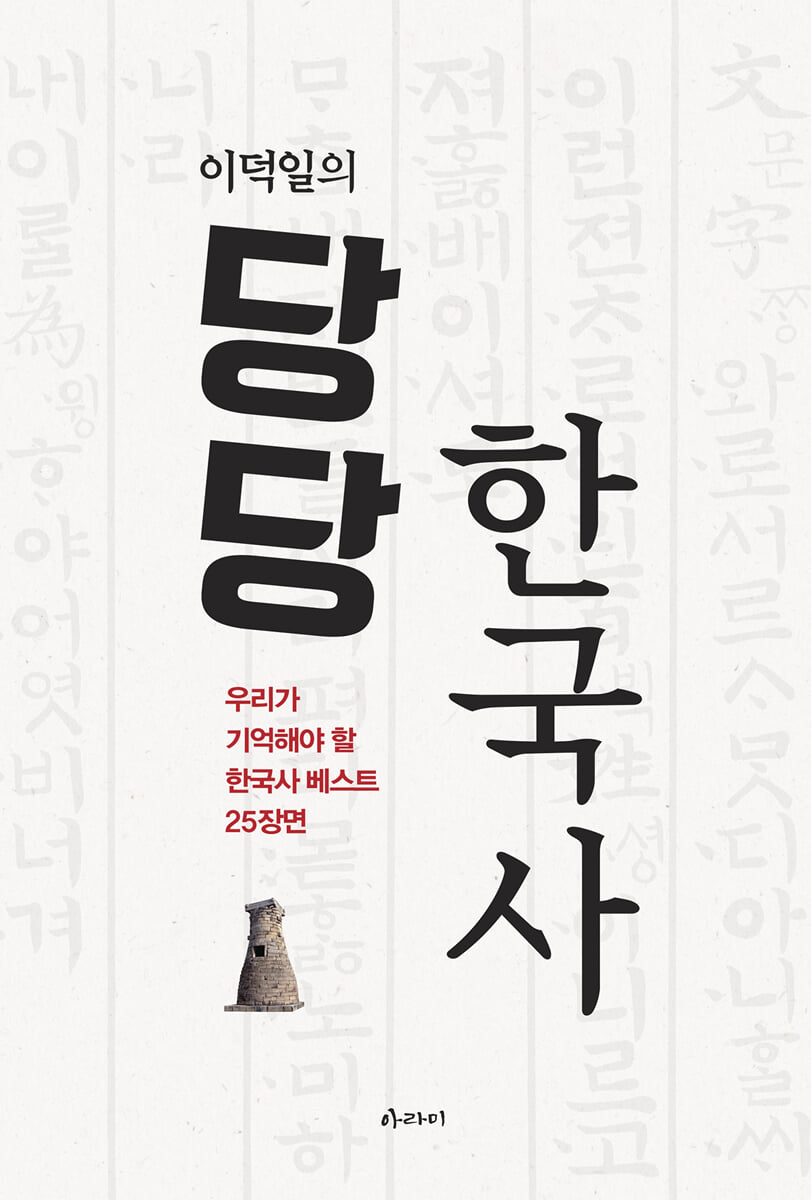
Lee Deok-il's Dangdang Korean History
 |
Description
Book Introduction
“Our footsteps have taken their rightful place in world history,
“Meet those shining moments!”
The wisdom and courage, culture and science, spirit and heritage of the Korean people
It vividly conveys how it has touched and illuminated the world.
The best scenes in Korean history all in one place!
-The 25 Best Scenes in Korean History, Selected by Historian Lee Deok-il
Although history education has been strengthened recently, the level of historical awareness among young people is still hopeless.
This is because of the simple idea that history is a subject to be memorized and the inconsistent historical consciousness.
Our future depends on education.
If young people develop an interest in history and a proper historical awareness, our future will be much brighter.
Lee Deok-il, a leading historian of our time, has compiled 25 scenes that marked a significant part of our history for young people.
"Lee Deok-il's Dignified Korean History" is a book published to help young people look at history with pride in being Korean and foster an enterprising spirit.
If you're a young person in Korea, you need to know this part of our history! This book brings together the proud moments we must remember, the most heart-pounding moments of Korean history.
From the people who commanded the world and moments of great victory, to the scientists and inventions that boasted the world's best science and technology, to the artists who created humanity's greatest works and the works they left behind, the 25 best scenes of our history, magnificently and splendidly decorated, unfold in a breathtaking way.
“Meet those shining moments!”
The wisdom and courage, culture and science, spirit and heritage of the Korean people
It vividly conveys how it has touched and illuminated the world.
The best scenes in Korean history all in one place!
-The 25 Best Scenes in Korean History, Selected by Historian Lee Deok-il
Although history education has been strengthened recently, the level of historical awareness among young people is still hopeless.
This is because of the simple idea that history is a subject to be memorized and the inconsistent historical consciousness.
Our future depends on education.
If young people develop an interest in history and a proper historical awareness, our future will be much brighter.
Lee Deok-il, a leading historian of our time, has compiled 25 scenes that marked a significant part of our history for young people.
"Lee Deok-il's Dignified Korean History" is a book published to help young people look at history with pride in being Korean and foster an enterprising spirit.
If you're a young person in Korea, you need to know this part of our history! This book brings together the proud moments we must remember, the most heart-pounding moments of Korean history.
From the people who commanded the world and moments of great victory, to the scientists and inventions that boasted the world's best science and technology, to the artists who created humanity's greatest works and the works they left behind, the 25 best scenes of our history, magnificently and splendidly decorated, unfold in a breathtaking way.
- You can preview some of the book's contents.
Preview
index
│Preface│ The true stage of our history and culture
Part 1: Global Historical Figures Who Shined in Korean History
Scene 1: Jang Bogo, the maritime king of Silla who founded a maritime empire
Scene 2: Lee Jeong-gi, a world-renowned figure who built a great empire in the heart of Central Plains.
Scene 3: Go Seonji, a general from Goguryeo who became a leading figure in world history.
Scene 4: Heukchi Sangji, the Baekje general who commanded the continent
│One More!│Silla, the Trading Powerhouse of the Three Kingdoms Period
Part 2: Great Victory Moments That Shine in Korean History
Scene 5: The Joseon-Han War - The War Between Gojoseon and Han
Scene 6: The Battle of Goguryeo and Sui - The War Between Goguryeo and Sui
Scene 7: The Battle of Goguryeo and Tang - The War Between Goguryeo and Tang
Scene 8: The Silla-Tang War - The Completion of the War for Unification
Scene 9: The Battle of Hansando, a Shining Piece of World Naval History
Scene 10: The Nasron Expedition Defeating the Russian Army
Scene 11: Victory of a Hundred Men, the Battle of Bongodong
Scene 12: The Immortal Battle of Cheongsanri
│One More!│The Great Conqueror, Gwanggaeto the Great
Part 3: Proud World Heritage Sites That Shine on Korean History
Scene 13: The Power of Buddhism to Protect the Nation, the Tripitaka Koreana
The 14-Scene Record of Cultural Heritage: The Annals of the Joseon Dynasty
Scene 15: The world's first metal movable type book, Jikji Simgyeong
Scene 16: Seokguram Grotto, a great work of art created by the spirit of science
│One More!│The 1,500-Year-Old Mystery: The Tomb of King Muryeong
Part 4: Brilliant Science and Culture that Shined in Korean History
Scene 17: Biwa-shaped Bronze Sword and Bronze Technology
Scene 18: The invincible turtle ship
Scene 19: Cheomseongdae, the oldest astronomical observatory in the East
20 Amazing Astronomical Observations, "The Celestial Train Map"
Scene 21: The Blossoming of Scientific Spirit in Exile: Jeong Yak-jeon and the Jasaneobo
Scene 22: Choi Mu-seon and the Invention of Gunpowder Weapons
Scene 23: The World's Most Beautiful Color, Goryeo Celadon
Scene 24: Heavenly Sounds, King Seongdeok's Divine Bell
25 Scenes of Goguryeo Castle and Tomb Murals
One More Thing! Jang Yeong-sil: From Slave to Scientist
Part 1: Global Historical Figures Who Shined in Korean History
Scene 1: Jang Bogo, the maritime king of Silla who founded a maritime empire
Scene 2: Lee Jeong-gi, a world-renowned figure who built a great empire in the heart of Central Plains.
Scene 3: Go Seonji, a general from Goguryeo who became a leading figure in world history.
Scene 4: Heukchi Sangji, the Baekje general who commanded the continent
│One More!│Silla, the Trading Powerhouse of the Three Kingdoms Period
Part 2: Great Victory Moments That Shine in Korean History
Scene 5: The Joseon-Han War - The War Between Gojoseon and Han
Scene 6: The Battle of Goguryeo and Sui - The War Between Goguryeo and Sui
Scene 7: The Battle of Goguryeo and Tang - The War Between Goguryeo and Tang
Scene 8: The Silla-Tang War - The Completion of the War for Unification
Scene 9: The Battle of Hansando, a Shining Piece of World Naval History
Scene 10: The Nasron Expedition Defeating the Russian Army
Scene 11: Victory of a Hundred Men, the Battle of Bongodong
Scene 12: The Immortal Battle of Cheongsanri
│One More!│The Great Conqueror, Gwanggaeto the Great
Part 3: Proud World Heritage Sites That Shine on Korean History
Scene 13: The Power of Buddhism to Protect the Nation, the Tripitaka Koreana
The 14-Scene Record of Cultural Heritage: The Annals of the Joseon Dynasty
Scene 15: The world's first metal movable type book, Jikji Simgyeong
Scene 16: Seokguram Grotto, a great work of art created by the spirit of science
│One More!│The 1,500-Year-Old Mystery: The Tomb of King Muryeong
Part 4: Brilliant Science and Culture that Shined in Korean History
Scene 17: Biwa-shaped Bronze Sword and Bronze Technology
Scene 18: The invincible turtle ship
Scene 19: Cheomseongdae, the oldest astronomical observatory in the East
20 Amazing Astronomical Observations, "The Celestial Train Map"
Scene 21: The Blossoming of Scientific Spirit in Exile: Jeong Yak-jeon and the Jasaneobo
Scene 22: Choi Mu-seon and the Invention of Gunpowder Weapons
Scene 23: The World's Most Beautiful Color, Goryeo Celadon
Scene 24: Heavenly Sounds, King Seongdeok's Divine Bell
25 Scenes of Goguryeo Castle and Tomb Murals
One More Thing! Jang Yeong-sil: From Slave to Scientist
Detailed image

Into the book
This suggests that Go Seonji's unit was composed of Goguryeo refugees who believed that they shared a common destiny with Go Seonji.
The unit, originally composed of Goguryeo refugees who were famous for their fighting prowess, was bound to be strong.
The Goseonji unit crossed the rugged Pamir Plateau at this time.
In the Pamir Plateau, there was only a path between sheer cliffs that could barely accommodate one person.
So no one in the Tang Dynasty ever thought of crossing the Pamir Plateau.
However, Go Seon-ji defied everyone's expectations by crossing the Pamir Plateau, just as the Carthaginian general Hannibal had crossed the Pyrenees and the Alps and taken the souls of the Romans away.
Tibet was so shocked when Gao Xianzhi's army suddenly appeared at their military base, Yanyun Fort (present-day Sarhad in eastern Pakistan), that they could not even imagine that the Tang army would cross the Pamir Plateau.
In the end, Toban lost the Yeonunbo without even being able to respond properly.
--- p.36~37, from the text “Go Seonji, a general from Goguryeo who became a leading figure in world history”
Silla's Gyeongju and Gaeunpo were the eastern end of the long Silk Road, which stretched 12,000 kilometers.
The fact that Westerners came to Silla can also be known through the records they left behind.
Westerners have been recording these facts since the late 9th century, and the contents are as follows.
“There is a country (Silla) in the east of China. Those who enter that country are not only blessed with clean air and wealth, fertile land and good water, but also with gentle personalities of its inhabitants, so they do not want to leave.
Any traveler who visits that place (Silla) settles down and never wants to come out again.
The reason is that it is very rich and has many beneficial things.
Among them, gold is so common that the locals even make dog chains and monkey leashes out of gold.
They also weave clothes themselves and sell them.
(The Silla people) decorate their houses with fabrics embroidered with silk and gold thread, and use gold utensils for meals.
“The people of Silla are the most beautiful in the world and have the fewest diseases.”
--- p.58, from the text “Silla, a trading powerhouse during the Three Kingdoms period”
Eulji Mundeok sent a messenger to falsely surrender, saying, “If the soldiers withdraw, I will take the king to the temporary residence and beg him.”
Umunsul was deceived by Eulji Mundeok's false surrender and began to withdraw, reaching a place called Salsu (present-day Cheongcheon River) in July.
When the Sui army was halfway across the Salsu River, the Goguryeo army suddenly launched a surprise attack.
The Sui soldiers, who were in disarray, fell like autumn leaves, and even the enemy general Shin Se-ung was killed.
According to records, the soldiers who barely survived fled a long distance of about 450 li in one day and one night.
The story is that he just ran forward without looking back.
So, when the Sui army of 305,000 men reached the outskirts of Liaodong, only about 2,700 men remained, so it was a crushing defeat like no other.
Yangje painfully realized that he could no longer defeat Goguryeo by fighting.
He held Umunsul and others responsible for the defeat and ended up retreating with them tied up in chains.
With this, the second war between Goguryeo and the Sui Dynasty ended with Goguryeo's victory, and this is the 'Battle of Salsu', which will forever shine in our ancient war history.
--- p.82~83, from the text “The Goguryeo-Sui War, the War between Goguryeo and the Sui Dynasty”
The independence fighters had to fight all day long while starving.
Women from nearby villages came up the mountain, bravely facing the hail of bullets, carrying rice wrapped in the hem of their skirts.
However, the independence fighters could not even find time to eat.
It was to the point where women had to make rice balls and feed them to the independence fighters one or two at a time.
This village, which had provided food to the independence fighters at that time, was later burned to the ground in retaliation by the Japanese army, and its compatriots were brutally massacred.
The independence fighters did not fear death because they dedicated their bodies and minds to the war for independence.
Choi In-geol, the machine gun company commander of the Northern Route Military Government, tied the machine gun to his own body after the machine gunner was killed.
And they concentrated fire on the advancing Japanese troops.
The Japanese army's attack had no choice but to falter.
When his machine gun runs out of ammunition, Choi In-geol fights the enemy with his bare body and dies a heroic death.
--- p.142, from the text “The Immortal Battle of Cheongsan-ri”
The Annals of the Joseon Dynasty is the most extensive historical book in world history.
Even in China, there is no historical record that records a dynasty in such detail over such a long period of time.
Not only China, but also Japan, Vietnam, and other Confucian cultural countries all compiled historical records, but these records are very brief compared to the Annals of the Joseon Dynasty.
There are also differences in their content.
While the annals of other countries were all influenced by the king, the Annals of the Joseon Dynasty are the only ones whose contents were not accessible to the king, and therefore contain many sensitive contents.
Because of this principle, the Annals of the Joseon Dynasty were recorded more faithfully than any other country's annals.
It is rare in world history for a royal record spanning over 500 years to be recorded under a single system, so it was designated as National Treasure No. 131 early on, and in 1997, along with Hunminjeongeum, it was registered as a UNESCO Memory of the World Register.
The unit, originally composed of Goguryeo refugees who were famous for their fighting prowess, was bound to be strong.
The Goseonji unit crossed the rugged Pamir Plateau at this time.
In the Pamir Plateau, there was only a path between sheer cliffs that could barely accommodate one person.
So no one in the Tang Dynasty ever thought of crossing the Pamir Plateau.
However, Go Seon-ji defied everyone's expectations by crossing the Pamir Plateau, just as the Carthaginian general Hannibal had crossed the Pyrenees and the Alps and taken the souls of the Romans away.
Tibet was so shocked when Gao Xianzhi's army suddenly appeared at their military base, Yanyun Fort (present-day Sarhad in eastern Pakistan), that they could not even imagine that the Tang army would cross the Pamir Plateau.
In the end, Toban lost the Yeonunbo without even being able to respond properly.
--- p.36~37, from the text “Go Seonji, a general from Goguryeo who became a leading figure in world history”
Silla's Gyeongju and Gaeunpo were the eastern end of the long Silk Road, which stretched 12,000 kilometers.
The fact that Westerners came to Silla can also be known through the records they left behind.
Westerners have been recording these facts since the late 9th century, and the contents are as follows.
“There is a country (Silla) in the east of China. Those who enter that country are not only blessed with clean air and wealth, fertile land and good water, but also with gentle personalities of its inhabitants, so they do not want to leave.
Any traveler who visits that place (Silla) settles down and never wants to come out again.
The reason is that it is very rich and has many beneficial things.
Among them, gold is so common that the locals even make dog chains and monkey leashes out of gold.
They also weave clothes themselves and sell them.
(The Silla people) decorate their houses with fabrics embroidered with silk and gold thread, and use gold utensils for meals.
“The people of Silla are the most beautiful in the world and have the fewest diseases.”
--- p.58, from the text “Silla, a trading powerhouse during the Three Kingdoms period”
Eulji Mundeok sent a messenger to falsely surrender, saying, “If the soldiers withdraw, I will take the king to the temporary residence and beg him.”
Umunsul was deceived by Eulji Mundeok's false surrender and began to withdraw, reaching a place called Salsu (present-day Cheongcheon River) in July.
When the Sui army was halfway across the Salsu River, the Goguryeo army suddenly launched a surprise attack.
The Sui soldiers, who were in disarray, fell like autumn leaves, and even the enemy general Shin Se-ung was killed.
According to records, the soldiers who barely survived fled a long distance of about 450 li in one day and one night.
The story is that he just ran forward without looking back.
So, when the Sui army of 305,000 men reached the outskirts of Liaodong, only about 2,700 men remained, so it was a crushing defeat like no other.
Yangje painfully realized that he could no longer defeat Goguryeo by fighting.
He held Umunsul and others responsible for the defeat and ended up retreating with them tied up in chains.
With this, the second war between Goguryeo and the Sui Dynasty ended with Goguryeo's victory, and this is the 'Battle of Salsu', which will forever shine in our ancient war history.
--- p.82~83, from the text “The Goguryeo-Sui War, the War between Goguryeo and the Sui Dynasty”
The independence fighters had to fight all day long while starving.
Women from nearby villages came up the mountain, bravely facing the hail of bullets, carrying rice wrapped in the hem of their skirts.
However, the independence fighters could not even find time to eat.
It was to the point where women had to make rice balls and feed them to the independence fighters one or two at a time.
This village, which had provided food to the independence fighters at that time, was later burned to the ground in retaliation by the Japanese army, and its compatriots were brutally massacred.
The independence fighters did not fear death because they dedicated their bodies and minds to the war for independence.
Choi In-geol, the machine gun company commander of the Northern Route Military Government, tied the machine gun to his own body after the machine gunner was killed.
And they concentrated fire on the advancing Japanese troops.
The Japanese army's attack had no choice but to falter.
When his machine gun runs out of ammunition, Choi In-geol fights the enemy with his bare body and dies a heroic death.
--- p.142, from the text “The Immortal Battle of Cheongsan-ri”
The Annals of the Joseon Dynasty is the most extensive historical book in world history.
Even in China, there is no historical record that records a dynasty in such detail over such a long period of time.
Not only China, but also Japan, Vietnam, and other Confucian cultural countries all compiled historical records, but these records are very brief compared to the Annals of the Joseon Dynasty.
There are also differences in their content.
While the annals of other countries were all influenced by the king, the Annals of the Joseon Dynasty are the only ones whose contents were not accessible to the king, and therefore contain many sensitive contents.
Because of this principle, the Annals of the Joseon Dynasty were recorded more faithfully than any other country's annals.
It is rare in world history for a royal record spanning over 500 years to be recorded under a single system, so it was designated as National Treasure No. 131 early on, and in 1997, along with Hunminjeongeum, it was registered as a UNESCO Memory of the World Register.
--- p.168, from the text, “The pinnacle of recorded culture, the Annals of the Joseon Dynasty”
Publisher's Review
The best scenes in Korean history all in one place!
-The 25 Best Scenes in Korean History, Selected by Historian Lee Deok-il
Although history education has been strengthened recently, the level of historical awareness among young people is still hopeless.
This is because of the simple idea that history is a subject to be memorized and the inconsistent historical consciousness.
Our future depends on education.
If young people develop an interest in history and a proper historical awareness, our future will be much brighter.
Lee Deok-il, a leading historian of our time, has compiled 25 scenes that marked a significant part of our history for young people.
"Lee Deok-il's Dignified Korean History" is a book published to help young people look at history with pride in being Korean and foster an enterprising spirit.
If you're a young person in Korea, you need to know this part of our history! This book brings together the proud moments we must remember, the most heart-pounding moments of Korean history.
From the people who commanded the world and moments of great victory, to the scientists and inventions that boasted the world's best science and technology, to the artists who created humanity's greatest works and the works they left behind, the 25 best scenes of our history, magnificently and splendidly decorated, unfold in a breathtaking way.
With a relentless spirit of challenge, we travel across continents and oceans,
The power of Korea, which left behind world-class scientific technology and cultural heritage!
Our ancestors ran without hesitation across the vast stage of history, from the vast continent of Manchuria to the ocean.
If Napoleon, the hero of the century, crossed the Alps, General Go Seon-ji crossed the Pamir Plateau and the Hindu Kush Mountains a thousand years before him, shining the light of our people's spirit of challenge on the world.
And that's not all.
Seorabeol, the capital of Unified Silla, was an international city crowded with numerous foreign merchants, as it was located at the eastern end of the Silk Road, which was the main artery of Eastern and Western civilization.
You can also meet great scientists who have demonstrated the world's best scientific technology and artists who have created the best works.
Bronze mirrors that cannot be reproduced even with modern technology, Cheomseongdae and Cheonsangbyeonyajido that showed that they could see through the order of the heavens in ancient times, metal type that preceded Gutenberg's printing press by 200 years, the turtle ship, an invincible warship that shone in the history of world wars, and the Annals of the Joseon Dynasty, the world's largest historical book registered as a UNESCO Memory of the World.
These are all cultural heritages that the world admires, and they clearly demonstrate the high cultural sophistication of our ancestors.
This book will bring you a new sense of emotion through the figures of our history who dreamed of becoming masters of the world, and the craftsmanship and artistic spirit of our ancestors who created a brilliant culture.
This book contains a total of 25 scenes, organized into three parts: 'Part 1: Global Historical Figures Who Made Korean History Shine', 'Part 2: Great Moments of Victory Shine on Korean History', 'Part 3: Proud World Heritage Shine on Korean History', and 'Part 4: Brilliant Science and Culture Shine on Korean History', featuring figures, events, and cultural heritages that left their mark on history as proud global citizens.
"Lee Deok-il's Dignified Korean History" will provide a good example for the youth of this land to boldly and courageously forge their own paths in life through the history of our ancestors who blossomed a brilliant culture across the five oceans and six continents.
It will serve as an excellent guide for our growing youth, not just a journey into the past, but one that will help them dream of the future and take on challenges for tomorrow.
-The 25 Best Scenes in Korean History, Selected by Historian Lee Deok-il
Although history education has been strengthened recently, the level of historical awareness among young people is still hopeless.
This is because of the simple idea that history is a subject to be memorized and the inconsistent historical consciousness.
Our future depends on education.
If young people develop an interest in history and a proper historical awareness, our future will be much brighter.
Lee Deok-il, a leading historian of our time, has compiled 25 scenes that marked a significant part of our history for young people.
"Lee Deok-il's Dignified Korean History" is a book published to help young people look at history with pride in being Korean and foster an enterprising spirit.
If you're a young person in Korea, you need to know this part of our history! This book brings together the proud moments we must remember, the most heart-pounding moments of Korean history.
From the people who commanded the world and moments of great victory, to the scientists and inventions that boasted the world's best science and technology, to the artists who created humanity's greatest works and the works they left behind, the 25 best scenes of our history, magnificently and splendidly decorated, unfold in a breathtaking way.
With a relentless spirit of challenge, we travel across continents and oceans,
The power of Korea, which left behind world-class scientific technology and cultural heritage!
Our ancestors ran without hesitation across the vast stage of history, from the vast continent of Manchuria to the ocean.
If Napoleon, the hero of the century, crossed the Alps, General Go Seon-ji crossed the Pamir Plateau and the Hindu Kush Mountains a thousand years before him, shining the light of our people's spirit of challenge on the world.
And that's not all.
Seorabeol, the capital of Unified Silla, was an international city crowded with numerous foreign merchants, as it was located at the eastern end of the Silk Road, which was the main artery of Eastern and Western civilization.
You can also meet great scientists who have demonstrated the world's best scientific technology and artists who have created the best works.
Bronze mirrors that cannot be reproduced even with modern technology, Cheomseongdae and Cheonsangbyeonyajido that showed that they could see through the order of the heavens in ancient times, metal type that preceded Gutenberg's printing press by 200 years, the turtle ship, an invincible warship that shone in the history of world wars, and the Annals of the Joseon Dynasty, the world's largest historical book registered as a UNESCO Memory of the World.
These are all cultural heritages that the world admires, and they clearly demonstrate the high cultural sophistication of our ancestors.
This book will bring you a new sense of emotion through the figures of our history who dreamed of becoming masters of the world, and the craftsmanship and artistic spirit of our ancestors who created a brilliant culture.
This book contains a total of 25 scenes, organized into three parts: 'Part 1: Global Historical Figures Who Made Korean History Shine', 'Part 2: Great Moments of Victory Shine on Korean History', 'Part 3: Proud World Heritage Shine on Korean History', and 'Part 4: Brilliant Science and Culture Shine on Korean History', featuring figures, events, and cultural heritages that left their mark on history as proud global citizens.
"Lee Deok-il's Dignified Korean History" will provide a good example for the youth of this land to boldly and courageously forge their own paths in life through the history of our ancestors who blossomed a brilliant culture across the five oceans and six continents.
It will serve as an excellent guide for our growing youth, not just a journey into the past, but one that will help them dream of the future and take on challenges for tomorrow.
GOODS SPECIFICS
- Date of issue: November 20, 2025
- Page count, weight, size: 288 pages | 152*225*18mm
- ISBN13: 9791188510993
- ISBN10: 1188510991
You may also like
카테고리
korean


korean

![GQ KOREA Mark (Monthly): December [2025]](http://librairie.coreenne.fr/cdn/shop/files/8ef265dbbfbf186523ed75ba7319009d.jpg?v=1765340328&width=3840)


