

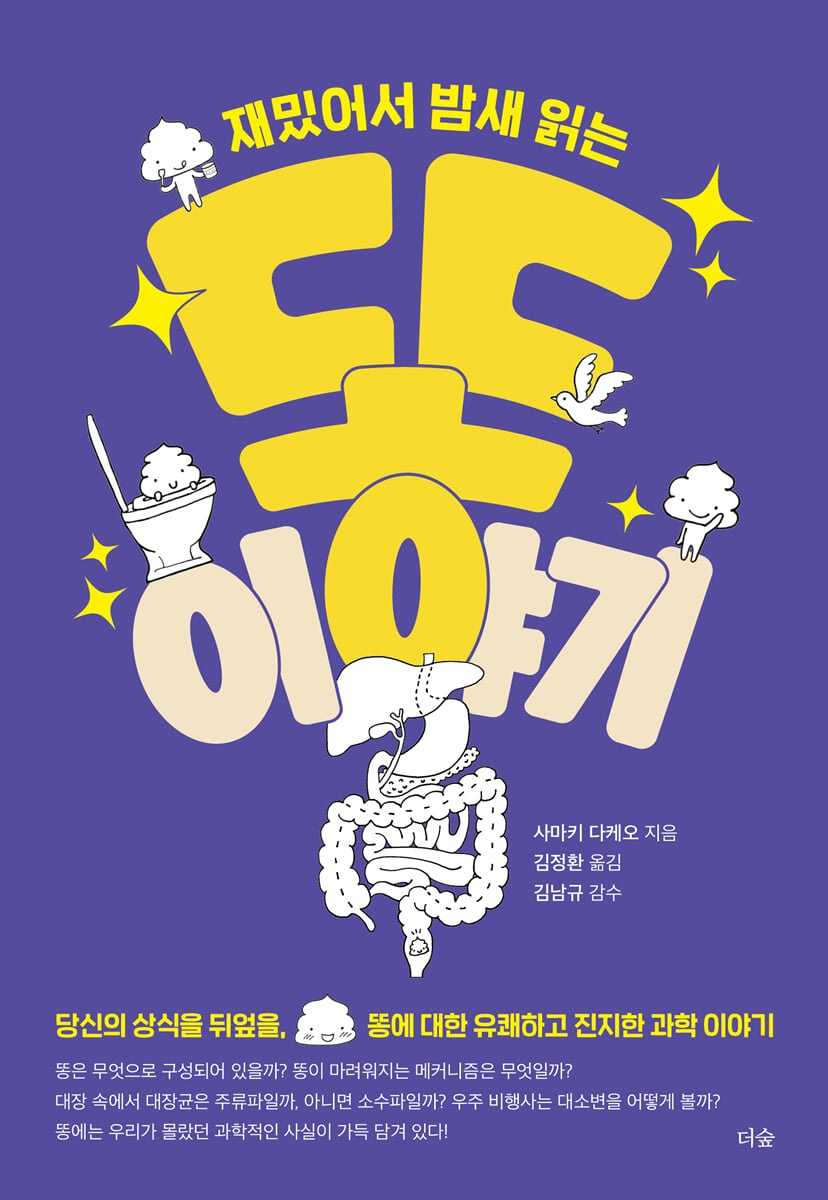
A fun poop story that will keep you reading all night
 |
Description
Book Introduction
A hilarious and serious science story about poop that will overturn your common sense.
Recommended by Professor Kim Nam-gyu, an authority on colon cancer who has appeared three times on EBS's "Myung-ui" program.
Despite being a part of human life, feces are often avoided from mention because they are considered dirty and embarrassing, and few people truly know what they are.
However, poop is the final product of digestion and excretion, and is the most direct and honest signal in our daily lives that tells us about our body's health.
The "Fun Night" series, consistently loved by parents and teachers, presents a new science book, "Fun Poop Stories You'll Read All Night," which is closely related to our daily lives.
This book uses the familiar yet little-known subject of "poop" to explain in an easy and interesting way how the digestive system works, how food changes in the body, the relationship between intestinal bacteria and immunity, and the scientific causes of constipation and fecal impaction.
Beyond simple physiological phenomena, this comprehensive science textbook explains the scientific and medical mechanisms occurring within the body in accessible language.
It also expands the scope of knowledge by covering traditional customs, folklore, folklore anecdotes, and even historical examples of human dealing with excrement.
In the process, rather than feeling aversion to excretion, you come to see excrement in a new light as a 'mirror of the body', discover the mysteries of the human body, and realize how essential this process is to sustaining life.
This book is not simply a book that makes you laugh, but it is also a practical scientific guide that helps you understand your body and examine your lifestyle habits, which is why it is so significant.
The scientific and medical verification and reliability of the content were secured through the supervision of Professor Nam-gyu Kim, who is known to the public as the 'first' and 'best' in the field of colon cancer and has appeared on EBS's "Myung-ui" three times.
Recommended by Professor Kim Nam-gyu, an authority on colon cancer who has appeared three times on EBS's "Myung-ui" program.
Despite being a part of human life, feces are often avoided from mention because they are considered dirty and embarrassing, and few people truly know what they are.
However, poop is the final product of digestion and excretion, and is the most direct and honest signal in our daily lives that tells us about our body's health.
The "Fun Night" series, consistently loved by parents and teachers, presents a new science book, "Fun Poop Stories You'll Read All Night," which is closely related to our daily lives.
This book uses the familiar yet little-known subject of "poop" to explain in an easy and interesting way how the digestive system works, how food changes in the body, the relationship between intestinal bacteria and immunity, and the scientific causes of constipation and fecal impaction.
Beyond simple physiological phenomena, this comprehensive science textbook explains the scientific and medical mechanisms occurring within the body in accessible language.
It also expands the scope of knowledge by covering traditional customs, folklore, folklore anecdotes, and even historical examples of human dealing with excrement.
In the process, rather than feeling aversion to excretion, you come to see excrement in a new light as a 'mirror of the body', discover the mysteries of the human body, and realize how essential this process is to sustaining life.
This book is not simply a book that makes you laugh, but it is also a practical scientific guide that helps you understand your body and examine your lifestyle habits, which is why it is so significant.
The scientific and medical verification and reliability of the content were secured through the supervision of Professor Nam-gyu Kim, who is known to the public as the 'first' and 'best' in the field of colon cancer and has appeared on EBS's "Myung-ui" three times.
- You can preview some of the book's contents.
Preview
index
preface
Reviewer's note
Part Ⅰ What are the components of feces and urine and how are they made?
1.
The journey of food from mouth to anus
2.
What is poop made of?
3.
Why Poop and Farts Smell So Bad
4.
The principles and components of urine production
5.
Farters who handle farts with ease
6.
Do babies in their mother's womb poop?
7.
The first poop you had since you were born (meconium)
8.
The mechanism by which you feel the need to poop
9.
What kind of poop is good poop?
10.
Food poisoning, a representative infectious diarrhea
11.
If I don't poop for several days, is it constipation?
Part Ⅱ Pathogens, pylori, intestinal flora, lactobacilli and bifidobacteria
12.
Bacteria that are both beneficial and harmful to humanity
13.
Microorganisms that live with our bodies, human commensal flora
14.
Pros and Cons of Eradication Treatment for Helicobacter pylori
15.
In the colon, are E. coli the majority or the minority?
16.
Yogurt enthusiast Metchnikov
17.
Representative bacteria of probiotics
18.
The pinnacle of probiotics: fecal transplant therapy
19.
Does dietary fiber prevent colon cancer?
Part Ⅲ Exciting Stories About Poop and Piss
20.
Cow dung is used as fuel in a product called 'cow dung cake'.
21.
Diet method that parasitizes tapeworms
22.
Medieval European methods of excrement disposal, a time when hygiene was lacking
23.
The excellent circulation system of the Edo period
24.
The Age of the Parasite Kingdom and Today's New Parasites
25.
How do astronauts defecate?
26.
Rabbits and koalas deliberately eating their own poop
27.
The structure of the digestive tract and feces of each animal are different.
28.
The surprising role of earthworm droppings discovered by Darwin
29.
What happens when you urinate on an earthworm?
30.
Bird droppings: The secret behind the uric acid lumps in the white cream.
Conclusion
References
Reviewer's note
Part Ⅰ What are the components of feces and urine and how are they made?
1.
The journey of food from mouth to anus
2.
What is poop made of?
3.
Why Poop and Farts Smell So Bad
4.
The principles and components of urine production
5.
Farters who handle farts with ease
6.
Do babies in their mother's womb poop?
7.
The first poop you had since you were born (meconium)
8.
The mechanism by which you feel the need to poop
9.
What kind of poop is good poop?
10.
Food poisoning, a representative infectious diarrhea
11.
If I don't poop for several days, is it constipation?
Part Ⅱ Pathogens, pylori, intestinal flora, lactobacilli and bifidobacteria
12.
Bacteria that are both beneficial and harmful to humanity
13.
Microorganisms that live with our bodies, human commensal flora
14.
Pros and Cons of Eradication Treatment for Helicobacter pylori
15.
In the colon, are E. coli the majority or the minority?
16.
Yogurt enthusiast Metchnikov
17.
Representative bacteria of probiotics
18.
The pinnacle of probiotics: fecal transplant therapy
19.
Does dietary fiber prevent colon cancer?
Part Ⅲ Exciting Stories About Poop and Piss
20.
Cow dung is used as fuel in a product called 'cow dung cake'.
21.
Diet method that parasitizes tapeworms
22.
Medieval European methods of excrement disposal, a time when hygiene was lacking
23.
The excellent circulation system of the Edo period
24.
The Age of the Parasite Kingdom and Today's New Parasites
25.
How do astronauts defecate?
26.
Rabbits and koalas deliberately eating their own poop
27.
The structure of the digestive tract and feces of each animal are different.
28.
The surprising role of earthworm droppings discovered by Darwin
29.
What happens when you urinate on an earthworm?
30.
Bird droppings: The secret behind the uric acid lumps in the white cream.
Conclusion
References
Detailed image

Into the book
Indole is a solid substance that smells like feces at room temperature.
However, when diluted to lower the concentration, it has a fragrant smell and is also a component of the fragrance of many flowers, including orange and jasmine.
In fact, natural jasmine oil used in perfumes contains about 2.5 percent indole, while synthetic indole is used in perfumes and fragrances.
The name scatol comes from the Greek word 'skato', meaning feces.
Looking at the chemical formula, it is similar to indole, but the difference is that it has a methyl group (-CH3) attached.
Skatole is also the source of the poop smell, but when diluted it has a jasmine scent.
So, like indole, it is used in perfumes and fragrances.
--- From the text "Indole and skatole, the source of the smell of poop, are ingredients in perfume?!"
Several months after the fetus begins living in the mother's womb, when the liver and kidneys develop, the fetus begins to urinate into the amniotic fluid.
The amount of urine increases as the fetus grows.
However, the fetus' urine does not accumulate in the amniotic fluid.
The fetus inhales its own urine along with amniotic fluid.
'Drink dirty piss
You may be thinking, ‘What the heck…’, but fetal urine does not contain any bacteria, so it is not dirty at all.
The urine consumed by the fetus travels through the stomach to the small intestine and then to the large intestine.
And at this time, it passes through the intestinal membrane and enters the blood vessels.
And it travels through the umbilical cord into the mother's bloodstream.
The mother's kidneys have to process the fetus' urine, so if they are not strong, they will not be able to withstand it.
If a pregnant mother's kidneys become weak, her face, hands, and feet may swell.
--- From the text “The fetus urinates in the amniotic fluid”
The main activity of the brain is to judge the surrounding environment or situation and suppress the stimulus for defecation when the defecation reflex is triggered by a physical stimulus, such as the movement of feces into the rectum.
The reason why stool does not normally come out of the anus is because the muscle called the anal sphincter acts as a lid for the anus.
In short, the anal flap must open for poop to come out.
There are two types of anal sphincters: internal sphincter and external sphincter.
The internal sphincter is controlled by the autonomic nervous system and cannot be consciously controlled, but the external sphincter can be consciously controlled through the pudendal nerve.
We can hold in our bowel movements to some extent thanks to the brain's inhibition of the external sphincter muscle.
In the case of newborns, this pudendal nerve is not yet developed, so when they feel the need to defecate, they unconsciously wet their diaper.
--- From the text “Reasons for Tolerating Change”
Constipation is difficult to define objectively because it varies greatly from person to person.
Even for the same person, the number and amount of bowel movements vary depending on the content and amount of food, and the normal range of bowel movements is wide enough that it is generally considered normal if the number of bowel movements is usually once a day, but more than three times a week.
① Constipation is defined as two or more of the following criteria:
■ You need to strain at least once out of every four bowel movements to get the stool out.
■ Hard or lumpy stool occurs more than once in every four bowel movements.
■ I feel like I have incomplete evacuation more than once in every four bowel movements.
■ I feel like my anus is blocked more than once every four bowel movements.
■ Use your hands to facilitate defecation at least once in every four bowel movements (hand defecation, pelvic floor support, etc.).
② Unless you have diarrhea, you will rarely have soft stools.
③ Does not meet the diagnostic criteria for irritable bowel syndrome
--- From the text “If I don’t poop for several days, is it constipation?”
On the ground, no matter how bad the smell is, the fart mixes with the surrounding air and the smell fades.
However, in a state of weightlessness, the air does not convect, so it keeps floating in one place inside the spaceship, and it is said that if this hits your nose directly, it will produce a stench that is enough to make you faint.
Additionally, because farts contain flammable gases called hydrogen and methane, there is a risk of fire if they come into contact with electrical systems or static electricity is generated, which could lead to an accident.
That's why astronauts are supposed to use the bathroom on the spaceship or space station when they fart.
However, when diluted to lower the concentration, it has a fragrant smell and is also a component of the fragrance of many flowers, including orange and jasmine.
In fact, natural jasmine oil used in perfumes contains about 2.5 percent indole, while synthetic indole is used in perfumes and fragrances.
The name scatol comes from the Greek word 'skato', meaning feces.
Looking at the chemical formula, it is similar to indole, but the difference is that it has a methyl group (-CH3) attached.
Skatole is also the source of the poop smell, but when diluted it has a jasmine scent.
So, like indole, it is used in perfumes and fragrances.
--- From the text "Indole and skatole, the source of the smell of poop, are ingredients in perfume?!"
Several months after the fetus begins living in the mother's womb, when the liver and kidneys develop, the fetus begins to urinate into the amniotic fluid.
The amount of urine increases as the fetus grows.
However, the fetus' urine does not accumulate in the amniotic fluid.
The fetus inhales its own urine along with amniotic fluid.
'Drink dirty piss
You may be thinking, ‘What the heck…’, but fetal urine does not contain any bacteria, so it is not dirty at all.
The urine consumed by the fetus travels through the stomach to the small intestine and then to the large intestine.
And at this time, it passes through the intestinal membrane and enters the blood vessels.
And it travels through the umbilical cord into the mother's bloodstream.
The mother's kidneys have to process the fetus' urine, so if they are not strong, they will not be able to withstand it.
If a pregnant mother's kidneys become weak, her face, hands, and feet may swell.
--- From the text “The fetus urinates in the amniotic fluid”
The main activity of the brain is to judge the surrounding environment or situation and suppress the stimulus for defecation when the defecation reflex is triggered by a physical stimulus, such as the movement of feces into the rectum.
The reason why stool does not normally come out of the anus is because the muscle called the anal sphincter acts as a lid for the anus.
In short, the anal flap must open for poop to come out.
There are two types of anal sphincters: internal sphincter and external sphincter.
The internal sphincter is controlled by the autonomic nervous system and cannot be consciously controlled, but the external sphincter can be consciously controlled through the pudendal nerve.
We can hold in our bowel movements to some extent thanks to the brain's inhibition of the external sphincter muscle.
In the case of newborns, this pudendal nerve is not yet developed, so when they feel the need to defecate, they unconsciously wet their diaper.
--- From the text “Reasons for Tolerating Change”
Constipation is difficult to define objectively because it varies greatly from person to person.
Even for the same person, the number and amount of bowel movements vary depending on the content and amount of food, and the normal range of bowel movements is wide enough that it is generally considered normal if the number of bowel movements is usually once a day, but more than three times a week.
① Constipation is defined as two or more of the following criteria:
■ You need to strain at least once out of every four bowel movements to get the stool out.
■ Hard or lumpy stool occurs more than once in every four bowel movements.
■ I feel like I have incomplete evacuation more than once in every four bowel movements.
■ I feel like my anus is blocked more than once every four bowel movements.
■ Use your hands to facilitate defecation at least once in every four bowel movements (hand defecation, pelvic floor support, etc.).
② Unless you have diarrhea, you will rarely have soft stools.
③ Does not meet the diagnostic criteria for irritable bowel syndrome
--- From the text “If I don’t poop for several days, is it constipation?”
On the ground, no matter how bad the smell is, the fart mixes with the surrounding air and the smell fades.
However, in a state of weightlessness, the air does not convect, so it keeps floating in one place inside the spaceship, and it is said that if this hits your nose directly, it will produce a stench that is enough to make you faint.
Additionally, because farts contain flammable gases called hydrogen and methane, there is a risk of fire if they come into contact with electrical systems or static electricity is generated, which could lead to an accident.
That's why astronauts are supposed to use the bathroom on the spaceship or space station when they fart.
--- From the text, “In the space station, you have to fart in the bathroom”
Publisher's Review
A hilarious and serious science story about poop that will overturn your common sense.
Recommended by Professor Nam-gyu Kim, an authority on colon cancer who has appeared three times on EBS's "Myung-ui" program.
Despite being a part of human life, feces are often avoided from mention because they are considered dirty and embarrassing, and few people truly know what they are.
However, poop is the final product of digestion and excretion, and is the most direct and honest signal in our daily lives that tells us about our body's health.
The "Fun Night" series, consistently loved by parents and teachers, presents a new science book, "Fun Poop Stories You'll Read All Night," which is closely related to our daily lives.
This book uses the familiar yet little-known subject of "poop" to explain in an easy and interesting way how the digestive system works, how food changes in the body, the relationship between intestinal bacteria and immunity, and the scientific causes of constipation and fecal impaction.
Beyond simple physiological phenomena, this comprehensive science textbook explains the scientific and medical mechanisms occurring within the body in accessible language.
It also expands the scope of knowledge by covering traditional customs, folklore, folklore anecdotes, and even historical examples of human dealing with excrement.
In the process, rather than feeling aversion to excretion, you come to see excrement in a new light as a 'mirror of the body', discover the mysteries of the human body, and realize how essential this process is to sustaining life.
This book is not simply a book that makes you laugh, but it is also a practical scientific guide that helps you understand your body and examine your lifestyle habits, which is why it is so significant.
The scientific and medical verification and reliability of the content were secured through the supervision of Professor Nam-gyu Kim, who is known to the public as the 'first' and 'best' in the field of colon cancer and has appeared on EBS's "Myung-ui" three times.
The science of poop you never knew about, and how humans have dealt with it.
The world of poop, full of interesting and fascinating stories
The complex systems of the human body, the secrets of health, and the cultural history of mankind are all hidden within this simple waste called poop.
This book unravels the fascinating science and story of poop through engaging stories and captivating explanations.
"The Mechanism of Pooping" explains in simple and detailed terms how scientifically sophisticated our human body works.
The reason we can hold back the urge to urinate for a certain period of time is because the brain consciously suppresses the external sphincter muscle through the pudendal nerve.
On the other hand, newborn babies have not yet developed this pudendal nerve, so they defecate unconsciously when they feel the need to defecate.
Constipation while traveling or in stressful situations is also closely related to the functioning of the autonomic nervous system.
The defecation reflex is activated when the parasympathetic nerves are dominant, and suppressed when the sympathetic nerves are dominant.
Therefore, in unfamiliar places or tense situations, the sympathetic nerves become activated, which can easily lead to constipation, and when you return home or feel relaxed, the parasympathetic nerves become activated again, allowing for smooth bowel movements.
In this way, poop is not just a simple excretion, but a 'mini physiology textbook' that shows how intricately our body's nervous system and physiological functions work together.
In "What Kind of Poop is Good Poop?", we present criteria for checking the health of intestinal bacteria through various factors such as the color, thickness, hardness, and stickiness of the poop.
The ideal stool is passed out smoothly without straining, and is covered in a mucus 'coat' so it doesn't stick to the anus.
This mucus is mucin and water that comes straight from the digestive tract.
Mucin is a high molecular weight compound composed of sugar and protein. This mucus is thinly spread on the surface of both the digestive tract and the feces, allowing the feces to move smoothly through the digestive tract and pass out smoothly through the anus.
Interestingly, mucin is also present in saliva, helping to make food easier to swallow.
Ultimately, good poop is a health indicator that shows that the digestive system is functioning smoothly and the intestinal bacteria are balanced.
Since long ago, mankind has recognized feces as not just waste, but as part of the cycle that connects life and ecology.
For example, in Japan's Edo period, farmers would sign contracts with samurai houses or commoners' communal houses to secure the right to collect excrement and urine to use as fertilizer, and exchange this for money or goods.
Also, by the mid-Edo period, human waste brokerage organizations had emerged in urban and rural areas, and trade was active.
At that time, there were grades in the quality of human waste compost.
At that time, there were also grades in the quality of human waste fertilizer. The idea that "the excrement of people who eat good food helps crops grow well" spread, so the human waste of the upper class was treated as high-quality fertilizer.
For example, in Edo, the quality of human waste was divided into three grades: upper, middle, and lower.
It is said that the excrement of lords and noble families was classified as 'upper', that of common warriors and merchants as 'middle', and that of poor commoners as 'lower'.
When it comes to feces and urine, Japan during the Edo period was building a "circular society" that sought to preserve the living environment based on limited resources and technology, and effectively utilize them by hygienically processing them.
By selling human feces and urine to farmers, the streets were kept clean and free from human feces and urine contamination.
A scientific book and practical health guide on reading the body's rhythms
This book is not a simple, easy-to-read, humorous, or educational book.
This book shows how sophisticated science and principles of life activities are hidden within the physiological phenomena that we repeat without thinking twice about.
The journey of food from the mouth through the stomach and intestines, from the absorption of nutrients to the excretion of waste as feces is a complete physiological system, the result of the body's self-regulating and balancing rhythm.
The book explains this process in friendly and humorous language, helping readers learn how to 'read' their own bodies.
By following this process, readers will go beyond simply 'knowing poop' and learn how to observe the rhythms of their body and manage their own health.
This book is about poop, but it goes beyond that.
Understanding the body through poop and realizing the relationship between food, gut bacteria, and health soon becomes a training in scientific thinking that allows us to look more deeply into human life.
As you read, you will find yourself examining your eating habits and lifestyle patterns, and small but consistent changes will help your body regain its rhythm.
After reading this book, your bathroom time might feel a little different.
You will also become conscious of 'what is the condition of today's poop?'
And you will realize.
Health does not begin in the hospital, but in understanding the body's rhythm of creating 'good poop' through daily bowel movements.
Recommended by Professor Nam-gyu Kim, an authority on colon cancer who has appeared three times on EBS's "Myung-ui" program.
Despite being a part of human life, feces are often avoided from mention because they are considered dirty and embarrassing, and few people truly know what they are.
However, poop is the final product of digestion and excretion, and is the most direct and honest signal in our daily lives that tells us about our body's health.
The "Fun Night" series, consistently loved by parents and teachers, presents a new science book, "Fun Poop Stories You'll Read All Night," which is closely related to our daily lives.
This book uses the familiar yet little-known subject of "poop" to explain in an easy and interesting way how the digestive system works, how food changes in the body, the relationship between intestinal bacteria and immunity, and the scientific causes of constipation and fecal impaction.
Beyond simple physiological phenomena, this comprehensive science textbook explains the scientific and medical mechanisms occurring within the body in accessible language.
It also expands the scope of knowledge by covering traditional customs, folklore, folklore anecdotes, and even historical examples of human dealing with excrement.
In the process, rather than feeling aversion to excretion, you come to see excrement in a new light as a 'mirror of the body', discover the mysteries of the human body, and realize how essential this process is to sustaining life.
This book is not simply a book that makes you laugh, but it is also a practical scientific guide that helps you understand your body and examine your lifestyle habits, which is why it is so significant.
The scientific and medical verification and reliability of the content were secured through the supervision of Professor Nam-gyu Kim, who is known to the public as the 'first' and 'best' in the field of colon cancer and has appeared on EBS's "Myung-ui" three times.
The science of poop you never knew about, and how humans have dealt with it.
The world of poop, full of interesting and fascinating stories
The complex systems of the human body, the secrets of health, and the cultural history of mankind are all hidden within this simple waste called poop.
This book unravels the fascinating science and story of poop through engaging stories and captivating explanations.
"The Mechanism of Pooping" explains in simple and detailed terms how scientifically sophisticated our human body works.
The reason we can hold back the urge to urinate for a certain period of time is because the brain consciously suppresses the external sphincter muscle through the pudendal nerve.
On the other hand, newborn babies have not yet developed this pudendal nerve, so they defecate unconsciously when they feel the need to defecate.
Constipation while traveling or in stressful situations is also closely related to the functioning of the autonomic nervous system.
The defecation reflex is activated when the parasympathetic nerves are dominant, and suppressed when the sympathetic nerves are dominant.
Therefore, in unfamiliar places or tense situations, the sympathetic nerves become activated, which can easily lead to constipation, and when you return home or feel relaxed, the parasympathetic nerves become activated again, allowing for smooth bowel movements.
In this way, poop is not just a simple excretion, but a 'mini physiology textbook' that shows how intricately our body's nervous system and physiological functions work together.
In "What Kind of Poop is Good Poop?", we present criteria for checking the health of intestinal bacteria through various factors such as the color, thickness, hardness, and stickiness of the poop.
The ideal stool is passed out smoothly without straining, and is covered in a mucus 'coat' so it doesn't stick to the anus.
This mucus is mucin and water that comes straight from the digestive tract.
Mucin is a high molecular weight compound composed of sugar and protein. This mucus is thinly spread on the surface of both the digestive tract and the feces, allowing the feces to move smoothly through the digestive tract and pass out smoothly through the anus.
Interestingly, mucin is also present in saliva, helping to make food easier to swallow.
Ultimately, good poop is a health indicator that shows that the digestive system is functioning smoothly and the intestinal bacteria are balanced.
Since long ago, mankind has recognized feces as not just waste, but as part of the cycle that connects life and ecology.
For example, in Japan's Edo period, farmers would sign contracts with samurai houses or commoners' communal houses to secure the right to collect excrement and urine to use as fertilizer, and exchange this for money or goods.
Also, by the mid-Edo period, human waste brokerage organizations had emerged in urban and rural areas, and trade was active.
At that time, there were grades in the quality of human waste compost.
At that time, there were also grades in the quality of human waste fertilizer. The idea that "the excrement of people who eat good food helps crops grow well" spread, so the human waste of the upper class was treated as high-quality fertilizer.
For example, in Edo, the quality of human waste was divided into three grades: upper, middle, and lower.
It is said that the excrement of lords and noble families was classified as 'upper', that of common warriors and merchants as 'middle', and that of poor commoners as 'lower'.
When it comes to feces and urine, Japan during the Edo period was building a "circular society" that sought to preserve the living environment based on limited resources and technology, and effectively utilize them by hygienically processing them.
By selling human feces and urine to farmers, the streets were kept clean and free from human feces and urine contamination.
A scientific book and practical health guide on reading the body's rhythms
This book is not a simple, easy-to-read, humorous, or educational book.
This book shows how sophisticated science and principles of life activities are hidden within the physiological phenomena that we repeat without thinking twice about.
The journey of food from the mouth through the stomach and intestines, from the absorption of nutrients to the excretion of waste as feces is a complete physiological system, the result of the body's self-regulating and balancing rhythm.
The book explains this process in friendly and humorous language, helping readers learn how to 'read' their own bodies.
By following this process, readers will go beyond simply 'knowing poop' and learn how to observe the rhythms of their body and manage their own health.
This book is about poop, but it goes beyond that.
Understanding the body through poop and realizing the relationship between food, gut bacteria, and health soon becomes a training in scientific thinking that allows us to look more deeply into human life.
As you read, you will find yourself examining your eating habits and lifestyle patterns, and small but consistent changes will help your body regain its rhythm.
After reading this book, your bathroom time might feel a little different.
You will also become conscious of 'what is the condition of today's poop?'
And you will realize.
Health does not begin in the hospital, but in understanding the body's rhythm of creating 'good poop' through daily bowel movements.
GOODS SPECIFICS
- Date of issue: November 6, 2025
- Page count, weight, size: 222 pages | 145*210*20mm
- ISBN13: 9791194273295
- ISBN10: 1194273297
You may also like
카테고리
korean


korean

![GQ KOREA Mark (Monthly): December [2025]](http://librairie.coreenne.fr/cdn/shop/files/8ef265dbbfbf186523ed75ba7319009d.jpg?v=1765340328&width=3840)


