

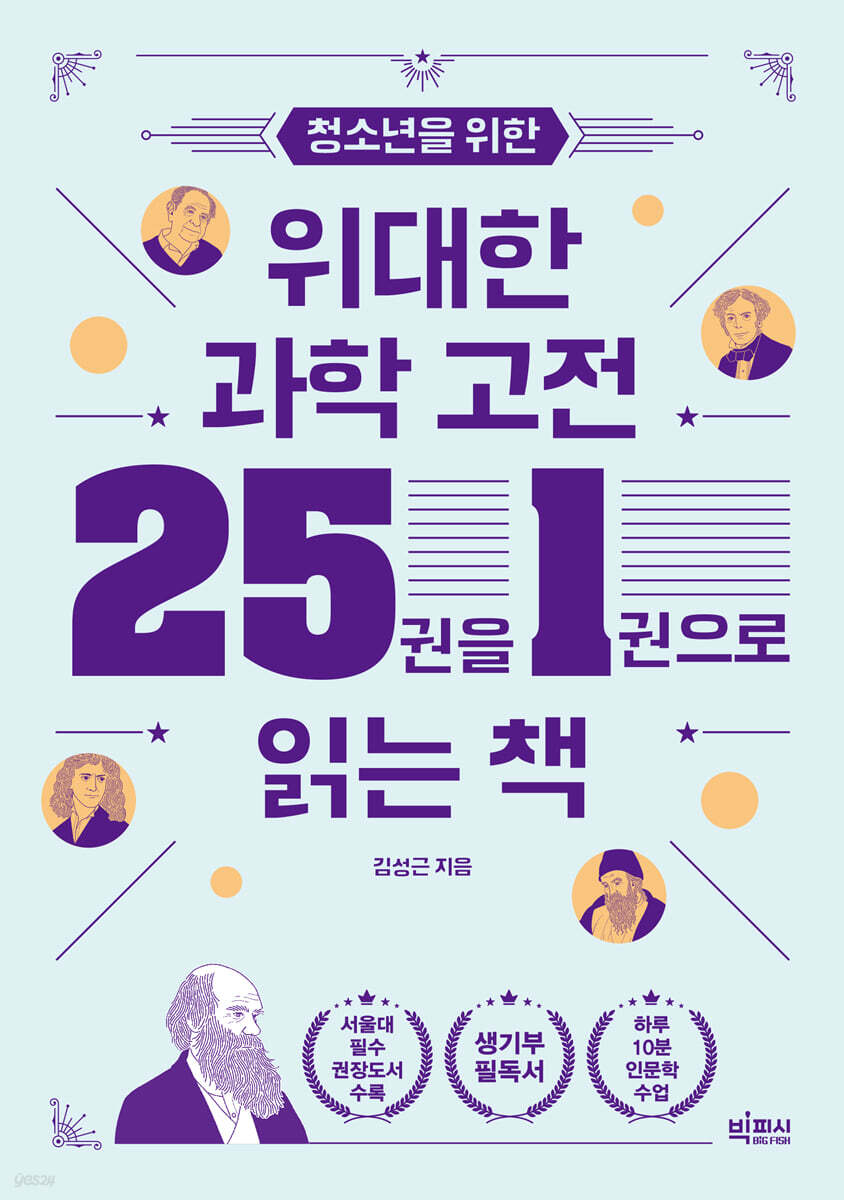
A book that contains 25 great science classics for teenagers in one volume.
 |
Description
Book Introduction
Shine brightly in your school grades, college entrance exams, and future life
10 minutes of science history class a day
This book contains 25 classic volumes considered to be the most important in the thousands of years of scientific history.
From Aristotle's "Physics" to Richard Dawkins' "The Selfish Gene," classics that have been pivotal in humanity's rapid growth are introduced in a condensed format of about 7-8 pages per volume.
Science books, which were once considered difficult, have been summarized in an easy and fun way, so you can properly understand the books included in textbooks, required readings from the life science department, and books recommended by Seoul National University in just 10 minutes a day, which can help you manage your grades, write essays, and prepare for entrance exams.
The teachings of the great scientists we encounter in this book will serve as a minimum of general knowledge for the present and future, and will serve as a guide for our lives in the days ahead.
10 minutes of science history class a day
This book contains 25 classic volumes considered to be the most important in the thousands of years of scientific history.
From Aristotle's "Physics" to Richard Dawkins' "The Selfish Gene," classics that have been pivotal in humanity's rapid growth are introduced in a condensed format of about 7-8 pages per volume.
Science books, which were once considered difficult, have been summarized in an easy and fun way, so you can properly understand the books included in textbooks, required readings from the life science department, and books recommended by Seoul National University in just 10 minutes a day, which can help you manage your grades, write essays, and prepare for entrance exams.
The teachings of the great scientists we encounter in this book will serve as a minimum of general knowledge for the present and future, and will serve as a guide for our lives in the days ahead.
- You can preview some of the book's contents.
Preview
index
introduction.
You can't understand modern civilization without knowing science.
Chapter 1.
A fun science classic that will have you hooked on science.
01 Tycho Brahe, On the Divinity, 1573
Astronomers strip away the transparent shell that covers the sky
02 Galileo Galilei, "Reports of the Starry World" 1610
The Birth of the Telescope, Unveiling the Wonders of the Celestial World
03 Michael Faraday, Science by Candlelight, 1860
The Christmas lecture that captured the public's hearts
04 Karl Popper, The Open Society and Its Enemies, 1945
A philosopher of science who shook the standards of science with falsificationism
05 Jacob Bronowski, "The Ascent of Man," 1973
How have humans expanded their intellectual capacity?
Chapter 2.
The Scientific Revolution: A Great Scientific Classic That Changed Human History
06 Nicolaus Copernicus, On the Revolutions of the Heavenly Spheres, 1543
Is the Earth or the Sun the center of the universe?
07 William Gilbert, On the Magnet, 1600
How do planets float in empty space?
08 Johannes Kepler's "New Astronomy" 1609
In what orbits do the planets orbit the sun?
09 Isaac Newton, Mathematical Principles of Natural Philosophy, 1687
To see further, stand on the shoulders of giants.
10 Thomas Kuhn, The Structure of Scientific Revolutions, 1962
Is science really progressive knowledge?
Chapter 3.
A modern and contemporary scientific masterpiece that shaped the status of science today.
11 Andreas Vesalius, On the Fabric of the Human Body, 1543
Anatomy rises to the center of medicine
12 Francis Bacon, The New Organ, 1620
How Scientific Theories Became Useful Technologies
13 Robert Hooke, Micrographia, 1665
Discovering another universe in the microscopic world
14 Carl von Linnaeus, Systema Naturae, 1735
When were whales first classified as mammals?
15 Joseph Needham, Science and Civilization in China, 1954
Was there really no science in China?
Chapter 4.
A scientific masterpiece that answers fundamental questions about life.
16 William Harvey, Anatomical Experiments on the Movement of the Heart and Blood in Animals, 1628
First to discover the circulation of blood throughout the body
17 Charles Darwin, The Origin of Species, 1859
A masterpiece of the century that almost led to a dispute over priority rights
18 Gregor Mendel, Experiments on Hybridization in Plants, 1866
Revolutionizing the development of genetics in the 20th century
19 James Watson, The Double Helix, 1968
How does DNA transmit genetic material?
20 Richard Dawkins, The Selfish Gene, 1976
Is altruistic behavior also a selfish instinct of genes?
Chapter 5.
An ancient scientific masterpiece you must read at least once in your life.
21 Aristotle, Physics, 4th century BC
Greek science, which dominated Western civilization for 2,000 years since ancient times
22 Epicurus, Pleasure, 3rd century BC
Did the emotions of life also originate from atoms?
23 Euclid, Elements of Geometry, c. 300 BC
The second most read book in human history after the Bible
24 Gaius Plinius Secundus, Natural History, 77
Did the immortal phoenix from Harry Potter come from ancient Rome?
25 Claudius Ptolemy, Almagest
The greatest book that guided Western astronomy before Copernicus in the mid-2nd century
References
You can't understand modern civilization without knowing science.
Chapter 1.
A fun science classic that will have you hooked on science.
01 Tycho Brahe, On the Divinity, 1573
Astronomers strip away the transparent shell that covers the sky
02 Galileo Galilei, "Reports of the Starry World" 1610
The Birth of the Telescope, Unveiling the Wonders of the Celestial World
03 Michael Faraday, Science by Candlelight, 1860
The Christmas lecture that captured the public's hearts
04 Karl Popper, The Open Society and Its Enemies, 1945
A philosopher of science who shook the standards of science with falsificationism
05 Jacob Bronowski, "The Ascent of Man," 1973
How have humans expanded their intellectual capacity?
Chapter 2.
The Scientific Revolution: A Great Scientific Classic That Changed Human History
06 Nicolaus Copernicus, On the Revolutions of the Heavenly Spheres, 1543
Is the Earth or the Sun the center of the universe?
07 William Gilbert, On the Magnet, 1600
How do planets float in empty space?
08 Johannes Kepler's "New Astronomy" 1609
In what orbits do the planets orbit the sun?
09 Isaac Newton, Mathematical Principles of Natural Philosophy, 1687
To see further, stand on the shoulders of giants.
10 Thomas Kuhn, The Structure of Scientific Revolutions, 1962
Is science really progressive knowledge?
Chapter 3.
A modern and contemporary scientific masterpiece that shaped the status of science today.
11 Andreas Vesalius, On the Fabric of the Human Body, 1543
Anatomy rises to the center of medicine
12 Francis Bacon, The New Organ, 1620
How Scientific Theories Became Useful Technologies
13 Robert Hooke, Micrographia, 1665
Discovering another universe in the microscopic world
14 Carl von Linnaeus, Systema Naturae, 1735
When were whales first classified as mammals?
15 Joseph Needham, Science and Civilization in China, 1954
Was there really no science in China?
Chapter 4.
A scientific masterpiece that answers fundamental questions about life.
16 William Harvey, Anatomical Experiments on the Movement of the Heart and Blood in Animals, 1628
First to discover the circulation of blood throughout the body
17 Charles Darwin, The Origin of Species, 1859
A masterpiece of the century that almost led to a dispute over priority rights
18 Gregor Mendel, Experiments on Hybridization in Plants, 1866
Revolutionizing the development of genetics in the 20th century
19 James Watson, The Double Helix, 1968
How does DNA transmit genetic material?
20 Richard Dawkins, The Selfish Gene, 1976
Is altruistic behavior also a selfish instinct of genes?
Chapter 5.
An ancient scientific masterpiece you must read at least once in your life.
21 Aristotle, Physics, 4th century BC
Greek science, which dominated Western civilization for 2,000 years since ancient times
22 Epicurus, Pleasure, 3rd century BC
Did the emotions of life also originate from atoms?
23 Euclid, Elements of Geometry, c. 300 BC
The second most read book in human history after the Bible
24 Gaius Plinius Secundus, Natural History, 77
Did the immortal phoenix from Harry Potter come from ancient Rome?
25 Claudius Ptolemy, Almagest
The greatest book that guided Western astronomy before Copernicus in the mid-2nd century
References
Detailed image

Into the book
It was around May 1609 that Galileo heard rumors about this curious instrument.
For him, who was known for his outstanding tool-making skills, making a telescope was not a difficult task.
At that time, telescopes that were commercially distributed in places like the Netherlands and France had a magnification of only 3 to 4 times.
However, Galileo's obsession was focused on improving the performance of the telescope several times.
At first he appealed to the powers that be of the telescope's military advantages, and met with some success.
Then, one day in November 1609, he looked up at the moon through a telescope.
《Reports from the Starry World》 is a vivid record of Galileo's observations from this time until the beginning of the following year.
(…) Compared to Galileo’s later masterpieces, The Report of the Other Worlds is written in a very readable narrative style.
This is because this book was not originally intended to be published.
Perhaps that is why, when reading this book, it feels as if Galileo is whispering to us the wonders of the celestial bodies he observed through his telescope.
---From "Galileo Galilei's "Report on the Starry World"
What Faraday took out was, unexpectedly, a single candle.
But as the lecture began, Faraday's hidden intentions were quickly revealed.
Faraday, through his unique and eloquent experiments, explained how many physical and chemical laws governing the universe are connected to a simple candle and how even the most difficult scientific laws are closely related to our daily lives.
The lecture that day remains in history and is still talked about to this day.
---From Michael Faraday's "Science by Candlelight"
Meanwhile, even to the last moment of his life, Wallace did not regret having virtually ceded the initiative in the theory of natural selection to Darwin.
He consistently said that it was an honor to have been able to work with Darwin.
Furthermore, Wallace took the lead in officially disseminating Darwin's theory by publishing a book titled "Darwinism" in May 1889.
The theory of evolution, which Darwin launched, continues to show its influence after being combined with genetics in the 20th century.
Some of the questions Darwin left behind are also being answered from a new genetic perspective.
In that respect, Darwin's "The Origin of Species" is a book that still lives and breathes with us even today, in the 21st century.
---From Charles Darwin's "On the Origin of Species"
The Copernican Revolution is known today as a symbolic event of the scientific revolution.
In a society where Christianity dominated the entire society, it was difficult to imagine that humans chosen by God and the Earth they lived on would be exchanged for the position of the sun.
Because the Earth, which should be at the center of the universe, fell to a similar position to other planets, it was an event that shook the foundations of religion.
That may be why today Copernicus is evaluated as an icon of revolution not only in the history of science but also in the history of civilization.
---From "On the Revolutions of the Heavenly Spheres" by Nicolaus Copernicus
But this book doesn't just present the success story of science.
Author Watson unflinchingly demonstrates that the discovery of DNA's double helix structure was a complex intertwining of common scientific phenomena: opposition for the sake of opposition, fair competition, and personal ambition.
For example, when Pauling, a strong competitor of Watson and Crick, announced that DNA was a triple helix with a sugar-phosphate backbone in the middle, they were overjoyed because they knew that the structure was something they had already failed to achieve the previous year, and they celebrated Pauling's continued failures. This is a scene that clearly shows the inside of the scientific field.
---From "The Double Helix" by James Watson
No book has had as lasting and powerful an influence on later generations as Pliny's Natural History.
This is because this book contains an overwhelming amount of information about not only Rome at the time, but also the world beyond Rome.
Moreover, the stories of mysterious tribes and animals appearing in this book served as an important source for later writers to use their imagination to create various illustrations.
(…)
Today, the monsters that appear in the "Museum" are still alive with us as characters in movies and online games.
Draco, a large winged serpent in Rob Cohen's fantasy film Dragonheart (1996), and the phoenix in the Harry Potter films are also imaginary animals derived from the book.
For him, who was known for his outstanding tool-making skills, making a telescope was not a difficult task.
At that time, telescopes that were commercially distributed in places like the Netherlands and France had a magnification of only 3 to 4 times.
However, Galileo's obsession was focused on improving the performance of the telescope several times.
At first he appealed to the powers that be of the telescope's military advantages, and met with some success.
Then, one day in November 1609, he looked up at the moon through a telescope.
《Reports from the Starry World》 is a vivid record of Galileo's observations from this time until the beginning of the following year.
(…) Compared to Galileo’s later masterpieces, The Report of the Other Worlds is written in a very readable narrative style.
This is because this book was not originally intended to be published.
Perhaps that is why, when reading this book, it feels as if Galileo is whispering to us the wonders of the celestial bodies he observed through his telescope.
---From "Galileo Galilei's "Report on the Starry World"
What Faraday took out was, unexpectedly, a single candle.
But as the lecture began, Faraday's hidden intentions were quickly revealed.
Faraday, through his unique and eloquent experiments, explained how many physical and chemical laws governing the universe are connected to a simple candle and how even the most difficult scientific laws are closely related to our daily lives.
The lecture that day remains in history and is still talked about to this day.
---From Michael Faraday's "Science by Candlelight"
Meanwhile, even to the last moment of his life, Wallace did not regret having virtually ceded the initiative in the theory of natural selection to Darwin.
He consistently said that it was an honor to have been able to work with Darwin.
Furthermore, Wallace took the lead in officially disseminating Darwin's theory by publishing a book titled "Darwinism" in May 1889.
The theory of evolution, which Darwin launched, continues to show its influence after being combined with genetics in the 20th century.
Some of the questions Darwin left behind are also being answered from a new genetic perspective.
In that respect, Darwin's "The Origin of Species" is a book that still lives and breathes with us even today, in the 21st century.
---From Charles Darwin's "On the Origin of Species"
The Copernican Revolution is known today as a symbolic event of the scientific revolution.
In a society where Christianity dominated the entire society, it was difficult to imagine that humans chosen by God and the Earth they lived on would be exchanged for the position of the sun.
Because the Earth, which should be at the center of the universe, fell to a similar position to other planets, it was an event that shook the foundations of religion.
That may be why today Copernicus is evaluated as an icon of revolution not only in the history of science but also in the history of civilization.
---From "On the Revolutions of the Heavenly Spheres" by Nicolaus Copernicus
But this book doesn't just present the success story of science.
Author Watson unflinchingly demonstrates that the discovery of DNA's double helix structure was a complex intertwining of common scientific phenomena: opposition for the sake of opposition, fair competition, and personal ambition.
For example, when Pauling, a strong competitor of Watson and Crick, announced that DNA was a triple helix with a sugar-phosphate backbone in the middle, they were overjoyed because they knew that the structure was something they had already failed to achieve the previous year, and they celebrated Pauling's continued failures. This is a scene that clearly shows the inside of the scientific field.
---From "The Double Helix" by James Watson
No book has had as lasting and powerful an influence on later generations as Pliny's Natural History.
This is because this book contains an overwhelming amount of information about not only Rome at the time, but also the world beyond Rome.
Moreover, the stories of mysterious tribes and animals appearing in this book served as an important source for later writers to use their imagination to create various illustrations.
(…)
Today, the monsters that appear in the "Museum" are still alive with us as characters in movies and online games.
Draco, a large winged serpent in Rob Cohen's fantasy film Dragonheart (1996), and the phoenix in the Harry Potter films are also imaginary animals derived from the book.
---From Pliny the Great's Natural History
Publisher's Review
From Aristotle to Richard Dawkins
From astronomy to modern genetics
Discover thousands of years of scientific development in 25 renowned volumes.
Modern people live with the greatest benefit from science in human history.
Rapidly changing science and technology have taken over industries, and talented individuals are naturally being absorbed into science-related industries.
The popularity of science high schools and science and engineering majors shows no signs of abating, and some YouTube channels that teach science in an easy-to-understand manner have over a million subscribers.
It is difficult to understand the real world without knowing science, and we live in an era where scientific knowledge is now an essential liberal arts skill.
This book condenses 25 scientific classics that played a crucial role in the rapid growth of humanity into 7-8 pages per volume.
From the birth of ancient science led by Aristotle, through the scientific revolution of the 16th and 17th centuries led by Copernicus, Newton, and Kepler, to modern and contemporary science represented by Watson, Dawkins, etc., this book provides an easy-to-understand summary of the scientists and their famous works that changed human history, allowing you to understand the history of scientific development over thousands of years in one volume.
It introduces books that are good to read together, focusing on key stories such as the introduction of the scientist, the background of the book, the main content of the book, and the influence it had on later generations. It also tells the story behind the lesser-known history of science, providing an opportunity to broaden the base of interest in science.
…Galileo's "Report of the Starry World," which vividly recorded the wonders of the celestial bodies
… Richard Dawkins' "The Selfish Gene," a modern science classic that has become a must-read for intellectuals
… Pliny the Great's Natural History, known as a treasure trove of imagination for later writers
…Epicurus's "Pleasures" that soothe anxious and depressed minds
The best science lecture that even humanities students were impressed by
“You will be completely immersed in the fun of science!”
If you are a young person who enjoys intellectual exploration, you probably have at least one classic book that you have been keeping in your heart, thinking, "I should read it someday."
Even though I open a book with determination, I soon encounter a high barrier of background knowledge and understanding, and I end up putting it back on the bookshelf without finishing it.
What if a specialist in the field reads this book first, digests it, and then tells the story?
The author, who majored in the history and philosophy of science after reading a book during his college years, has encountered countless scientific classics that have inspired and inspired him over the past 30 years of his academic journey.
This book contains 25 science classics that I would like to introduce to young people.
In today's world, where scientific information and knowledge are more abundant than ever, the unique appeal of this book lies in the fact that it offers 25 epoch-making works from various scientific fields, including astronomy, chemistry, physics, and genetics, all in one volume.
Students who first took the author's lectures on the history of science cite his lectures as "easy to understand even for liberal arts students," "more fun the more you learn," and "a liberal arts course that many students should take regardless of their grades."
Likewise, young people who read this book will also become immersed in the fun of science, realizing how science, which has been considered distant and difficult, is actually closely related to our lives and how it greatly helps us understand the real world.
From astronomy to modern genetics
Discover thousands of years of scientific development in 25 renowned volumes.
Modern people live with the greatest benefit from science in human history.
Rapidly changing science and technology have taken over industries, and talented individuals are naturally being absorbed into science-related industries.
The popularity of science high schools and science and engineering majors shows no signs of abating, and some YouTube channels that teach science in an easy-to-understand manner have over a million subscribers.
It is difficult to understand the real world without knowing science, and we live in an era where scientific knowledge is now an essential liberal arts skill.
This book condenses 25 scientific classics that played a crucial role in the rapid growth of humanity into 7-8 pages per volume.
From the birth of ancient science led by Aristotle, through the scientific revolution of the 16th and 17th centuries led by Copernicus, Newton, and Kepler, to modern and contemporary science represented by Watson, Dawkins, etc., this book provides an easy-to-understand summary of the scientists and their famous works that changed human history, allowing you to understand the history of scientific development over thousands of years in one volume.
It introduces books that are good to read together, focusing on key stories such as the introduction of the scientist, the background of the book, the main content of the book, and the influence it had on later generations. It also tells the story behind the lesser-known history of science, providing an opportunity to broaden the base of interest in science.
…Galileo's "Report of the Starry World," which vividly recorded the wonders of the celestial bodies
… Richard Dawkins' "The Selfish Gene," a modern science classic that has become a must-read for intellectuals
… Pliny the Great's Natural History, known as a treasure trove of imagination for later writers
…Epicurus's "Pleasures" that soothe anxious and depressed minds
The best science lecture that even humanities students were impressed by
“You will be completely immersed in the fun of science!”
If you are a young person who enjoys intellectual exploration, you probably have at least one classic book that you have been keeping in your heart, thinking, "I should read it someday."
Even though I open a book with determination, I soon encounter a high barrier of background knowledge and understanding, and I end up putting it back on the bookshelf without finishing it.
What if a specialist in the field reads this book first, digests it, and then tells the story?
The author, who majored in the history and philosophy of science after reading a book during his college years, has encountered countless scientific classics that have inspired and inspired him over the past 30 years of his academic journey.
This book contains 25 science classics that I would like to introduce to young people.
In today's world, where scientific information and knowledge are more abundant than ever, the unique appeal of this book lies in the fact that it offers 25 epoch-making works from various scientific fields, including astronomy, chemistry, physics, and genetics, all in one volume.
Students who first took the author's lectures on the history of science cite his lectures as "easy to understand even for liberal arts students," "more fun the more you learn," and "a liberal arts course that many students should take regardless of their grades."
Likewise, young people who read this book will also become immersed in the fun of science, realizing how science, which has been considered distant and difficult, is actually closely related to our lives and how it greatly helps us understand the real world.
GOODS SPECIFICS
- Date of issue: September 6, 2023
- Page count, weight, size: 252 pages | 358g | 148*210*15mm
- ISBN13: 9791193128374
- ISBN10: 1193128374
You may also like
카테고리
korean


korean

![GQ KOREA Mark (Monthly): December [2025]](http://librairie.coreenne.fr/cdn/shop/files/8ef265dbbfbf186523ed75ba7319009d.jpg?v=1765340328&width=3840)


