

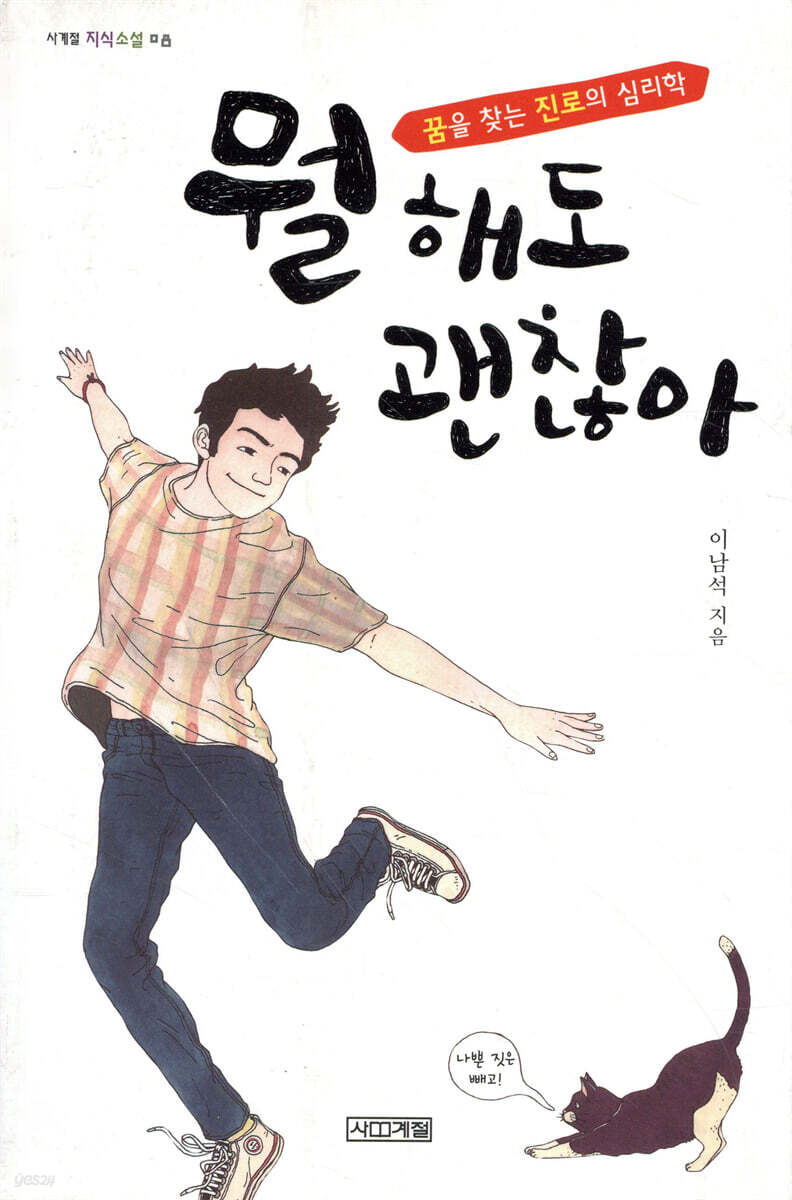
Whatever you do is okay
 |
Description
Book Introduction
This book is for young people who are struggling to find their career path and talks about the happiness of achieving their dreams and the courage and strength to find them.
Unlike existing career guidance books, it guides young people to become the protagonists of their own lives and find their dreams.
This book, written in the format of a knowledge novel designed to encourage young readers to reflect on themselves, vividly depicts the plight of today's youth and the wounds they endure, while also incorporating psychological principles and wisdom to help them overcome them.
As we watch the protagonist change from a helpless state to achieve something, we develop an eye for self-understanding and take big steps toward finding our dreams.
In addition, it is designed to help you find your career path by indirectly experiencing the story of the main character in the novel, which includes using aptitude tests, reading biographies correctly, changing jobs and planning your career path, and the secret to planning your career path.
Additionally, the book's special section, "Stepping Stones of Thought," contains useful information for determining the direction of career development.
Unlike existing career guidance books, it guides young people to become the protagonists of their own lives and find their dreams.
This book, written in the format of a knowledge novel designed to encourage young readers to reflect on themselves, vividly depicts the plight of today's youth and the wounds they endure, while also incorporating psychological principles and wisdom to help them overcome them.
As we watch the protagonist change from a helpless state to achieve something, we develop an eye for self-understanding and take big steps toward finding our dreams.
In addition, it is designed to help you find your career path by indirectly experiencing the story of the main character in the novel, which includes using aptitude tests, reading biographies correctly, changing jobs and planning your career path, and the secret to planning your career path.
Additionally, the book's special section, "Stepping Stones of Thought," contains useful information for determining the direction of career development.
- You can preview some of the book's contents.
Preview
index
1.
You are my destiny - moving forward on your own two feet
2.
What Can I Do for a Living? - Making the Most of Aptitude Tests
3.
Reunion or First Encounter - A Crucial Moment for Success?
4.
Seesaw Game - Reading the Biographies Correctly
5.
Four Types - Career Change and Career Planning
6.
Is success the mother of failure?
7.
Exploration - The Secret to Career Planning
8.
Festival - Career and Occupation
Author's Note
References
You are my destiny - moving forward on your own two feet
2.
What Can I Do for a Living? - Making the Most of Aptitude Tests
3.
Reunion or First Encounter - A Crucial Moment for Success?
4.
Seesaw Game - Reading the Biographies Correctly
5.
Four Types - Career Change and Career Planning
6.
Is success the mother of failure?
7.
Exploration - The Secret to Career Planning
8.
Festival - Career and Occupation
Author's Note
References
Into the book
"How can I earn enough money to live without worry? Would a middle-class annual salary of 60 million won be enough? But how can I make money? Should I start a business? To start a business, you need capital, right? And to have capital, you need your parents' wealth. We don't have much money at home. If I don't have money, wouldn't a brilliant business idea that can attract investment be a good idea? How do I come up with such an idea? If I go to a good university like my mom wants, will I really make a lot of money?"
The questions kept coming, but no answers were forthcoming.
(……)
'Oh, it's pathetic to think about what I'll do to make a living.
Why do I live like this?'
Taeseop suddenly got scared.
I wasn't particularly good at studying and I didn't have any other interests.
But when I imagined going down a path other than studying, I felt dizzy, as if I were looking down a cliff.
-- pp.31-32
There may be several problems with immediately thinking about your career path after looking at the results of a career aptitude test.
First, the test was created by considering the ideal abilities required for the original job rather than considering the evaluation criteria of those who select talent in reality.
So there are some aspects that don't fit with reality.
Second, because the occupational group classification reflects the situation in the 1960s when aptitude tests were becoming established, there are bound to be many parts that do not match today.
In today's world, where information technology and globalization have changed so much, it's difficult to say that the tests developed 50 years ago are still valid.
Third, abilities are not fixed but changeable.
There are many people who initially lacked the ability, but through persistent challenge, they were able to acquire the ability they wanted.
The questions kept coming, but no answers were forthcoming.
(……)
'Oh, it's pathetic to think about what I'll do to make a living.
Why do I live like this?'
Taeseop suddenly got scared.
I wasn't particularly good at studying and I didn't have any other interests.
But when I imagined going down a path other than studying, I felt dizzy, as if I were looking down a cliff.
-- pp.31-32
There may be several problems with immediately thinking about your career path after looking at the results of a career aptitude test.
First, the test was created by considering the ideal abilities required for the original job rather than considering the evaluation criteria of those who select talent in reality.
So there are some aspects that don't fit with reality.
Second, because the occupational group classification reflects the situation in the 1960s when aptitude tests were becoming established, there are bound to be many parts that do not match today.
In today's world, where information technology and globalization have changed so much, it's difficult to say that the tests developed 50 years ago are still valid.
Third, abilities are not fixed but changeable.
There are many people who initially lacked the ability, but through persistent challenge, they were able to acquire the ability they wanted.
--- p.46
Publisher's Review
A book that helps young people who feel helpless in the face of career problems find their own dreams.
Career path is the number one concern for young people.
That's why there are already many books that guide career paths.
However, existing books usually assume that success can be achieved by running faster than others to occupy a limited space.
And they see parents investing a lot of time and money into guiding their children, rather than guiding them to find their own dreams.
It simply urges us to run according to the designs of adults who have experienced the world first.
These books not only discourage young people from thinking about a worthwhile life, but also instill a passive attitude in them, making them more susceptible to the world.
Additionally, the job guides that have been pouring out recently also have limitations.
They are replacing career guidance with job placement.
However, no matter how much information there is about careers, it will be of no help if young people do not think about their own dreams and career paths.
Unlike existing career guidance books, "It's Okay to Do Anything" guides young people to become the protagonists of their own lives and find their dreams.
Provide the right approach to career path
They say that young people these days have no dreams.
There's nothing in particular that I want to do or become.
Adults look at such teenagers and scold them, saying, “Kids these days don’t have dreams.”
But isn't it only natural that young people, in the current climate, are struggling to find their dreams? They're locked into a tight college entrance exam schedule, preventing them from spreading their wings.
Maybe it's the adults who tie their wings and nag them, asking why they can't fly towards their dreams.
Moreover, there is no proper career education, and adults are too busy worrying about their own career paths to provide any useful help.
To break out of this situation, we need to encourage young people to take an active role in their lives and have diverse experiences.
In the process, young people can test their potential and find their dreams.
On the other hand, some people think that if they do well in college, they will be fine.
But even if you go to a so-called good university, problems still remain.
There are many cases where people are pushed around without a clear path.
Sometimes, just to make money, we end up going in a direction that is far from a happy life.
That's why.
We cannot help but think about what true success and happiness are, what our career outlook should be like, and what attitude we need to have to pursue our dreams.
This book starts from this perspective and aims to provide fundamental help to young people in their career concerns.
A compelling story tailored to the needs of today's youth
This book is written in the form of a knowledge novel to encourage young readers to reflect on themselves.
Even though the protagonist Taeseop resolves to study hard, it only lasts for three days, and even when he tries to do something other than studying, it is not easy.
I have no idea what I like and am good at, or what I will do to make a living in the future.
There is no progress in thinking about career path.
As a result, I end up developing an attitude of just killing time as it passes.
Fortunately, Taeseop has a teacher who helps him grow.
The librarian reads Taeseop's struggling mind and recommends a book.
It's Lincoln Electric.
Taeseop is surprised when he reads the book.
Because he was so different from the Lincoln he knew.
The book was written in the first person, showing Lincoln wavering and unsure of his path.
Lincoln struggled with numerous failures and frustrations.
Yet Lincoln continued to challenge.
Taeseop sees that and has doubts.
'How did Lincoln keep trying and ultimately succeed despite so many failures?' Tae-seop is faced with a new and unfamiliar question, one he's never faced before, thanks to his librarian and the Lincoln biography.
Taeseop grows through the process of contemplation, and there is a reason why this book shows this process.
Today's youth are under a lot of pressure to follow the expectations and perspectives of those around them.
So, we get frustrated and dwell on small failures.
Eventually, they become so afraid of failure that they stop trying anything.
Author Lee Nam-seok understands these situations and the psychology of young people and imparts wisdom to help them spread their wings.
Taking full advantage of the author's background as a psychology major
The process of finding and achieving a dream is enjoyable in itself.
People who only look at the results will quickly become tired.
If today's youth, who are inevitably immersed in performance-based pay, learned how to achieve their dreams happily and tirelessly, they would be able to adopt a different attitude.
This book draws heavily on the author's experience as a psychology major and counselor of adolescents.
In other words, it impressively depicts the situation of today's youth and the wounds they suffer, and it well incorporates the principles and wisdom of psychology to help them overcome them.
Thanks to this, young readers can relate to the story and turn the pages quickly. As they watch the protagonist change from a helpless state to achieve something, they develop an eye for self-understanding and take a big step closer to finding their dreams.
That is why the subtitle of this book is 'The Psychology of Finding Your Dream Path'.
From reflections on career, happiness, and success to practical advice.
Taeseop attends a lecture on career paths at school and begins to seriously think about career paths, happiness, and success.
The instructor says that 'doing what you love is success' and that if you really want to be happy, don't follow what others envy, but find your own happiness.
The instructor also provides guidance on how to find out what students like to do if they don't know what they like.
The career path special lectures in the novel are a highlight of this book and will be of great help to young readers in establishing their own opinions regarding career paths.
After hearing the lecture, Taeseop gains courage and begins to pursue various activities and discovers many things he enjoys.
In the process, Taeseop discovers strengths he didn't know he had and finds confidence.
This book provides essential, practical help to young people who need to discover themselves, such as how to bring out strengths they didn't know they had and how to make their dreams bigger.
Revealing that fostering diverse possibilities is the core of career guidance
This book's special section, "The Stepping Stones of Thought," also contains useful information for determining the direction of career development.
How to properly utilize aptitude tests, the report of the 21st Century Education Council in the United States and examples of career transitions, what to watch out for when imitating role models, and how to organize clues about your own career path are all worth listening to.
Adolescence is a time when many possibilities rapidly grow.
That's why I have to encourage you to try this and that.
That way, the things you want to do and like will increase, and your dreams will grow bigger.
Your abilities in the things you want to do well with him will also grow rapidly.
Adolescence is not a process toward some end, and it is certainly not a time to risk unhappiness for the sake of the future.
The time when you have a dream should be a happy time, and the process of making that dream come true should be a happy time.
I recommend this book to young people who are curious about what they like and where their potential lies.
By the time you close the book, you will see a dream growing in your heart.
Career path is the number one concern for young people.
That's why there are already many books that guide career paths.
However, existing books usually assume that success can be achieved by running faster than others to occupy a limited space.
And they see parents investing a lot of time and money into guiding their children, rather than guiding them to find their own dreams.
It simply urges us to run according to the designs of adults who have experienced the world first.
These books not only discourage young people from thinking about a worthwhile life, but also instill a passive attitude in them, making them more susceptible to the world.
Additionally, the job guides that have been pouring out recently also have limitations.
They are replacing career guidance with job placement.
However, no matter how much information there is about careers, it will be of no help if young people do not think about their own dreams and career paths.
Unlike existing career guidance books, "It's Okay to Do Anything" guides young people to become the protagonists of their own lives and find their dreams.
Provide the right approach to career path
They say that young people these days have no dreams.
There's nothing in particular that I want to do or become.
Adults look at such teenagers and scold them, saying, “Kids these days don’t have dreams.”
But isn't it only natural that young people, in the current climate, are struggling to find their dreams? They're locked into a tight college entrance exam schedule, preventing them from spreading their wings.
Maybe it's the adults who tie their wings and nag them, asking why they can't fly towards their dreams.
Moreover, there is no proper career education, and adults are too busy worrying about their own career paths to provide any useful help.
To break out of this situation, we need to encourage young people to take an active role in their lives and have diverse experiences.
In the process, young people can test their potential and find their dreams.
On the other hand, some people think that if they do well in college, they will be fine.
But even if you go to a so-called good university, problems still remain.
There are many cases where people are pushed around without a clear path.
Sometimes, just to make money, we end up going in a direction that is far from a happy life.
That's why.
We cannot help but think about what true success and happiness are, what our career outlook should be like, and what attitude we need to have to pursue our dreams.
This book starts from this perspective and aims to provide fundamental help to young people in their career concerns.
A compelling story tailored to the needs of today's youth
This book is written in the form of a knowledge novel to encourage young readers to reflect on themselves.
Even though the protagonist Taeseop resolves to study hard, it only lasts for three days, and even when he tries to do something other than studying, it is not easy.
I have no idea what I like and am good at, or what I will do to make a living in the future.
There is no progress in thinking about career path.
As a result, I end up developing an attitude of just killing time as it passes.
Fortunately, Taeseop has a teacher who helps him grow.
The librarian reads Taeseop's struggling mind and recommends a book.
It's Lincoln Electric.
Taeseop is surprised when he reads the book.
Because he was so different from the Lincoln he knew.
The book was written in the first person, showing Lincoln wavering and unsure of his path.
Lincoln struggled with numerous failures and frustrations.
Yet Lincoln continued to challenge.
Taeseop sees that and has doubts.
'How did Lincoln keep trying and ultimately succeed despite so many failures?' Tae-seop is faced with a new and unfamiliar question, one he's never faced before, thanks to his librarian and the Lincoln biography.
Taeseop grows through the process of contemplation, and there is a reason why this book shows this process.
Today's youth are under a lot of pressure to follow the expectations and perspectives of those around them.
So, we get frustrated and dwell on small failures.
Eventually, they become so afraid of failure that they stop trying anything.
Author Lee Nam-seok understands these situations and the psychology of young people and imparts wisdom to help them spread their wings.
Taking full advantage of the author's background as a psychology major
The process of finding and achieving a dream is enjoyable in itself.
People who only look at the results will quickly become tired.
If today's youth, who are inevitably immersed in performance-based pay, learned how to achieve their dreams happily and tirelessly, they would be able to adopt a different attitude.
This book draws heavily on the author's experience as a psychology major and counselor of adolescents.
In other words, it impressively depicts the situation of today's youth and the wounds they suffer, and it well incorporates the principles and wisdom of psychology to help them overcome them.
Thanks to this, young readers can relate to the story and turn the pages quickly. As they watch the protagonist change from a helpless state to achieve something, they develop an eye for self-understanding and take a big step closer to finding their dreams.
That is why the subtitle of this book is 'The Psychology of Finding Your Dream Path'.
From reflections on career, happiness, and success to practical advice.
Taeseop attends a lecture on career paths at school and begins to seriously think about career paths, happiness, and success.
The instructor says that 'doing what you love is success' and that if you really want to be happy, don't follow what others envy, but find your own happiness.
The instructor also provides guidance on how to find out what students like to do if they don't know what they like.
The career path special lectures in the novel are a highlight of this book and will be of great help to young readers in establishing their own opinions regarding career paths.
After hearing the lecture, Taeseop gains courage and begins to pursue various activities and discovers many things he enjoys.
In the process, Taeseop discovers strengths he didn't know he had and finds confidence.
This book provides essential, practical help to young people who need to discover themselves, such as how to bring out strengths they didn't know they had and how to make their dreams bigger.
Revealing that fostering diverse possibilities is the core of career guidance
This book's special section, "The Stepping Stones of Thought," also contains useful information for determining the direction of career development.
How to properly utilize aptitude tests, the report of the 21st Century Education Council in the United States and examples of career transitions, what to watch out for when imitating role models, and how to organize clues about your own career path are all worth listening to.
Adolescence is a time when many possibilities rapidly grow.
That's why I have to encourage you to try this and that.
That way, the things you want to do and like will increase, and your dreams will grow bigger.
Your abilities in the things you want to do well with him will also grow rapidly.
Adolescence is not a process toward some end, and it is certainly not a time to risk unhappiness for the sake of the future.
The time when you have a dream should be a happy time, and the process of making that dream come true should be a happy time.
I recommend this book to young people who are curious about what they like and where their potential lies.
By the time you close the book, you will see a dream growing in your heart.
GOODS SPECIFICS
- Date of publication: October 15, 2012
- Page count, weight, size: 224 pages | 300g | 146*220*20mm
- ISBN13: 9788958286400
- ISBN10: 8958286407
You may also like
카테고리
korean


korean

![GQ KOREA Mark (Monthly): December [2025]](http://librairie.coreenne.fr/cdn/shop/files/8ef265dbbfbf186523ed75ba7319009d.jpg?v=1765340328&width=3840)


