

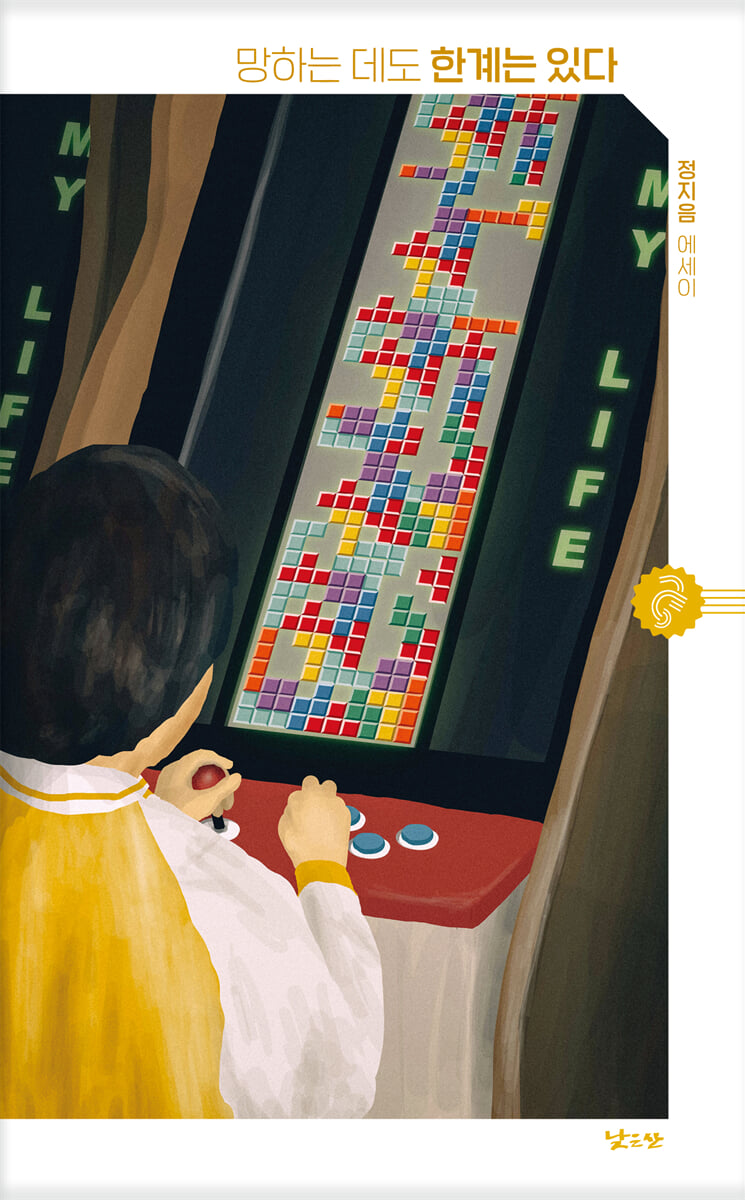
There is a limit to ruin
 |
Description
Book Introduction
The sixth solo book by author Jeong Ji-eum, renowned for her chewy writing style, and the seventh book in the youth essay series, “There is a limit to failure,” has been published.
The pages turn quickly as the unpredictable, unpredictable episodes absorb your mind with their mysterious allure.
The fifteen essays by the author, who writes on his cell phone while lying down or rolling around because he cannot sit down in front of the computer, are read like udon noodles.
Each article is not long, but the aftertaste is never short.
The author's uninhibited dialogue, a culmination of joys and sorrows, leaves a vivid, vivid afterimage in the reader's mind. As they embark on this journey to uncover the origins of ADHD, readers will encounter words like happiness, love, and normalcy in a new light, and discover unexpected utility in words like failure, hate, and abnormality.
The pages turn quickly as the unpredictable, unpredictable episodes absorb your mind with their mysterious allure.
The fifteen essays by the author, who writes on his cell phone while lying down or rolling around because he cannot sit down in front of the computer, are read like udon noodles.
Each article is not long, but the aftertaste is never short.
The author's uninhibited dialogue, a culmination of joys and sorrows, leaves a vivid, vivid afterimage in the reader's mind. As they embark on this journey to uncover the origins of ADHD, readers will encounter words like happiness, love, and normalcy in a new light, and discover unexpected utility in words like failure, hate, and abnormality.
- You can preview some of the book's contents.
Preview
index
True Master Kim Daegam
I have superpowers
I am my friend
I became an adult obsessed with money.
A pack of dogs in my head
Solitary farts and fragrant clouds
A Ugly Person's Ugly Lyrics Diary
Emergency exit found in a book
Mother's wet towel
I wish I was close with my dad
Everyone hates you
Chronicles of Loss
My Ugly and Beautiful Failures
Counseling for worries that no one asked about
To Jeong Ji-eum, who is in her twenties
I have superpowers
I am my friend
I became an adult obsessed with money.
A pack of dogs in my head
Solitary farts and fragrant clouds
A Ugly Person's Ugly Lyrics Diary
Emergency exit found in a book
Mother's wet towel
I wish I was close with my dad
Everyone hates you
Chronicles of Loss
My Ugly and Beautiful Failures
Counseling for worries that no one asked about
To Jeong Ji-eum, who is in her twenties
Detailed image
Into the book
The letter of reflection, which started out as a heartbreaking appeal, gradually turned into a piece of writing full of laughter, tears, anger, and chaos, as if written by someone with multiple personalities.
In my view, that reflection paper was a clear waste of paper.
Because it was too much of a stretch and ultimately not a reflection.
But Mr. Kim did not get angry.
What was even stranger was her reaction to the monkey's writings.
“Wow, you can become a writer later.
“This is no joke, man.”
--- From the text “True Master Kim Dae-gam”
That's when I first came to the conclusion that there must be a 'pack of dogs' in my head.
Since there was no way 'I' would have said such bad things, it was seen as 'a dog' saying them.
Words were never water, but they could change shape like water.
By changing one consonant from 'ㄴ' to 'ㄱ', the responsibility for the slip of the tongue has changed.
--- From the text "I have superpowers"
“Why have you become so sensitive since we last met? The way you speak is a bit… like a suspicious old man.”
I'm not an auntie, I'm an uncle. I always wanted to be more mature, but I didn't want to be a sleazy uncle.
It was only then that I began to feel that something was seriously wrong.
I was becoming more and more unnatural.
I finally realized the blind spot in the approach I was pursuing.
For some reason, I considered 'thoughts' to be the currency of the spiritual world.
Because I perceived money as a precious commodity, I felt a compulsion to constantly collect and accumulate thoughts.
--- From the text “Solitary Fart and Fragrant Cloud”
Of course, life didn't change with just one book.
But what was important was not the miracle that changed everything in an instant, but the 'positive doubt' that finally sprouted.
As I went through books about happiness, the perfection of unhappiness that I had been feeding myself while locked in my room would be shattered.
--- From the text "Emergency Exits Found in Books"
To be honest, I liked books that made me feel ashamed.
Other media often just throw away shame and stand out, but books always take responsibility.
The book did not ignore the confusion presented in the introduction, but guided the reader through the prescribed process to the solution.
So, even if you feel ashamed or defeated in the beginning, don't be embarrassed.
Rather, I was just curious about what would come out next.
--- From the text “Mother’s Wet Towel”
“I really can’t live because of you!”
Whenever they were embarrassed, like in a scene from a drama, I felt like a viewer of my own case.
Although I felt sorry and embarrassed, even as a child I believed in the two-way nature of relationships.
'If my parents raised me, then I also raise my parents.
The theory was, 'If I want to become strong, they have to become strong too.'
I heard later that my parents never wanted me to be strong.
--- From the text "It's Good to Be Close to Dad"
Then one day, I decided to try a new approach.
Going beyond suppressing or observing emotions, it was about becoming friends with them.
When anxiety comes, say, “Hello, anxiety.
“You’re back again,” he said as a greeting.
When I felt sad, I said, “Sad, why did you come so early today?”
Strangely enough, when we welcomed emotions as guests, their power became significantly weaker.
In my view, that reflection paper was a clear waste of paper.
Because it was too much of a stretch and ultimately not a reflection.
But Mr. Kim did not get angry.
What was even stranger was her reaction to the monkey's writings.
“Wow, you can become a writer later.
“This is no joke, man.”
--- From the text “True Master Kim Dae-gam”
That's when I first came to the conclusion that there must be a 'pack of dogs' in my head.
Since there was no way 'I' would have said such bad things, it was seen as 'a dog' saying them.
Words were never water, but they could change shape like water.
By changing one consonant from 'ㄴ' to 'ㄱ', the responsibility for the slip of the tongue has changed.
--- From the text "I have superpowers"
“Why have you become so sensitive since we last met? The way you speak is a bit… like a suspicious old man.”
I'm not an auntie, I'm an uncle. I always wanted to be more mature, but I didn't want to be a sleazy uncle.
It was only then that I began to feel that something was seriously wrong.
I was becoming more and more unnatural.
I finally realized the blind spot in the approach I was pursuing.
For some reason, I considered 'thoughts' to be the currency of the spiritual world.
Because I perceived money as a precious commodity, I felt a compulsion to constantly collect and accumulate thoughts.
--- From the text “Solitary Fart and Fragrant Cloud”
Of course, life didn't change with just one book.
But what was important was not the miracle that changed everything in an instant, but the 'positive doubt' that finally sprouted.
As I went through books about happiness, the perfection of unhappiness that I had been feeding myself while locked in my room would be shattered.
--- From the text "Emergency Exits Found in Books"
To be honest, I liked books that made me feel ashamed.
Other media often just throw away shame and stand out, but books always take responsibility.
The book did not ignore the confusion presented in the introduction, but guided the reader through the prescribed process to the solution.
So, even if you feel ashamed or defeated in the beginning, don't be embarrassed.
Rather, I was just curious about what would come out next.
--- From the text “Mother’s Wet Towel”
“I really can’t live because of you!”
Whenever they were embarrassed, like in a scene from a drama, I felt like a viewer of my own case.
Although I felt sorry and embarrassed, even as a child I believed in the two-way nature of relationships.
'If my parents raised me, then I also raise my parents.
The theory was, 'If I want to become strong, they have to become strong too.'
I heard later that my parents never wanted me to be strong.
--- From the text "It's Good to Be Close to Dad"
Then one day, I decided to try a new approach.
Going beyond suppressing or observing emotions, it was about becoming friends with them.
When anxiety comes, say, “Hello, anxiety.
“You’re back again,” he said as a greeting.
When I felt sad, I said, “Sad, why did you come so early today?”
Strangely enough, when we welcomed emotions as guests, their power became significantly weaker.
--- From the text "Everyone Hates You"
Publisher's Review
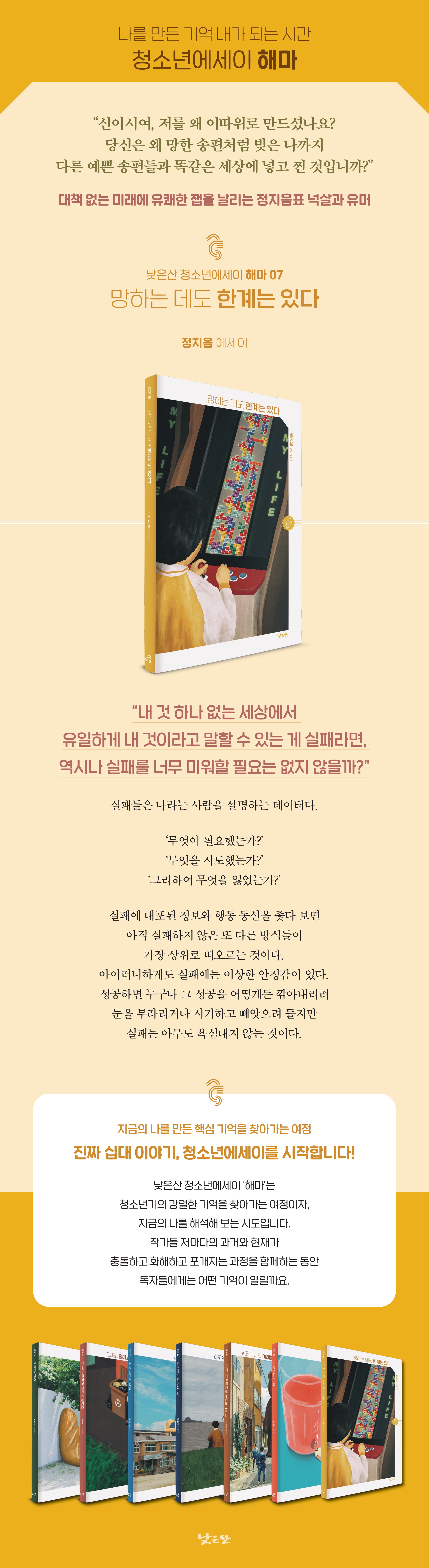
“God, why did you make me like this?
Why are you like me, who is like a ruined songpyeon?
“Is it just steamed in the same world as other pretty songpyeon?”
A playful jab at a future without solutions, with a playful, humorous, and still note.
“There are limits to how much I can save myself,
“There is a limit to how much you can ruin”
A synopsis of joys and sorrows unfolded through uninhibited speech
Author Jeong Ji-eum has already written about ADHD in her first book, the Brunch Book Award-winning “The Sadness of Young ADHD,” but like many adult ADHD patients, the “signs” had already started a long time ago.
The author realizes that during his childhood and adolescence, he was “feeling sorry for the ‘stories’ that had not yet been discovered,” and traces the “pack of dogs in his head” that had been tearing at his life.
My childhood, when I often heard extremely conflicting evaluations like “you’re smart or stupid, kind or bad, gentle or cruel,” my adolescence when my parents were constantly called to school because of my aggressive speech, and even my college entrance exam interview where I was kicked out after repeating only the four words “what?” because I couldn’t hear the question… “Memories I wanted to deny” were embedded throughout my past.
In episodes that are, at face value, incredibly bleak, the author alternates between the cool-headed judge and the passionate lawyer, meticulously categorizing what is a “problem” and what is a “toxic growth accelerant.”
Each article is not long, but the aftertaste is never short.
The story of joy, sorrow, and pleasure unfolds through the unstoppable wit, leaving a vivid afterimage in the reader's mind.
The story about “failure” at the end of this book contains insights that only someone who has experienced failure to the point where “repeated failures acquire a sense of routine” can discover.
“As the year draws to a close, I look back on the big and small failures of the year and think that at least those are truly mine.
Ironically, there is a strange sense of security in failure.
When someone succeeds, everyone tries to belittle that success, become jealous, or try to steal it away, but when someone fails, no one wants to.
“If failure is the only thing I can say is mine in a world where nothing is mine, then I guess there’s no need to hate failure so much, right?”
_ "My Ugly and Beautiful Failures"
Even if there is no hope of turning life around
“I can make my own pottery with ruined dough.”
After being diagnosed with ADHD, the emotion that tormented the writer until the very end, after going through anger, resentment, and self-loathing, was 'betrayal.'
Although things are currently “like this, like this” and there are no signs of things getting better, for the writer who had “the belief that life would turn around someday,” the ADHD diagnosis was like “a declaration that such glory would never come.”
I read all kinds of stories about people who had already been through X and got better, consciously filled my head with thoughts, and even started taking medication to wake up my brain, but “all the methods and costs were surprisingly useless.”
Recalling the shock he felt when a friend in middle school made the bombshell, “Everyone hates you!”, the author confesses, “I felt like I was shattered and invisible in an instant.”
But in the process of revisiting that event, we realize that “human relationships themselves are part of a dynamic that is repeated in vain.”
“In the end, neither the promise to love someone forever nor the resolution to hate them could be kept.
After realizing the nature of emotions, even the phrase "everyone hates you" seemed ridiculous.
How could everyone hate me? In this hectic modern society, if someone were to hate me with a perpetual, boiling heat, it would be more appropriate to call it love."
_ "Everyone hates you"
The author decides to create his own life with his own 'abnormality'.
Instead of thinking of happiness as “the highest point on a graph,” define it as “no thoughts or thoughts,” “a feeling of fullness,” or “nothing to do,” and enjoy small happinesses in your daily life often. Instead of taking those who criticize you on your side, “start practicing friendship with yourself,” and realize that “there are people in the world who understand me and people who don’t.”
And you learn the truth that “all of it is natural.”
“Winning out of the desire to beat others,
That is the only victory"
The horizon that opens after honest self-confrontation
Although it may seem like it is filled with a cheerful style and optimistic humor, Jeong Ji-eum's writing is always filled with a frighteningly honest self-confrontation.
This is also an essential element of a good essay.
There is a horizon that opens only through the process of transparently facing one's own flaws, and surprisingly, writer Jeong Ji-eum steps into it every time.
Moreover, readers experience catharsis, liberation from emotions such as shame, self-loathing, and unhappiness.
As the author hopes, this book will be one of those “temporary comforts that come whenever times are tough” for those who are “hated without reason, always at the bottom of the class, fooled for no reason, have lost something precious, and constantly fail.”
“Winning out of the desire to beat others is the only victory.
If you want to be happy, I hope you develop the habit of seeing your life's battles with only you.
Only then can I enjoy a life where I always lose… … .”
_ "To Jeong Ji-eum, who is in her twenties"
Why are you like me, who is like a ruined songpyeon?
“Is it just steamed in the same world as other pretty songpyeon?”
A playful jab at a future without solutions, with a playful, humorous, and still note.
“There are limits to how much I can save myself,
“There is a limit to how much you can ruin”
A synopsis of joys and sorrows unfolded through uninhibited speech
Author Jeong Ji-eum has already written about ADHD in her first book, the Brunch Book Award-winning “The Sadness of Young ADHD,” but like many adult ADHD patients, the “signs” had already started a long time ago.
The author realizes that during his childhood and adolescence, he was “feeling sorry for the ‘stories’ that had not yet been discovered,” and traces the “pack of dogs in his head” that had been tearing at his life.
My childhood, when I often heard extremely conflicting evaluations like “you’re smart or stupid, kind or bad, gentle or cruel,” my adolescence when my parents were constantly called to school because of my aggressive speech, and even my college entrance exam interview where I was kicked out after repeating only the four words “what?” because I couldn’t hear the question… “Memories I wanted to deny” were embedded throughout my past.
In episodes that are, at face value, incredibly bleak, the author alternates between the cool-headed judge and the passionate lawyer, meticulously categorizing what is a “problem” and what is a “toxic growth accelerant.”
Each article is not long, but the aftertaste is never short.
The story of joy, sorrow, and pleasure unfolds through the unstoppable wit, leaving a vivid afterimage in the reader's mind.
The story about “failure” at the end of this book contains insights that only someone who has experienced failure to the point where “repeated failures acquire a sense of routine” can discover.
“As the year draws to a close, I look back on the big and small failures of the year and think that at least those are truly mine.
Ironically, there is a strange sense of security in failure.
When someone succeeds, everyone tries to belittle that success, become jealous, or try to steal it away, but when someone fails, no one wants to.
“If failure is the only thing I can say is mine in a world where nothing is mine, then I guess there’s no need to hate failure so much, right?”
_ "My Ugly and Beautiful Failures"
Even if there is no hope of turning life around
“I can make my own pottery with ruined dough.”
After being diagnosed with ADHD, the emotion that tormented the writer until the very end, after going through anger, resentment, and self-loathing, was 'betrayal.'
Although things are currently “like this, like this” and there are no signs of things getting better, for the writer who had “the belief that life would turn around someday,” the ADHD diagnosis was like “a declaration that such glory would never come.”
I read all kinds of stories about people who had already been through X and got better, consciously filled my head with thoughts, and even started taking medication to wake up my brain, but “all the methods and costs were surprisingly useless.”
Recalling the shock he felt when a friend in middle school made the bombshell, “Everyone hates you!”, the author confesses, “I felt like I was shattered and invisible in an instant.”
But in the process of revisiting that event, we realize that “human relationships themselves are part of a dynamic that is repeated in vain.”
“In the end, neither the promise to love someone forever nor the resolution to hate them could be kept.
After realizing the nature of emotions, even the phrase "everyone hates you" seemed ridiculous.
How could everyone hate me? In this hectic modern society, if someone were to hate me with a perpetual, boiling heat, it would be more appropriate to call it love."
_ "Everyone hates you"
The author decides to create his own life with his own 'abnormality'.
Instead of thinking of happiness as “the highest point on a graph,” define it as “no thoughts or thoughts,” “a feeling of fullness,” or “nothing to do,” and enjoy small happinesses in your daily life often. Instead of taking those who criticize you on your side, “start practicing friendship with yourself,” and realize that “there are people in the world who understand me and people who don’t.”
And you learn the truth that “all of it is natural.”
“Winning out of the desire to beat others,
That is the only victory"
The horizon that opens after honest self-confrontation
Although it may seem like it is filled with a cheerful style and optimistic humor, Jeong Ji-eum's writing is always filled with a frighteningly honest self-confrontation.
This is also an essential element of a good essay.
There is a horizon that opens only through the process of transparently facing one's own flaws, and surprisingly, writer Jeong Ji-eum steps into it every time.
Moreover, readers experience catharsis, liberation from emotions such as shame, self-loathing, and unhappiness.
As the author hopes, this book will be one of those “temporary comforts that come whenever times are tough” for those who are “hated without reason, always at the bottom of the class, fooled for no reason, have lost something precious, and constantly fail.”
“Winning out of the desire to beat others is the only victory.
If you want to be happy, I hope you develop the habit of seeing your life's battles with only you.
Only then can I enjoy a life where I always lose… … .”
_ "To Jeong Ji-eum, who is in her twenties"
GOODS SPECIFICS
- Date of issue: November 28, 2025
- Page count, weight, size: 168 pages | 115*185*20mm
- ISBN13: 9791155251850
You may also like
카테고리
korean


korean

![GQ KOREA Mark (Monthly): December [2025]](http://librairie.coreenne.fr/cdn/shop/files/8ef265dbbfbf186523ed75ba7319009d.jpg?v=1765340328&width=3840)


