

My first classical class
 |
Description
Book Introduction
The 19 Most Frequently Featured Musicians in Textbooks
Talking about their lives and art
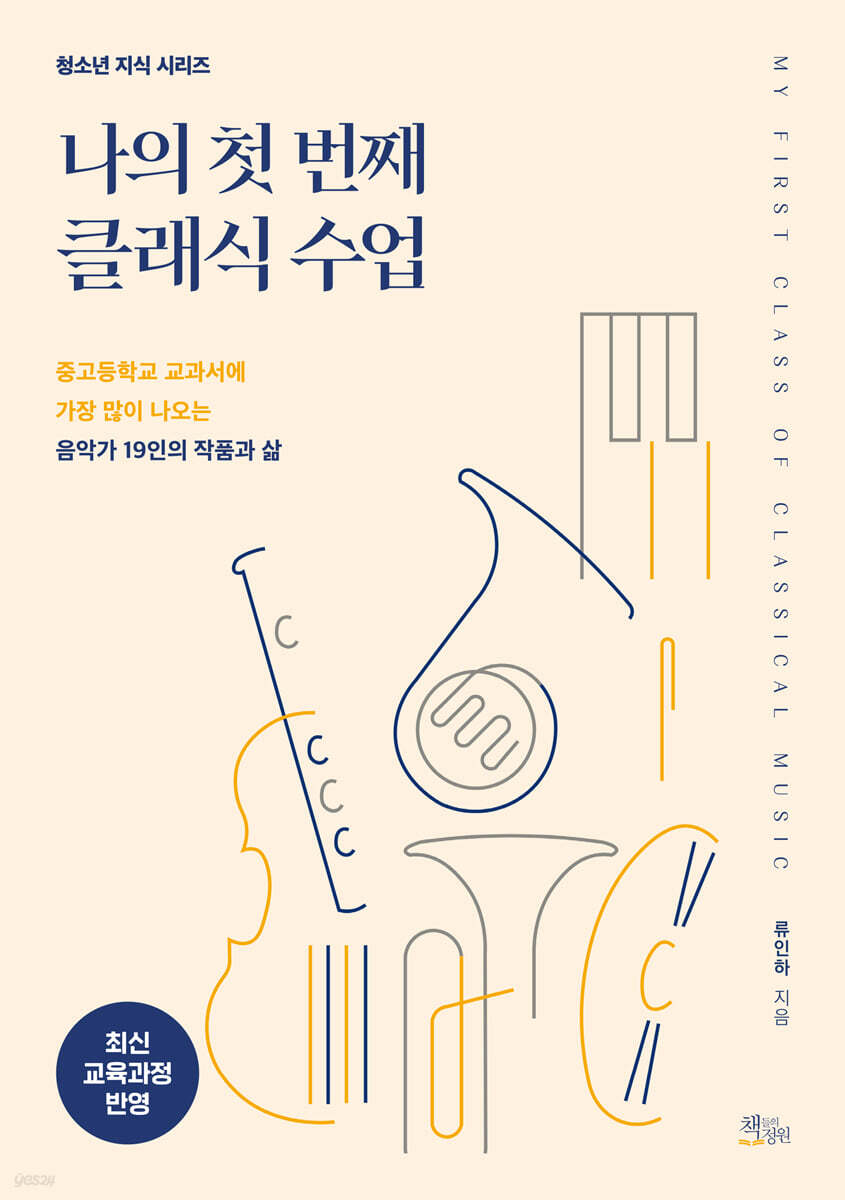
"My First Classical Music Lesson" is a book that tells the stories of the lives and art of 19 musicians who appear most frequently in middle and high school textbooks.
It breaks the stereotype that classical music is boring and difficult, and helps people enjoy it as fun and approachable as K-pop.
It reminds us of the presence of classical music that is embedded in our lives, like Beethoven's "Für Elise" playing when a car is in reverse or Schubert's "The Trout" playing when the washing machine is finished running.
Author Ryu In-ha is credited with popularizing classical music as the operator of "Easy Classic," which ranked first on the podcast charts.
This book also avoids difficult terms or vocabulary as much as possible, and maintains an easy and friendly tone, making it accessible to everyone, from teenagers to adults, who want to get started with classical music.
It introduces representative composers and works of each era, moving from Baroque to Classicism, Romanticism, Nationalism, and Impressionism.
Talking about their lives and art
"My First Classical Music Lesson" is a book that tells the stories of the lives and art of 19 musicians who appear most frequently in middle and high school textbooks.
It breaks the stereotype that classical music is boring and difficult, and helps people enjoy it as fun and approachable as K-pop.
It reminds us of the presence of classical music that is embedded in our lives, like Beethoven's "Für Elise" playing when a car is in reverse or Schubert's "The Trout" playing when the washing machine is finished running.
Author Ryu In-ha is credited with popularizing classical music as the operator of "Easy Classic," which ranked first on the podcast charts.
This book also avoids difficult terms or vocabulary as much as possible, and maintains an easy and friendly tone, making it accessible to everyone, from teenagers to adults, who want to get started with classical music.
It introduces representative composers and works of each era, moving from Baroque to Classicism, Romanticism, Nationalism, and Impressionism.
- You can preview some of the book's contents.
Preview
index
Classical music that is as fun as K-pop
Part 1: The Baroque Era | The Beginnings of Western Classical Music
· Vivaldi: Catholic priest, orchestra conductor
· Handel: The first freelance musician who pursued freedom
· Bach: Was the father of the ‘Father of Music’ also a musician?
Part 2: The Classical Era | The Beauty of Form, with Order and Balance
· Haydn: Perfecting the Classical Style
· Mozart: A genius who improvised at the age of 5
Beethoven: A deaf composer who couldn't even hear applause
Part 3: The Beginning and Heyday of the Romantic Era | Breaking Free from Form, Lyrical and Brilliant
Schubert: A young man who refused to be nagged into having a stable job.
Mendelssohn: A life with talent, looks, popularity, and family
· Schumann: A musician who writes literature, a writer who writes music
· Chopin: Bury my heart in Polish soil
· List: The Devil's Pianist, a true first-generation idol
Brahms: Called Beethoven's successor
Part 4: Late Romanticism and Nationalism | The Winds of the National Movement Blowing Through the Art World
· Wagner: The King of German Opera, Wanted During the Revolution
· Tchaikovsky: A representative figure of Russia along with Tolstoy
· Dvorak: In Search of the Colors of the Slavic People
· Puccini: Master of Italian verismo opera
· Rachmaninoff: Exiled to the United States, but Unforgettable Homeland
Part 5: Impressionism | Express your subjective feelings like Monet's paintings.
· Debussy: Expressing Color and Mood with Sound
· Label: The exquisite craftsman of the jewel that is French music
Part 1: The Baroque Era | The Beginnings of Western Classical Music
· Vivaldi: Catholic priest, orchestra conductor
· Handel: The first freelance musician who pursued freedom
· Bach: Was the father of the ‘Father of Music’ also a musician?
Part 2: The Classical Era | The Beauty of Form, with Order and Balance
· Haydn: Perfecting the Classical Style
· Mozart: A genius who improvised at the age of 5
Beethoven: A deaf composer who couldn't even hear applause
Part 3: The Beginning and Heyday of the Romantic Era | Breaking Free from Form, Lyrical and Brilliant
Schubert: A young man who refused to be nagged into having a stable job.
Mendelssohn: A life with talent, looks, popularity, and family
· Schumann: A musician who writes literature, a writer who writes music
· Chopin: Bury my heart in Polish soil
· List: The Devil's Pianist, a true first-generation idol
Brahms: Called Beethoven's successor
Part 4: Late Romanticism and Nationalism | The Winds of the National Movement Blowing Through the Art World
· Wagner: The King of German Opera, Wanted During the Revolution
· Tchaikovsky: A representative figure of Russia along with Tolstoy
· Dvorak: In Search of the Colors of the Slavic People
· Puccini: Master of Italian verismo opera
· Rachmaninoff: Exiled to the United States, but Unforgettable Homeland
Part 5: Impressionism | Express your subjective feelings like Monet's paintings.
· Debussy: Expressing Color and Mood with Sound
· Label: The exquisite craftsman of the jewel that is French music
Detailed image

Into the book
Even before Handel achieved success with opera, art-loving members of the nobility and royalty had offered him patronage.
Among the offers was one that offered to fund my studies in Italy for several years.
But Handel refused all these offers.
Being exposed to advanced Italian music was a dream come true, and I hated living in poverty, but I felt that accepting sponsorship would be no different from selling my talent to a wealthy employer.
In other words, Handel was the first musician in history to pursue a 'freelance' career.
--- p.23, from the text “Handel: The First Freelance Musician Who Pursued Freedom”
As time passed and Haydn reached puberty and his voice changed, the choir and school forced him to graduate.
Although his parents urged him to become a priest and remain in the church, the 17-year-old Haydn decided against it and pursued his own path.
I decided not to return to my hometown of Lorraine and to survive alone in Vienna with a suitcase containing three old pairs of underwear and one old coat.
Although he was thrown out onto the streets without a penny, Haydn was not lonely thanks to the street friends he hung out with.
His friends lent him money and even gave him a corner of the attic where they lived.
--- p.51, from the text “Haydn: Perfecting the Classical Style”
The Mozarts arrived in Rome and visited the Sistine Chapel in the Vatican.
Among the works of the Vatican composer Allegri, "Miserere" was performed only during Easter week.
Since the publication of the score from the Miserere was strictly forbidden by special order of the Pope, a visit to the Sistine Chapel during Easter week was the only way to hear the piece.
At this time, the 14-year-old Mozart memorized the entire piece after hearing it just once, and when he returned to his lodgings, he transcribed it almost perfectly into sheet music.
And after visiting the second cathedral and listening to the music, I made a few minor corrections and completed the score.
--- p.69, from the text “Mozart: A genius who improvised at the age of 5”
When the symphony "Choral" was performed at the Kärntnertor Theater in Vienna in 1824, Beethoven was already deaf and could not play a role in the performance of his own symphony.
On this day, Beethoven sat next to the conductor, looked at the score, and gave instructions at important parts to ensure that the performance proceeded properly.
When the performance ended, the audience stood and gave Beethoven a rousing round of applause.
But Beethoven, who had lost his hearing, could not hear the cheers of the audience.
At this moment, an alto singer who had been singing in the choir grabbed his sleeve and turned him around, and only then did Beethoven see the audience's excitement.
--- p.89~90, from the text “Beethoven: A deaf composer who couldn’t even hear the sound of applause”
His father recommended teachers' school because he wanted his son to have a stable job and a comfortable life like himself.
Schubert entered a teachers' college for a year to obtain a teaching license, completed a teacher training course, and then worked as an assistant teacher at his father's school for four years until he turned 21.
Because it was a path he had no choice but to choose, he was miserable and lost interest in teaching children.
Instead, when he wasn't doing school work, he devoted himself to composing and completed many songs.
--- p.101~102, from the text “Schubert: A Young Man Who Rejected the Nagging to Get a Stable Job”
At a salon gathering hosted by Liszt, Chopin met and fell in love with the female novelist George Sand.
My first impression of Sand was not good.
She was different from other women of the time, as she enjoyed dressing up as a man and even smoked a pipe.
But as time passed, Chopin was drawn to Sand's intellectual and sensitive side, contrary to his first impression.
This was especially true for Sand's devoted appearance.
She was six years older than Chopin, and while living with him, she took him to the warm Spanish island of Mallorca to recuperate when he developed tuberculosis and took great care of him.
--- p.150~151, from the text “Chopin: Bury my heart in Polish soil”
Tchaikovsky's depression and nervous breakdown worsened with each passing day.
In this context, Tchaikovsky's new Symphony No. 6 'Pathetique' had its first performance in St. Petersburg.
This piece was so heavy and dark that Modest, one of Tchaikovsky's twin brothers, suggested giving it the subtitle "Pathétique" after its first performance.
After the first concert, the audience remained indifferent and unresponsive, neither booing nor cheering.
Tchaikovsky's activities, which had been on the rise, were restricted.
--- p.215, from the text “Tchaikovsky: A figure representing Russia along with Tolstoy”
Four years after Dvořák began working as a viola player in the National Theater Orchestra, Smetana, the leading Czech composer of the time, was appointed as the orchestra's conductor.
Smetana was the founder of Czech national music and had a great influence on Dvorak's later path as a composer.
Smetana was a composer who expressed Czech history, legends, and landscapes through music, and as he played the music of his predecessor in an orchestra, Dvorak also developed the desire to create music for the Czech people.
--- p.221~222, from the text “Dvorak: In Search of the Colors of the Slavic People”
Two years after Puccini's death, his last opera, Turandot, was premiered at Milan's La Scala, conducted by Toscanini, who had maintained a close bond with Puccini during his lifetime.
On this day, Toscanini is said to have played the last scene of Act 3, Scene 1, composed by Puccini, in which Prince Calaf's maid Liu dies, and then said, "Mr. Puccini has finished composing up to this point and passed away," and then put down his baton.
After the first performance, the remaining two scenes of "Turandot" were completed by Puccini's friend and disciple Alfano based on sketches left by Puccini, and the version completed by Alfano is currently being performed on stage.
Among the offers was one that offered to fund my studies in Italy for several years.
But Handel refused all these offers.
Being exposed to advanced Italian music was a dream come true, and I hated living in poverty, but I felt that accepting sponsorship would be no different from selling my talent to a wealthy employer.
In other words, Handel was the first musician in history to pursue a 'freelance' career.
--- p.23, from the text “Handel: The First Freelance Musician Who Pursued Freedom”
As time passed and Haydn reached puberty and his voice changed, the choir and school forced him to graduate.
Although his parents urged him to become a priest and remain in the church, the 17-year-old Haydn decided against it and pursued his own path.
I decided not to return to my hometown of Lorraine and to survive alone in Vienna with a suitcase containing three old pairs of underwear and one old coat.
Although he was thrown out onto the streets without a penny, Haydn was not lonely thanks to the street friends he hung out with.
His friends lent him money and even gave him a corner of the attic where they lived.
--- p.51, from the text “Haydn: Perfecting the Classical Style”
The Mozarts arrived in Rome and visited the Sistine Chapel in the Vatican.
Among the works of the Vatican composer Allegri, "Miserere" was performed only during Easter week.
Since the publication of the score from the Miserere was strictly forbidden by special order of the Pope, a visit to the Sistine Chapel during Easter week was the only way to hear the piece.
At this time, the 14-year-old Mozart memorized the entire piece after hearing it just once, and when he returned to his lodgings, he transcribed it almost perfectly into sheet music.
And after visiting the second cathedral and listening to the music, I made a few minor corrections and completed the score.
--- p.69, from the text “Mozart: A genius who improvised at the age of 5”
When the symphony "Choral" was performed at the Kärntnertor Theater in Vienna in 1824, Beethoven was already deaf and could not play a role in the performance of his own symphony.
On this day, Beethoven sat next to the conductor, looked at the score, and gave instructions at important parts to ensure that the performance proceeded properly.
When the performance ended, the audience stood and gave Beethoven a rousing round of applause.
But Beethoven, who had lost his hearing, could not hear the cheers of the audience.
At this moment, an alto singer who had been singing in the choir grabbed his sleeve and turned him around, and only then did Beethoven see the audience's excitement.
--- p.89~90, from the text “Beethoven: A deaf composer who couldn’t even hear the sound of applause”
His father recommended teachers' school because he wanted his son to have a stable job and a comfortable life like himself.
Schubert entered a teachers' college for a year to obtain a teaching license, completed a teacher training course, and then worked as an assistant teacher at his father's school for four years until he turned 21.
Because it was a path he had no choice but to choose, he was miserable and lost interest in teaching children.
Instead, when he wasn't doing school work, he devoted himself to composing and completed many songs.
--- p.101~102, from the text “Schubert: A Young Man Who Rejected the Nagging to Get a Stable Job”
At a salon gathering hosted by Liszt, Chopin met and fell in love with the female novelist George Sand.
My first impression of Sand was not good.
She was different from other women of the time, as she enjoyed dressing up as a man and even smoked a pipe.
But as time passed, Chopin was drawn to Sand's intellectual and sensitive side, contrary to his first impression.
This was especially true for Sand's devoted appearance.
She was six years older than Chopin, and while living with him, she took him to the warm Spanish island of Mallorca to recuperate when he developed tuberculosis and took great care of him.
--- p.150~151, from the text “Chopin: Bury my heart in Polish soil”
Tchaikovsky's depression and nervous breakdown worsened with each passing day.
In this context, Tchaikovsky's new Symphony No. 6 'Pathetique' had its first performance in St. Petersburg.
This piece was so heavy and dark that Modest, one of Tchaikovsky's twin brothers, suggested giving it the subtitle "Pathétique" after its first performance.
After the first concert, the audience remained indifferent and unresponsive, neither booing nor cheering.
Tchaikovsky's activities, which had been on the rise, were restricted.
--- p.215, from the text “Tchaikovsky: A figure representing Russia along with Tolstoy”
Four years after Dvořák began working as a viola player in the National Theater Orchestra, Smetana, the leading Czech composer of the time, was appointed as the orchestra's conductor.
Smetana was the founder of Czech national music and had a great influence on Dvorak's later path as a composer.
Smetana was a composer who expressed Czech history, legends, and landscapes through music, and as he played the music of his predecessor in an orchestra, Dvorak also developed the desire to create music for the Czech people.
--- p.221~222, from the text “Dvorak: In Search of the Colors of the Slavic People”
Two years after Puccini's death, his last opera, Turandot, was premiered at Milan's La Scala, conducted by Toscanini, who had maintained a close bond with Puccini during his lifetime.
On this day, Toscanini is said to have played the last scene of Act 3, Scene 1, composed by Puccini, in which Prince Calaf's maid Liu dies, and then said, "Mr. Puccini has finished composing up to this point and passed away," and then put down his baton.
After the first performance, the remaining two scenes of "Turandot" were completed by Puccini's friend and disciple Alfano based on sketches left by Puccini, and the version completed by Alfano is currently being performed on stage.
--- p.239~240, from the text “Puccini: Master of Italian Verismo Opera”
Publisher's Review
Handel, who refused casting from major agencies and remained an indie act.
A list of first-generation idols that fandoms chased after.
Enjoy classics with a new perspective
When you think of first-generation idols, who comes to mind? HOT or G.O.D? Or maybe Fire Truck, the forefathers of dance groups? The true first idol is someone else.
This is Liszt, who was the most popular musician in 19th century Europe.
Let's take a look at what his fandom has been up to.
Liszt was the most popular musician in Europe at the time.
Many noble ladies who were fascinated by his performances that bordered on acrobatics were his fans.
During the concert, they would fight among themselves, pulling each other's hair to get hold of the cigar butts, broken strings, and gloves that Liszt had thrown away during the performance. After the concert, hundreds of ladies' carriages would line up behind Liszt's carriage as he was going home.
At the time, this list syndrome was called 'Lisztomania', which is also the origin of the word 'Mania', which refers to a fanatic fan today.
Pages 163-164 "List: The Devil's Pianist Who Became a True First-Generation Idol"
Then there's Handel, armed with the 'indie spirit'.
Although numerous royalty and nobles who fell in love with his music came forward as patrons, he declared that he would remain a freelancer, saying, "I don't want to sell my talent to an employer."
Because I hated poverty, but I hated being tied down by capital even more.
However, he enjoyed immense popularity within the British aristocracy, and Handel's fans and anti-fans fought each other to the point of even clashing politically, making him a true legend.
There are also composers who create hook songs with classical music.
Ravel's "Bolero," a familiar piece of music used as insert music in dramas and movies, is experimental music with a structure of one short melody repeated countless times, without any introduction, development, climax, or emotional changes.
When this song was first released to the public, an old man reportedly shouted, "Trash! A piece of crap!"
It's a scene that reminds me of the older generation who listen to hook songs that repeat meaningless lyrics and say, "What kind of song is this?"
Like this, there is an interesting incident hidden behind classical music.
While some are lucky enough to suddenly find themselves in the public eye, others are plunged into scandal, while others struggle through life, plagued by poverty, rumors, or illness.
Just like the entertainment and art world today.
Now, let's throw away our prejudices and listen to classical music with a light heart.
As you follow the story told in “My First Classical Music Lesson,” you will naturally come across your “favorite” classical music.
A list of first-generation idols that fandoms chased after.
Enjoy classics with a new perspective
When you think of first-generation idols, who comes to mind? HOT or G.O.D? Or maybe Fire Truck, the forefathers of dance groups? The true first idol is someone else.
This is Liszt, who was the most popular musician in 19th century Europe.
Let's take a look at what his fandom has been up to.
Liszt was the most popular musician in Europe at the time.
Many noble ladies who were fascinated by his performances that bordered on acrobatics were his fans.
During the concert, they would fight among themselves, pulling each other's hair to get hold of the cigar butts, broken strings, and gloves that Liszt had thrown away during the performance. After the concert, hundreds of ladies' carriages would line up behind Liszt's carriage as he was going home.
At the time, this list syndrome was called 'Lisztomania', which is also the origin of the word 'Mania', which refers to a fanatic fan today.
Pages 163-164 "List: The Devil's Pianist Who Became a True First-Generation Idol"
Then there's Handel, armed with the 'indie spirit'.
Although numerous royalty and nobles who fell in love with his music came forward as patrons, he declared that he would remain a freelancer, saying, "I don't want to sell my talent to an employer."
Because I hated poverty, but I hated being tied down by capital even more.
However, he enjoyed immense popularity within the British aristocracy, and Handel's fans and anti-fans fought each other to the point of even clashing politically, making him a true legend.
There are also composers who create hook songs with classical music.
Ravel's "Bolero," a familiar piece of music used as insert music in dramas and movies, is experimental music with a structure of one short melody repeated countless times, without any introduction, development, climax, or emotional changes.
When this song was first released to the public, an old man reportedly shouted, "Trash! A piece of crap!"
It's a scene that reminds me of the older generation who listen to hook songs that repeat meaningless lyrics and say, "What kind of song is this?"
Like this, there is an interesting incident hidden behind classical music.
While some are lucky enough to suddenly find themselves in the public eye, others are plunged into scandal, while others struggle through life, plagued by poverty, rumors, or illness.
Just like the entertainment and art world today.
Now, let's throw away our prejudices and listen to classical music with a light heart.
As you follow the story told in “My First Classical Music Lesson,” you will naturally come across your “favorite” classical music.
GOODS SPECIFICS
- Date of issue: November 30, 2025
- Page count, weight, size: 284 pages | 397g | 148*210*18mm
- ISBN13: 9791164162628
- ISBN10: 1164162624
You may also like
카테고리
korean


korean

![GQ KOREA Mark (Monthly): December [2025]](http://librairie.coreenne.fr/cdn/shop/files/8ef265dbbfbf186523ed75ba7319009d.jpg?v=1765340328&width=3840)


