

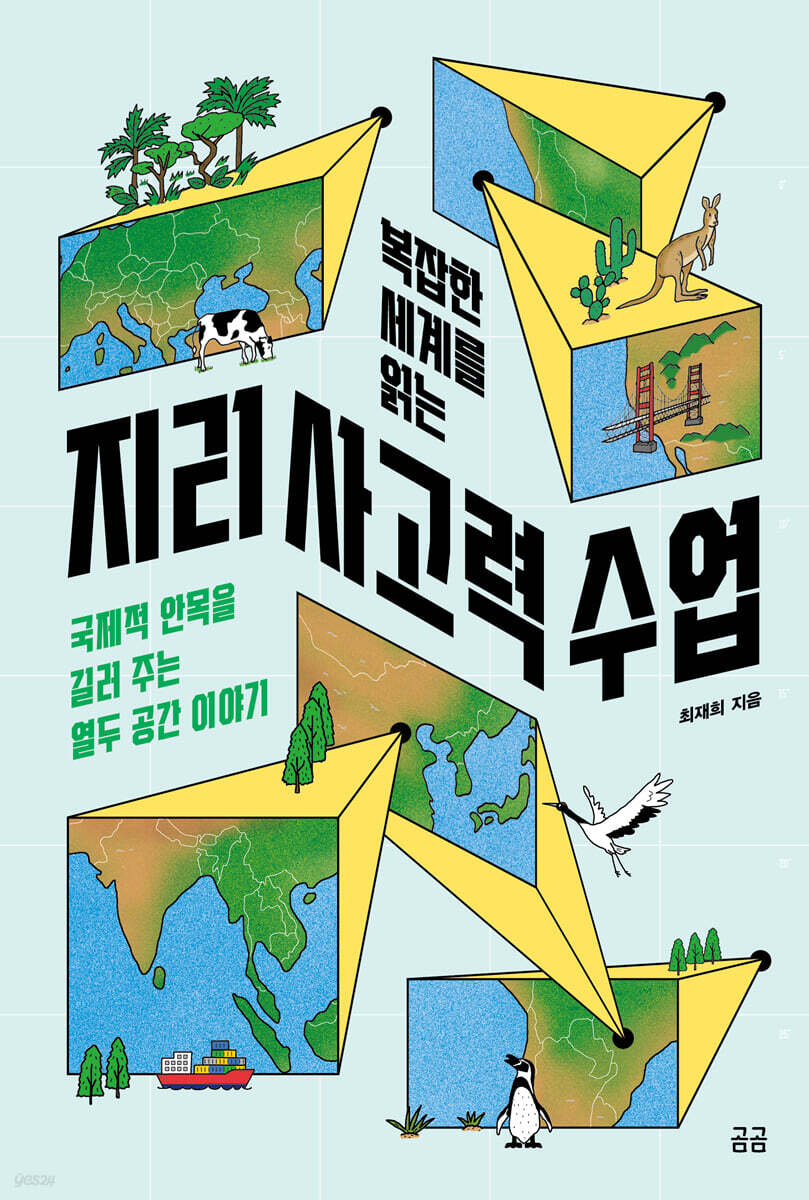
Geography Thinking Class: Reading a Complex World
 |
Description
Book Introduction
A unique geography class that fosters international perspectives
A liberal arts textbook that fosters geographic thinking, a skill essential for global citizens.
"A Geographic Thinking Class for Reading a Complex World" is the new work of author Choi Jae-hee, who has consistently published high-quality general education books that stimulate interest in geography, such as "Geography through Sports" and "Starbucks Geography Travel," and has participated in writing numerous textbooks.
To foster geographical thinking, the author selects twelve historically and geopolitically significant regions across the five oceans and seven continents, meticulously guiding readers through the geography, history, culture, politics, and economy surrounding them.
This fascinating geographic story, centered around unique encounters in the Strait of Malacca, the Caucasus Mountains, and the Bering Strait, naturally leads to important global issues of today such as climate change, ethnic conflict, trade conflict, and refugees, fostering an international perspective.
It also trains you to broaden your thinking by comparing different regions and to view local issues from a global perspective.
'Thinking skills' are one of the core concepts of the 2022 revised curriculum.
Nowadays, the ability to actively and creatively solve problems by utilizing various types of knowledge is more important than knowing a lot.
"Geographic Thinking: A Class for Reading a Complex World" is a geography textbook fit for a new era, teaching students how to wisely use the tool of geography.
Let's solidify the skills needed to become a global citizen with this book!
A liberal arts textbook that fosters geographic thinking, a skill essential for global citizens.
"A Geographic Thinking Class for Reading a Complex World" is the new work of author Choi Jae-hee, who has consistently published high-quality general education books that stimulate interest in geography, such as "Geography through Sports" and "Starbucks Geography Travel," and has participated in writing numerous textbooks.
To foster geographical thinking, the author selects twelve historically and geopolitically significant regions across the five oceans and seven continents, meticulously guiding readers through the geography, history, culture, politics, and economy surrounding them.
This fascinating geographic story, centered around unique encounters in the Strait of Malacca, the Caucasus Mountains, and the Bering Strait, naturally leads to important global issues of today such as climate change, ethnic conflict, trade conflict, and refugees, fostering an international perspective.
It also trains you to broaden your thinking by comparing different regions and to view local issues from a global perspective.
'Thinking skills' are one of the core concepts of the 2022 revised curriculum.
Nowadays, the ability to actively and creatively solve problems by utilizing various types of knowledge is more important than knowing a lot.
"Geographic Thinking: A Class for Reading a Complex World" is a geography textbook fit for a new era, teaching students how to wisely use the tool of geography.
Let's solidify the skills needed to become a global citizen with this book!
- You can preview some of the book's contents.
Preview
index
Introduction: We invite you to a geographic thinking class for global citizens.
Part 1.
Asia-Oceania: From Conflict to Peace
The Demilitarized Zone, a battlefield transformed into a space of life.
- The Tibetan Plateau, a benchmark for climate change
The Strait of Malacca, a sea route coveted by the world
The Great Dividing Mountains, the unexpected charm of resource-rich Australia
Part 2.
Europe and Africa: A Diverse Coexistence
- The Caucasus Mountains, the world's powder keg, containing genetic material
- The Alps, offering diversity and abundance
- The Strait of Gibraltar, the narrowest sea route between continents
- The Sahara Desert and the Sahel, huge continental belts created by climate zones
Part 3.
America, a place of polar opposites
- The Sierra Nevada Mountains overlooking vineyards and Silicon Valley
South America's boundless charm, the secret lies in the Andes Mountains.
- The Panama Canal, the only sea route that cuts through the American continent
- The Bering Strait, where the United States and Russia meet
Image source
Part 1.
Asia-Oceania: From Conflict to Peace
The Demilitarized Zone, a battlefield transformed into a space of life.
- The Tibetan Plateau, a benchmark for climate change
The Strait of Malacca, a sea route coveted by the world
The Great Dividing Mountains, the unexpected charm of resource-rich Australia
Part 2.
Europe and Africa: A Diverse Coexistence
- The Caucasus Mountains, the world's powder keg, containing genetic material
- The Alps, offering diversity and abundance
- The Strait of Gibraltar, the narrowest sea route between continents
- The Sahara Desert and the Sahel, huge continental belts created by climate zones
Part 3.
America, a place of polar opposites
- The Sierra Nevada Mountains overlooking vineyards and Silicon Valley
South America's boundless charm, the secret lies in the Andes Mountains.
- The Panama Canal, the only sea route that cuts through the American continent
- The Bering Strait, where the United States and Russia meet
Image source
Detailed image

Into the book
It is said that people who lack thinking skills know a lot, but do not have their own thoughts.
The same is true if you lack geographical thinking skills.
No matter how much information you have about space, if you lack the power to organize it, it's all for naught.
People with geographical thinking skills are able to grasp the essence of countless spatial information and numerous natural and human phenomena.
There's a strange thrill in discovering that seemingly insignificant geographic units are deeply intertwined with the problems of regions, nations, even continents and the world.
--- From the "Preface"
Crude oil from the Middle East, which boasts the world's largest production, is divided into two main streams and heads to numerous countries.
One stream flows to Europe through the Suez Canal, and the other stream flows to East Asia through the Strait of Malacca.
East Asia, which includes South Korea, China, and Japan, holds a significant share of the global economy today, and all are major importers of crude oil.
It is clear as day that if there is a disruption in the supply of crude oil to these countries, they will suffer astronomical economic losses.
The Strait of Malacca is not only a route for crude oil, but also a trade route between Europe, Asia, and even America.
The Strait of Malacca, at the crossroads of maritime trade, holds a crucial position in today's rapidly globalizing economy.
Perhaps that's why, paradoxically, the Strait of Malacca has the reputation of being the area with the greatest piracy damage in the world.
--- From "The Strait of Malacca, the Sea Route the World Covets"
The Sahel region, which connects desert and tropical climate regions, has high ecological value, but its geographical characteristics as the boundary between two climate zones also create complex issues.
A recent problem facing the Sahel is desertification.
Around 1960, known as the 'Year of Africa,' most of the countries spanning the Sahel gained independence, bringing about rapid changes in the Sahel region.
The influx of people into the Sahel region without a systematic management system in place resulted in indiscriminate logging and overgrazing.
As a result, the nomadic system that had been maintained naturally for a long time is collapsing.
Uneven rainfall due to climate change also threatens the Sahel region.
--- From "The Sahara Desert and the Sahel, a gigantic continental belt shaped by climate change"
It is interesting that if you fold it in half around the equator, you will see the Mediterranean climate of the Central Valley of the United States on top, and the Mediterranean climate of the Central Valley of Chile on the bottom, forming a symmetry.
All of the world's wine-producing regions are in Mediterranean climate regions.
Just as Napa Valley near the Central Valley in the United States is famous for its wine, Maipo Valley and Maule Valley near the Central Valley in Chile are also famous wine producing regions.
If the geographical grammar is similar, then the use of the land will also be similar.
The same is true if you lack geographical thinking skills.
No matter how much information you have about space, if you lack the power to organize it, it's all for naught.
People with geographical thinking skills are able to grasp the essence of countless spatial information and numerous natural and human phenomena.
There's a strange thrill in discovering that seemingly insignificant geographic units are deeply intertwined with the problems of regions, nations, even continents and the world.
--- From the "Preface"
Crude oil from the Middle East, which boasts the world's largest production, is divided into two main streams and heads to numerous countries.
One stream flows to Europe through the Suez Canal, and the other stream flows to East Asia through the Strait of Malacca.
East Asia, which includes South Korea, China, and Japan, holds a significant share of the global economy today, and all are major importers of crude oil.
It is clear as day that if there is a disruption in the supply of crude oil to these countries, they will suffer astronomical economic losses.
The Strait of Malacca is not only a route for crude oil, but also a trade route between Europe, Asia, and even America.
The Strait of Malacca, at the crossroads of maritime trade, holds a crucial position in today's rapidly globalizing economy.
Perhaps that's why, paradoxically, the Strait of Malacca has the reputation of being the area with the greatest piracy damage in the world.
--- From "The Strait of Malacca, the Sea Route the World Covets"
The Sahel region, which connects desert and tropical climate regions, has high ecological value, but its geographical characteristics as the boundary between two climate zones also create complex issues.
A recent problem facing the Sahel is desertification.
Around 1960, known as the 'Year of Africa,' most of the countries spanning the Sahel gained independence, bringing about rapid changes in the Sahel region.
The influx of people into the Sahel region without a systematic management system in place resulted in indiscriminate logging and overgrazing.
As a result, the nomadic system that had been maintained naturally for a long time is collapsing.
Uneven rainfall due to climate change also threatens the Sahel region.
--- From "The Sahara Desert and the Sahel, a gigantic continental belt shaped by climate change"
It is interesting that if you fold it in half around the equator, you will see the Mediterranean climate of the Central Valley of the United States on top, and the Mediterranean climate of the Central Valley of Chile on the bottom, forming a symmetry.
All of the world's wine-producing regions are in Mediterranean climate regions.
Just as Napa Valley near the Central Valley in the United States is famous for its wine, Maipo Valley and Maule Valley near the Central Valley in Chile are also famous wine producing regions.
If the geographical grammar is similar, then the use of the land will also be similar.
--- From "South America's Endless Charm, the Secret is the Andes"
Publisher's Review
If you know geography, you can understand global politics, economy, and culture!
- The Strait of Malacca, the center of Asian trade, the Sierra Nevada Mountains that embrace Silicon Valley…
Geopolitics and Geoeconomics in Twelve Major Stages of International News
Why did Russia invade Ukraine, why is there constant conflict in the Caucasus Mountains next to Russia, why did Australia lease the port of Darwin to China, what is China's purpose in building a canal in Nicaragua...?
These are questions that are difficult to answer without knowing the previous context, history, and current situation.
To properly understand international news today, a wealth of prior knowledge is required.
Geographic knowledge is one of them.
Understanding the region's location on the map, as well as its natural geographical characteristics such as climate and resources, and its human geographical characteristics such as military power, economic power, religion, and culture, is the starting point for understanding the issues surrounding it.
"Geographic Thinking Class: Reading a Complex World" explores places that frequently appear in international news and where the characteristics of two different regions intersect to create rich geographic stories.
We introduce twelve noteworthy locations on each continent, including the Strait of Malacca, a conduit for crude oil imports from Korea, China, and Japan; the Himalayas, a barometer of climate change; and the Bering Strait, a key location on the Northern Sea Route where the United States and Russia meet.
The first place we will visit is the Demilitarized Zone, a special border area on the Korean Peninsula.
We examine the historical background of the DMZ's birth and its social and ecological significance today, comparing it with Germany's Green Belt and Bangladesh's Sundarbans.
This reminds us of the core values of peace and coexistence and prompts us to reflect on how we should shape the future of the DMZ.
The next important area we encounter is the Strait of Malacca.
This sea route, which is only 3km wide at its narrowest point, is newly emerging as a great shortcut connecting Europe and Africa and Asia and Oceania when viewed through the lens of geopolitics.
Recognizing these values allows us to understand the struggle for power that began around the Straits of Malacca in the 15th century and the urban landscape that is a melting pot of cultures.
Furthermore, the impact of this region, which serves as a conduit for crude oil imports from Korea, China, and Japan, on the East Asian economy, including Korean industry, can be examined more deeply from a geoeconomic perspective.
The story gradually expands its horizons to Europe, Africa, the Americas, and the Polar Regions, making us realize that various regions of the world are interconnected and influence each other on various scales.
If you read along step by step, you will soon have the major geographical features in your mind and gain the ability to grasp the world at a glance.
A geography textbook fit for the new era
- New world geography linked to the 2022 revised middle and high school social studies curriculum
"Geography Thinking Class: Reading a Complex World," which fully embodies the author's expertise in teaching geography in schools for many years, connects the concepts, topics, and values that are majorly covered in social studies.
The 2022 revised middle school social studies curriculum, which focuses on understanding the natural and humanistic environmental characteristics of each continent, can be linked to the high school social studies curriculum's "Global Citizenship and Geography," making it highly applicable in educational settings.
Additionally, it includes abundant photographic data, detailed maps, and schematic diagrams to help readers grasp various geographical features at a glance, and it also explains complex geopolitics and geoeconomics in an easy and friendly manner, making it suitable for young people to cultivate their own curiosity and geographical thinking skills.
By covering the book, your ability to grasp the role of geography and to infer the natural and human environments of various regions of the world will grow significantly.
With "Geography Thinking Class: Reading a Complex World," let's become wise and thoughtful global citizens who understand and accept diversity and consider the sustainability of the planet.
- The Strait of Malacca, the center of Asian trade, the Sierra Nevada Mountains that embrace Silicon Valley…
Geopolitics and Geoeconomics in Twelve Major Stages of International News
Why did Russia invade Ukraine, why is there constant conflict in the Caucasus Mountains next to Russia, why did Australia lease the port of Darwin to China, what is China's purpose in building a canal in Nicaragua...?
These are questions that are difficult to answer without knowing the previous context, history, and current situation.
To properly understand international news today, a wealth of prior knowledge is required.
Geographic knowledge is one of them.
Understanding the region's location on the map, as well as its natural geographical characteristics such as climate and resources, and its human geographical characteristics such as military power, economic power, religion, and culture, is the starting point for understanding the issues surrounding it.
"Geographic Thinking Class: Reading a Complex World" explores places that frequently appear in international news and where the characteristics of two different regions intersect to create rich geographic stories.
We introduce twelve noteworthy locations on each continent, including the Strait of Malacca, a conduit for crude oil imports from Korea, China, and Japan; the Himalayas, a barometer of climate change; and the Bering Strait, a key location on the Northern Sea Route where the United States and Russia meet.
The first place we will visit is the Demilitarized Zone, a special border area on the Korean Peninsula.
We examine the historical background of the DMZ's birth and its social and ecological significance today, comparing it with Germany's Green Belt and Bangladesh's Sundarbans.
This reminds us of the core values of peace and coexistence and prompts us to reflect on how we should shape the future of the DMZ.
The next important area we encounter is the Strait of Malacca.
This sea route, which is only 3km wide at its narrowest point, is newly emerging as a great shortcut connecting Europe and Africa and Asia and Oceania when viewed through the lens of geopolitics.
Recognizing these values allows us to understand the struggle for power that began around the Straits of Malacca in the 15th century and the urban landscape that is a melting pot of cultures.
Furthermore, the impact of this region, which serves as a conduit for crude oil imports from Korea, China, and Japan, on the East Asian economy, including Korean industry, can be examined more deeply from a geoeconomic perspective.
The story gradually expands its horizons to Europe, Africa, the Americas, and the Polar Regions, making us realize that various regions of the world are interconnected and influence each other on various scales.
If you read along step by step, you will soon have the major geographical features in your mind and gain the ability to grasp the world at a glance.
A geography textbook fit for the new era
- New world geography linked to the 2022 revised middle and high school social studies curriculum
"Geography Thinking Class: Reading a Complex World," which fully embodies the author's expertise in teaching geography in schools for many years, connects the concepts, topics, and values that are majorly covered in social studies.
The 2022 revised middle school social studies curriculum, which focuses on understanding the natural and humanistic environmental characteristics of each continent, can be linked to the high school social studies curriculum's "Global Citizenship and Geography," making it highly applicable in educational settings.
Additionally, it includes abundant photographic data, detailed maps, and schematic diagrams to help readers grasp various geographical features at a glance, and it also explains complex geopolitics and geoeconomics in an easy and friendly manner, making it suitable for young people to cultivate their own curiosity and geographical thinking skills.
By covering the book, your ability to grasp the role of geography and to infer the natural and human environments of various regions of the world will grow significantly.
With "Geography Thinking Class: Reading a Complex World," let's become wise and thoughtful global citizens who understand and accept diversity and consider the sustainability of the planet.
GOODS SPECIFICS
- Date of issue: November 18, 2024
- Page count, weight, size: 252 pages | 348g | 135*200*16mm
- ISBN13: 9791170872627
- ISBN10: 117087262X
You may also like
카테고리
korean


korean

![GQ KOREA Mark (Monthly): December [2025]](http://librairie.coreenne.fr/cdn/shop/files/8ef265dbbfbf186523ed75ba7319009d.jpg?v=1765340328&width=3840)


