

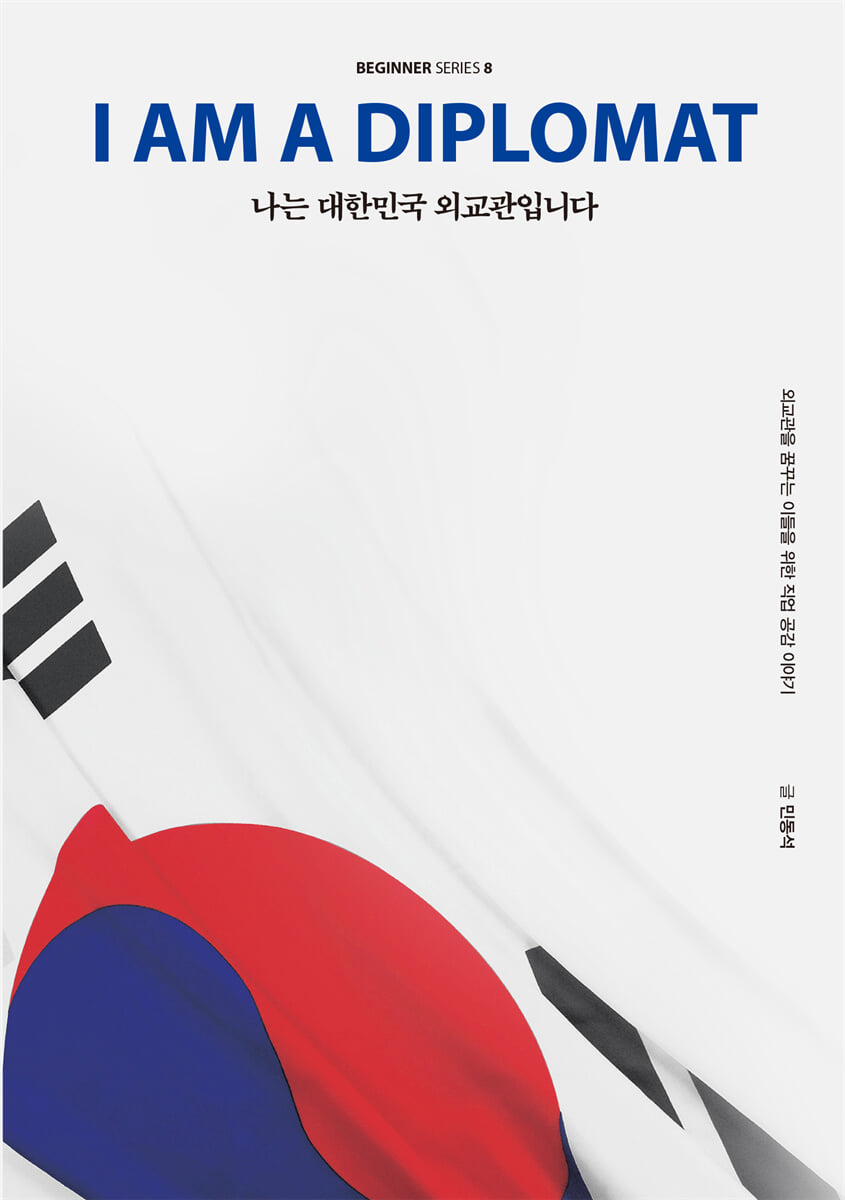
I am a diplomat of the Republic of Korea.
 |
Description
Book Introduction
Diplomats, making dreams come true
A vivid career story told by a current diplomat
This book was written for aspiring diplomats who wish to work on the international stage.
This book covers a wide spectrum of stories, from how to become a diplomat to the work of diplomats, their daily lives at home and abroad, and various cases of diplomats.
This will give you a broader understanding of the professional world and a glimpse into what's happening inside and outside the embassy.
It will serve as a valuable guide not only for those aspiring to become diplomats, but also for anyone with a keen interest in international relations.
A vivid career story told by a current diplomat
This book was written for aspiring diplomats who wish to work on the international stage.
This book covers a wide spectrum of stories, from how to become a diplomat to the work of diplomats, their daily lives at home and abroad, and various cases of diplomats.
This will give you a broader understanding of the professional world and a glimpse into what's happening inside and outside the embassy.
It will serve as a valuable guide not only for those aspiring to become diplomats, but also for anyone with a keen interest in international relations.
- You can preview some of the book's contents.
Preview
index
Recommendation
prolog
Part 1.
Diplomats dream of a special life
1.
A person who dreams of becoming a diplomat
What do diplomats do?
What are the duties of a diplomat at an overseas mission?
What is the role of the Ambassador Extraordinary and Plenipotentiary?
How are ambassadorial ranks determined?
What procedures are followed when dispatching an ambassador?
2.
The ABCs of Diplomacy
What are the areas of work and organizational structure of the Ministry of Foreign Affairs?
How are the ranks and positions of diplomats determined?
What is the difference between an ambassador, minister, and consul?
3.
Challenging the dream of becoming a diplomat
What is the recruitment process and competition rate for diplomats?
What major or department would be good?
Are there any age or education restrictions?
Tip.
An agency that works closely with diplomats
Part 2.
Foreign Service Candidate Selection Exam
1.
First Exam Preparation
How should I develop my PSAT strategy?
How should I study the Constitution?
How do I prepare for the external certification exam replacement subjects?
2.
Second Exam Preparation
How should I prepare for the integrated essay test?
How should I prepare for the major evaluation exam?
3.
3rd Exam Preparation
How is the interview conducted?
How are the evaluation criteria structured?
What are the key evaluation criteria you consider?
Is there a way to do well in a group discussion interview?
Is there any way to do well in individual interviews?
What should I wear to the interview?
4.
Korea National Diplomatic Academy regular course
How is training and evaluation conducted?
How does the intensive English course proceed?
What are the educational facilities and environment like?
Tip.
Time management and physical strength
Part 3.
A successful diplomat
1.
Qualities and virtues required for a diplomat
What qualities and virtues are necessary for a diplomat?
Are there any personality traits and temperaments that are suitable for a diplomat?
What is the strength that sustains the difficult role of diplomat?
What business mindset should a diplomat have?
How do I become a skilled negotiator?
2.
Basic competencies of a diplomat
How can we cultivate creativity that will benefit diplomacy?
Why are communication and empathy important to diplomats?
Have you ever had an experience that reminded you that skills are important?
Should diplomats be generalists?
Or should I become a specialist?
How much knowledge about foreign policy, politics, and economics do I need?
What are some self-development options that can be pursued alongside work?
3.
Foreign language: an essential weapon for diplomats
How good does a diplomat need to be in English?
Which language should I choose as my second foreign language?
Do you have any special secrets for studying foreign languages?
Language used by diplomats
Tip.
4 Habits for Becoming a Good Diplomat
Part 4.
The Work and Life of a Diplomat
1.
The good things about being a diplomat
Is there any reason why being a diplomat is a good career?
What moment is most memorable?
How much money do diplomats earn?
Are there any economic benefits to being a diplomat?
Do diplomats have extraterritorial rights?
When are diplomats' holidays?
2.
The difficult and challenging life of a diplomat
Do you have to move often?
How do you relieve stress?
How do you usually take care of your health?
How should I respond in case of a crisis?
3.
Future Prospects for Diplomats
Is there a change in the gender ratio of diplomats?
Do female diplomats also work in rough terrain?
What is a diplomat's home life like?
How do diplomats handle marriage and childcare?
Are there any difficulties in raising your children due to frequent moves?
Tip.
Where can I get information about diplomats?
Part 5.
practical diplomat
Keep people around you whom you want to be like.
1.
The man who moved the world,
Ban Ki-moon, the 8th Secretary-General of the United Nations
2.
'South Korea's representative female diplomat'
Former Ambassador to Geneva Baek Ji-ah
3.
A diplomat who moved the hearts of Koreans,
Former U.S. Ambassador to Korea Stevens
4.
“This is how I became a diplomat.”
A Straightforward Roundtable Discussion with Four Rookie Diplomats Who Have Achieved Their Dreams
Tip.
Learn diplomatic terms
Epilogue
prolog
Part 1.
Diplomats dream of a special life
1.
A person who dreams of becoming a diplomat
What do diplomats do?
What are the duties of a diplomat at an overseas mission?
What is the role of the Ambassador Extraordinary and Plenipotentiary?
How are ambassadorial ranks determined?
What procedures are followed when dispatching an ambassador?
2.
The ABCs of Diplomacy
What are the areas of work and organizational structure of the Ministry of Foreign Affairs?
How are the ranks and positions of diplomats determined?
What is the difference between an ambassador, minister, and consul?
3.
Challenging the dream of becoming a diplomat
What is the recruitment process and competition rate for diplomats?
What major or department would be good?
Are there any age or education restrictions?
Tip.
An agency that works closely with diplomats
Part 2.
Foreign Service Candidate Selection Exam
1.
First Exam Preparation
How should I develop my PSAT strategy?
How should I study the Constitution?
How do I prepare for the external certification exam replacement subjects?
2.
Second Exam Preparation
How should I prepare for the integrated essay test?
How should I prepare for the major evaluation exam?
3.
3rd Exam Preparation
How is the interview conducted?
How are the evaluation criteria structured?
What are the key evaluation criteria you consider?
Is there a way to do well in a group discussion interview?
Is there any way to do well in individual interviews?
What should I wear to the interview?
4.
Korea National Diplomatic Academy regular course
How is training and evaluation conducted?
How does the intensive English course proceed?
What are the educational facilities and environment like?
Tip.
Time management and physical strength
Part 3.
A successful diplomat
1.
Qualities and virtues required for a diplomat
What qualities and virtues are necessary for a diplomat?
Are there any personality traits and temperaments that are suitable for a diplomat?
What is the strength that sustains the difficult role of diplomat?
What business mindset should a diplomat have?
How do I become a skilled negotiator?
2.
Basic competencies of a diplomat
How can we cultivate creativity that will benefit diplomacy?
Why are communication and empathy important to diplomats?
Have you ever had an experience that reminded you that skills are important?
Should diplomats be generalists?
Or should I become a specialist?
How much knowledge about foreign policy, politics, and economics do I need?
What are some self-development options that can be pursued alongside work?
3.
Foreign language: an essential weapon for diplomats
How good does a diplomat need to be in English?
Which language should I choose as my second foreign language?
Do you have any special secrets for studying foreign languages?
Language used by diplomats
Tip.
4 Habits for Becoming a Good Diplomat
Part 4.
The Work and Life of a Diplomat
1.
The good things about being a diplomat
Is there any reason why being a diplomat is a good career?
What moment is most memorable?
How much money do diplomats earn?
Are there any economic benefits to being a diplomat?
Do diplomats have extraterritorial rights?
When are diplomats' holidays?
2.
The difficult and challenging life of a diplomat
Do you have to move often?
How do you relieve stress?
How do you usually take care of your health?
How should I respond in case of a crisis?
3.
Future Prospects for Diplomats
Is there a change in the gender ratio of diplomats?
Do female diplomats also work in rough terrain?
What is a diplomat's home life like?
How do diplomats handle marriage and childcare?
Are there any difficulties in raising your children due to frequent moves?
Tip.
Where can I get information about diplomats?
Part 5.
practical diplomat
Keep people around you whom you want to be like.
1.
The man who moved the world,
Ban Ki-moon, the 8th Secretary-General of the United Nations
2.
'South Korea's representative female diplomat'
Former Ambassador to Geneva Baek Ji-ah
3.
A diplomat who moved the hearts of Koreans,
Former U.S. Ambassador to Korea Stevens
4.
“This is how I became a diplomat.”
A Straightforward Roundtable Discussion with Four Rookie Diplomats Who Have Achieved Their Dreams
Tip.
Learn diplomatic terms
Epilogue
Detailed image

Into the book
Whether it's patriotism and a sense of mission for your country, or a fateful pull, if you have a passion that burns your heart, I encourage you to pursue a career in diplomacy without hesitation.
If it's a special job that could serve your country and its people, and even change the fate of the nation, wouldn't it be worth knocking on the door with all your might?
--- p.24
When it comes to issues related to current affairs, it is important to note that there is a tendency to use past issues as themes that are linked or compared to current phenomena, as well as recent issues.
It is necessary to constantly check international affairs and current issues through the news.
It would be helpful to regularly read and summarize the key points of books that contain the perspectives and logic of international political experts on the international order and the changing dynamics of relations between nations.
--- p.105
To do well in an interview, the applicant must first and foremost understand why and what is being evaluated.
If you lack understanding of the interview, it is difficult to prepare and respond appropriately.
The interview in the diplomatic candidate selection exam is an opportunity to see whether the applicant can effectively demonstrate his or her abilities as a diplomat in the future.
To this end, the applicants' capabilities are assessed by presenting 'group in-depth discussion' and 'individual presentation' assignments on topics similar to actual diplomatic work.
The five assessment factors introduced in the previous section are the items for evaluating competency.
--- p.123
As a diplomat, acting with courage and conviction is not as easy as it sounds.
In bureaucratic society, there is a tendency to simply follow the trend without taking responsibility for one's own actions.
However, as diplomats are public officials who represent their country abroad, their actions have a very large national impact.
As a diplomat, you will inevitably encounter various situations in the field. To carry out your duties without wavering, you need conviction and courage above all else.
If you have the conviction that your work is for the sake of your country and its people, and the courage to move forward even when things are difficult and challenging, I believe you are already a great diplomat.
--- p.151
A generalist is someone who has a wide range of knowledge and skills, while a specialist is someone who has specialized knowledge in a specific field.
It is not easy to give a definitive answer to this question.
Because diplomacy itself is a specialized field, all diplomats can be considered specialists.
If I had to say, I think a diplomat should be a generalist, but also a specialist with his or her own field of expertise.
For example, if you have the ability to handle a wide range of tasks, including economics, culture, and consular affairs for overseas Koreans, while also having specialized knowledge and experience in the environmental field, you can be considered a generalist and a specialist at the same time.
--- p.181
Although it varies from diplomat to diplomat, roughly half of their time as diplomats is spent living abroad.
While working at an overseas mission, they lead a relatively comfortable life, enough to maintain their dignity as diplomats.
Living between Korea and a foreign country can make it difficult to educate your children, but being able to educate your children abroad without having to send them to study abroad is a huge benefit.
--- p.220
A diplomat must be able to throw himself into the service of his country and its people in times of crisis.
Crisis management skills are not developed overnight.
A diplomat may face moments of crisis and trial at any time or place.
No matter how great your diplomatic achievements may be, if you fail to properly handle a crisis, your tower of effort will collapse in an instant.
Diplomats must always be thoroughly prepared for crisis situations.
--- p.239
As of June 2015, there were approximately 4,900 women among the UN Secretariat's P-level and above staff, accounting for approximately 40%.
In the case of P2 level, which is a practical level, the number of female employees actually exceeds that of male employees.
Although women's advancement into the UN is gradually becoming more active, the reality is that men still make up more than three-quarters of the highest-ranking positions, including Under-Secretary-General and Assistant Under-Secretaries-General.
However, it is very encouraging that four of the nine candidates currently running for the position of the next UN Secretary-General are women.
--- p.271
As someone who has spent his entire life as a diplomat, there is something I really want to say to young people.
It means to always dream and never stop taking on new challenges.
The path of a diplomat may seem like a difficult and arduous journey.
On the scale of life, the weight of reality can sometimes be much heavier than dreams.
But there is no sea without waves.
I believe in the limitless potential of young people.
I hope you cherish yourself and your dreams.
If you embrace your dreams for the future with fervent conviction and a sense of mission, it will become a wonderful challenge that will transform not only the Republic of Korea but also humanity.
I hope you challenge your own potential and your dreams for the world.
If it's a special job that could serve your country and its people, and even change the fate of the nation, wouldn't it be worth knocking on the door with all your might?
--- p.24
When it comes to issues related to current affairs, it is important to note that there is a tendency to use past issues as themes that are linked or compared to current phenomena, as well as recent issues.
It is necessary to constantly check international affairs and current issues through the news.
It would be helpful to regularly read and summarize the key points of books that contain the perspectives and logic of international political experts on the international order and the changing dynamics of relations between nations.
--- p.105
To do well in an interview, the applicant must first and foremost understand why and what is being evaluated.
If you lack understanding of the interview, it is difficult to prepare and respond appropriately.
The interview in the diplomatic candidate selection exam is an opportunity to see whether the applicant can effectively demonstrate his or her abilities as a diplomat in the future.
To this end, the applicants' capabilities are assessed by presenting 'group in-depth discussion' and 'individual presentation' assignments on topics similar to actual diplomatic work.
The five assessment factors introduced in the previous section are the items for evaluating competency.
--- p.123
As a diplomat, acting with courage and conviction is not as easy as it sounds.
In bureaucratic society, there is a tendency to simply follow the trend without taking responsibility for one's own actions.
However, as diplomats are public officials who represent their country abroad, their actions have a very large national impact.
As a diplomat, you will inevitably encounter various situations in the field. To carry out your duties without wavering, you need conviction and courage above all else.
If you have the conviction that your work is for the sake of your country and its people, and the courage to move forward even when things are difficult and challenging, I believe you are already a great diplomat.
--- p.151
A generalist is someone who has a wide range of knowledge and skills, while a specialist is someone who has specialized knowledge in a specific field.
It is not easy to give a definitive answer to this question.
Because diplomacy itself is a specialized field, all diplomats can be considered specialists.
If I had to say, I think a diplomat should be a generalist, but also a specialist with his or her own field of expertise.
For example, if you have the ability to handle a wide range of tasks, including economics, culture, and consular affairs for overseas Koreans, while also having specialized knowledge and experience in the environmental field, you can be considered a generalist and a specialist at the same time.
--- p.181
Although it varies from diplomat to diplomat, roughly half of their time as diplomats is spent living abroad.
While working at an overseas mission, they lead a relatively comfortable life, enough to maintain their dignity as diplomats.
Living between Korea and a foreign country can make it difficult to educate your children, but being able to educate your children abroad without having to send them to study abroad is a huge benefit.
--- p.220
A diplomat must be able to throw himself into the service of his country and its people in times of crisis.
Crisis management skills are not developed overnight.
A diplomat may face moments of crisis and trial at any time or place.
No matter how great your diplomatic achievements may be, if you fail to properly handle a crisis, your tower of effort will collapse in an instant.
Diplomats must always be thoroughly prepared for crisis situations.
--- p.239
As of June 2015, there were approximately 4,900 women among the UN Secretariat's P-level and above staff, accounting for approximately 40%.
In the case of P2 level, which is a practical level, the number of female employees actually exceeds that of male employees.
Although women's advancement into the UN is gradually becoming more active, the reality is that men still make up more than three-quarters of the highest-ranking positions, including Under-Secretary-General and Assistant Under-Secretaries-General.
However, it is very encouraging that four of the nine candidates currently running for the position of the next UN Secretary-General are women.
--- p.271
As someone who has spent his entire life as a diplomat, there is something I really want to say to young people.
It means to always dream and never stop taking on new challenges.
The path of a diplomat may seem like a difficult and arduous journey.
On the scale of life, the weight of reality can sometimes be much heavier than dreams.
But there is no sea without waves.
I believe in the limitless potential of young people.
I hope you cherish yourself and your dreams.
If you embrace your dreams for the future with fervent conviction and a sense of mission, it will become a wonderful challenge that will transform not only the Republic of Korea but also humanity.
I hope you challenge your own potential and your dreams for the world.
--- p.303
Publisher's Review
The eighth story in the Beginner Series: The Diplomat
Facing issues from various fields, representing the country!
The Beginner Series is a series of candid, honest interviews with experts and seniors in the field, asking and answering questions about the profession for those who dream of it.
The eighth installment in the series tells the story of 'The Diplomat'.
Through “I am a Diplomat of the Republic of Korea,” you will be able to experience a profession that is usually difficult to access more closely.
- What procedures are followed when dispatching an ambassador?
- How should I develop my PSAT strategy?
- How do I become a skilled negotiator?
- How much knowledge do I need about foreign policy, politics, and economics?
- Are there any economic benefits for diplomats?
- Do you have to move often?
- Is there any change in the gender ratio of diplomats?
- How do diplomats handle marriage and childcare?
- How should I respond in case of a crisis?
Anyone who dreams of becoming a diplomat has probably thought about the above at least once.
If you still have concerns or would like to hear more from a senior diplomat, this book will help you resolve them.
I confidently recommend this book to anyone who is just beginning to dream of becoming a diplomat or to anyone who is taking their first steps as a diplomat.
“Protect and promote the interests of the country externally,
Promoting friendly, economic, and cultural relations with foreign countries,
“Its mission is to protect and foster overseas Koreans.”
The Ministry of Foreign Affairs is a ministry that never sleeps.
That means the mission is very important.
The Ministry of Foreign Affairs headquarters issues instructions to embassies around the world, and the embassies carry out the headquarters' instructions while reporting on the situation in the countries where they are stationed.
If the headquarters is the brain, the overseas missions stationed around the world can be said to be the hands and feet.
The headquarters and overseas missions maintain a 24-hour contact system and are making every effort to protect the national interest, including national security, economic and sales diplomacy, support and protection of overseas Koreans, various information collection, development cooperation with international organizations and developing countries, and public diplomacy.
The scope of activities of diplomats has expanded significantly compared to the past, and as Korea's national power and status have risen, the presence of our diplomats has also grown.
This book was written for aspiring diplomats who wish to become diplomats.
A senior diplomat with over 30 years of experience as a career diplomat, and the man responsible for changing the long-standing Foreign Service Examination into the Diplomatic Candidate Selection Examination, personally guides you through the world of this profession.
This book covers a wide spectrum of stories, from how to become a diplomat to the work of diplomats, their daily lives at home and abroad, and various cases of diplomats.
The table of contents consists of five parts.
Part 1 introduces information about the work and daily life of diplomats, the organization's structure, and recruitment.
Part 2 covers the Diplomatic Service Candidate Examination, the most common way to become a diplomat.
It provides detailed tips and procedures on how to prepare for the first, second, and third exams and the regular course of the National Diplomatic Academy.
Part 3 covers in detail the qualities and virtues required of a diplomat and the essence of diplomatic work.
It also emphasizes the skills of speaking, listening, reading, and writing in foreign languages, which are essential for diplomats.
Part 4 covers the lives of real diplomats, their daily lives and life cycles.
Part 5 contains a wide range of cases of diplomats working as actual diplomats, from junior to senior.
All-round player, DIPLOMAT
Tips are provided at the end of each part of the book.
In addition to introducing organizations that work closely with diplomats and websites where you can find information about diplomats, you can also find practical advice on how to become a good diplomat, including daily habits, time management, and physical strength.
Additionally, you can think more seriously about your career by looking at the terminology used in diplomatic situations.
You can read this book from beginning to end, or you can just skim through the pages that answer your questions.
No matter which page you read, we will provide you with only customized information that will answer your questions.
I hope that through "I am a Diplomat of the Republic of Korea," which is filled with sincere advice and useful information from current seniors, you can nurture your dream of becoming a diplomat who can reach a wider world.
The story of your seniors supporting your dreams continues.
Facing issues from various fields, representing the country!
The Beginner Series is a series of candid, honest interviews with experts and seniors in the field, asking and answering questions about the profession for those who dream of it.
The eighth installment in the series tells the story of 'The Diplomat'.
Through “I am a Diplomat of the Republic of Korea,” you will be able to experience a profession that is usually difficult to access more closely.
- What procedures are followed when dispatching an ambassador?
- How should I develop my PSAT strategy?
- How do I become a skilled negotiator?
- How much knowledge do I need about foreign policy, politics, and economics?
- Are there any economic benefits for diplomats?
- Do you have to move often?
- Is there any change in the gender ratio of diplomats?
- How do diplomats handle marriage and childcare?
- How should I respond in case of a crisis?
Anyone who dreams of becoming a diplomat has probably thought about the above at least once.
If you still have concerns or would like to hear more from a senior diplomat, this book will help you resolve them.
I confidently recommend this book to anyone who is just beginning to dream of becoming a diplomat or to anyone who is taking their first steps as a diplomat.
“Protect and promote the interests of the country externally,
Promoting friendly, economic, and cultural relations with foreign countries,
“Its mission is to protect and foster overseas Koreans.”
The Ministry of Foreign Affairs is a ministry that never sleeps.
That means the mission is very important.
The Ministry of Foreign Affairs headquarters issues instructions to embassies around the world, and the embassies carry out the headquarters' instructions while reporting on the situation in the countries where they are stationed.
If the headquarters is the brain, the overseas missions stationed around the world can be said to be the hands and feet.
The headquarters and overseas missions maintain a 24-hour contact system and are making every effort to protect the national interest, including national security, economic and sales diplomacy, support and protection of overseas Koreans, various information collection, development cooperation with international organizations and developing countries, and public diplomacy.
The scope of activities of diplomats has expanded significantly compared to the past, and as Korea's national power and status have risen, the presence of our diplomats has also grown.
This book was written for aspiring diplomats who wish to become diplomats.
A senior diplomat with over 30 years of experience as a career diplomat, and the man responsible for changing the long-standing Foreign Service Examination into the Diplomatic Candidate Selection Examination, personally guides you through the world of this profession.
This book covers a wide spectrum of stories, from how to become a diplomat to the work of diplomats, their daily lives at home and abroad, and various cases of diplomats.
The table of contents consists of five parts.
Part 1 introduces information about the work and daily life of diplomats, the organization's structure, and recruitment.
Part 2 covers the Diplomatic Service Candidate Examination, the most common way to become a diplomat.
It provides detailed tips and procedures on how to prepare for the first, second, and third exams and the regular course of the National Diplomatic Academy.
Part 3 covers in detail the qualities and virtues required of a diplomat and the essence of diplomatic work.
It also emphasizes the skills of speaking, listening, reading, and writing in foreign languages, which are essential for diplomats.
Part 4 covers the lives of real diplomats, their daily lives and life cycles.
Part 5 contains a wide range of cases of diplomats working as actual diplomats, from junior to senior.
All-round player, DIPLOMAT
Tips are provided at the end of each part of the book.
In addition to introducing organizations that work closely with diplomats and websites where you can find information about diplomats, you can also find practical advice on how to become a good diplomat, including daily habits, time management, and physical strength.
Additionally, you can think more seriously about your career by looking at the terminology used in diplomatic situations.
You can read this book from beginning to end, or you can just skim through the pages that answer your questions.
No matter which page you read, we will provide you with only customized information that will answer your questions.
I hope that through "I am a Diplomat of the Republic of Korea," which is filled with sincere advice and useful information from current seniors, you can nurture your dream of becoming a diplomat who can reach a wider world.
The story of your seniors supporting your dreams continues.
GOODS SPECIFICS
- Date of issue: January 19, 2024
- Page count, weight, size: 304 pages | 492g | 145*205*20mm
- ISBN13: 9791169838771
You may also like
카테고리
korean


korean

![GQ KOREA Mark (Monthly): December [2025]](http://librairie.coreenne.fr/cdn/shop/files/8ef265dbbfbf186523ed75ba7319009d.jpg?v=1765340328&width=3840)


