

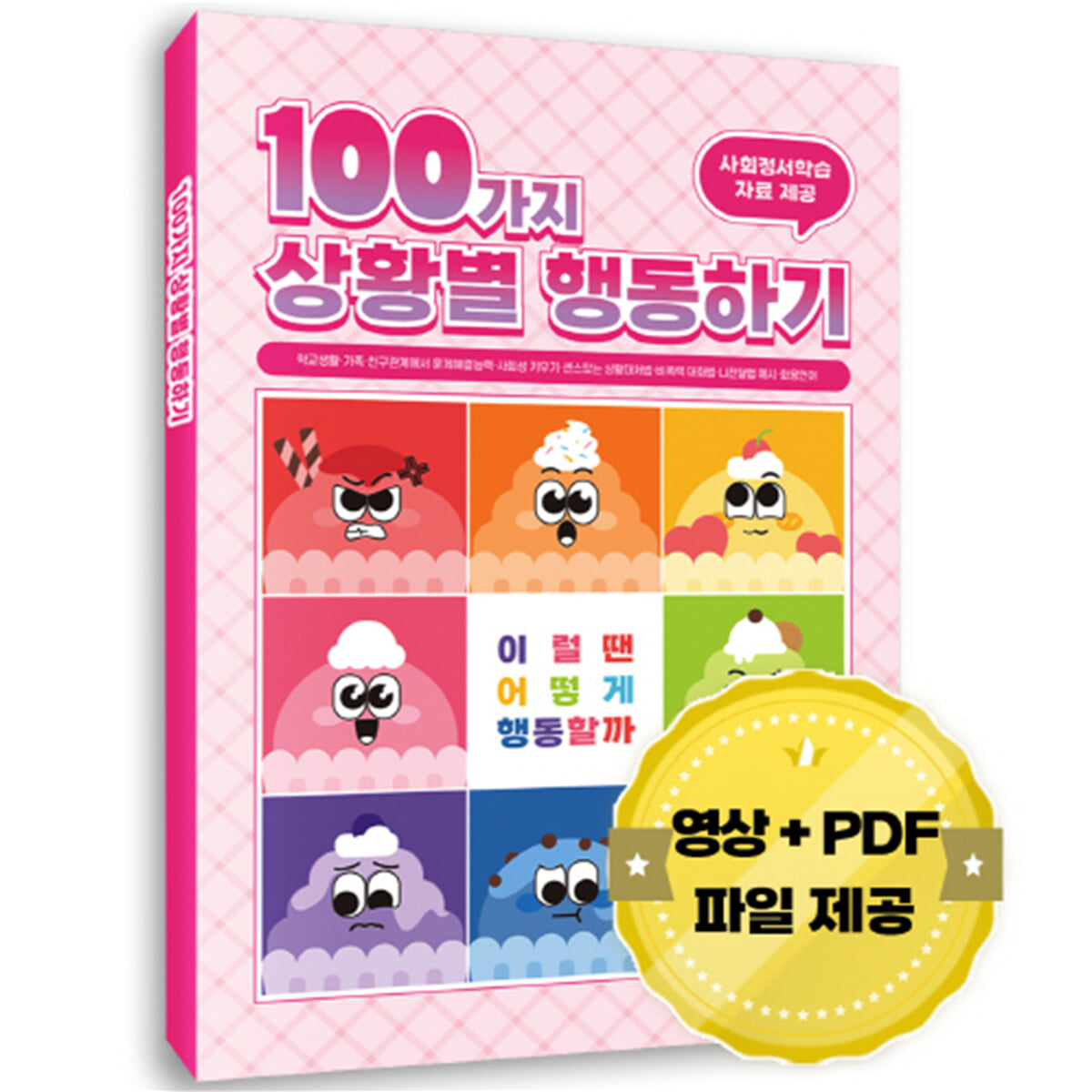
100 Situational Actions
 |
Description
Book Introduction
This workbook contains 100 real-life conflict situations that teenagers experience at school, at home, and in their daily lives.
You can notice your emotions by focusing on the question “What if I were you?” → find your desires → choose a behavior type → and speak about it using the “I” method.
It is designed to practice the entire process from emotion-desire-action-speaking all at once.
Additionally, 100 QR videos are provided so that you can develop social skills, problem-solving skills, and emotional intelligence by sharing stories with friends, family, and teachers.
Another great advantage is that it comes with videos, PPTs, and PDF activity sheets for school violence prevention and social-emotional learning (SEL) education.
▶Data Room https://cafe.naver.com/jobcard/2637
You can notice your emotions by focusing on the question “What if I were you?” → find your desires → choose a behavior type → and speak about it using the “I” method.
It is designed to practice the entire process from emotion-desire-action-speaking all at once.
Additionally, 100 QR videos are provided so that you can develop social skills, problem-solving skills, and emotional intelligence by sharing stories with friends, family, and teachers.
Another great advantage is that it comes with videos, PPTs, and PDF activity sheets for school violence prevention and social-emotional learning (SEL) education.
▶Data Room https://cafe.naver.com/jobcard/2637
index
Download the 112-page booklet + activity sheets and PPT materials online
1.
Instructions (3 pages) | Emotional Words (4 pages) | Desire Words (5 pages) | How to Express Yourself (6 pages) | Pre-Start Instructions (7 pages) | Communication/Behavior Types (108-109 pages) | Encouraging Messages (110 pages)
2.
Speaking in 100 Situations, pp. 8-107
1) Composition: Real-life portrait, What if I were you?, Expression/emotion words, Desire (desire), Select 5 types of behavior, Write my choice and reason, Other friends' choices, Example sentences of how to convey myself, QR code video
2) Field: 100 total, 10 situations in 10 different colors
01-10: Congratulations, Praise
11-20: Empathy Dialogue, Apologizing, and Reconciling
Numbers 21-30: Setting Boundaries, Saying No
Numbers 31-40: Dealing with Bullying, Teasing, and Pranks
41-50: Cooperate and Follow the Rules
51-60: Adapting to New Situations
61-70: Solving Study and Career Concerns
71-80: Using Social Media, Digital Media, and Social Media Smartly
81-90: Managing Uncomfortable Feelings
91-100: Strengthening Relationships with Family
4.
Providing teaching materials
1) Video (QR link): 100 videos (1 minute each)
2) PPT PowerPoint
3) PDF activity sheet
▶https://cafe.naver.com/jobcard/2637
Data Room → Download File → Enter Password (Password: Bottom of page 3 of the booklet)
5.
Group Purchase Benefits
100 additional videos, PPT PDFs, and more
Target: Purchasers of 10 or more volumes
Application: Add KakaoTalk ID anykcm.com / Phone 02-2268-8856
1.
Instructions (3 pages) | Emotional Words (4 pages) | Desire Words (5 pages) | How to Express Yourself (6 pages) | Pre-Start Instructions (7 pages) | Communication/Behavior Types (108-109 pages) | Encouraging Messages (110 pages)
2.
Speaking in 100 Situations, pp. 8-107
1) Composition: Real-life portrait, What if I were you?, Expression/emotion words, Desire (desire), Select 5 types of behavior, Write my choice and reason, Other friends' choices, Example sentences of how to convey myself, QR code video
2) Field: 100 total, 10 situations in 10 different colors
01-10: Congratulations, Praise
11-20: Empathy Dialogue, Apologizing, and Reconciling
Numbers 21-30: Setting Boundaries, Saying No
Numbers 31-40: Dealing with Bullying, Teasing, and Pranks
41-50: Cooperate and Follow the Rules
51-60: Adapting to New Situations
61-70: Solving Study and Career Concerns
71-80: Using Social Media, Digital Media, and Social Media Smartly
81-90: Managing Uncomfortable Feelings
91-100: Strengthening Relationships with Family
4.
Providing teaching materials
1) Video (QR link): 100 videos (1 minute each)
2) PPT PowerPoint
3) PDF activity sheet
▶https://cafe.naver.com/jobcard/2637
Data Room → Download File → Enter Password (Password: Bottom of page 3 of the booklet)
5.
Group Purchase Benefits
100 additional videos, PPT PDFs, and more
Target: Purchasers of 10 or more volumes
Application: Add KakaoTalk ID anykcm.com / Phone 02-2268-8856
Detailed image

Into the book
Congratulatory compliment number 1
1.
Situation: When someone compliments you - What if I gave a presentation and my friends or people around me complimented me on my performance?
2.
What emotions will you feel? Proud, happy, confident, relieved.
3.
What do you want? Gratitude, humility.
4.
How should I act? ① Laugh it off without saying anything. ② Deny it because it's embarrassing. ③ Say thank you. ④ Talk about your next goal or areas for improvement. ⑤ Praise the people you worked with.
5.
What would I do if I were you? I'd choose number 5.
Saying things like, "I liked your presentation too! Your idea was really interesting!" creates a positive cycle of giving and receiving compliments, which makes everyone feel even better.
/ You can become a leader who emphasizes teamwork by saying, “I worked hard too, but it’s thanks to our team.”
If you feel awkward receiving compliments like in number 2 and say “no,” the other person’s sincerity may be ignored.
6.
How should I put it? (My way of saying it) “I am happy and confident because I was praised for my presentation.
Thank you for your support.
“You did really well in your presentation today.”
Empathy Conversation #11
1.
Situation: When you and your friend have different ideas - What if your ideas clash because what you want to do is different from what your friend wants to do?
2.
What emotions would you feel? Dissatisfied, frustrated, dissatisfied, sullen, upset.
3.
What do you want? Understanding, communication
4.
How should I act? ① Follow my friend's opinion. ② Insist on my own opinion, saying, "I'm right." ③ Listen to each other's reasons. ④ Offer alternatives and find a compromise. ⑤ Decide by playing rock-paper-scissors.
5.
What would I do if I were you? I'd choose number 4.
By combining each other's ideas, new solutions can be created.
The attitude of “we could both be right” is very effective in maintaining a relationship.
/ If I choose number 2, my thoughts will be clearly conveyed, but there is a risk that my friend will be hurt or it may escalate into an argument.
Even if I do what I want, the relationship may become a little distant.
6.
How should I put it? (Method of communication) “It’s a little frustrating because we have different wants, but I hope we can listen to each other and find a better way.
“I’m curious about your opinion too.”
SNS Digital No. 71
1.
Situation: When it's hard to stop using social media - What if you were just trying to take a quick look at social media, but the video recommendations kept coming and you kept watching?
2.
What emotions would you feel? Lethargic, tired, depressed, anxious, regretful.
3.
What do you want? Self-control, balance.
4.
How to act: ① Keep checking social media ② Put your phone away ③ Set aside time for social media use ④ Review your reasons for using social media ⑤ Create an alternative activity
5.
What would I do if I were you? I'd like to figure out my true desires, like number 4: "Do I really miss you? Am I bored? Do I just want to rest? Am I lonely?"
After that, I'll find another way to relax, like drawing or something like number 5.
/ If you avoid reality like number 1 and get lost in the virtual world, it may be fun for a moment, but regret and fatigue will accumulate and your self-esteem will drop.
Another way is to put your phone in another room and turn off notifications, like number 2.
6.
How should I put it? (My way of communicating) (To myself) "I'm also a person who is easily attracted to stimulation.
You just have to practice adjusting it little by little.
Let's decide to check social media for 15 minutes after finishing homework today.
Then you will feel at ease.”
1.
Situation: When someone compliments you - What if I gave a presentation and my friends or people around me complimented me on my performance?
2.
What emotions will you feel? Proud, happy, confident, relieved.
3.
What do you want? Gratitude, humility.
4.
How should I act? ① Laugh it off without saying anything. ② Deny it because it's embarrassing. ③ Say thank you. ④ Talk about your next goal or areas for improvement. ⑤ Praise the people you worked with.
5.
What would I do if I were you? I'd choose number 5.
Saying things like, "I liked your presentation too! Your idea was really interesting!" creates a positive cycle of giving and receiving compliments, which makes everyone feel even better.
/ You can become a leader who emphasizes teamwork by saying, “I worked hard too, but it’s thanks to our team.”
If you feel awkward receiving compliments like in number 2 and say “no,” the other person’s sincerity may be ignored.
6.
How should I put it? (My way of saying it) “I am happy and confident because I was praised for my presentation.
Thank you for your support.
“You did really well in your presentation today.”
Empathy Conversation #11
1.
Situation: When you and your friend have different ideas - What if your ideas clash because what you want to do is different from what your friend wants to do?
2.
What emotions would you feel? Dissatisfied, frustrated, dissatisfied, sullen, upset.
3.
What do you want? Understanding, communication
4.
How should I act? ① Follow my friend's opinion. ② Insist on my own opinion, saying, "I'm right." ③ Listen to each other's reasons. ④ Offer alternatives and find a compromise. ⑤ Decide by playing rock-paper-scissors.
5.
What would I do if I were you? I'd choose number 4.
By combining each other's ideas, new solutions can be created.
The attitude of “we could both be right” is very effective in maintaining a relationship.
/ If I choose number 2, my thoughts will be clearly conveyed, but there is a risk that my friend will be hurt or it may escalate into an argument.
Even if I do what I want, the relationship may become a little distant.
6.
How should I put it? (Method of communication) “It’s a little frustrating because we have different wants, but I hope we can listen to each other and find a better way.
“I’m curious about your opinion too.”
SNS Digital No. 71
1.
Situation: When it's hard to stop using social media - What if you were just trying to take a quick look at social media, but the video recommendations kept coming and you kept watching?
2.
What emotions would you feel? Lethargic, tired, depressed, anxious, regretful.
3.
What do you want? Self-control, balance.
4.
How to act: ① Keep checking social media ② Put your phone away ③ Set aside time for social media use ④ Review your reasons for using social media ⑤ Create an alternative activity
5.
What would I do if I were you? I'd like to figure out my true desires, like number 4: "Do I really miss you? Am I bored? Do I just want to rest? Am I lonely?"
After that, I'll find another way to relax, like drawing or something like number 5.
/ If you avoid reality like number 1 and get lost in the virtual world, it may be fun for a moment, but regret and fatigue will accumulate and your self-esteem will drop.
Another way is to put your phone in another room and turn off notifications, like number 2.
6.
How should I put it? (My way of communicating) (To myself) "I'm also a person who is easily attracted to stimulation.
You just have to practice adjusting it little by little.
Let's decide to check social media for 15 minutes after finishing homework today.
Then you will feel at ease.”
--- From the text
Publisher's Review
▶Booklet: 100 Actions for Different Situations, 112 pages
▶File: Download class materials - videos, PPT, PDF activity sheets
▶ Why is it necessary to ‘act according to the situation’ now?
Children experience relationship stress much more quickly and in more complex ways than in the past due to the influence of friends, social media, and the media.
Someone's pranks make you uncomfortable, a small comment can hurt you, and you can make matters worse by not knowing how to say something.
→ This book organizes 100 ambiguous and subtle situations that teenagers face, helping them develop the power to speak, choose, and act on their own.
▶ What are the advantages of this book?
1.
Real-life photos enhance immersion
“What would I really do?” The thought comes naturally and stimulates my imagination.
2.
100 situations, 10 areas
We've compiled the most common situations students experience, including friendships, teasing and bullying, rejection, social media and digital addiction, learning and career concerns, and family relationships.
3.
Learn Coping Skills with 5 Behavioral Types
By comparing different behavioral types, such as avoidant, honest, assertive, humorous, and alternative-proposing, you can understand your own behavioral patterns and make new choices.
4.
Follow the 'nonverbal behavior' and 'speaking examples'
You can follow specific example sentences on how to respond to situations or speak intelligently using nonverbal behaviors such as eye contact, facial expressions, and gestures.
5. Vivid with QR video!
Watch the video with friends, family, and teachers and ask, "What would I do? What would you do?" to increase your practical application.
6.
Use it right away in classes, consultations, and events!
We provide videos, PPTs, and PDF activity sheets so that anyone, including teachers, counselors, youth leaders, and parents, can use them immediately in the field.
▶ I recommend this book
1.
Students who have difficulty making friends
2.
A student who doesn't know how to refuse
3. Students stressed by social media and digital media
4.
Students who have difficulty expressing their emotions in words
5.
Schools that need school violence prevention education
6.
Teachers preparing peer relations, social skills, and SEL classes
7.
WeClass, Counseling Center for those in need of counseling
8.
Teachers who want to provide character education in career and classroom management
▶ What can you gain from this book?
1.
Emotion recognition
2.
Finding the wind (desire)
3.
Identifying behavioral types
4.
Conflict resolution skills
5.
Problem-solving skills
6.
I'm talking about transmission method
7.
Developing social and emotional intelligence
Let's have fun learning lifelong skills to protect yourself, build better relationships, and cope with situations!
▶How do I receive class materials?
1.
Data Room → Download File → Enter Password (Password: Bottom of page 3 of the booklet)
https://cafe.naver.com/jobcard/2637
2.
Bulk Purchase Benefit: Receive 100 video, PPT, and PDF files when you purchase 10 or more books.
Application: Add KakaoTalk ID anykcm.com / Phone 02-2268-8856 → File transfer
▶Curriculum Linkage Table
1.
Elementary Korean: Sharing Our Hearts | Conversation and Empathy
2.
Morality: Valuing Emotions | Peaceful Conflict Resolution
3.
Career Paths and Jobs: Understanding Yourself | Positive Self
4.
Character Education | Classroom Management
5.
Weekly Class Event
6.
Youth Peer Counseling
7.
School violence prevention education
8.
social emotional learning
▶File: Download class materials - videos, PPT, PDF activity sheets
▶ Why is it necessary to ‘act according to the situation’ now?
Children experience relationship stress much more quickly and in more complex ways than in the past due to the influence of friends, social media, and the media.
Someone's pranks make you uncomfortable, a small comment can hurt you, and you can make matters worse by not knowing how to say something.
→ This book organizes 100 ambiguous and subtle situations that teenagers face, helping them develop the power to speak, choose, and act on their own.
▶ What are the advantages of this book?
1.
Real-life photos enhance immersion
“What would I really do?” The thought comes naturally and stimulates my imagination.
2.
100 situations, 10 areas
We've compiled the most common situations students experience, including friendships, teasing and bullying, rejection, social media and digital addiction, learning and career concerns, and family relationships.
3.
Learn Coping Skills with 5 Behavioral Types
By comparing different behavioral types, such as avoidant, honest, assertive, humorous, and alternative-proposing, you can understand your own behavioral patterns and make new choices.
4.
Follow the 'nonverbal behavior' and 'speaking examples'
You can follow specific example sentences on how to respond to situations or speak intelligently using nonverbal behaviors such as eye contact, facial expressions, and gestures.
5. Vivid with QR video!
Watch the video with friends, family, and teachers and ask, "What would I do? What would you do?" to increase your practical application.
6.
Use it right away in classes, consultations, and events!
We provide videos, PPTs, and PDF activity sheets so that anyone, including teachers, counselors, youth leaders, and parents, can use them immediately in the field.
▶ I recommend this book
1.
Students who have difficulty making friends
2.
A student who doesn't know how to refuse
3. Students stressed by social media and digital media
4.
Students who have difficulty expressing their emotions in words
5.
Schools that need school violence prevention education
6.
Teachers preparing peer relations, social skills, and SEL classes
7.
WeClass, Counseling Center for those in need of counseling
8.
Teachers who want to provide character education in career and classroom management
▶ What can you gain from this book?
1.
Emotion recognition
2.
Finding the wind (desire)
3.
Identifying behavioral types
4.
Conflict resolution skills
5.
Problem-solving skills
6.
I'm talking about transmission method
7.
Developing social and emotional intelligence
Let's have fun learning lifelong skills to protect yourself, build better relationships, and cope with situations!
▶How do I receive class materials?
1.
Data Room → Download File → Enter Password (Password: Bottom of page 3 of the booklet)
https://cafe.naver.com/jobcard/2637
2.
Bulk Purchase Benefit: Receive 100 video, PPT, and PDF files when you purchase 10 or more books.
Application: Add KakaoTalk ID anykcm.com / Phone 02-2268-8856 → File transfer
▶Curriculum Linkage Table
1.
Elementary Korean: Sharing Our Hearts | Conversation and Empathy
2.
Morality: Valuing Emotions | Peaceful Conflict Resolution
3.
Career Paths and Jobs: Understanding Yourself | Positive Self
4.
Character Education | Classroom Management
5.
Weekly Class Event
6.
Youth Peer Counseling
7.
School violence prevention education
8.
social emotional learning
GOODS SPECIFICS
- Date of issue: November 17, 2025
- Page count, weight, size: 128 pages | 250g | 72*102*20mm
- ISBN13: 9791172344825
- ISBN10: 1172344825
You may also like
카테고리
korean


korean

![GQ KOREA Mark (Monthly): December [2025]](http://librairie.coreenne.fr/cdn/shop/files/8ef265dbbfbf186523ed75ba7319009d.jpg?v=1765340328&width=3840)


