

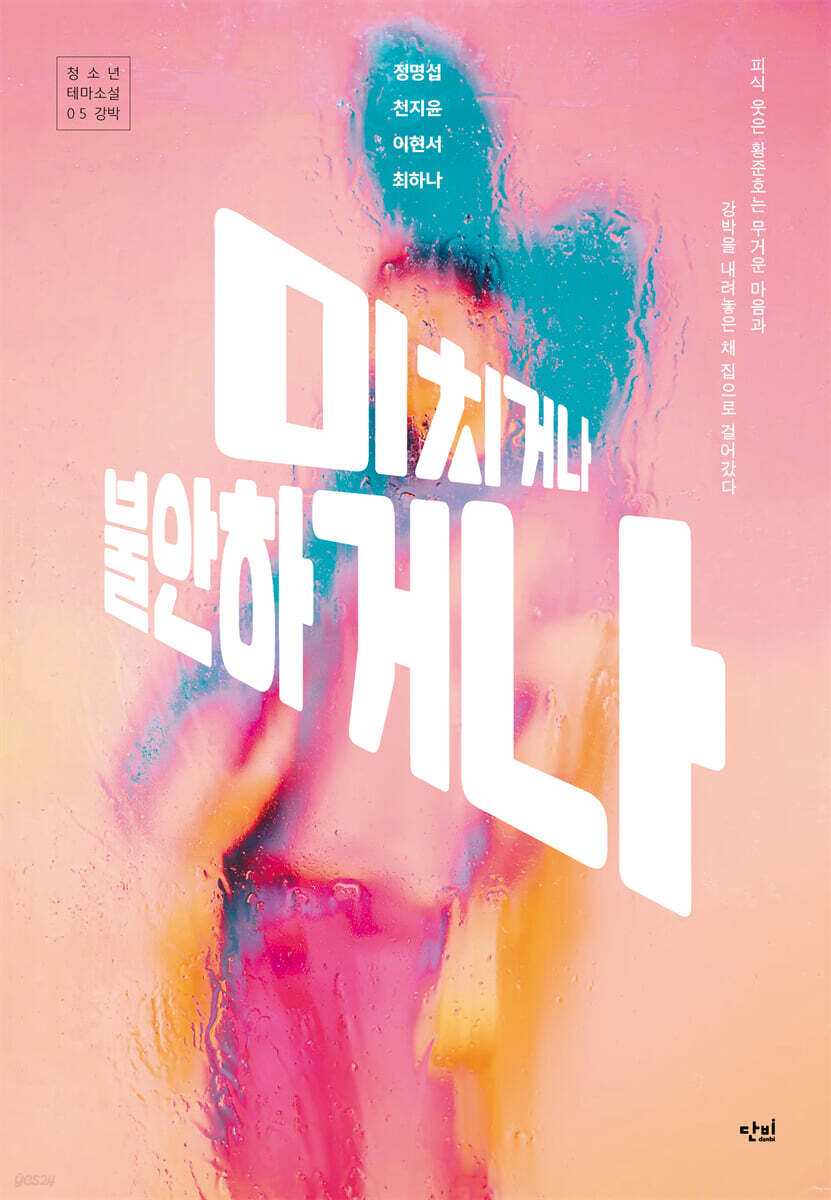
Crazy or anxious
 |
Description
Book Introduction
I can't overcome my crazy anxiety
Stories of our youth trapped in obsession
A collection of themed novels by four authors, united by the keyword "obsession."
These days, children endure countless anxieties before adults even realize it.
In an age where everything is evaluated and compared—grades, career paths, relationships, appearance, even social media image—teenagers are gradually consumed by obsessions they find difficult to explain.
From arranging pencils on your desk to repetitive checking actions to fearful thoughts that won't go away.
Obsession is no longer a problem for just a few children; it's a daily reality for countless young people.
Danbi Youth Literature 42.195's new book, "Crazy or Anxious," is an anthology themed around this "obsession."
Because looking into the innermost thoughts of children through literature is the most realistic response that young adult novels must provide today.
Stories of our youth trapped in obsession
A collection of themed novels by four authors, united by the keyword "obsession."
These days, children endure countless anxieties before adults even realize it.
In an age where everything is evaluated and compared—grades, career paths, relationships, appearance, even social media image—teenagers are gradually consumed by obsessions they find difficult to explain.
From arranging pencils on your desk to repetitive checking actions to fearful thoughts that won't go away.
Obsession is no longer a problem for just a few children; it's a daily reality for countless young people.
Danbi Youth Literature 42.195's new book, "Crazy or Anxious," is an anthology themed around this "obsession."
Because looking into the innermost thoughts of children through literature is the most realistic response that young adult novels must provide today.
- You can preview some of the book's contents.
Preview
Into the book
Obsessive-compulsive disorder is classified as a medical condition that requires treatment.
But many people are unable to let go of the obsession they carry.
In particular, I wrote this story after hearing that this is also the case for growing teenagers.
Please read it with interest.
-Jeong Myeong-seop
Everyone has a desire to be loved.
I, too, have had moments when I wanted attention from my family, friends, and sometimes even complete strangers.
(…) If you, the reader of this book, are in a state of ‘Sol’ rather than ‘Asol’, I would like to ask you this.
What do you like and what do you dislike? And now, do you love yourself?
-Cheon Ji-yoon
The changes that open up our breathing space can be much simpler than changing our chairs.
Only when we have the courage to ask for help, acknowledge our weaknesses, and accept that it's okay to be imperfect can we truly move forward. The anxiety and uncertainty you feel are natural, and you're not alone.
In the process of waiting for 'high', we grow, restore relationships, and understand ourselves.
Still, I hope your tomorrow will be a little more comfortable.
-Lee Hyeon-seo
No one deserves to be pointed at.
Because we all have compulsions that go beyond deficiencies.
These days, I've been thinking a lot about what I'm obsessed with.
Fortunately, nothing comes to mind right away, but I'm trying not to obsess over one thing and act compulsively in the future.
-Choi Ha-na
But many people are unable to let go of the obsession they carry.
In particular, I wrote this story after hearing that this is also the case for growing teenagers.
Please read it with interest.
-Jeong Myeong-seop
Everyone has a desire to be loved.
I, too, have had moments when I wanted attention from my family, friends, and sometimes even complete strangers.
(…) If you, the reader of this book, are in a state of ‘Sol’ rather than ‘Asol’, I would like to ask you this.
What do you like and what do you dislike? And now, do you love yourself?
-Cheon Ji-yoon
The changes that open up our breathing space can be much simpler than changing our chairs.
Only when we have the courage to ask for help, acknowledge our weaknesses, and accept that it's okay to be imperfect can we truly move forward. The anxiety and uncertainty you feel are natural, and you're not alone.
In the process of waiting for 'high', we grow, restore relationships, and understand ourselves.
Still, I hope your tomorrow will be a little more comfortable.
-Lee Hyeon-seo
No one deserves to be pointed at.
Because we all have compulsions that go beyond deficiencies.
These days, I've been thinking a lot about what I'm obsessed with.
Fortunately, nothing comes to mind right away, but I'm trying not to obsess over one thing and act compulsively in the future.
-Choi Ha-na
--- From the author's note in the main text
Publisher's Review
A close look into children's anxious minds
The four authors, Jeong Myeong-seop, Cheon Ji-yoon, Lee Hyeon-seo, and Choi Ha-na, honestly brought out the anxiety, deprivation, pressure from college entrance exams, and moments of being swayed by the gaze of others that they each experienced in their own lives, and turned them into stories of teenagers.
The book vividly portrays the reality of children wandering in the revolving door of their hearts, wanting to stop but unable to.
Jeong Myeong-seop said that he wrote this story based on the unfortunate reality that many people carry obsessions and cannot let go.
This story began with the idea that this is especially true for growing teenagers.
Cheon Ji-yoon confesses to having "lost herself because she wanted to be loved," and teaches "how to love herself" to children who are swayed by the gaze of others and fall into obsession.
Lee Hyun-seo points out the structural problems of the college entrance exam system, which turns children into "dummy students" and causes excessive expectations and fear of failure to lead to a loss of self-control, and hopes that young people will understand themselves and not lose themselves.
Based on her own experience of trying to fill a void with material objects, Choi Ha-na shows how loneliness that cannot be filled, no matter how much one tries, can become an obsession.
While the four works illuminate obsession in different ways, the unifying theme across the four colorful manuscripts is one of faith, strong support, and a loving gaze toward children.
The 'comfort' and small 'breathing gaps' that literature can provide
Obsession is not a strange habit of someone special, but a language of pain created by the times in which today's youth live.
The writers console them by saying that 'the anxiety and despair they feel are natural and they are not alone.'
Encourage children by telling them to 'acknowledge their weaknesses, have the courage to ask for help, and that it's okay to not be perfect.'
Literature sometimes shines a light on the most painful points first.
Through the diverse obsessions of four children, this book calmly yet profoundly reveals the burden that a society where anxiety and competition are the norm has placed on youth.
Characters who live with different pains listen to each other's wounds and finally find a path to understanding themselves.
For children suffering from obsessive-compulsive disorder, I hope it will provide warmth like a cup of mixed coffee offered to 'Jay', and for the adults who stay by their side, it will be a mirror that allows us to look at the reality that we have been missing.
The book introduction concludes with the authors' message to children through the book.
“Take courage.
“Only we can solve our problems.”
The four authors, Jeong Myeong-seop, Cheon Ji-yoon, Lee Hyeon-seo, and Choi Ha-na, honestly brought out the anxiety, deprivation, pressure from college entrance exams, and moments of being swayed by the gaze of others that they each experienced in their own lives, and turned them into stories of teenagers.
The book vividly portrays the reality of children wandering in the revolving door of their hearts, wanting to stop but unable to.
Jeong Myeong-seop said that he wrote this story based on the unfortunate reality that many people carry obsessions and cannot let go.
This story began with the idea that this is especially true for growing teenagers.
Cheon Ji-yoon confesses to having "lost herself because she wanted to be loved," and teaches "how to love herself" to children who are swayed by the gaze of others and fall into obsession.
Lee Hyun-seo points out the structural problems of the college entrance exam system, which turns children into "dummy students" and causes excessive expectations and fear of failure to lead to a loss of self-control, and hopes that young people will understand themselves and not lose themselves.
Based on her own experience of trying to fill a void with material objects, Choi Ha-na shows how loneliness that cannot be filled, no matter how much one tries, can become an obsession.
While the four works illuminate obsession in different ways, the unifying theme across the four colorful manuscripts is one of faith, strong support, and a loving gaze toward children.
The 'comfort' and small 'breathing gaps' that literature can provide
Obsession is not a strange habit of someone special, but a language of pain created by the times in which today's youth live.
The writers console them by saying that 'the anxiety and despair they feel are natural and they are not alone.'
Encourage children by telling them to 'acknowledge their weaknesses, have the courage to ask for help, and that it's okay to not be perfect.'
Literature sometimes shines a light on the most painful points first.
Through the diverse obsessions of four children, this book calmly yet profoundly reveals the burden that a society where anxiety and competition are the norm has placed on youth.
Characters who live with different pains listen to each other's wounds and finally find a path to understanding themselves.
For children suffering from obsessive-compulsive disorder, I hope it will provide warmth like a cup of mixed coffee offered to 'Jay', and for the adults who stay by their side, it will be a mirror that allows us to look at the reality that we have been missing.
The book introduction concludes with the authors' message to children through the book.
“Take courage.
“Only we can solve our problems.”
GOODS SPECIFICS
- Date of issue: November 30, 2025
- Format: Paperback book binding method guide
- Page count, weight, size: 184 pages | 147*212*8mm
- ISBN13: 9791163501558
You may also like
카테고리
korean


korean

![GQ KOREA Mark (Monthly): December [2025]](http://librairie.coreenne.fr/cdn/shop/files/8ef265dbbfbf186523ed75ba7319009d.jpg?v=1765340328&width=3840)


