

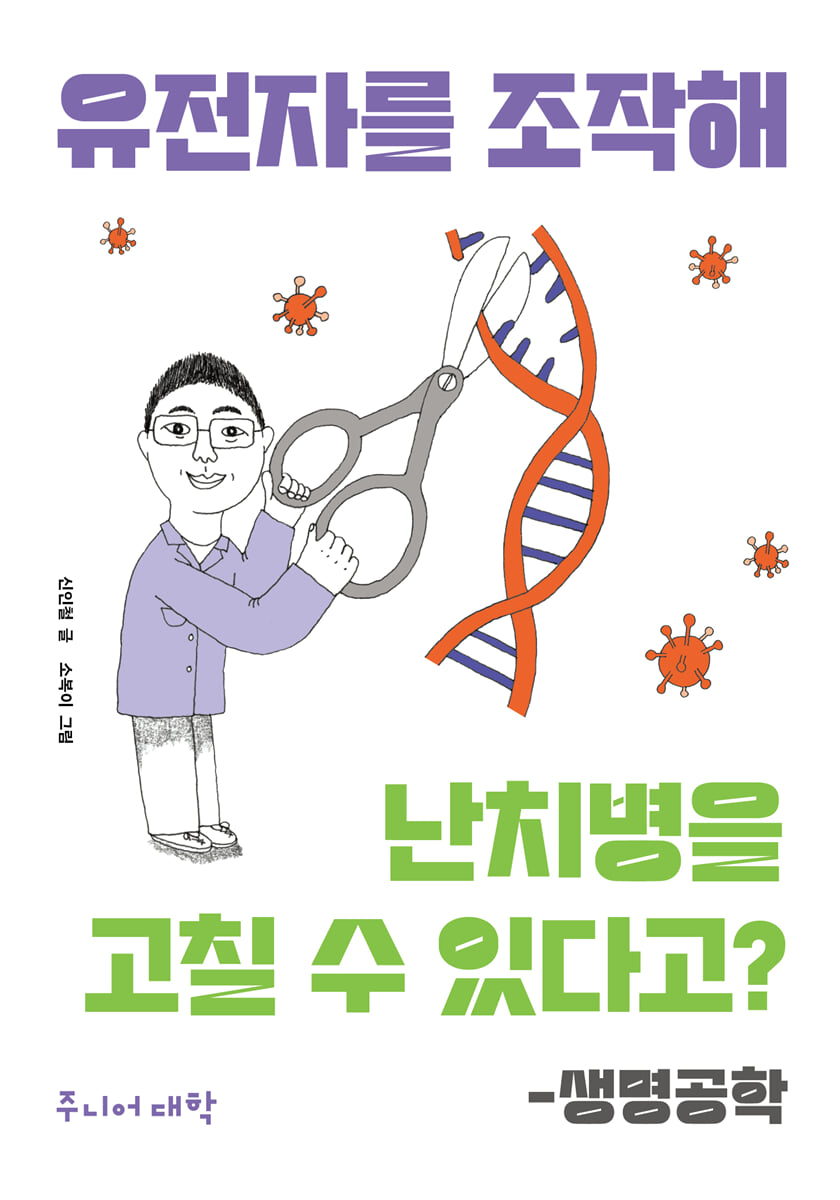
Can we cure incurable diseases by manipulating genes?
 |
Description
Book Introduction
The new book in the "Junior University" series, a must-read for young people contemplating their career paths, "Can Genetic Manipulation Cure Incurable Diseases? - Biotechnology," has been published by Biryongso Co., Ltd.
This series is designed to help young people explore their career paths by presenting books in which experts in each field introduce core topics of their specialized studies using interesting examples.
Since its first publication in 2012, experts in each field have introduced 17 major fields of study that form the foundation of our society, including architecture, pharmacy, law, medicine, economics, and sociology.
This series has been loved by youth, teachers, and parents, receiving recommendations from various organizations, including the Sejong Books Culture Category Selection, the Youth Book of the Year Selection by the Korean Publishers Association, the School Library Journal Recommended Book, the Hanuri Reading Movement Headquarters Recommended Book, and the Morning Reading Recommended Book.
This book will help you realize that all disciplines have developed to understand the world we live in and humanity, and will serve as the first step toward cultivating not only knowledge and information but also deep thought and critical thinking skills.
The 'High School Credit System' will be fully introduced starting in 2025.
This allows students to choose and take a variety of subjects according to their aptitude, and graduate by earning credits for subjects that meet the completion criteria.
Now that it's become increasingly important to actively explore career paths and majors to prepare for college entrance exams, "Junior University" is a useful book for young people seeking to discover their aptitude.
Discover and decide on your career path, gain deeper understanding of your studies, and gain access to up-to-date information and practical advice all at once.
This series is designed to help young people explore their career paths by presenting books in which experts in each field introduce core topics of their specialized studies using interesting examples.
Since its first publication in 2012, experts in each field have introduced 17 major fields of study that form the foundation of our society, including architecture, pharmacy, law, medicine, economics, and sociology.
This series has been loved by youth, teachers, and parents, receiving recommendations from various organizations, including the Sejong Books Culture Category Selection, the Youth Book of the Year Selection by the Korean Publishers Association, the School Library Journal Recommended Book, the Hanuri Reading Movement Headquarters Recommended Book, and the Morning Reading Recommended Book.
This book will help you realize that all disciplines have developed to understand the world we live in and humanity, and will serve as the first step toward cultivating not only knowledge and information but also deep thought and critical thinking skills.
The 'High School Credit System' will be fully introduced starting in 2025.
This allows students to choose and take a variety of subjects according to their aptitude, and graduate by earning credits for subjects that meet the completion criteria.
Now that it's become increasingly important to actively explore career paths and majors to prepare for college entrance exams, "Junior University" is a useful book for young people seeking to discover their aptitude.
Discover and decide on your career path, gain deeper understanding of your studies, and gain access to up-to-date information and practical advice all at once.
- You can preview some of the book's contents.
Preview
index
Part 1: Biotechnology: A discipline that creates value for humanity
01 The fascinating world of biotechnology
What is the difference between life science and biotechnology?
Want to learn about genetic engineering?
Gene cloning, a core technology in genetic engineering
02 Biomedical engineering that protects our health
Can gene therapy cure incurable diseases?
If gene therapy is difficult, how about cell therapy?
Overcoming Disabilities with Tissue Engineering
03 Biotechnology that Creates Abundant Food
Tongil rice that saved us from starvation
Adding features that help with health?
Humanity has been breeding animals for a long time.
04 Please take care of the Earth in crisis
People buried in mountains of garbage
What is bioremediation?
Getting energy from trash?
05 The scary biotechnology is a double-edged sword
What if the virus leaks from the lab?
What are your thoughts on the pros and cons surrounding biotechnology?
We need a higher level of ethics
Part 2: Masters of Biotechnology
01 Stanley Cohen, the founder of modern genetic engineering
I'm going to pursue a career as a basic medical scientist.
What if we made proteins using plasmids?
Finally developing DNA recombination technology
02 Zhang Feng, a pioneer in gene editing research
What is the difference between restriction enzymes and genetic scissors?
Young scientists come up with fresh ideas
You're saying you're carving your natural enemy into your body?
Part 3: Biotechnology, What Are You Curious About?
01 Using light in biotechnology?
02 How long do I have to wait for stem cell treatment?
03 Are you using antibodies for treatment?
04 Why can't the vaccine be made quickly?
05 What technologies are used for early diagnosis of disease?
06 What is an 'organoid'?
07 Neuroengineering requires collaboration across multiple fields?
08 Is bioinformatics something that only requires a computer?
09 Developing materials by imitating living organisms?
10 Can environmental biotechnology help humanity's future?
01 The fascinating world of biotechnology
What is the difference between life science and biotechnology?
Want to learn about genetic engineering?
Gene cloning, a core technology in genetic engineering
02 Biomedical engineering that protects our health
Can gene therapy cure incurable diseases?
If gene therapy is difficult, how about cell therapy?
Overcoming Disabilities with Tissue Engineering
03 Biotechnology that Creates Abundant Food
Tongil rice that saved us from starvation
Adding features that help with health?
Humanity has been breeding animals for a long time.
04 Please take care of the Earth in crisis
People buried in mountains of garbage
What is bioremediation?
Getting energy from trash?
05 The scary biotechnology is a double-edged sword
What if the virus leaks from the lab?
What are your thoughts on the pros and cons surrounding biotechnology?
We need a higher level of ethics
Part 2: Masters of Biotechnology
01 Stanley Cohen, the founder of modern genetic engineering
I'm going to pursue a career as a basic medical scientist.
What if we made proteins using plasmids?
Finally developing DNA recombination technology
02 Zhang Feng, a pioneer in gene editing research
What is the difference between restriction enzymes and genetic scissors?
Young scientists come up with fresh ideas
You're saying you're carving your natural enemy into your body?
Part 3: Biotechnology, What Are You Curious About?
01 Using light in biotechnology?
02 How long do I have to wait for stem cell treatment?
03 Are you using antibodies for treatment?
04 Why can't the vaccine be made quickly?
05 What technologies are used for early diagnosis of disease?
06 What is an 'organoid'?
07 Neuroengineering requires collaboration across multiple fields?
08 Is bioinformatics something that only requires a computer?
09 Developing materials by imitating living organisms?
10 Can environmental biotechnology help humanity's future?
Publisher's Review
The new book in the "Junior University" series, a must-read for young people contemplating their career paths, "Can Genetic Manipulation Cure Incurable Diseases? - Biotechnology," has been published by Biryongso Co., Ltd.
This series is designed to help young people explore their career paths by presenting books in which experts in each field introduce core topics of their specialized studies using interesting examples.
Since its first publication in 2012, experts in each field have introduced 17 major fields of study that form the foundation of our society, including architecture, pharmacy, law, medicine, economics, and sociology.
This series has been loved by youth, teachers, and parents, receiving recommendations from various organizations, including the Sejong Books Culture Category Selection, the Youth Book of the Year Selection by the Korean Publishers Association, the School Library Journal Recommended Book, the Hanuri Reading Movement Headquarters Recommended Book, and the Morning Reading Recommended Book.
This book will help you realize that all disciplines have developed to understand the world we live in and humanity, and will serve as the first step toward cultivating not only knowledge and information but also deep thought and critical thinking skills.
The 'High School Credit System' will be fully introduced starting in 2025.
This allows students to choose and take a variety of subjects according to their aptitude, and graduate by earning credits for subjects that meet the completion criteria.
Now that it's become increasingly important to actively explore career paths and majors to prepare for college entrance exams, "Junior University" is a useful book for young people seeking to discover their aptitude.
Discover and decide on your career path, gain deeper understanding of your studies, and gain access to up-to-date information and practical advice all at once.
Gene therapy, stem cells, solving food problems, and even bioenergy…
Biotechnology changes the future of humanity!
This book is an introductory textbook that explains the vast field of biotechnology in an easy and interesting way.
From core technologies in biotechnology to various attempts to solve the disease, food, and environmental problems facing humanity, it provides a balanced presentation of scientific facts and ethical concerns.
It delves into cutting-edge biotechnology issues closely related to our lives, including gene cloning and DNA recombination, stem cell and antibody therapy, bioremediation, and bioenergy technology, and demonstrates in detail how this discipline can enrich and enrich human life.
In particular, this book emphasizes that biotechnology is more than just a technology; it is a science that understands and helps humans.
Advances in biomedical engineering have opened up possibilities for treating cancer, genetic diseases, and incurable diseases, and the improvement of crop varieties and the development of functional crops are contributing to solving the global food problem.
Furthermore, technologies such as those for extracting energy from waste and for purifying polluted environments remind us that science can be of benefit to humanity.
But at the same time, we do not ignore the ethical questions that biotechnology raises.
It raises the question, "What is right?" about viruses leaking from labs, the potential spread of genetically modified organisms, and experiments on human embryos.
Biotechnology is a field that demands both technological advancement and ethical reflection, and this book seeks to share these concerns with readers.
The author defines biotechnology as “the science of adding necessary value.”
This means that it is not a science that manipulates or controls life itself, but a technology that seeks harmony between humans and the environment and designs a better life.
This is an issue that young people preparing for an essay must organize their own thoughts on.
Meanwhile, we also introduce figures who can serve as role models for young people through the giants of biotechnology.
Through Stanley Cohen, the founder of modern genetic engineering, and Zhang Feng, who pioneered gene-editing technology, we can vividly see how passionate and creative the process of scientific discovery can be.
I also don't miss the latest news in the biotechnology field.
It stimulates scientific curiosity by answering questions such as, "What is an organoid?", "How long do we have to wait for stem cell therapy?", and "Why can't we develop a vaccine quickly?"
This series is designed to help young people explore their career paths by presenting books in which experts in each field introduce core topics of their specialized studies using interesting examples.
Since its first publication in 2012, experts in each field have introduced 17 major fields of study that form the foundation of our society, including architecture, pharmacy, law, medicine, economics, and sociology.
This series has been loved by youth, teachers, and parents, receiving recommendations from various organizations, including the Sejong Books Culture Category Selection, the Youth Book of the Year Selection by the Korean Publishers Association, the School Library Journal Recommended Book, the Hanuri Reading Movement Headquarters Recommended Book, and the Morning Reading Recommended Book.
This book will help you realize that all disciplines have developed to understand the world we live in and humanity, and will serve as the first step toward cultivating not only knowledge and information but also deep thought and critical thinking skills.
The 'High School Credit System' will be fully introduced starting in 2025.
This allows students to choose and take a variety of subjects according to their aptitude, and graduate by earning credits for subjects that meet the completion criteria.
Now that it's become increasingly important to actively explore career paths and majors to prepare for college entrance exams, "Junior University" is a useful book for young people seeking to discover their aptitude.
Discover and decide on your career path, gain deeper understanding of your studies, and gain access to up-to-date information and practical advice all at once.
Gene therapy, stem cells, solving food problems, and even bioenergy…
Biotechnology changes the future of humanity!
This book is an introductory textbook that explains the vast field of biotechnology in an easy and interesting way.
From core technologies in biotechnology to various attempts to solve the disease, food, and environmental problems facing humanity, it provides a balanced presentation of scientific facts and ethical concerns.
It delves into cutting-edge biotechnology issues closely related to our lives, including gene cloning and DNA recombination, stem cell and antibody therapy, bioremediation, and bioenergy technology, and demonstrates in detail how this discipline can enrich and enrich human life.
In particular, this book emphasizes that biotechnology is more than just a technology; it is a science that understands and helps humans.
Advances in biomedical engineering have opened up possibilities for treating cancer, genetic diseases, and incurable diseases, and the improvement of crop varieties and the development of functional crops are contributing to solving the global food problem.
Furthermore, technologies such as those for extracting energy from waste and for purifying polluted environments remind us that science can be of benefit to humanity.
But at the same time, we do not ignore the ethical questions that biotechnology raises.
It raises the question, "What is right?" about viruses leaking from labs, the potential spread of genetically modified organisms, and experiments on human embryos.
Biotechnology is a field that demands both technological advancement and ethical reflection, and this book seeks to share these concerns with readers.
The author defines biotechnology as “the science of adding necessary value.”
This means that it is not a science that manipulates or controls life itself, but a technology that seeks harmony between humans and the environment and designs a better life.
This is an issue that young people preparing for an essay must organize their own thoughts on.
Meanwhile, we also introduce figures who can serve as role models for young people through the giants of biotechnology.
Through Stanley Cohen, the founder of modern genetic engineering, and Zhang Feng, who pioneered gene-editing technology, we can vividly see how passionate and creative the process of scientific discovery can be.
I also don't miss the latest news in the biotechnology field.
It stimulates scientific curiosity by answering questions such as, "What is an organoid?", "How long do we have to wait for stem cell therapy?", and "Why can't we develop a vaccine quickly?"
GOODS SPECIFICS
- Date of issue: August 8, 2025
- Page count, weight, size: 168 pages | 270g | 140*200*20mm
- ISBN13: 9788949153674
- ISBN10: 894915367X
- KC Certification: Certification Type: Conformity Confirmation
You may also like
카테고리
korean


korean

![GQ KOREA Mark (Monthly): December [2025]](http://librairie.coreenne.fr/cdn/shop/files/8ef265dbbfbf186523ed75ba7319009d.jpg?v=1765340328&width=3840)


