

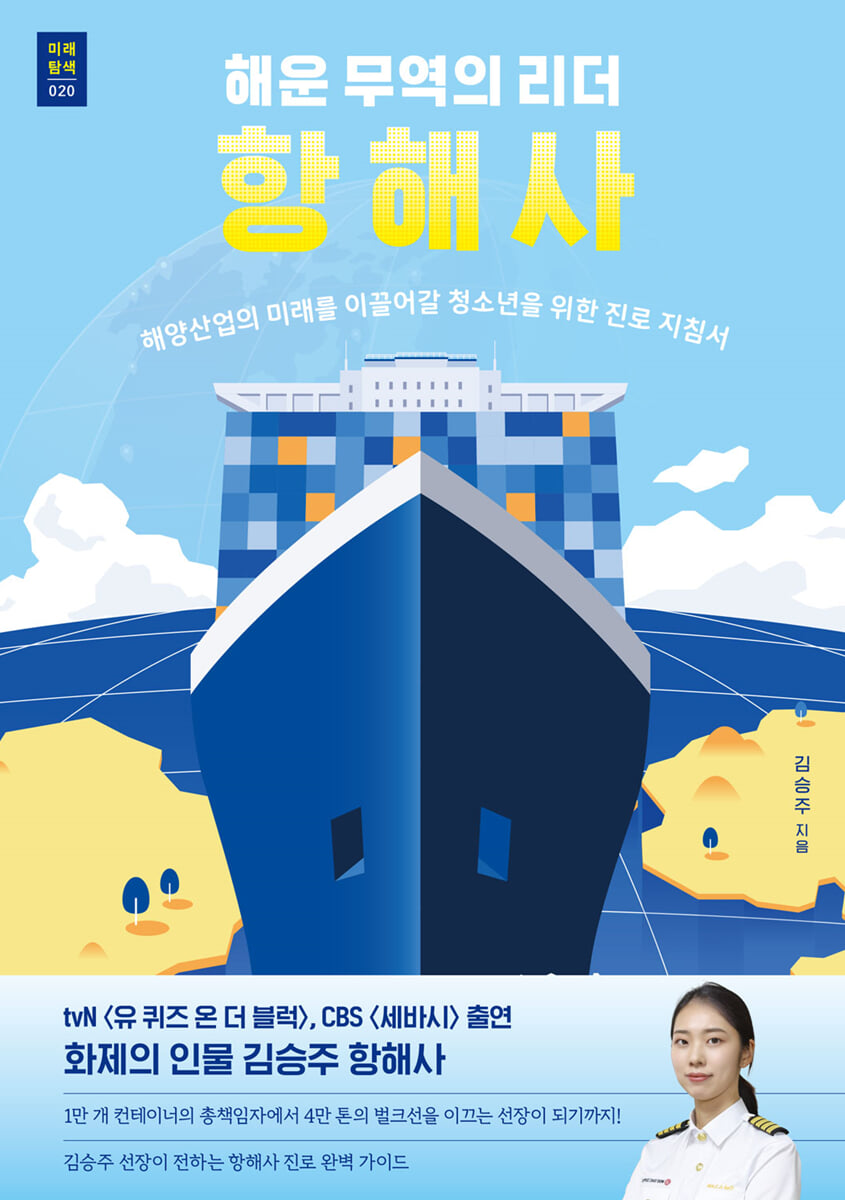
A leading navigator in the maritime trade
 |
Description
Book Introduction
The world is wide, and the sea is wider!
Meet the seafarer, the maritime profession responsible for 99% of Korea's logistics!
About 99% of South Korea's trade is conducted through maritime transport.
At the center of logistics is an unfamiliar but essential profession called ‘navigator.’
However, what a navigator does and what process he or she must go through to reach that path are not well known to the public.
"Navigator: The Leader of Maritime Trade" is Korea's first comprehensive guide to navigating the seafarer, containing a detailed career roadmap that aspiring navigators need to know.
In a world where practical information about the shipping industry is scarce, this book goes beyond a simple job introduction and guides you through the life of a navigator to the point of "experiencing."
"Leader of the Maritime Trade: Navigator" is a book that provides clear guidelines to address the vagueness and confusion that young people face when exploring and choosing a career path.
It vividly records not only the entrance exam strategies, qualification exams, practical training, and interview preparation required to become a navigator, but also the urgent situations, human struggles, failures, and moments of recovery encountered on actual ships.
The greatest strength of this book is its ‘real-worldness.’
Through interviews with various types of ships, including container ships, bulk carriers, car carriers, passenger ships, and deep-sea fishing vessels, the book provides a firsthand look at the broad scope of a navigator's duties, detailing how to deal with various situations, daily life, and division of labor.
It also provides realistic and honest answers to questions like, “Can I become a navigator if I suffer from severe seasickness?”, “What do female navigators do?”, and “What should I do if I encounter pirates at sea?”
In addition, the author shares the various prejudices and limitations she overcame as a female navigator, serving as a rare and valuable role model for young women seeking to enter the shipping industry.
The heartfelt advice and compass-like guidance contained throughout the book resonate deeply with all those who ask about their "attitude toward life" beyond the framework of "career."
This book will be a valuable resource for young people contemplating their career paths, parents seeking their children's direction, teachers seeking job experience and career guidance materials, and even young people considering a career change. It will be a special voyage that will allow readers to explore a wider world and a deeper self through the ocean.
Meet the seafarer, the maritime profession responsible for 99% of Korea's logistics!
About 99% of South Korea's trade is conducted through maritime transport.
At the center of logistics is an unfamiliar but essential profession called ‘navigator.’
However, what a navigator does and what process he or she must go through to reach that path are not well known to the public.
"Navigator: The Leader of Maritime Trade" is Korea's first comprehensive guide to navigating the seafarer, containing a detailed career roadmap that aspiring navigators need to know.
In a world where practical information about the shipping industry is scarce, this book goes beyond a simple job introduction and guides you through the life of a navigator to the point of "experiencing."
"Leader of the Maritime Trade: Navigator" is a book that provides clear guidelines to address the vagueness and confusion that young people face when exploring and choosing a career path.
It vividly records not only the entrance exam strategies, qualification exams, practical training, and interview preparation required to become a navigator, but also the urgent situations, human struggles, failures, and moments of recovery encountered on actual ships.
The greatest strength of this book is its ‘real-worldness.’
Through interviews with various types of ships, including container ships, bulk carriers, car carriers, passenger ships, and deep-sea fishing vessels, the book provides a firsthand look at the broad scope of a navigator's duties, detailing how to deal with various situations, daily life, and division of labor.
It also provides realistic and honest answers to questions like, “Can I become a navigator if I suffer from severe seasickness?”, “What do female navigators do?”, and “What should I do if I encounter pirates at sea?”
In addition, the author shares the various prejudices and limitations she overcame as a female navigator, serving as a rare and valuable role model for young women seeking to enter the shipping industry.
The heartfelt advice and compass-like guidance contained throughout the book resonate deeply with all those who ask about their "attitude toward life" beyond the framework of "career."
This book will be a valuable resource for young people contemplating their career paths, parents seeking their children's direction, teachers seeking job experience and career guidance materials, and even young people considering a career change. It will be a special voyage that will allow readers to explore a wider world and a deeper self through the ocean.
- You can preview some of the book's contents.
Preview
index
Recommendation
Author's Note: Records Drive Growth
01 Prologue This is how I became a navigator
From coincidence to inevitability
Because I did my best | As I set my mind to | I will become a navigator
My Navigator's Chronicles
2012, Entered Maritime University | 2015, LPG Ship Trainee | 2016, First Third Mate on a Container Ship | 2020, Became the First Mate I Longed For | 2021, Let's Go to the Pacific! | 2023, Calmly and Meticulously
Dreams become reality when you put effort into them.
From "Can Do" to "Love" | Even sailing requires milestones.
Shall we watch it together? Movie recommendations
02 Anyone can become a navigator
The prospects for navigators are very bright.
The Importance of Shipping | The Seafarer Shortage | Changes Driven by Technological Innovations in Shipbuilding | Navigators Are in High Demand and Highly Rare
This is what a navigator does
What a Navigator Does | Cargo Ship Navigator | Passenger Ship Navigator
A Vivid Interview with the First Officer of an LNG Ship
A Vivid Interview with the First Officer of a Car Transporter
A Vivid Interview with the First Officer of a Passenger Ship
Lively Interviews with Overseas Cruise Ship Navigators
A Vivid Interview with the First Officer of a Deep-Ocean Fishing Vessel
A Vivid Interview with a Bulk Carrier's First Mate
A Live Interview with a Container Ship Captain
A Vivid Interview with an Overseas LNG Ship Captain
Tips | Preview of How to Become a Navigator
Shall we watch together? Documentary recommendation 1
Shall we watch together? 2 documentary recommendations
03 Becoming a Merchant Marine Navigator
Status of merchant mariners by origin
Method 1 | Target the Maritime University! Admission to a Maritime-Related University
Korea Maritime and Ocean University, College of Maritime Science | Mokpo National Maritime University, College of Maritime Science
Method 2: Admission to a Maritime High School (Meister High School)
Busan National Maritime High School, Incheon National Maritime High School
Method 3 | Conquer the Marine and Fisheries Training Institute!
Becoming a passenger ship navigator
Merchant Marine License and Passenger Ship Training | Become a Cruise Ship Navigator
Overseas shipping company employment
I take care of my own documents | English is basic
Shall we read together? Book recommendations
Shall we watch it together? Movie recommendations
04 A Comprehensive Guide to Becoming a Navigator
School life tips
Dormitory Life: The Beginning of Group Life | Manage Your Grades Well | Improve Your English Grades |
Prepare for the Class 2 Naval Officer written exam in advance | Be actively involved in company-related activities
Practical Life Know-How
Required for a Marine Officer's License, 1 Year of Experience | Handover from Apprentice Navigator | Familiarize Yourself with Simulations | Think, "I'm a Third Mate" | Think Again | Repeat Orders | Strikeouts and Mistake List | Report Later | The Waves Keep Coming
Tips for passing the exam
3rd Class Navigator Written Exam | 3rd Class Radio Electronics Communications License
Tips for passing an interview
Write your self-introduction with sincerity | Conduct mock interviews with friends | Look neat and present yourself with confidence | Be strict about scheduling appointments | Understand the contents of your self-introduction | Sample self-introduction for a rookie officer written by the author | Nothing is 'obvious' | What questions will interviewers ask? | Prepare a few perfect answers | An interview is not a place to tell everything | Check the company website
Shall we watch it together? Movie recommendations
Shall we read together? Book recommendations
05 Qualities of a Navigator
Are there any specific aptitudes required for a navigator?
The uniqueness of the sea, isolated living | Positive thinking | Decisions must be made | Don't be afraid of failure | Ask for help
Drawing my own 'Navigator's Award' - Finding the reason I sail
Let's build up our stamina
Mental strength comes from physical strength | Get enough sleep | Eat enough nutrients
The value of one navigator
Even at sea, the common language is English.
English Rules for the Sea | Everyday Life: Communicating with People of Different Nationalities
Shall we read together? Book recommendations
06 A Thorough Guide for Aspiring Sailors
Entrance Examination (University and High School Admission, Training Institute Curriculum)
Korea Maritime and Ocean University, College of Maritime Science | Mokpo National Maritime University, College of Maritime Science | Busan Maritime High School | Incheon Maritime High School | Korea Maritime and Fisheries Training Institute, Ocean Polytechnic Program
Get past exam questions and various materials.
Navigator License Exam | See various websites
Job search activities
Career Paths After Boarding | Career Information | Education, Classification, and Inspection | Government and Public Agencies | Law and Ship Finance | Shipping, Ports, and Shipbuilding | Maritime Associations and Organizations | Other Government and Public Agencies
Shall we watch it together? Movie recommendations
07 Epilogue _ Uncover the Secrets of the Navigator's World
To become a navigator
Benefits and salary level
Conditions to consider
Miscellaneous facts about navigators
Truth or Rumor About the Navigator
Shall we watch it together? Movie recommendations
Conclusion _ To those who are considering their career path
Appendix _ A Taste of the World of Sailors: Terminology
Hull structure terms | Steering terms | Engine-related terms | Deck roles by ship organization and position | Tonnage-related terms | Port entry and departure terms | Vessel status and movement terms | Navigational equipment terms | Types of ships | Ship safety equipment terms | International conventions | Other frequently used terms
Appendix _References
Author's Note: Records Drive Growth
01 Prologue This is how I became a navigator
From coincidence to inevitability
Because I did my best | As I set my mind to | I will become a navigator
My Navigator's Chronicles
2012, Entered Maritime University | 2015, LPG Ship Trainee | 2016, First Third Mate on a Container Ship | 2020, Became the First Mate I Longed For | 2021, Let's Go to the Pacific! | 2023, Calmly and Meticulously
Dreams become reality when you put effort into them.
From "Can Do" to "Love" | Even sailing requires milestones.
Shall we watch it together? Movie recommendations
02 Anyone can become a navigator
The prospects for navigators are very bright.
The Importance of Shipping | The Seafarer Shortage | Changes Driven by Technological Innovations in Shipbuilding | Navigators Are in High Demand and Highly Rare
This is what a navigator does
What a Navigator Does | Cargo Ship Navigator | Passenger Ship Navigator
A Vivid Interview with the First Officer of an LNG Ship
A Vivid Interview with the First Officer of a Car Transporter
A Vivid Interview with the First Officer of a Passenger Ship
Lively Interviews with Overseas Cruise Ship Navigators
A Vivid Interview with the First Officer of a Deep-Ocean Fishing Vessel
A Vivid Interview with a Bulk Carrier's First Mate
A Live Interview with a Container Ship Captain
A Vivid Interview with an Overseas LNG Ship Captain
Tips | Preview of How to Become a Navigator
Shall we watch together? Documentary recommendation 1
Shall we watch together? 2 documentary recommendations
03 Becoming a Merchant Marine Navigator
Status of merchant mariners by origin
Method 1 | Target the Maritime University! Admission to a Maritime-Related University
Korea Maritime and Ocean University, College of Maritime Science | Mokpo National Maritime University, College of Maritime Science
Method 2: Admission to a Maritime High School (Meister High School)
Busan National Maritime High School, Incheon National Maritime High School
Method 3 | Conquer the Marine and Fisheries Training Institute!
Becoming a passenger ship navigator
Merchant Marine License and Passenger Ship Training | Become a Cruise Ship Navigator
Overseas shipping company employment
I take care of my own documents | English is basic
Shall we read together? Book recommendations
Shall we watch it together? Movie recommendations
04 A Comprehensive Guide to Becoming a Navigator
School life tips
Dormitory Life: The Beginning of Group Life | Manage Your Grades Well | Improve Your English Grades |
Prepare for the Class 2 Naval Officer written exam in advance | Be actively involved in company-related activities
Practical Life Know-How
Required for a Marine Officer's License, 1 Year of Experience | Handover from Apprentice Navigator | Familiarize Yourself with Simulations | Think, "I'm a Third Mate" | Think Again | Repeat Orders | Strikeouts and Mistake List | Report Later | The Waves Keep Coming
Tips for passing the exam
3rd Class Navigator Written Exam | 3rd Class Radio Electronics Communications License
Tips for passing an interview
Write your self-introduction with sincerity | Conduct mock interviews with friends | Look neat and present yourself with confidence | Be strict about scheduling appointments | Understand the contents of your self-introduction | Sample self-introduction for a rookie officer written by the author | Nothing is 'obvious' | What questions will interviewers ask? | Prepare a few perfect answers | An interview is not a place to tell everything | Check the company website
Shall we watch it together? Movie recommendations
Shall we read together? Book recommendations
05 Qualities of a Navigator
Are there any specific aptitudes required for a navigator?
The uniqueness of the sea, isolated living | Positive thinking | Decisions must be made | Don't be afraid of failure | Ask for help
Drawing my own 'Navigator's Award' - Finding the reason I sail
Let's build up our stamina
Mental strength comes from physical strength | Get enough sleep | Eat enough nutrients
The value of one navigator
Even at sea, the common language is English.
English Rules for the Sea | Everyday Life: Communicating with People of Different Nationalities
Shall we read together? Book recommendations
06 A Thorough Guide for Aspiring Sailors
Entrance Examination (University and High School Admission, Training Institute Curriculum)
Korea Maritime and Ocean University, College of Maritime Science | Mokpo National Maritime University, College of Maritime Science | Busan Maritime High School | Incheon Maritime High School | Korea Maritime and Fisheries Training Institute, Ocean Polytechnic Program
Get past exam questions and various materials.
Navigator License Exam | See various websites
Job search activities
Career Paths After Boarding | Career Information | Education, Classification, and Inspection | Government and Public Agencies | Law and Ship Finance | Shipping, Ports, and Shipbuilding | Maritime Associations and Organizations | Other Government and Public Agencies
Shall we watch it together? Movie recommendations
07 Epilogue _ Uncover the Secrets of the Navigator's World
To become a navigator
Benefits and salary level
Conditions to consider
Miscellaneous facts about navigators
Truth or Rumor About the Navigator
Shall we watch it together? Movie recommendations
Conclusion _ To those who are considering their career path
Appendix _ A Taste of the World of Sailors: Terminology
Hull structure terms | Steering terms | Engine-related terms | Deck roles by ship organization and position | Tonnage-related terms | Port entry and departure terms | Vessel status and movement terms | Navigational equipment terms | Types of ships | Ship safety equipment terms | International conventions | Other frequently used terms
Appendix _References
Into the book
How many people can say from the beginning, "My dream is ○○○!"? Even I, who now enjoys the profession of a navigator, didn't dream of being a navigator from the beginning.
In a society that emphasizes studying and entrance exams, it is nearly impossible to gradually figure out what I like and what I am good at.
Most people only start looking into what occupations are available around the time of the college entrance exam.
As it becomes more difficult to get a job, everyone is choosing schools with good job prospects as their first choice.
From the moment they enter university, students begin to worry about their future career path.
After becoming a navigator, I often give lectures to students who dream of becoming maritime officers at Korea Maritime and Ocean University, Mokpo National Maritime University, Maritime High School, and Korea Maritime and Fisheries Training Institute.
The same goes for students' questions.
“How did you become a navigator?” “Isn’t being a navigator difficult?” “How much does a navigator earn?” “What skills do I need to develop to become a navigator?” “Don’t I need to be good at English?” “If I travel around the world, I can travel to those countries?” Questions pour in.
When I give lectures at maritime organizations and meet readers of my books, I get a lot of questions from students and parents.
Among them, the most frequently asked questions are summarized below.
(Omitted) In movies and media, the image of a sailor enjoying romantic seascapes is often highlighted.
But the ship is real.
Once you've adapted to life on board and can handle your work smoothly, the scenery will come as a bonus.
---From "01 Prologue_This is how I became a navigator"
A navigator is a person whose job is to navigate a ship.
What is navigation, and what is its purpose? Navigation is the act of traveling along a sea route to safely transport something to its destination.
The object being transported can be cargo, people, or fish.
Accordingly, ships can be broadly classified into cargo ships, passenger ships, and fishing ships.
Navigators are also divided into those working on merchant ships such as cargo ships, passenger ships, and fishing ships.
Let's look at the four main types of fishing boats.
Fishing vessels can be divided into fishing vessels that catch fish, catch carriers that transport the caught fish, public vessels that have refrigeration, freezing, or processing facilities on board and have several private vessels that receive the catch from private vessels and process it on board, such as for canning, and special fishing vessels.
This book focuses on merchant ships, that is, passenger ships and cargo ships engaged in trade.
(syncopation)
A cargo ship navigator's role is to safely navigate the ship and transport the cargo to its destination.
South Korea, surrounded by the sea on three sides, is a country with a high dependence on exports and imports.
As I briefly mentioned earlier, more than 99% of total cargo volume is transported through maritime trade.
This means that ships are responsible for 99% of the import and export volume.
There are many different types of cargo.
Depending on the type, the structure of the ship also changes.
There are container ships that carry containers, bulk carriers that carry bulk cargo such as iron ore, coal, and grain, tankers that carry LNG, LPG, and crude oil, and car carriers that carry cars.
Because the structure of a ship varies significantly depending on the type of cargo, there are cases where separate training is required for special cargo in addition to the common training that must be received for different ship types.
As a navigator of a cargo ship, the most important thing is to transport the cargo safely.
To achieve this, the safety of the ship, the safety of the cargo, and the safety of the crew must be given priority.
---「02 Anyone Can Be a Navigator: This is What Navigators Do」
Currently, two schools in Korea, Korea Maritime and Ocean University and Target Maritime University, are operating related educational courses.
If you go to college, you can receive the education and training necessary to obtain a navigation license through the educational program provided by the school.
Korea Maritime and Ocean University's College of Maritime Science is the school with the longest history in the maritime field in Korea.
You can prepare to become a navigator by attending Korea Maritime and Ocean University.
The Korea Maritime and Ocean University's Maritime College aims to cultivate maritime professionals by providing all students with a basic education course that includes a one-year onboard training course.
You can become a navigator by advancing to the Department of Navigation Convergence, Department of Marine Police, or Department of Maritime Artificial Intelligence Security at the Maritime University.
All students enrolled in the Maritime University live in the boarding house for four years, and are provided with room and board and prescribed clothing (some items are paid for by the individual) at the government expense.
Part of the entrance fee and tuition fee will be waived for four years.
In the case of male students, those who are determined to be eligible for active duty military service as a result of the physical examination for military service may, in accordance with the Military Service Act, be transferred to the reserve force for shipboard service within the scope of the number of personnel determined by the Military Manpower Administration Commissioner after graduation and complete their military service by serving on board for three years within five years.
---From "03 Becoming a Merchant Marine Navigator: Conquer the Maritime University! Admission to a Maritime University"
When you become a third-year university student, life on a training ship begins.
This is because one year of experience on a training ship is required to obtain a 3rd class marine engineer license.
The school has two training ships, and the basic plan is to live on different training ships for six months.
During the first or second semester, students are given the opportunity to live and practice on a ship operated by an actual company.
You can choose which semester to board and which ship to take based on your grades and circumstances.
Life on a school training ship is like moving your living area and dormitory from land to ship, as you have classmates and professors.
Most of the ships are moored at the docks within the university and classes are held on board, and they also travel to domestic and foreign ports according to the school schedule.
When you train at a shipping company, you board a ship engaged in actual trade as a trainee navigator and live with the captain, navigator, engineer, and crew members, so the atmosphere is different from that of a school training ship.
(syncopation)
If you do a six-month internship as a shipping company captain, you will initially focus all your energy on adapting to life on a ship.
First, you have to get used to the moving ship.
However, even after getting used to it, fatigue often builds up due to the ship's unique smell and unfamiliar environment.
Even I, a 10-year veteran, feel heavy and crushed for a week after returning from vacation and boarding the ship.
Even people who are accustomed to ship life will feel it, but for trainee sailors boarding for the first time, it will be even more difficult and they will feel greatly tired even with just a little movement.
Besides, because I don't know what to do, my nerves are on edge and I'm busy watching the officers' faces.
It's nice to meet an officer who's kind and explains things to you, but don't expect all officers to be like that.
For trainees who are accustomed to learning as students and doing as they are told, this situation can feel unsettling.
If possible, get a detailed handover from the previous trainee navigator.
Even if it is explained in detail in the handover document, there are cases where it gets stuck when actually trying to do it.
Let's watch and learn directly from what the previous trainee navigators do.
It is also a good idea to take a video or record it for personal use after asking permission.
---From "04 Complete Collection of Know-How to Become a Navigator: Practical Life Know-How"
I had an indecisive personality.
I had a hard time choosing what to eat for lunch, and I even had a hard time deciding which snack to eat.
It was hard for me to decide on anything, so I always followed my friends' lead in making decisions.
Then, an incident occurred that changed my indecisive personality in an instant.
It was when I was in college.
There was a sailing simulation class, where the equipment was set up similar to a mission and the class used graphics to make it seem like you were on a ship.
That day, we split into teams and each person took turns being the captain.
When I became a captain, I had to dodge a line of yachts crossing in front of me.
One friend advised me to dodge to the right, while another advised me to dodge to the left.
While I was wandering around, unable to decide which way to go, the screen suddenly froze.
It was because it collided with a yacht.
The screen froze for a while and then the class ended.
I was shocked.
Even after several years, I still remember that scene clearly.
What if this were a real situation? If I had decided to go either right or left, the next path would have been clear.
The accident happened because I just worried and didn't take any action.
When you actually work on a ship and are on watch, there comes a time when you have to make a decision to avoid fishing boats.
You must check the surrounding traffic conditions and make an accurate decision.
To prevent major accidents, navigators must make quick decisions and take a clear stance.
In a society that emphasizes studying and entrance exams, it is nearly impossible to gradually figure out what I like and what I am good at.
Most people only start looking into what occupations are available around the time of the college entrance exam.
As it becomes more difficult to get a job, everyone is choosing schools with good job prospects as their first choice.
From the moment they enter university, students begin to worry about their future career path.
After becoming a navigator, I often give lectures to students who dream of becoming maritime officers at Korea Maritime and Ocean University, Mokpo National Maritime University, Maritime High School, and Korea Maritime and Fisheries Training Institute.
The same goes for students' questions.
“How did you become a navigator?” “Isn’t being a navigator difficult?” “How much does a navigator earn?” “What skills do I need to develop to become a navigator?” “Don’t I need to be good at English?” “If I travel around the world, I can travel to those countries?” Questions pour in.
When I give lectures at maritime organizations and meet readers of my books, I get a lot of questions from students and parents.
Among them, the most frequently asked questions are summarized below.
(Omitted) In movies and media, the image of a sailor enjoying romantic seascapes is often highlighted.
But the ship is real.
Once you've adapted to life on board and can handle your work smoothly, the scenery will come as a bonus.
---From "01 Prologue_This is how I became a navigator"
A navigator is a person whose job is to navigate a ship.
What is navigation, and what is its purpose? Navigation is the act of traveling along a sea route to safely transport something to its destination.
The object being transported can be cargo, people, or fish.
Accordingly, ships can be broadly classified into cargo ships, passenger ships, and fishing ships.
Navigators are also divided into those working on merchant ships such as cargo ships, passenger ships, and fishing ships.
Let's look at the four main types of fishing boats.
Fishing vessels can be divided into fishing vessels that catch fish, catch carriers that transport the caught fish, public vessels that have refrigeration, freezing, or processing facilities on board and have several private vessels that receive the catch from private vessels and process it on board, such as for canning, and special fishing vessels.
This book focuses on merchant ships, that is, passenger ships and cargo ships engaged in trade.
(syncopation)
A cargo ship navigator's role is to safely navigate the ship and transport the cargo to its destination.
South Korea, surrounded by the sea on three sides, is a country with a high dependence on exports and imports.
As I briefly mentioned earlier, more than 99% of total cargo volume is transported through maritime trade.
This means that ships are responsible for 99% of the import and export volume.
There are many different types of cargo.
Depending on the type, the structure of the ship also changes.
There are container ships that carry containers, bulk carriers that carry bulk cargo such as iron ore, coal, and grain, tankers that carry LNG, LPG, and crude oil, and car carriers that carry cars.
Because the structure of a ship varies significantly depending on the type of cargo, there are cases where separate training is required for special cargo in addition to the common training that must be received for different ship types.
As a navigator of a cargo ship, the most important thing is to transport the cargo safely.
To achieve this, the safety of the ship, the safety of the cargo, and the safety of the crew must be given priority.
---「02 Anyone Can Be a Navigator: This is What Navigators Do」
Currently, two schools in Korea, Korea Maritime and Ocean University and Target Maritime University, are operating related educational courses.
If you go to college, you can receive the education and training necessary to obtain a navigation license through the educational program provided by the school.
Korea Maritime and Ocean University's College of Maritime Science is the school with the longest history in the maritime field in Korea.
You can prepare to become a navigator by attending Korea Maritime and Ocean University.
The Korea Maritime and Ocean University's Maritime College aims to cultivate maritime professionals by providing all students with a basic education course that includes a one-year onboard training course.
You can become a navigator by advancing to the Department of Navigation Convergence, Department of Marine Police, or Department of Maritime Artificial Intelligence Security at the Maritime University.
All students enrolled in the Maritime University live in the boarding house for four years, and are provided with room and board and prescribed clothing (some items are paid for by the individual) at the government expense.
Part of the entrance fee and tuition fee will be waived for four years.
In the case of male students, those who are determined to be eligible for active duty military service as a result of the physical examination for military service may, in accordance with the Military Service Act, be transferred to the reserve force for shipboard service within the scope of the number of personnel determined by the Military Manpower Administration Commissioner after graduation and complete their military service by serving on board for three years within five years.
---From "03 Becoming a Merchant Marine Navigator: Conquer the Maritime University! Admission to a Maritime University"
When you become a third-year university student, life on a training ship begins.
This is because one year of experience on a training ship is required to obtain a 3rd class marine engineer license.
The school has two training ships, and the basic plan is to live on different training ships for six months.
During the first or second semester, students are given the opportunity to live and practice on a ship operated by an actual company.
You can choose which semester to board and which ship to take based on your grades and circumstances.
Life on a school training ship is like moving your living area and dormitory from land to ship, as you have classmates and professors.
Most of the ships are moored at the docks within the university and classes are held on board, and they also travel to domestic and foreign ports according to the school schedule.
When you train at a shipping company, you board a ship engaged in actual trade as a trainee navigator and live with the captain, navigator, engineer, and crew members, so the atmosphere is different from that of a school training ship.
(syncopation)
If you do a six-month internship as a shipping company captain, you will initially focus all your energy on adapting to life on a ship.
First, you have to get used to the moving ship.
However, even after getting used to it, fatigue often builds up due to the ship's unique smell and unfamiliar environment.
Even I, a 10-year veteran, feel heavy and crushed for a week after returning from vacation and boarding the ship.
Even people who are accustomed to ship life will feel it, but for trainee sailors boarding for the first time, it will be even more difficult and they will feel greatly tired even with just a little movement.
Besides, because I don't know what to do, my nerves are on edge and I'm busy watching the officers' faces.
It's nice to meet an officer who's kind and explains things to you, but don't expect all officers to be like that.
For trainees who are accustomed to learning as students and doing as they are told, this situation can feel unsettling.
If possible, get a detailed handover from the previous trainee navigator.
Even if it is explained in detail in the handover document, there are cases where it gets stuck when actually trying to do it.
Let's watch and learn directly from what the previous trainee navigators do.
It is also a good idea to take a video or record it for personal use after asking permission.
---From "04 Complete Collection of Know-How to Become a Navigator: Practical Life Know-How"
I had an indecisive personality.
I had a hard time choosing what to eat for lunch, and I even had a hard time deciding which snack to eat.
It was hard for me to decide on anything, so I always followed my friends' lead in making decisions.
Then, an incident occurred that changed my indecisive personality in an instant.
It was when I was in college.
There was a sailing simulation class, where the equipment was set up similar to a mission and the class used graphics to make it seem like you were on a ship.
That day, we split into teams and each person took turns being the captain.
When I became a captain, I had to dodge a line of yachts crossing in front of me.
One friend advised me to dodge to the right, while another advised me to dodge to the left.
While I was wandering around, unable to decide which way to go, the screen suddenly froze.
It was because it collided with a yacht.
The screen froze for a while and then the class ended.
I was shocked.
Even after several years, I still remember that scene clearly.
What if this were a real situation? If I had decided to go either right or left, the next path would have been clear.
The accident happened because I just worried and didn't take any action.
When you actually work on a ship and are on watch, there comes a time when you have to make a decision to avoid fishing boats.
You must check the surrounding traffic conditions and make an accurate decision.
To prevent major accidents, navigators must make quick decisions and take a clear stance.
---From "05 Qualities of a Navigator: You Must Decide"
Publisher's Review
The world of "Navigator" in one volume
"Navigator, the Leader of Maritime Trade" is the 20th book in Pureundeulnyok's "Future Exploration Series," a career guide designed to help young people develop their interests into careers.
Author Seung-ju Kim, a current captain who has been at sea for over 10 years and is also active as a YouTuber called 'Dreaming Navigator', has kindly introduced the world of navigation at a level suitable for young people.
This book, which explores the specialized profession of navigator from a realistic perspective rather than a romantic one, will be a useful resource for teachers, parents, and students alike in career education settings.
Through the journey of a vague career at sea becoming a reality, young readers will gain the courage to change their career path from something they "can do" to something they "love."
The author graduated from Korea Maritime and Ocean University, served as a third mate, second mate, and first mate, and is currently working as a captain on a bulk carrier.
Captain Seung-ju Kim has consistently introduced the world of navigators through books such as “I am 27, a Second Mate” (Hanbit Biz) and “Oh Jin-da O-ryeok” (Deulnyok).
This book systematically organizes all the information needed to prepare for a career as a navigator.
It's packed with practical tips that readers can immediately put into practice, including how to advance to maritime universities and maritime high schools, how to prepare for internships, the navigational license exam, and interview strategies.
It provides more depth than a career information book by adding interesting content such as actual emergency situations experienced while on board, interviews with each ship type, and movie and book recommendations.
In particular, this book not only contains practical information on the process of becoming a navigator, but also on actual work and life, characteristics of each job, differences between ship types, annual salary, entrance exam and interview strategies, etc., but also various episodes and honest concerns experienced at sea, functioning as a true 'career experience book'.
This book will serve as a reliable compass for young people and parents curious about the path to becoming a navigator, aspiring sailors contemplating their career path, and those seeking to establish a direction in life.
In particular, it honestly portrays the hardships and overcoming experiences experienced as a female navigator, providing special empathy and courage to young women who wish to take on the challenge of the shipping industry.
Beyond simply conveying information, the author tells young people contemplating their future paths about “why they chose this path” and “their determination to never give up.”
This book is also a moving record that shows the process of going beyond the concept of 'career' and actively setting one's own life's course.
"Navigator, the Leader of Maritime Trade" is the 20th book in Pureundeulnyok's "Future Exploration Series," a career guide designed to help young people develop their interests into careers.
Author Seung-ju Kim, a current captain who has been at sea for over 10 years and is also active as a YouTuber called 'Dreaming Navigator', has kindly introduced the world of navigation at a level suitable for young people.
This book, which explores the specialized profession of navigator from a realistic perspective rather than a romantic one, will be a useful resource for teachers, parents, and students alike in career education settings.
Through the journey of a vague career at sea becoming a reality, young readers will gain the courage to change their career path from something they "can do" to something they "love."
The author graduated from Korea Maritime and Ocean University, served as a third mate, second mate, and first mate, and is currently working as a captain on a bulk carrier.
Captain Seung-ju Kim has consistently introduced the world of navigators through books such as “I am 27, a Second Mate” (Hanbit Biz) and “Oh Jin-da O-ryeok” (Deulnyok).
This book systematically organizes all the information needed to prepare for a career as a navigator.
It's packed with practical tips that readers can immediately put into practice, including how to advance to maritime universities and maritime high schools, how to prepare for internships, the navigational license exam, and interview strategies.
It provides more depth than a career information book by adding interesting content such as actual emergency situations experienced while on board, interviews with each ship type, and movie and book recommendations.
In particular, this book not only contains practical information on the process of becoming a navigator, but also on actual work and life, characteristics of each job, differences between ship types, annual salary, entrance exam and interview strategies, etc., but also various episodes and honest concerns experienced at sea, functioning as a true 'career experience book'.
This book will serve as a reliable compass for young people and parents curious about the path to becoming a navigator, aspiring sailors contemplating their career path, and those seeking to establish a direction in life.
In particular, it honestly portrays the hardships and overcoming experiences experienced as a female navigator, providing special empathy and courage to young women who wish to take on the challenge of the shipping industry.
Beyond simply conveying information, the author tells young people contemplating their future paths about “why they chose this path” and “their determination to never give up.”
This book is also a moving record that shows the process of going beyond the concept of 'career' and actively setting one's own life's course.
GOODS SPECIFICS
- Date of issue: June 17, 2025
- Page count, weight, size: 340 pages | 148*210*30mm
- ISBN13: 9791159259470
- ISBN10: 115925947X
You may also like
카테고리
korean


korean

![GQ KOREA Mark (Monthly): December [2025]](http://librairie.coreenne.fr/cdn/shop/files/8ef265dbbfbf186523ed75ba7319009d.jpg?v=1765340328&width=3840)


