

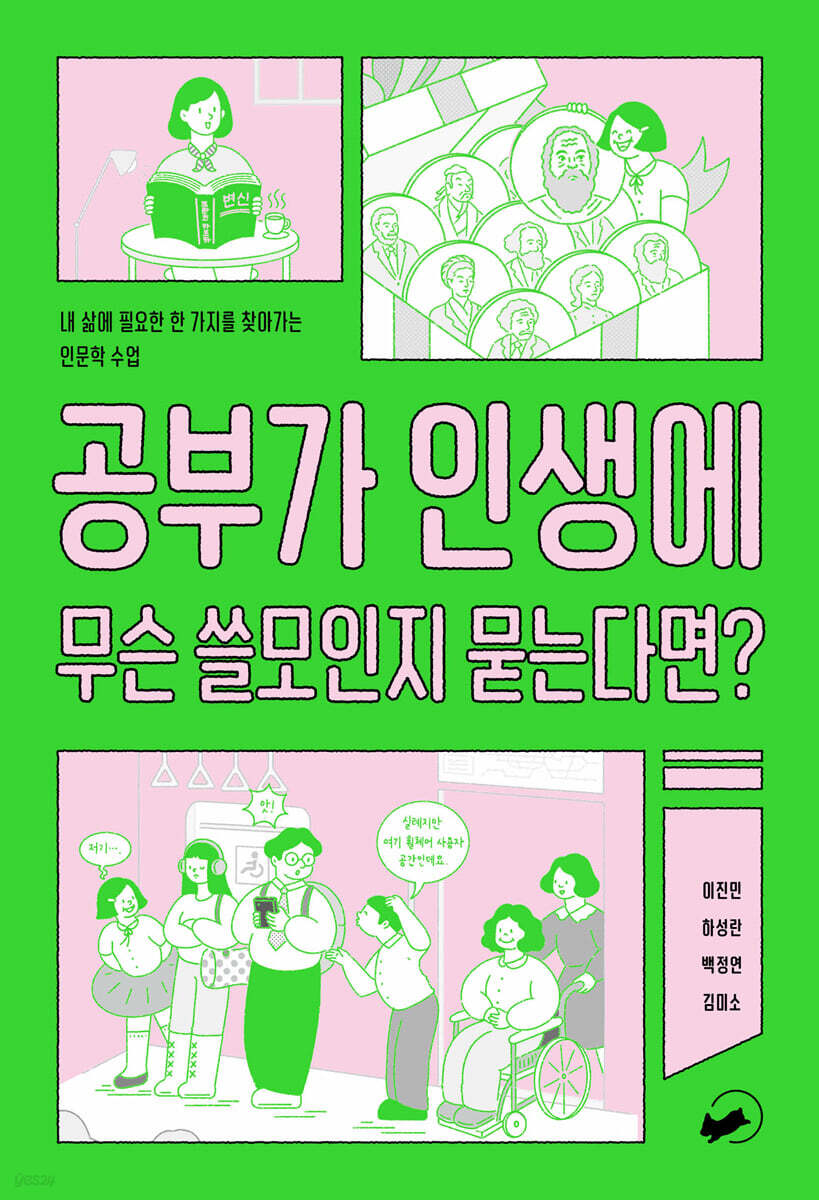
If you ask what use is studying in life?
 |
Description
Book Introduction
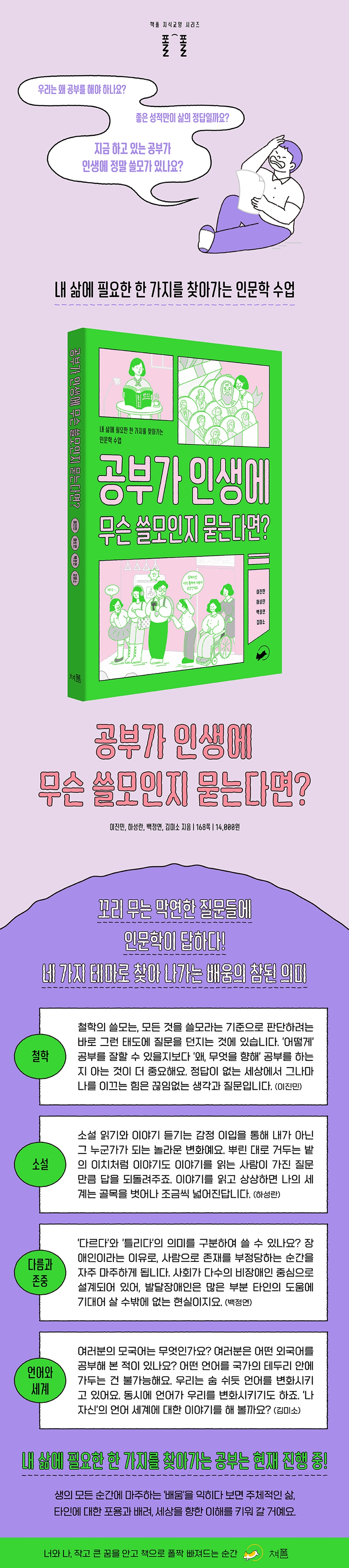
Are good grades the only answer to life?
Why should we study?
The usefulness of learning through humanities themes to answer vague questions that leave you scratching your head
What exactly is study? The definition of "study" is inherently relative and personal, depending on the person and the situation. Yet, it's so often lumped together into a single, absolute value that it overwhelms us.
The reality is that the chemistry between ‘me’ and ‘sex’ feels distant.
Could I, someone like me, find the learning essential to life through study? Indeed? "What Use is Studying in Life?" explores the humanities themes of philosophy, literature, respect for difference (disability), and language, addressing "the one thing we must study in life."
Four authors—political philosopher Lee Jin-min, novelist Ha Seong-ran, social entrepreneur and social worker Baek Jeong-yeon, and linguist Kim Mi-so—tell their own stories and share their own lessons learned for living in an honest and engaging way.
Additionally, the illustrations of Lee Ju-yoon, an illustrator and bestselling author who is beloved by readers for her witty and humorous style, are added to the text, enriching the reading experience.
As I read, I find myself listening to the common voice of the authors I happen to come across: “We all know ourselves (and the world) less than we think.”
Wouldn't it be an honest recognition of ignorance, rather than the illusion of knowledge, that leads people into a deep and wide world?
Observing our surroundings, experiencing the joys and sorrows of life, and accepting the world outside of ourselves with a friendly heart all begin with an attitude of studying the world.
I hope that through "What Use is Studying in Life?", you will discover a new and curious understanding of the many and varied meanings of studying.
The sixth book in the Bookpole knowledge and culture series, 'Polpole'.
Why should we study?
The usefulness of learning through humanities themes to answer vague questions that leave you scratching your head
What exactly is study? The definition of "study" is inherently relative and personal, depending on the person and the situation. Yet, it's so often lumped together into a single, absolute value that it overwhelms us.
The reality is that the chemistry between ‘me’ and ‘sex’ feels distant.
Could I, someone like me, find the learning essential to life through study? Indeed? "What Use is Studying in Life?" explores the humanities themes of philosophy, literature, respect for difference (disability), and language, addressing "the one thing we must study in life."
Four authors—political philosopher Lee Jin-min, novelist Ha Seong-ran, social entrepreneur and social worker Baek Jeong-yeon, and linguist Kim Mi-so—tell their own stories and share their own lessons learned for living in an honest and engaging way.
Additionally, the illustrations of Lee Ju-yoon, an illustrator and bestselling author who is beloved by readers for her witty and humorous style, are added to the text, enriching the reading experience.
As I read, I find myself listening to the common voice of the authors I happen to come across: “We all know ourselves (and the world) less than we think.”
Wouldn't it be an honest recognition of ignorance, rather than the illusion of knowledge, that leads people into a deep and wide world?
Observing our surroundings, experiencing the joys and sorrows of life, and accepting the world outside of ourselves with a friendly heart all begin with an attitude of studying the world.
I hope that through "What Use is Studying in Life?", you will discover a new and curious understanding of the many and varied meanings of studying.
The sixth book in the Bookpole knowledge and culture series, 'Polpole'.
- You can preview some of the book's contents.
Preview
index
Part 1: Philosophy, My Life 101: Caring for Myself and Reading the World (Jinmin Lee)
A list of recommended books for you - please read them!
Part 2 Novels and Stories: As if Living a Thousand Years (Ha Seong-ran)
A list of recommended books for you - please read them!
Part 3: Disability, the World Beyond Difference: Living with "Different" People (Baek Jeong-yeon)
A list of recommended books for you - please read them!
Part 4: Language and Life: Building My World with My Language (Kim Mi-so)
A list of recommended books for you - please read them!
A list of recommended books for you - please read them!
Part 2 Novels and Stories: As if Living a Thousand Years (Ha Seong-ran)
A list of recommended books for you - please read them!
Part 3: Disability, the World Beyond Difference: Living with "Different" People (Baek Jeong-yeon)
A list of recommended books for you - please read them!
Part 4: Language and Life: Building My World with My Language (Kim Mi-so)
A list of recommended books for you - please read them!
Detailed image
Into the book
What comes to mind when you think of philosophy? It's a seemingly intelligible concept, but it's a bunch of words that don't make any sense, something boring and disconnected from reality.
Maybe it will come fluttering towards you like a unicorn or a phoenix.
Actually, it was the same for me when I was a teenager.
They seemed like words on a cloud, and people who studied philosophy seemed a bit odd.
Adults would often pour cold water on the philosophy that already felt distant by saying, "It's perfect for starving."
It felt like dead, gray letters in a thick book, like an old scripture. I think you'll feel the same way.
--- pp.15-16
Write a novel → Write an outrageous lie → Write something that is 'absurdly false and pointless' + 'says something that is not true and pretends to be true'.
Some people use the word novel to mean 'a ridiculous lie' or 'a made-up story that is not true', while others seem to think of novel as 'something without substance'.
Because I often meet people who make a confession, not a confession, that “I don’t read novels.”
They say it's because there's nothing to gain from it like self-help books or business books.
So they think reading novels is a way to pass the time.
You end up wasting precious time on useless things while putting off what you really need to do.
In a word, such people are lazy.
There is an old saying that goes, "If you like stories, you will live in poverty," so it seems that people were wary of reading novels in the past.
--- pp.56-57
People are often curious about 'why' they work with people with developmental disabilities, but they don't seem to be as curious about 'how' they actually get along with people with developmental disabilities.
Perhaps it's because I can't imagine a life where I make friends with someone with a developmental disability and get along well with them. But just as everyone is unique and yet we remain friends, we're all the same, and the same holds true for people with developmental disabilities.
--- pp.116-117
“Now that we have AI and translators, why would we learn two languages?” “When I travel abroad, I can just take a picture with a smartphone app and it will translate it for me. I can even speak to the app and it will interpret it in real time into the foreign language. Why would I learn a language?” “I can just type a few Korean words into AI and it will write an English essay for me. Why would I have to write it out line by line?”
Whenever I hear something like this, I respond like this.
Why do we still handwrite, why do we still have paper books, why are handmade crafts still popular, why do we go through fierce competition to buy tickets and pay a lot of money to go to idol concerts when we can just watch them on YouTube, why do we make plans to go out and hang out with friends when we can just video call them?
I think this might be the answer to all these questions.
Maybe it will come fluttering towards you like a unicorn or a phoenix.
Actually, it was the same for me when I was a teenager.
They seemed like words on a cloud, and people who studied philosophy seemed a bit odd.
Adults would often pour cold water on the philosophy that already felt distant by saying, "It's perfect for starving."
It felt like dead, gray letters in a thick book, like an old scripture. I think you'll feel the same way.
--- pp.15-16
Write a novel → Write an outrageous lie → Write something that is 'absurdly false and pointless' + 'says something that is not true and pretends to be true'.
Some people use the word novel to mean 'a ridiculous lie' or 'a made-up story that is not true', while others seem to think of novel as 'something without substance'.
Because I often meet people who make a confession, not a confession, that “I don’t read novels.”
They say it's because there's nothing to gain from it like self-help books or business books.
So they think reading novels is a way to pass the time.
You end up wasting precious time on useless things while putting off what you really need to do.
In a word, such people are lazy.
There is an old saying that goes, "If you like stories, you will live in poverty," so it seems that people were wary of reading novels in the past.
--- pp.56-57
People are often curious about 'why' they work with people with developmental disabilities, but they don't seem to be as curious about 'how' they actually get along with people with developmental disabilities.
Perhaps it's because I can't imagine a life where I make friends with someone with a developmental disability and get along well with them. But just as everyone is unique and yet we remain friends, we're all the same, and the same holds true for people with developmental disabilities.
--- pp.116-117
“Now that we have AI and translators, why would we learn two languages?” “When I travel abroad, I can just take a picture with a smartphone app and it will translate it for me. I can even speak to the app and it will interpret it in real time into the foreign language. Why would I learn a language?” “I can just type a few Korean words into AI and it will write an English essay for me. Why would I have to write it out line by line?”
Whenever I hear something like this, I respond like this.
Why do we still handwrite, why do we still have paper books, why are handmade crafts still popular, why do we go through fierce competition to buy tickets and pay a lot of money to go to idol concerts when we can just watch them on YouTube, why do we make plans to go out and hang out with friends when we can just video call them?
I think this might be the answer to all these questions.
--- pp.156-157
Publisher's Review
What kind of 'learning' do you need right now?
"My Study Story" by a philosopher, novelist, social entrepreneur, and linguist
The amount of studying that needs to be done in the limited time each day never decreases.
Once you've achieved your target grades, once you're close to getting into your desired university, will you finally feel relieved? What if neither of those things works out? The reality is that we're pressed for time, but often times, the feeling of emptiness grows.
Is it because we need to quickly and coolly recognize the fierce college entrance exam race where everyone is everyone's competitor?
Or, perhaps they are not really interested in studying and are unsure of what to do, but are just doing their homework and solving problems because of the adults' advice and nagging.
“In fact, studying is not easy.
But it's not that difficult." This obvious irony seems to be what leaves most people at a loss.
Well then, let's change the sentence slightly.
“Actually, studying isn’t fun.
But it's not that it's not fun." It's also an obvious irony.
Ultimately, the definition of 'study' is extremely relative and personal depending on the person and the situation, but it is so absolute that it overwhelms us by being lumped together into one value.
There is a lot of good information out there that suggests methods and directions for studying, such as 'how' to study and 'why' to study, but the actual chemistry between 'me' and 'grades' feels close but distant.
Could I, someone like me, find the learning I need in life through studying? Indeed?
"If you ask what use is studying in life?" is a book that discusses "one thing you must study in life" through the theme of humanities.
Four authors—political philosopher Lee Jin-min, novelist Ha Seong-ran, social entrepreneur and social worker Baek Jeong-yeon, and linguist Kim Mi-so—tell their own stories and share their own lessons learned for living in an honest and engaging way.
For those of you who are busy, let me start by saying that this book may not have an immediate effect on your grades.
The process of finding out what studying is and what its use is cannot be easy or quick.
In that sense, how about taking a closer look at the ‘humanities’ written in the book’s subtitle?
Humanities, which are studies of humans, by humans, and for humans, are the most common learning.
We are humans, not AI.
Family, friends, and neighbors are (still mostly) human, and we all live in a world that humans discover, ruin, and then try to rebuild.
So, can we live tomorrow without understanding humanity? When we feel disgusted by someone who looks different from us, when we feel jealousy and hatred toward someone more accomplished than us, when we don't understand why we seek out novels or poetry, when we wonder why we should study languages when a translator can do it for us... We must recognize that what we see, hear, and think isn't the whole story.
Observing our surroundings, experiencing all the joys and sorrows of life, and accepting the world outside of ourselves with a friendly heart all begin with an attitude of studying the world.
I hope that through "What Use is Studying in Life?", you will discover a new and curious understanding of the many and varied meanings of studying.
Before starting the main text, the door to each theme is opened through the 'Checklist' and 'Laying the Foundation for Studying' section, and at the end of the main text, the 'Books, Recommended Reading!' section introduces a list of books carefully selected by each author for readers.
I confidently recommend that you spend time reading this book, and it will not be wasted on your life.
Philosophy - Literature - Difference and Respect (Disability) - Language and the World
I'm starting a humanities class to find the one thing I need in my life!
In Part 1, “Philosophy, My Life 101: Caring for Myself and Reading the World,” we meet the story of political philosopher Jinmin Lee.
Author Lee Jin-min studied political philosophy in Korea and the United States, and now lives in a rural German village, reading, writing, and giving lectures.
It's not like "I'd die without it, like money or Wi-Fi," nor is it "my favorite food, like naengmyeon or tteokbokki," yet philosophy is considered essential, or even essential, to living! Author Lee Jin-min argues, "The utility of philosophy lies precisely in its attitude of questioning its utility." (p. 14)
As we live, we encounter philosophy that is close to us in more diverse forms and shapes than we might think.
Philosophy is embedded in the classroom, in the lyrics of your favorite songs, and even in famous movies.
The author says that we are “fundamentally ignorant beings” and that “not only is the world around me ignorant, but there is also a lot of ignorance within me.”
And this is a natural course of action in a rapidly changing world.
So, let's not miss the author's delightful advice on why we really need philosophy in our lives.
Part 2, 'Novels and Stories: As if Living a Thousand Years', continues with the story of novelist Ha Seong-ran.
Author Ha Seong-ran begins her story by confessing that although she has been writing novels for nearly 30 years, she is always embarrassed when faced with introducing herself.
The sentence the author carefully handed over was 'a person who sees and hears'.
“Seeing and listening is harder than you think.
When faced with a sight that is 'unbearable to look at', it is easy to close our eyes and turn away.
It takes will as well as affection to see it.
“The same goes for listening.” (Page 49) The years of dignified quietude that have passed since he became one of the representative novelists of Korean literature are fully reflected in every word of the story.
You've probably heard this phrase before: "I'm sitting here writing a novel!"
Novels are often dismissed as 'outrageous lies' or 'empty stories'.
Is literature really the subject that universities adjust departments for lack of future prospects and that adults worry about whether their children's career paths and futures will be promising?
The author emphasizes that “reading stories should be a part of life.”
Becoming someone else and empathizing with someone.
This would be an important attitude to not be trapped in my world (dogmatism and stubbornness) through literature.
Four themes of humanities
Let's cultivate a life of self-reliance, tolerance and consideration, and understanding of the world!
Part 3, “A World Beyond Disability and Difference: Living with ‘Different’ People,” tells the story of Baek Jeong-yeon, a social entrepreneur and social worker.
The author, who majored in social welfare, has worked in the field of welfare for the disabled for a long time.
After working as a social worker for 15 years, he decided to start his own business and is currently running a social enterprise called ‘Sosohan Sotong’, which provides easy-to-understand information for people with developmental disabilities and other information-disadvantaged groups.
It's difficult to set a standard because 'easy' feels different to each person.
This is because more people than you might think try to fit a minority answer into the majority answer.
Respecting a person's human rights means respecting that person as he or she is.
Depending on how and with whom you live, people will become slightly different.
Living with her husband, a spinal cord injury patient who uses a wheelchair, the author is exposed to the daily lives of people with disabilities who face discrimination.
“Discrimination continues today, and tomorrow we may discover another form of discrimination,” but the author continues to speak out today, “standing beside the rejected body.”
Everyone has the right to be respected as an equal human being.
It's not about anyone's special talent or ability, it's just a matter of putting your mind to it.
Because difference and discrimination are just a hair's breadth apart.
In Part 4, “Language and Life: How to Create My World with My Language,” we meet the story of linguist Kim Mi-so.
Author Kim Mi-so loves stories and loves to immerse herself in and float between languages.
Wait, what does it mean to enjoy being lost not in language but in the "between" of language? Perhaps there's a hint in the author's words: "Language always crosses borders" (p. 131).
The author, who happened to enter the English Education department instead of the Korean Education department, fell into the world of a new language. After graduating, he lived in the United States for six years and Japan for five years, and ended up in a valley between three languages.
The author, whose interesting background includes being a “Korean who teaches English in Japan,” uses the terms “first language” and “second language” to describe the world of language, rather than using the terms “native language” and “foreign language.”
Because I need to shift the focus from the country to myself to establish my own linguistic world.
But these days, there has been a big change in the world of language.
'Translators' and 'artificial intelligence' are replacing people's second language learning.
Of course, communicating with a translation app is easy and convenient, but going beyond that is difficult.
The author emphasizes that the process of discovering “what I like and what kind of learner I am” is a valuable experience that one encounters when studying a language directly.
"My Study Story" by a philosopher, novelist, social entrepreneur, and linguist
The amount of studying that needs to be done in the limited time each day never decreases.
Once you've achieved your target grades, once you're close to getting into your desired university, will you finally feel relieved? What if neither of those things works out? The reality is that we're pressed for time, but often times, the feeling of emptiness grows.
Is it because we need to quickly and coolly recognize the fierce college entrance exam race where everyone is everyone's competitor?
Or, perhaps they are not really interested in studying and are unsure of what to do, but are just doing their homework and solving problems because of the adults' advice and nagging.
“In fact, studying is not easy.
But it's not that difficult." This obvious irony seems to be what leaves most people at a loss.
Well then, let's change the sentence slightly.
“Actually, studying isn’t fun.
But it's not that it's not fun." It's also an obvious irony.
Ultimately, the definition of 'study' is extremely relative and personal depending on the person and the situation, but it is so absolute that it overwhelms us by being lumped together into one value.
There is a lot of good information out there that suggests methods and directions for studying, such as 'how' to study and 'why' to study, but the actual chemistry between 'me' and 'grades' feels close but distant.
Could I, someone like me, find the learning I need in life through studying? Indeed?
"If you ask what use is studying in life?" is a book that discusses "one thing you must study in life" through the theme of humanities.
Four authors—political philosopher Lee Jin-min, novelist Ha Seong-ran, social entrepreneur and social worker Baek Jeong-yeon, and linguist Kim Mi-so—tell their own stories and share their own lessons learned for living in an honest and engaging way.
For those of you who are busy, let me start by saying that this book may not have an immediate effect on your grades.
The process of finding out what studying is and what its use is cannot be easy or quick.
In that sense, how about taking a closer look at the ‘humanities’ written in the book’s subtitle?
Humanities, which are studies of humans, by humans, and for humans, are the most common learning.
We are humans, not AI.
Family, friends, and neighbors are (still mostly) human, and we all live in a world that humans discover, ruin, and then try to rebuild.
So, can we live tomorrow without understanding humanity? When we feel disgusted by someone who looks different from us, when we feel jealousy and hatred toward someone more accomplished than us, when we don't understand why we seek out novels or poetry, when we wonder why we should study languages when a translator can do it for us... We must recognize that what we see, hear, and think isn't the whole story.
Observing our surroundings, experiencing all the joys and sorrows of life, and accepting the world outside of ourselves with a friendly heart all begin with an attitude of studying the world.
I hope that through "What Use is Studying in Life?", you will discover a new and curious understanding of the many and varied meanings of studying.
Before starting the main text, the door to each theme is opened through the 'Checklist' and 'Laying the Foundation for Studying' section, and at the end of the main text, the 'Books, Recommended Reading!' section introduces a list of books carefully selected by each author for readers.
I confidently recommend that you spend time reading this book, and it will not be wasted on your life.
Philosophy - Literature - Difference and Respect (Disability) - Language and the World
I'm starting a humanities class to find the one thing I need in my life!
In Part 1, “Philosophy, My Life 101: Caring for Myself and Reading the World,” we meet the story of political philosopher Jinmin Lee.
Author Lee Jin-min studied political philosophy in Korea and the United States, and now lives in a rural German village, reading, writing, and giving lectures.
It's not like "I'd die without it, like money or Wi-Fi," nor is it "my favorite food, like naengmyeon or tteokbokki," yet philosophy is considered essential, or even essential, to living! Author Lee Jin-min argues, "The utility of philosophy lies precisely in its attitude of questioning its utility." (p. 14)
As we live, we encounter philosophy that is close to us in more diverse forms and shapes than we might think.
Philosophy is embedded in the classroom, in the lyrics of your favorite songs, and even in famous movies.
The author says that we are “fundamentally ignorant beings” and that “not only is the world around me ignorant, but there is also a lot of ignorance within me.”
And this is a natural course of action in a rapidly changing world.
So, let's not miss the author's delightful advice on why we really need philosophy in our lives.
Part 2, 'Novels and Stories: As if Living a Thousand Years', continues with the story of novelist Ha Seong-ran.
Author Ha Seong-ran begins her story by confessing that although she has been writing novels for nearly 30 years, she is always embarrassed when faced with introducing herself.
The sentence the author carefully handed over was 'a person who sees and hears'.
“Seeing and listening is harder than you think.
When faced with a sight that is 'unbearable to look at', it is easy to close our eyes and turn away.
It takes will as well as affection to see it.
“The same goes for listening.” (Page 49) The years of dignified quietude that have passed since he became one of the representative novelists of Korean literature are fully reflected in every word of the story.
You've probably heard this phrase before: "I'm sitting here writing a novel!"
Novels are often dismissed as 'outrageous lies' or 'empty stories'.
Is literature really the subject that universities adjust departments for lack of future prospects and that adults worry about whether their children's career paths and futures will be promising?
The author emphasizes that “reading stories should be a part of life.”
Becoming someone else and empathizing with someone.
This would be an important attitude to not be trapped in my world (dogmatism and stubbornness) through literature.
Four themes of humanities
Let's cultivate a life of self-reliance, tolerance and consideration, and understanding of the world!
Part 3, “A World Beyond Disability and Difference: Living with ‘Different’ People,” tells the story of Baek Jeong-yeon, a social entrepreneur and social worker.
The author, who majored in social welfare, has worked in the field of welfare for the disabled for a long time.
After working as a social worker for 15 years, he decided to start his own business and is currently running a social enterprise called ‘Sosohan Sotong’, which provides easy-to-understand information for people with developmental disabilities and other information-disadvantaged groups.
It's difficult to set a standard because 'easy' feels different to each person.
This is because more people than you might think try to fit a minority answer into the majority answer.
Respecting a person's human rights means respecting that person as he or she is.
Depending on how and with whom you live, people will become slightly different.
Living with her husband, a spinal cord injury patient who uses a wheelchair, the author is exposed to the daily lives of people with disabilities who face discrimination.
“Discrimination continues today, and tomorrow we may discover another form of discrimination,” but the author continues to speak out today, “standing beside the rejected body.”
Everyone has the right to be respected as an equal human being.
It's not about anyone's special talent or ability, it's just a matter of putting your mind to it.
Because difference and discrimination are just a hair's breadth apart.
In Part 4, “Language and Life: How to Create My World with My Language,” we meet the story of linguist Kim Mi-so.
Author Kim Mi-so loves stories and loves to immerse herself in and float between languages.
Wait, what does it mean to enjoy being lost not in language but in the "between" of language? Perhaps there's a hint in the author's words: "Language always crosses borders" (p. 131).
The author, who happened to enter the English Education department instead of the Korean Education department, fell into the world of a new language. After graduating, he lived in the United States for six years and Japan for five years, and ended up in a valley between three languages.
The author, whose interesting background includes being a “Korean who teaches English in Japan,” uses the terms “first language” and “second language” to describe the world of language, rather than using the terms “native language” and “foreign language.”
Because I need to shift the focus from the country to myself to establish my own linguistic world.
But these days, there has been a big change in the world of language.
'Translators' and 'artificial intelligence' are replacing people's second language learning.
Of course, communicating with a translation app is easy and convenient, but going beyond that is difficult.
The author emphasizes that the process of discovering “what I like and what kind of learner I am” is a valuable experience that one encounters when studying a language directly.
GOODS SPECIFICS
- Date of issue: March 10, 2025
- Page count, weight, size: 168 pages | 232g | 140*205*11mm
- ISBN13: 9791193162453
- ISBN10: 1193162459
You may also like
카테고리
korean


korean

![GQ KOREA Mark (Monthly): December [2025]](http://librairie.coreenne.fr/cdn/shop/files/8ef265dbbfbf186523ed75ba7319009d.jpg?v=1765340328&width=3840)


