

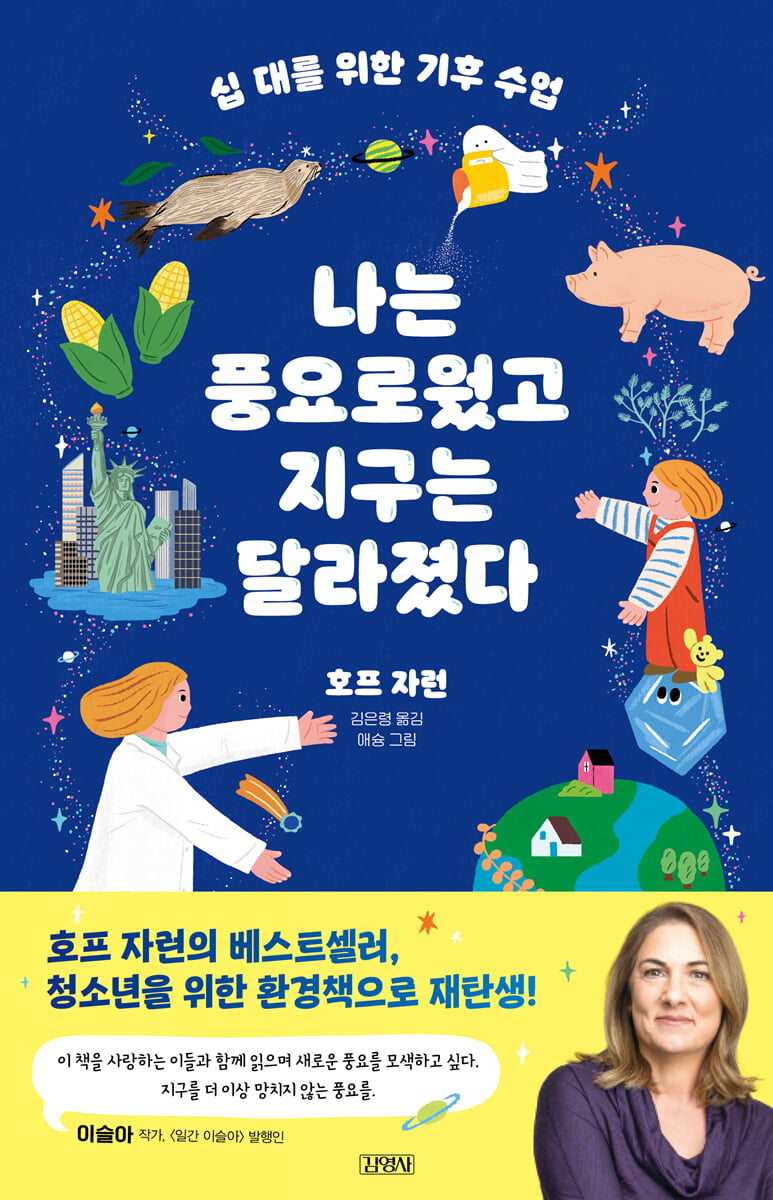
Climate Lessons for Teens: I Was Rich, and the Earth Was Changed
 |
Description
Book Introduction
Hope Jahren's bestseller, "I Was Rich, and the World Was Different"
Reborn as an environmental policy for teenagers!
"I highly recommend this book to children and young readers who will have a longer relationship with the Earth than adults today." _Ha Kyung-ja (Professor of Earth and Environmental Sciences, Pusan National University, former President of the Korean Meteorological Society)
How have our lives and the planet changed over the past 50 years? Hope Jahren, whose books "Rap Girl" and "I Was Rich, the Earth Was Different," have won global acclaim, is now reaching readers with a new book titled "The World's Kindest Climate Lesson."
The title is "Climate Lessons for Teens: I Was Rich and the Earth Was Different."
Hope Jahren has personally revised and published the book, "I Was Rich, and the World Was Different," which was previously written for adult readers, to suit the eye level of teenage readers.
This new book has been edited and simplified to make it more accessible to young people, and the Korean edition features illustrations by popular illustrator Ae-Sung.
Through this book, many young readers will gain a broader understanding of the climate and ecological crisis facing our society and deeply empathize with the need for change to transform the world.
Reborn as an environmental policy for teenagers!
"I highly recommend this book to children and young readers who will have a longer relationship with the Earth than adults today." _Ha Kyung-ja (Professor of Earth and Environmental Sciences, Pusan National University, former President of the Korean Meteorological Society)
How have our lives and the planet changed over the past 50 years? Hope Jahren, whose books "Rap Girl" and "I Was Rich, the Earth Was Different," have won global acclaim, is now reaching readers with a new book titled "The World's Kindest Climate Lesson."
The title is "Climate Lessons for Teens: I Was Rich and the Earth Was Different."
Hope Jahren has personally revised and published the book, "I Was Rich, and the World Was Different," which was previously written for adult readers, to suit the eye level of teenage readers.
This new book has been edited and simplified to make it more accessible to young people, and the Korean edition features illustrations by popular illustrator Ae-Sung.
Through this book, many young readers will gain a broader understanding of the climate and ecological crisis facing our society and deeply empathize with the need for change to transform the world.
- You can preview some of the book's contents.
Preview
index
Recommendation
Preface to the Korean edition
Part 1.
life
1.
Our story begins
2.
Who are we
3.
How do we exist?
4.
Where do we stand?
Part 2.
food
5.
Growing crops
6.
Raising livestock
7.
catching fish
8.
Making sugar
9.
Throw it all away
Part 3.
energy
10.
Turn on the light
11.
Move around
12.
The plants we burned
13.
The wheel we turn
Part 4.
earth
14.
The atmosphere has changed
15.
Warmer weather
16.
melting glaciers
17.
Rising water levels
18.
A harsh farewell
19.
Another page
supplement.
For the abundance of the earth
1.
What we need to do
2.
The changes we make
3.
Facts about the environment
4.
Sources and Further Reading
Acknowledgements
Preface to the Korean edition
Part 1.
life
1.
Our story begins
2.
Who are we
3.
How do we exist?
4.
Where do we stand?
Part 2.
food
5.
Growing crops
6.
Raising livestock
7.
catching fish
8.
Making sugar
9.
Throw it all away
Part 3.
energy
10.
Turn on the light
11.
Move around
12.
The plants we burned
13.
The wheel we turn
Part 4.
earth
14.
The atmosphere has changed
15.
Warmer weather
16.
melting glaciers
17.
Rising water levels
18.
A harsh farewell
19.
Another page
supplement.
For the abundance of the earth
1.
What we need to do
2.
The changes we make
3.
Facts about the environment
4.
Sources and Further Reading
Acknowledgements
Detailed image

Into the book
“I’m over 50 years old and I’ve been hearing people talk about climate change for at least the past 20 years.
I am a scientist who studies climate change.
So, fortunately, I hear people arguing about climate change almost every day.
But I only recently learned that this fight started much earlier.”
--- p.16 「1.
From "Our Story Begins"
“I was born and raised in a small town of about 10,000 people, where my grandparents settled in 1920.
As an adult, I moved to a city with a population of over a million to study and find a job.
This is probably a very common story all over the world.
Over the past half-century, more than a billion people have moved to or been born in cities with populations exceeding one million.
I was one of many people who moved to the city, and they left for much the same reasons.
It's because of the hope that you'll discover new opportunities that are hard to find back home.
…then a question arises.
If all the world's people migrate to cities and all resources are concentrated there, who will remain on rural farms to farm? The answer is that such people will become increasingly rare.
In the next chapter, we'll talk about the few people left who grow all the food we need to feed you and me.”
--- p.40 「4.
From "Where Do We Stand"
“My friend said it took him some time to realize that the Ukrainian tour guide hadn’t stopped the car next to the pasture just to show us a cow.
The guide showed my friend three years of hard work.
There is no such thing as easy farm work.
The robust bulls, ready for slaughter, are born from young heifers who have been fed special food and cared for during their 280-day gestation period.
When a calf is born, it is castrated and fed with hay for 18 months.
They have to be cleaned of manure, pastured, fenced, watered, wormed, and finally fattened for slaughter.
The guide's choice of his sister's wedding feast as the final destination for the beef signifies the many years of hard work that went into raising this calf and bringing it to the table.”
--- p.69-70 「6.
From "Raising Livestock"
“Every day, women and men around the world work six, eight, ten, or even more hours to produce something of value.
However, the monetary value assigned to these individual products is formed by a complex intertwining of factors such as supply and demand, history, and greed.
Sewing thirty pairs of jeans, performing a complex surgical procedure, and teaching a child to read are all the same tasks that take a full day of work, yet the global market places vastly different values on each outcome—a box of clothes, a successful surgery, a child who can read.”
--- p.120-122 「10.
From "Turning on the Light"
“For various reasons, like the ice being too thin, kids in my hometown can no longer skate on the pond, and I sneeze about 15 more days a year from ragweed pollen than when I was a kid.
“If you want to truly understand how the world has changed over time, there is no better way than to revisit your childhood memories.”
--- p.186 「15.
From "Warmer Weather"
“…Bangladeshi people have emitted less than 1 percent of global carbon dioxide emissions over the past 50 years, yet they pay the highest price for their impact.
But in fact, this happens very often.
“There is a mismatch between those who benefit from fossil fuel use and those who suffer most from its excessive use.”
--- p.212-213 「17.
From "Rising Water Level"
“I was born late in my father’s life as the youngest and only daughter.
When we had this conversation, my father was 55 years old, and he had already witnessed the world map change completely twice in his life.
But that wasn't the only reason my father believed in the human ability to change the world.
My father believed this because he had taught physics, chemistry, calculus, and geology to everyone in the neighborhood and their children, and had seen them grow and change.
… My father believed that way because he loved me as his daughter, and thanks to him, I too came to have that belief.
“I believed in the words of my first and favorite science teacher: if you work hard and love, eventually your dreams will come true.”
I am a scientist who studies climate change.
So, fortunately, I hear people arguing about climate change almost every day.
But I only recently learned that this fight started much earlier.”
--- p.16 「1.
From "Our Story Begins"
“I was born and raised in a small town of about 10,000 people, where my grandparents settled in 1920.
As an adult, I moved to a city with a population of over a million to study and find a job.
This is probably a very common story all over the world.
Over the past half-century, more than a billion people have moved to or been born in cities with populations exceeding one million.
I was one of many people who moved to the city, and they left for much the same reasons.
It's because of the hope that you'll discover new opportunities that are hard to find back home.
…then a question arises.
If all the world's people migrate to cities and all resources are concentrated there, who will remain on rural farms to farm? The answer is that such people will become increasingly rare.
In the next chapter, we'll talk about the few people left who grow all the food we need to feed you and me.”
--- p.40 「4.
From "Where Do We Stand"
“My friend said it took him some time to realize that the Ukrainian tour guide hadn’t stopped the car next to the pasture just to show us a cow.
The guide showed my friend three years of hard work.
There is no such thing as easy farm work.
The robust bulls, ready for slaughter, are born from young heifers who have been fed special food and cared for during their 280-day gestation period.
When a calf is born, it is castrated and fed with hay for 18 months.
They have to be cleaned of manure, pastured, fenced, watered, wormed, and finally fattened for slaughter.
The guide's choice of his sister's wedding feast as the final destination for the beef signifies the many years of hard work that went into raising this calf and bringing it to the table.”
--- p.69-70 「6.
From "Raising Livestock"
“Every day, women and men around the world work six, eight, ten, or even more hours to produce something of value.
However, the monetary value assigned to these individual products is formed by a complex intertwining of factors such as supply and demand, history, and greed.
Sewing thirty pairs of jeans, performing a complex surgical procedure, and teaching a child to read are all the same tasks that take a full day of work, yet the global market places vastly different values on each outcome—a box of clothes, a successful surgery, a child who can read.”
--- p.120-122 「10.
From "Turning on the Light"
“For various reasons, like the ice being too thin, kids in my hometown can no longer skate on the pond, and I sneeze about 15 more days a year from ragweed pollen than when I was a kid.
“If you want to truly understand how the world has changed over time, there is no better way than to revisit your childhood memories.”
--- p.186 「15.
From "Warmer Weather"
“…Bangladeshi people have emitted less than 1 percent of global carbon dioxide emissions over the past 50 years, yet they pay the highest price for their impact.
But in fact, this happens very often.
“There is a mismatch between those who benefit from fossil fuel use and those who suffer most from its excessive use.”
--- p.212-213 「17.
From "Rising Water Level"
“I was born late in my father’s life as the youngest and only daughter.
When we had this conversation, my father was 55 years old, and he had already witnessed the world map change completely twice in his life.
But that wasn't the only reason my father believed in the human ability to change the world.
My father believed this because he had taught physics, chemistry, calculus, and geology to everyone in the neighborhood and their children, and had seen them grow and change.
… My father believed that way because he loved me as his daughter, and thanks to him, I too came to have that belief.
“I believed in the words of my first and favorite science teacher: if you work hard and love, eventually your dreams will come true.”
--- p.230-231 「19.
From "Another Page"
From "Another Page"
Publisher's Review
Hope Jahren's bestseller, "I Was Rich, and the World Was Different"
Reborn as an environmental policy for teenagers!
How have our lives and the planet changed over the past 50 years? Hope Jahren, whose books "Rap Girl" and "I Was Rich, and the Earth Was Different," have won global acclaim, is now reaching readers with a new book titled "The World's Kindest Climate Lesson."
The title is “Climate Lessons for Teens: I Was Rich and the Earth Was Different.”
This is a revised version of "I Was Rich, and the World Was Different," previously written for adult readers, by Hope Jahren, tailored to the teenage readers' level.
Published in 2020, "I Was Rich, and the Earth Was Changed" is a book that looks back on the author's life over the past 50 years and the changes that have occurred on the Earth during that time. It has been well-received by various media outlets and organizations both domestically and internationally, including being selected as the "Book of the Year."
However, it was difficult for young readers to read because of difficult terms and descriptions that assumed adult readers.
This new book has been edited and simplified to make it more accessible to young people, and the Korean edition features illustrations by popular illustrator Ae-Sung.
Through this book, many young readers will gain a broader understanding of the climate and ecological crisis facing our society and deeply empathize with the need for change to transform the world.
The author's childhood story and excellent science storytelling
A friendly, environmentally friendly book that explains scientific terms and statistics with fun analogies.
The most notable features of the previous work, "I Was Rich, and the Earth Was Changed," were, first, the storytelling that incorporated Hope Jahren's personal narrative; second, the explanation of statistical data and scientific facts through entertaining metaphors; and third, the comprehensive treatment of ecological and environmental issues.
These strengths are fully reflected in this new publication, presented in a format more tailored to young readers.
Each chapter begins with a personal story, mostly from Hope Jahren.
Hope Jaren talks about melting glaciers and how, when she was six years old, she befriended a block of ice and named it "Covington."
He also recounts his mother teaching him how to mend clothes, a friend's introduction to a Ukrainian travel guide who would slaughter a cow for his wedding day, and a visit to a research institute in Brazil that studies endangered species.
These anecdotes are enjoyable to read in their own right and help readers more easily approach the topics of each chapter.
Although this book contains a lot of statistics and numbers, it is not difficult or boring at all.
The author helps young readers intuitively understand the changing face of the Earth, using his characteristic cheerfulness and wit to convey hard data with entertaining metaphors.
The author's age, born in 1969, is also an important point to consider when reading this book.
As a parent, Hope Jahren examines the Earth's ecosystem through the lens of the rapid industrial and cultural changes she has experienced over the past fifty years (almost two generations, a good time to consider the rapid changes that have occurred in recent times).
In this book, readers can vividly see how changes in population, life expectancy, food production methods, and energy consumption have occurred worldwide, and what impact these have ultimately had on the global environment.
This book consists of four parts and an appendix.
〈Part 1.
In “Life,” we take a comprehensive look at how humanity has lived, and in “Part 2: Food,” we look at how we produce grains, livestock, fish, sugar, and waste.
〈Part 3.
In 〈Energy〉, the production and consumption of electricity, fossil fuels, biofuels, and renewable energy are covered. 〈Part 4.
In "Earth," we take a comprehensive look at climate change, including the current atmosphere and glaciers, rising sea levels, and species extinction.
The final appendix provides a practical guide to planning ecological practices that are right for you.
This book will challenge young readers to fundamentally question how humans have shaped nature and life, and to seriously consider the ways in which we live, how we eat, think, and act.
If we cultivate this kind of understanding and questioning, we will be able to find the courage necessary to embrace hope and willingly change the world.
“Climate change is not your fault.
It is even more of a responsibility you have to take on.
This is because the previous generation failed to properly address the issues that were clearly evident for a long time.
I can't predict the future, but I know one thing for sure.
“It is a matter of questioning the habits we have continued without rest for the past 50 years.” - From the preface to the Korean edition
Reborn as an environmental policy for teenagers!
How have our lives and the planet changed over the past 50 years? Hope Jahren, whose books "Rap Girl" and "I Was Rich, and the Earth Was Different," have won global acclaim, is now reaching readers with a new book titled "The World's Kindest Climate Lesson."
The title is “Climate Lessons for Teens: I Was Rich and the Earth Was Different.”
This is a revised version of "I Was Rich, and the World Was Different," previously written for adult readers, by Hope Jahren, tailored to the teenage readers' level.
Published in 2020, "I Was Rich, and the Earth Was Changed" is a book that looks back on the author's life over the past 50 years and the changes that have occurred on the Earth during that time. It has been well-received by various media outlets and organizations both domestically and internationally, including being selected as the "Book of the Year."
However, it was difficult for young readers to read because of difficult terms and descriptions that assumed adult readers.
This new book has been edited and simplified to make it more accessible to young people, and the Korean edition features illustrations by popular illustrator Ae-Sung.
Through this book, many young readers will gain a broader understanding of the climate and ecological crisis facing our society and deeply empathize with the need for change to transform the world.
The author's childhood story and excellent science storytelling
A friendly, environmentally friendly book that explains scientific terms and statistics with fun analogies.
The most notable features of the previous work, "I Was Rich, and the Earth Was Changed," were, first, the storytelling that incorporated Hope Jahren's personal narrative; second, the explanation of statistical data and scientific facts through entertaining metaphors; and third, the comprehensive treatment of ecological and environmental issues.
These strengths are fully reflected in this new publication, presented in a format more tailored to young readers.
Each chapter begins with a personal story, mostly from Hope Jahren.
Hope Jaren talks about melting glaciers and how, when she was six years old, she befriended a block of ice and named it "Covington."
He also recounts his mother teaching him how to mend clothes, a friend's introduction to a Ukrainian travel guide who would slaughter a cow for his wedding day, and a visit to a research institute in Brazil that studies endangered species.
These anecdotes are enjoyable to read in their own right and help readers more easily approach the topics of each chapter.
Although this book contains a lot of statistics and numbers, it is not difficult or boring at all.
The author helps young readers intuitively understand the changing face of the Earth, using his characteristic cheerfulness and wit to convey hard data with entertaining metaphors.
The author's age, born in 1969, is also an important point to consider when reading this book.
As a parent, Hope Jahren examines the Earth's ecosystem through the lens of the rapid industrial and cultural changes she has experienced over the past fifty years (almost two generations, a good time to consider the rapid changes that have occurred in recent times).
In this book, readers can vividly see how changes in population, life expectancy, food production methods, and energy consumption have occurred worldwide, and what impact these have ultimately had on the global environment.
This book consists of four parts and an appendix.
〈Part 1.
In “Life,” we take a comprehensive look at how humanity has lived, and in “Part 2: Food,” we look at how we produce grains, livestock, fish, sugar, and waste.
〈Part 3.
In 〈Energy〉, the production and consumption of electricity, fossil fuels, biofuels, and renewable energy are covered. 〈Part 4.
In "Earth," we take a comprehensive look at climate change, including the current atmosphere and glaciers, rising sea levels, and species extinction.
The final appendix provides a practical guide to planning ecological practices that are right for you.
This book will challenge young readers to fundamentally question how humans have shaped nature and life, and to seriously consider the ways in which we live, how we eat, think, and act.
If we cultivate this kind of understanding and questioning, we will be able to find the courage necessary to embrace hope and willingly change the world.
“Climate change is not your fault.
It is even more of a responsibility you have to take on.
This is because the previous generation failed to properly address the issues that were clearly evident for a long time.
I can't predict the future, but I know one thing for sure.
“It is a matter of questioning the habits we have continued without rest for the past 50 years.” - From the preface to the Korean edition
GOODS SPECIFICS
- Date of issue: October 7, 2024
- Page count, weight, size: 284 pages | 514g | 145*225*18mm
- ISBN13: 9788934946298
You may also like
카테고리
korean


korean

![GQ KOREA Mark (Monthly): December [2025]](http://librairie.coreenne.fr/cdn/shop/files/8ef265dbbfbf186523ed75ba7319009d.jpg?v=1765340328&width=3840)


