

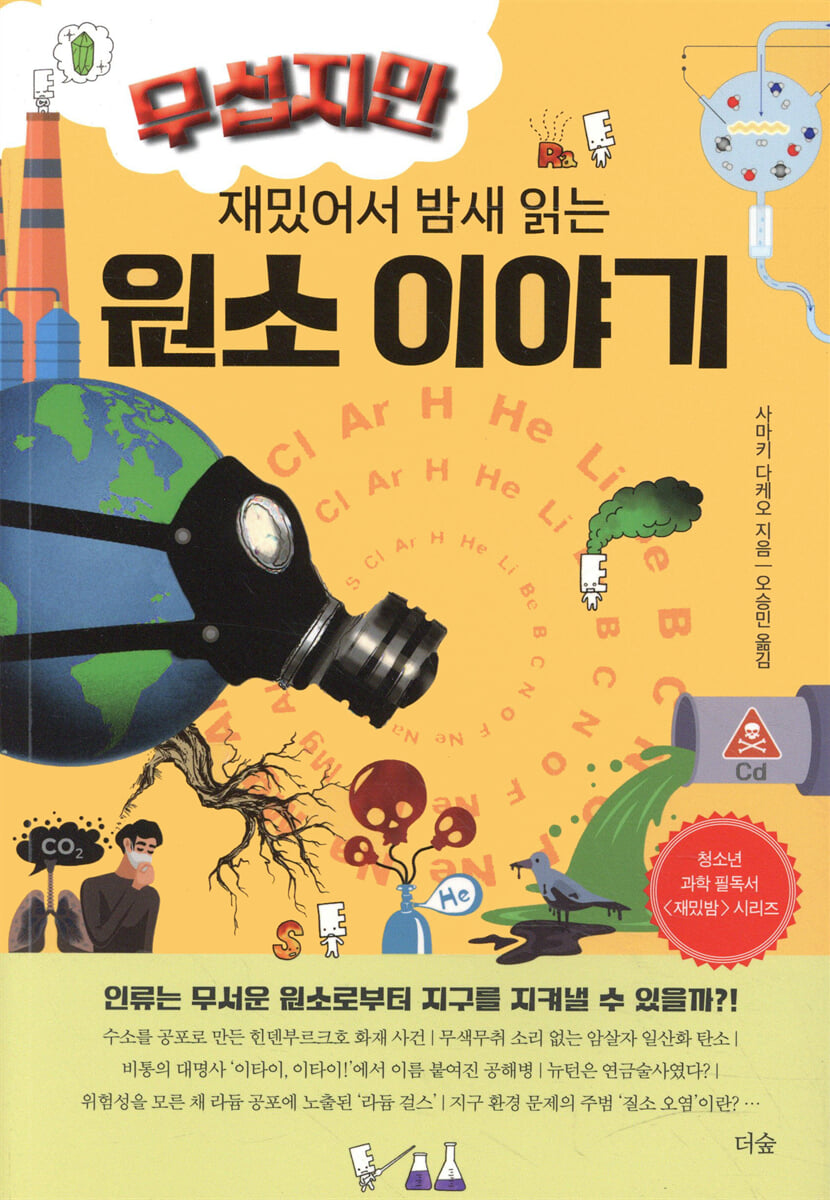
A scary but fun elemental story that you'll read all night long
 |
Description
Book Introduction
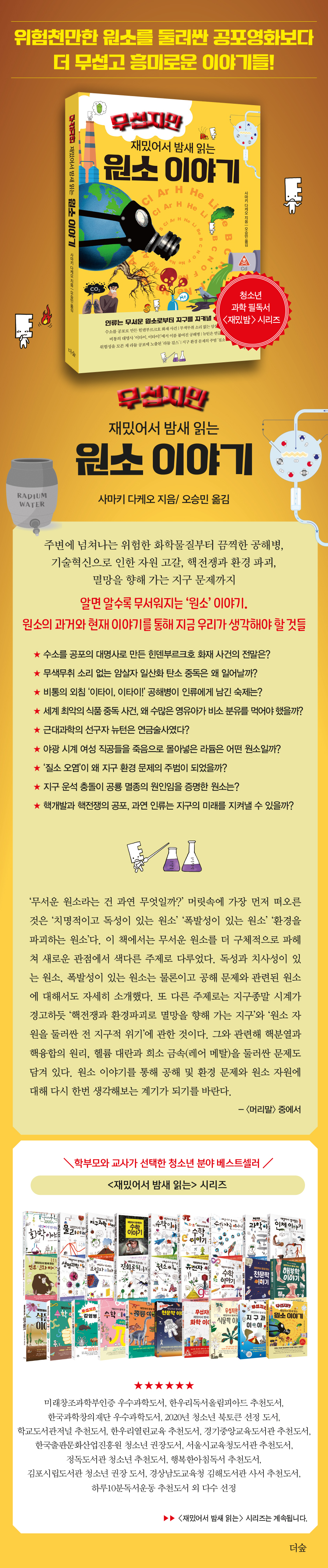
The scariest and most exciting story in the [Scary Night] series!
Dangerous chemicals overflowing around us, terrible pollution,
Resource depletion due to technological innovation, nuclear war, and environmental problems
We live in an age where the material, technological, and social structural advancements achieved by humanity threaten us.
"Scary but Fun Elemental Stories That Will Keep You Reading All Night" clearly reveals and explores this truth through surprising, terrifying, and fascinating stories about the elements from around the world.
This is the story of the so-called "scary elements" that can become poisonous or cause various accidents depending on how they are used, such as toxic and lethal elements, explosive elements, representative pollution problems related to elements, a global crisis surrounding element resources, the Earth heading towards destruction due to nuclear war and environmental destruction, the principles of nuclear fission and nuclear fusion, the helium crisis, and the problems surrounding rare metals.
In this book, the story, which is the greatest strength of the [Fun Night Series], shines.
Stories of past and present events and accidents spark interest in science, explain complex topics in an accessible way, and show how various elements affect our lives and the environment.
By exploring the fascinating world of elements, you will understand their diverse roles and importance, gain a deeper understanding of chemistry and environmental issues, and gain new perspectives on the dangers and possibilities of elements.
Dangerous chemicals overflowing around us, terrible pollution,
Resource depletion due to technological innovation, nuclear war, and environmental problems
We live in an age where the material, technological, and social structural advancements achieved by humanity threaten us.
"Scary but Fun Elemental Stories That Will Keep You Reading All Night" clearly reveals and explores this truth through surprising, terrifying, and fascinating stories about the elements from around the world.
This is the story of the so-called "scary elements" that can become poisonous or cause various accidents depending on how they are used, such as toxic and lethal elements, explosive elements, representative pollution problems related to elements, a global crisis surrounding element resources, the Earth heading towards destruction due to nuclear war and environmental destruction, the principles of nuclear fission and nuclear fusion, the helium crisis, and the problems surrounding rare metals.
In this book, the story, which is the greatest strength of the [Fun Night Series], shines.
Stories of past and present events and accidents spark interest in science, explain complex topics in an accessible way, and show how various elements affect our lives and the environment.
By exploring the fascinating world of elements, you will understand their diverse roles and importance, gain a deeper understanding of chemistry and environmental issues, and gain new perspectives on the dangers and possibilities of elements.
- You can preview some of the book's contents.
Preview
index
preface
Chapter 1: Hazardous Chemical Accidents Abounding Around Us
H hydrogen
The Hindenburg fire that made hydrogen synonymous with fear
He helium
The Helium Gas Accident and Helium Crisis, Thought to Be Safe
C carbon
The horror of carbon monoxide poisoning: a colorless, odorless, and silent assassin
Chapter 2: An Era of Coexistence of Elemental Risk and Development
B boron
Why are scientific glassware resistant to heat?
F fluorine
The chemist killer who created the fluorine martyr
Ca calcium Mg magnesium Al aluminum
Calcium, magnesium, and aluminum along with the development of camera lighting
P person
From highly toxic yellow phosphorus to the bone phosphorus that creates will-o'-the-wisps
Chapter 3: The Arsenic-Contaminated Milk Powder Case and the Four Major Pollutant Diseases That Still Require Responsibility
As arsenic
The Morinaga Arsenic-Contaminated Milk Powder Incident: Arsenic Poisoning Affecting Countless Infants and Toddlers
S Hwang
Toxic gases with a foul odor, sulfur compounds, sulfur dioxide and hydrogen sulfide
Cd cadmium
Pollution disease named after the synonym of sorrow, "Itai, Itai!"
Hg mercury
Tuna contains large amounts of methylmercury, the causative agent of Minamata disease?
Chapter 4: The Devil's Substance That Fascinated Scientists
Au gold
Was Newton, the pioneer of modern science, an alchemist?
Tl thallium
The Graham Young Case: The Thallium Crime That Shocked the World
Ra radium
The Radium Girls, unaware of the dangers, were exposed to radium fear.
Am americium Th thorium
The tragic end of David Hahn, who was obsessed with radioactive elements.
Chapter 5: The Beginning of the End of the Earth: What Will Be the Future of the Earth?
N nitrogen
What is nitrogen pollution, the main culprit of global environmental problems?
Ir iridium
Earth meteorite impact theory proven by detection of high concentrations of iridium
U uranium Pu plutonium
Earth heading towards destruction due to nuclear war and environmental destruction
rare metals
The crisis of rare metals, the "industrial vitamins" needed for cutting-edge devices.
Conclusion
References
Acknowledgements
Chapter 1: Hazardous Chemical Accidents Abounding Around Us
H hydrogen
The Hindenburg fire that made hydrogen synonymous with fear
He helium
The Helium Gas Accident and Helium Crisis, Thought to Be Safe
C carbon
The horror of carbon monoxide poisoning: a colorless, odorless, and silent assassin
Chapter 2: An Era of Coexistence of Elemental Risk and Development
B boron
Why are scientific glassware resistant to heat?
F fluorine
The chemist killer who created the fluorine martyr
Ca calcium Mg magnesium Al aluminum
Calcium, magnesium, and aluminum along with the development of camera lighting
P person
From highly toxic yellow phosphorus to the bone phosphorus that creates will-o'-the-wisps
Chapter 3: The Arsenic-Contaminated Milk Powder Case and the Four Major Pollutant Diseases That Still Require Responsibility
As arsenic
The Morinaga Arsenic-Contaminated Milk Powder Incident: Arsenic Poisoning Affecting Countless Infants and Toddlers
S Hwang
Toxic gases with a foul odor, sulfur compounds, sulfur dioxide and hydrogen sulfide
Cd cadmium
Pollution disease named after the synonym of sorrow, "Itai, Itai!"
Hg mercury
Tuna contains large amounts of methylmercury, the causative agent of Minamata disease?
Chapter 4: The Devil's Substance That Fascinated Scientists
Au gold
Was Newton, the pioneer of modern science, an alchemist?
Tl thallium
The Graham Young Case: The Thallium Crime That Shocked the World
Ra radium
The Radium Girls, unaware of the dangers, were exposed to radium fear.
Am americium Th thorium
The tragic end of David Hahn, who was obsessed with radioactive elements.
Chapter 5: The Beginning of the End of the Earth: What Will Be the Future of the Earth?
N nitrogen
What is nitrogen pollution, the main culprit of global environmental problems?
Ir iridium
Earth meteorite impact theory proven by detection of high concentrations of iridium
U uranium Pu plutonium
Earth heading towards destruction due to nuclear war and environmental destruction
rare metals
The crisis of rare metals, the "industrial vitamins" needed for cutting-edge devices.
Conclusion
References
Acknowledgements
Detailed image
Into the book
The Hindenburg was carrying 16 gas bladders filled with 99% hydrogen.
The hydrogen in the gas bag was well above the upper explosive limit of 75%, so even if it ignited and burned, there would have been no explosion.
It is said that the time it took from the start of the fire until it was completely engulfed was around 30 seconds, but if it had been an explosion, it would have happened even faster.
Moreover, there was no explosion sound.
This incident is commonly known as a hydrogen explosion, but chemically it is a gas fire caused by diffusion combustion of hydrogen.
--- From "The Hindenburg Fire That Made Hydrogen a Byword for Fear"
The normal concentration of carbon monoxide in the air varies depending on the location, but is usually around 0.5 ppm.
Using combustion appliances in an enclosed space reduces the oxygen concentration in the room.
When the oxygen concentration falls below 18%, the combustion performance of the combustion device suddenly deteriorates, causing incomplete combustion, and the amount of carbon monoxide emitted at this time begins to rapidly increase uncontrollably.
In fact, carbon monoxide poisoning occurs when burning charcoal briquettes, using combustion appliances, or using gasoline engines in closed rooms or enclosed spaces.
--- From "The Colorless, Odorless, Silent Assassin: The Horror of Carbon Monoxide Poisoning"
Muasang won the 1906 Nobel Prize in Chemistry for his work in isolating fluorine into its elemental form, that is, obtaining fluorine gas.
The following year, Muasang died suddenly, the cause of which remains a mystery.
Isaac Asimov, the American author, science commentator, and biochemist, described fluorine as "the yellow assassin who killed many a chemist."
--- From "The Chemist Killer Who Created the Fluorine Martyr"
Cadmium is always present in zinc ore at a ratio of 1-2%, like a 'partner' of zinc.
Cadmium is a byproduct of zinc refining and is used for plating purposes because of its excellent rust prevention effect.
However, since it was of little use beyond that, mines would either pour the cadmium-containing slag (slag, the residue produced when metal is smelted from ore) produced during the zinc smelting process into rivers or dump it on the ground.
During this process, cadmium was leached and flowed into groundwater, and crops such as rice absorbed the cadmium.
--- From "The Air Pollution Disease Named After the Epitome of Sorrow, 'Itai, Itai!'"
Minamata disease was caused by eating fish contaminated with methylmercury from factory wastewater.
Minamata disease caused by methylmercury begins to appear when a person sensitive to the chemical ingests more than 1.75 mg of methylmercury per week, and the proportion of patients who develop symptoms increases as the concentration increases.
If a pregnant mother consumes it, it can affect the fetus and cause congenital Minamata disease.
--- From "Methylmercury, the causative agent of Minamata disease, is contained in large quantities in tuna?"
Red tide is a name given to the seawater that often takes on a reddish tint when phytoplankton grow in large quantities, but it is not always red.
When red tide occurs, a large number of phytoplankton die, and a lot of oxygen is consumed in the process of their bodies decomposing.
At this time, fish and shellfish die as the dissolved oxygen in the water becomes insufficient.
--- From "What is nitrogen pollution, the main culprit of global environmental problems?"
The Shoemaker-Levy 9 impact was the moment when celestial collisions were recognized as a real-world threat.
The detection of high concentrations of iridium provides strong evidence for the hypothesis that a celestial impact with Earth may have contributed to the extinction of the dinosaurs.
There is a good chance that we will collide with a celestial body approaching Earth in the future.
--- From "The Earth Meteorite Impact Theory Proven by Detection of High Concentrations of Iridium"
Any major city in the world could be destroyed with a single hydrogen bomb.
It is also estimated that if a 100-megaton hydrogen bomb were to explode, the Earth's environment would be destroyed to the point of causing a 'nuclear winter'.
Nuclear winter is a theory that if a nuclear war breaks out, large fires in cities and forests will occur, causing a large amount of ash and dust to cover the Earth's upper atmosphere, absorbing sunlight and reducing the amount of solar radiation reaching the ground, resulting in a prolonged cooling of the Earth's climate.
--- From "Earth heading towards destruction due to nuclear war and environmental destruction"
Even though rare metals themselves are not radioactive, the process of extracting them from radioactive minerals mixed in the earth's crust generates a significant amount of radioactivity.
Green technologies that environmental groups claim could lead to a nuclear phase-out depend on mining radioactive resources like rare earth elements and tantalum.
Will humanity be able to solve the various problems caused by the rare metal crisis that will face us in the future?
The hydrogen in the gas bag was well above the upper explosive limit of 75%, so even if it ignited and burned, there would have been no explosion.
It is said that the time it took from the start of the fire until it was completely engulfed was around 30 seconds, but if it had been an explosion, it would have happened even faster.
Moreover, there was no explosion sound.
This incident is commonly known as a hydrogen explosion, but chemically it is a gas fire caused by diffusion combustion of hydrogen.
--- From "The Hindenburg Fire That Made Hydrogen a Byword for Fear"
The normal concentration of carbon monoxide in the air varies depending on the location, but is usually around 0.5 ppm.
Using combustion appliances in an enclosed space reduces the oxygen concentration in the room.
When the oxygen concentration falls below 18%, the combustion performance of the combustion device suddenly deteriorates, causing incomplete combustion, and the amount of carbon monoxide emitted at this time begins to rapidly increase uncontrollably.
In fact, carbon monoxide poisoning occurs when burning charcoal briquettes, using combustion appliances, or using gasoline engines in closed rooms or enclosed spaces.
--- From "The Colorless, Odorless, Silent Assassin: The Horror of Carbon Monoxide Poisoning"
Muasang won the 1906 Nobel Prize in Chemistry for his work in isolating fluorine into its elemental form, that is, obtaining fluorine gas.
The following year, Muasang died suddenly, the cause of which remains a mystery.
Isaac Asimov, the American author, science commentator, and biochemist, described fluorine as "the yellow assassin who killed many a chemist."
--- From "The Chemist Killer Who Created the Fluorine Martyr"
Cadmium is always present in zinc ore at a ratio of 1-2%, like a 'partner' of zinc.
Cadmium is a byproduct of zinc refining and is used for plating purposes because of its excellent rust prevention effect.
However, since it was of little use beyond that, mines would either pour the cadmium-containing slag (slag, the residue produced when metal is smelted from ore) produced during the zinc smelting process into rivers or dump it on the ground.
During this process, cadmium was leached and flowed into groundwater, and crops such as rice absorbed the cadmium.
--- From "The Air Pollution Disease Named After the Epitome of Sorrow, 'Itai, Itai!'"
Minamata disease was caused by eating fish contaminated with methylmercury from factory wastewater.
Minamata disease caused by methylmercury begins to appear when a person sensitive to the chemical ingests more than 1.75 mg of methylmercury per week, and the proportion of patients who develop symptoms increases as the concentration increases.
If a pregnant mother consumes it, it can affect the fetus and cause congenital Minamata disease.
--- From "Methylmercury, the causative agent of Minamata disease, is contained in large quantities in tuna?"
Red tide is a name given to the seawater that often takes on a reddish tint when phytoplankton grow in large quantities, but it is not always red.
When red tide occurs, a large number of phytoplankton die, and a lot of oxygen is consumed in the process of their bodies decomposing.
At this time, fish and shellfish die as the dissolved oxygen in the water becomes insufficient.
--- From "What is nitrogen pollution, the main culprit of global environmental problems?"
The Shoemaker-Levy 9 impact was the moment when celestial collisions were recognized as a real-world threat.
The detection of high concentrations of iridium provides strong evidence for the hypothesis that a celestial impact with Earth may have contributed to the extinction of the dinosaurs.
There is a good chance that we will collide with a celestial body approaching Earth in the future.
--- From "The Earth Meteorite Impact Theory Proven by Detection of High Concentrations of Iridium"
Any major city in the world could be destroyed with a single hydrogen bomb.
It is also estimated that if a 100-megaton hydrogen bomb were to explode, the Earth's environment would be destroyed to the point of causing a 'nuclear winter'.
Nuclear winter is a theory that if a nuclear war breaks out, large fires in cities and forests will occur, causing a large amount of ash and dust to cover the Earth's upper atmosphere, absorbing sunlight and reducing the amount of solar radiation reaching the ground, resulting in a prolonged cooling of the Earth's climate.
--- From "Earth heading towards destruction due to nuclear war and environmental destruction"
Even though rare metals themselves are not radioactive, the process of extracting them from radioactive minerals mixed in the earth's crust generates a significant amount of radioactivity.
Green technologies that environmental groups claim could lead to a nuclear phase-out depend on mining radioactive resources like rare earth elements and tantalum.
Will humanity be able to solve the various problems caused by the rare metal crisis that will face us in the future?
--- From "The Crisis of Rare Metals, the 'Industrial Vitamins' Needed for Cutting-Edge Devices"
Publisher's Review
Through the story of the past and present of the elements
Things we need to think about now
Countless horrific incidents and crises caused by hazardous elements can be found throughout history.
Chapter 1 deals with 'the hazardous chemical accidents that are overflowing around us.'
Stories like the Hindenburg fire, the world's largest airship that made hydrogen a byword for fear, the helium party item causing deaths due to oxygen deprivation, and the carbon monoxide poisoning incident caused by an illegally modified instantaneous water heater show that many aspects of our lives are significantly exposed to dangerous chemicals.
In addition, the story of the helium shortage, a valuable resource in the cutting-edge electronics industry and scientific research fields, as evidenced by the saying, "A drop of helium is as good as a drop of blood," provides an interesting glimpse into how important the element is to the advancement of science and the economy.
Chapter 2 shows 'an era where elemental danger and development coexist.'
The story of fluorine, the 'yellow assassin who killed many chemists'; the destruction of the ozone layer by freon gas, which was considered a dream substance because it was non-explosive and non-flammable; calcium, magnesium, and aluminum that developed alongside camera lighting; and safety matches that do not cause fires, all imply that the world's progress has been and continues to be accompanied by danger.
Chapter 3 discusses the Morinaga arsenic-laced milk powder incident, for which responsibility is still being sought, and the four major public health diseases.
The Morinaga arsenic-contaminated milk powder incident occurred in 1955, and is recorded as the world's worst food poisoning incident, affecting numerous infants and young children.
Morinaga Milk, which had a near-monopoly on the powdered milk market, added sodium dihydrogen phosphate to its powdered milk as a stabilizer to prevent coagulation and make it easier to dissolve. The stabilizer used was sodium dihydrogen phosphate, which was produced as a byproduct at an aluminum factory.
It was found to contain a large amount of arsenic.
At the time, Japan was in the midst of a period of rapid economic growth, so even though the cause was revealed, the government sided with the companies in support of industrial development.
The victims of this incident still suffer from mental and physical aftereffects, including intellectual disabilities, and live with anxiety.
In addition, Chapter 3 provides a detailed introduction to four major pollution-related diseases, including Itai-itai disease, named after the sorrowful phrase "Itai, Itai!"; Yokkaichi asthma, which had a significant impact on Japan's pollution countermeasures; and Minamata disease (two outbreaks in 1956 and 1965) caused by methylmercury poisoning.
The conflict that took place around the elements
Many amazing events and stories
Newton suffered from mental confusion in his fifties, and one of the causes suggested was mercury poisoning.
It is said that Newton's hair contained 10 times more mercury than the average person.
In addition, gold, arsenic, lead, and antimony were also found to be out of normal levels.
It can be said that he was so absorbed in alchemical experiments in pursuit of the 'philosopher's stone' as a 'philosopher by the hearth'.
The story that Newton, a pioneer of modern science, devoted his entire life to the study of alchemy is quite surprising.
Marie Curie, a pioneer in the field of radioactivity, died of aplastic anemia due to her deteriorating health caused by long-term handling of radioactive materials.
This is a disease in which the bone marrow is severely damaged and blood cells cannot be regenerated.
There is another example of death from the same anemia.
This is the story of the 'Radium Girls' of the luminous watch factory who suffered terrible losses without even knowing the horrors of radiation exposure from radium.
Radium poisoning occurred among American women workers who manufactured luminous watches from World War I until about 1924.
This luminous watch was made on the principle that alpha rays emitted from radioactive radium would cause the dial coated with fluorescent paint to glow.
What was particularly problematic was that the female workers used their lips and tongues to smooth the paint-soaked tips of their brushes while applying fine dots.
Because of that, a large amount of radium entered his body and he ended up getting osteosarcoma, a cancer that develops around the bones.
In addition, it deeply addresses the challenges that humanity will have to solve in the future, from the environmental problems caused by excessive nitrogen accumulation, to the possibility of a collision between the Earth and a celestial body, the threat of the end of the world due to nuclear development and nuclear war, and the depletion of rare metals essential for cutting-edge electronic devices and green technology.
The author emphasizes that what is convenient for humans is not necessarily beneficial for humans, and that it cannot be overemphasized that the government and companies should be held accountable for chemical safety management.
Furthermore, it reminds us once again that nuclear weapons, which threaten the end of the world, and humanity can never coexist.
Things we need to think about now
Countless horrific incidents and crises caused by hazardous elements can be found throughout history.
Chapter 1 deals with 'the hazardous chemical accidents that are overflowing around us.'
Stories like the Hindenburg fire, the world's largest airship that made hydrogen a byword for fear, the helium party item causing deaths due to oxygen deprivation, and the carbon monoxide poisoning incident caused by an illegally modified instantaneous water heater show that many aspects of our lives are significantly exposed to dangerous chemicals.
In addition, the story of the helium shortage, a valuable resource in the cutting-edge electronics industry and scientific research fields, as evidenced by the saying, "A drop of helium is as good as a drop of blood," provides an interesting glimpse into how important the element is to the advancement of science and the economy.
Chapter 2 shows 'an era where elemental danger and development coexist.'
The story of fluorine, the 'yellow assassin who killed many chemists'; the destruction of the ozone layer by freon gas, which was considered a dream substance because it was non-explosive and non-flammable; calcium, magnesium, and aluminum that developed alongside camera lighting; and safety matches that do not cause fires, all imply that the world's progress has been and continues to be accompanied by danger.
Chapter 3 discusses the Morinaga arsenic-laced milk powder incident, for which responsibility is still being sought, and the four major public health diseases.
The Morinaga arsenic-contaminated milk powder incident occurred in 1955, and is recorded as the world's worst food poisoning incident, affecting numerous infants and young children.
Morinaga Milk, which had a near-monopoly on the powdered milk market, added sodium dihydrogen phosphate to its powdered milk as a stabilizer to prevent coagulation and make it easier to dissolve. The stabilizer used was sodium dihydrogen phosphate, which was produced as a byproduct at an aluminum factory.
It was found to contain a large amount of arsenic.
At the time, Japan was in the midst of a period of rapid economic growth, so even though the cause was revealed, the government sided with the companies in support of industrial development.
The victims of this incident still suffer from mental and physical aftereffects, including intellectual disabilities, and live with anxiety.
In addition, Chapter 3 provides a detailed introduction to four major pollution-related diseases, including Itai-itai disease, named after the sorrowful phrase "Itai, Itai!"; Yokkaichi asthma, which had a significant impact on Japan's pollution countermeasures; and Minamata disease (two outbreaks in 1956 and 1965) caused by methylmercury poisoning.
The conflict that took place around the elements
Many amazing events and stories
Newton suffered from mental confusion in his fifties, and one of the causes suggested was mercury poisoning.
It is said that Newton's hair contained 10 times more mercury than the average person.
In addition, gold, arsenic, lead, and antimony were also found to be out of normal levels.
It can be said that he was so absorbed in alchemical experiments in pursuit of the 'philosopher's stone' as a 'philosopher by the hearth'.
The story that Newton, a pioneer of modern science, devoted his entire life to the study of alchemy is quite surprising.
Marie Curie, a pioneer in the field of radioactivity, died of aplastic anemia due to her deteriorating health caused by long-term handling of radioactive materials.
This is a disease in which the bone marrow is severely damaged and blood cells cannot be regenerated.
There is another example of death from the same anemia.
This is the story of the 'Radium Girls' of the luminous watch factory who suffered terrible losses without even knowing the horrors of radiation exposure from radium.
Radium poisoning occurred among American women workers who manufactured luminous watches from World War I until about 1924.
This luminous watch was made on the principle that alpha rays emitted from radioactive radium would cause the dial coated with fluorescent paint to glow.
What was particularly problematic was that the female workers used their lips and tongues to smooth the paint-soaked tips of their brushes while applying fine dots.
Because of that, a large amount of radium entered his body and he ended up getting osteosarcoma, a cancer that develops around the bones.
In addition, it deeply addresses the challenges that humanity will have to solve in the future, from the environmental problems caused by excessive nitrogen accumulation, to the possibility of a collision between the Earth and a celestial body, the threat of the end of the world due to nuclear development and nuclear war, and the depletion of rare metals essential for cutting-edge electronic devices and green technology.
The author emphasizes that what is convenient for humans is not necessarily beneficial for humans, and that it cannot be overemphasized that the government and companies should be held accountable for chemical safety management.
Furthermore, it reminds us once again that nuclear weapons, which threaten the end of the world, and humanity can never coexist.
GOODS SPECIFICS
- Date of issue: June 24, 2024
- Page count, weight, size: 220 pages | 350g | 145*210*13mm
- ISBN13: 9791192444970
- ISBN10: 1192444973
You may also like
카테고리
korean


korean

![GQ KOREA Mark (Monthly): December [2025]](http://librairie.coreenne.fr/cdn/shop/files/8ef265dbbfbf186523ed75ba7319009d.jpg?v=1765340328&width=3840)


