

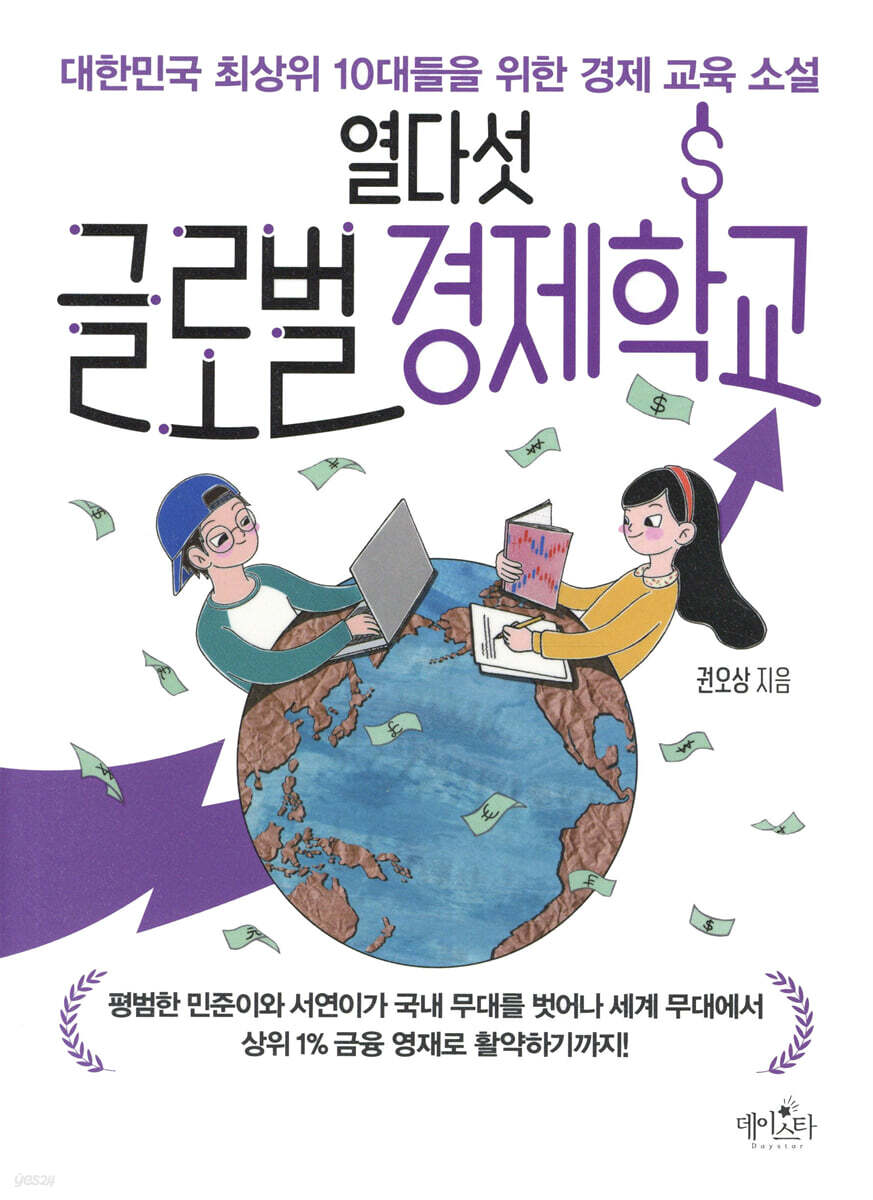
Fifteen Global Economic Schools
 |
Description
Book Introduction
From ordinary Minjun and Seoyeon to the top 1% financial geniuses on the global stage, beyond the domestic stage!
The best choice for a flexible semester: Global economics classes for the top 1% of students in Korea.
From the basic principles of financial economics to how to read the global financial economic trends,
A one-volume financial economics course from a Seoul National University graduate and financial expert.
This is a financial knowledge novel written by the author, who is a financial expert and a father of two, to teach financial economics to young people in an easy and fun way.
If the author's previous work, "Minjun and Seoyeon's Financial Competition," was set in the domestic National Financial Competition, "Fifteen Global Economic Schools" is set in the international International Financial Olympiad.
This novel, which contains the special experiences of the top 1% of South Korean teenagers who are active on the global stage beyond the domestic stage, is a complete economics textbook for teenagers that teaches everything from the basic principles of financial economics to how to read the flow of global financial economics by cross-editing the United States and Korea, the centers of global finance.
"Fifteen Global Economic Schools" begins with the story of Seoyeon and Minjun, who have just finished the first semester of their second year of middle school, following the events of "Minjun and Seoyeon's Financial Competition."
Seoyeon goes to study abroad in the United States with her family and participates in the International Finance Olympiad with friends she meets in the United States.
Minjun, who is in Korea, also participates in the International Finance Olympiad at his teacher's suggestion.
Seoyeon and Minjun each prepare for the International Finance Olympiad and learn advanced finance from Korean seniors active around the world.
These two people participated in the International Finance Olympiad.
Minjun, who was leaving the testing center after finishing his first day's test, runs into Seoyeon.
What will happen to Seoyeon and Minjun?
The best choice for a flexible semester: Global economics classes for the top 1% of students in Korea.
From the basic principles of financial economics to how to read the global financial economic trends,
A one-volume financial economics course from a Seoul National University graduate and financial expert.
This is a financial knowledge novel written by the author, who is a financial expert and a father of two, to teach financial economics to young people in an easy and fun way.
If the author's previous work, "Minjun and Seoyeon's Financial Competition," was set in the domestic National Financial Competition, "Fifteen Global Economic Schools" is set in the international International Financial Olympiad.
This novel, which contains the special experiences of the top 1% of South Korean teenagers who are active on the global stage beyond the domestic stage, is a complete economics textbook for teenagers that teaches everything from the basic principles of financial economics to how to read the flow of global financial economics by cross-editing the United States and Korea, the centers of global finance.
"Fifteen Global Economic Schools" begins with the story of Seoyeon and Minjun, who have just finished the first semester of their second year of middle school, following the events of "Minjun and Seoyeon's Financial Competition."
Seoyeon goes to study abroad in the United States with her family and participates in the International Finance Olympiad with friends she meets in the United States.
Minjun, who is in Korea, also participates in the International Finance Olympiad at his teacher's suggestion.
Seoyeon and Minjun each prepare for the International Finance Olympiad and learn advanced finance from Korean seniors active around the world.
These two people participated in the International Finance Olympiad.
Minjun, who was leaving the testing center after finishing his first day's test, runs into Seoyeon.
What will happen to Seoyeon and Minjun?
- You can preview some of the book's contents.
Preview
index
Introduction
▶ Chapter 1 - Starting School in the Hidden Heart of American Finance
▶ Chapter 2 - Can you compete globally with the skills you learned only in Korea?
▶ Chapter 3 - Wouldn't it be better if we could spend any money in our country?
▶ Chapter 4 - Is there a reason why the Ivy League is the most popular university in the United States?
▶ Chapter 5 - Is it possible for money to give birth to calves like a cow gives birth to a calf?
▶ Chapter 6 - Porsche and Hermes stocks went up, so why did I lose money?
▶ Chapter 7 - You idiot, risk doesn't make you more profitable.
▶ Chapter 8 - Do both Koreans and Americans want to anticipate that the exchange rate will change?
▶ Chapter 9 - Unless you live in a parallel universe, you shouldn't look at the average of money.
▶ Chapter 10 - Why is the name of the derivatives transaction given and received in the future called futures?
▶ Chapter 11 - Don't be fooled by the past, for the future is not a simple repetition of the past.
▶ Chapter 12 - When we help each other and share together, the pie ends up getting bigger.
▶ Chapter 1 - Starting School in the Hidden Heart of American Finance
▶ Chapter 2 - Can you compete globally with the skills you learned only in Korea?
▶ Chapter 3 - Wouldn't it be better if we could spend any money in our country?
▶ Chapter 4 - Is there a reason why the Ivy League is the most popular university in the United States?
▶ Chapter 5 - Is it possible for money to give birth to calves like a cow gives birth to a calf?
▶ Chapter 6 - Porsche and Hermes stocks went up, so why did I lose money?
▶ Chapter 7 - You idiot, risk doesn't make you more profitable.
▶ Chapter 8 - Do both Koreans and Americans want to anticipate that the exchange rate will change?
▶ Chapter 9 - Unless you live in a parallel universe, you shouldn't look at the average of money.
▶ Chapter 10 - Why is the name of the derivatives transaction given and received in the future called futures?
▶ Chapter 11 - Don't be fooled by the past, for the future is not a simple repetition of the past.
▶ Chapter 12 - When we help each other and share together, the pie ends up getting bigger.
Detailed image

Into the book
Minjun nodded.
Minjun's favorite basketball player, Stephen Curry, was American, but Minjun knew that professional basketball in the US was no longer just a feast for Americans.
Professor Son Byeong-seok added a word.
“De Coubertin said, ‘The most important thing in the Olympic Games is not to win, but to participate; the most important thing in life is not to conquer, but to fight well.’”
--- pp.
41-42
“There is a reason why foreign money cannot be used domestically.
If something like that happens, the country will be unable to implement normal economic policies.
A nation must have money to spend, and if it believes it must be procured with foreign currency, wouldn't it be impossible to escape the influence of the foreign powers that create that money? Cryptographic numbers, often claimed as digital money, are no different.
Any country that does not prohibit the use of such money is not really a country, no matter how good it may seem on the surface.
“You could say that he is no different from a scarecrow.”
--- p.57
“If my dad heard what I’m saying now, he’d probably be really angry, but the truth is, not all Ivy League schools are the same.
There are three schools that people really want to go to.
If my dad had been accepted to any of the three, he would have gone there instead of the University of Pennsylvania.
“The difference between those three schools and the other five is huge.” “Where are they?” “They’re Harvard, Yale, and Princeton.”
--- pp.
67-68
“What you just said is exactly what Aristotle said.
Aristotle believed that money was something that disappeared when spent.
Besides, he said, 'Money doesn't breed chicks.'
For example, the cow used to plow the field gives birth to a calf.
As time goes by, the number of cattle will naturally increase.
But money doesn't grow on its own.
Money won't grow or produce offspring if you put it in a jar and bury it in the ground.
So Aristotle judged usury, that is, lending money and receiving interest, to be the most unnatural and hated thing.
I saw it as an unfair act of taking advantage of other people's difficulties to fill one's own stomach."
--- p.88
“There is a field that studies exchange rates, but it is economics, not finance.
But there aren't many people who do that.
Because it's kind of a minefield there.
There are several theories that have been put forward to predict exchange rates, but they are notorious for not matching the actual exchange rates.
The actual exchange rate fluctuates up and down without any particular reason.
In other words, it is difficult to say that the exchange rate is proportional to any risk.
They know that too, so they don't want to touch it."
--- p.104
“Let me pose a problem.
I eat more ice cream in the summer.
The number of drowning accidents is also increasing.
In other words, there is a strong correlation between ice cream consumption and the number of water accidents.
But does it make sense to say we should eat less ice cream to reduce the number of water accidents, or to eat less ice cream to reduce water accidents? It's just laughable.
Because there is correlation but no causality.
In other words, observing a correlation does not provide evidence of causation.
The relationship between volatility and returns is the same.”
--- pp.122-123
"okay.
So, let's talk about specific numbers this time. There's a stock called Orange, and it's currently trading at $1.
And let's assume that if Orange's stock price goes up every day, it will be 1.6 times, and if it goes down, it will be 0.5 times.
The probability of going up or down is equal at 50 percent.
“Then, does Seoyeon want to buy an orange?”
--- p.152
“It may sound obvious, but universities are places that help students find jobs in the country where they are located, whether undergraduate or graduate.
In other words, it is unreasonable to expect to get a job in a country called Napoli with a degree from a country called Geese.
This is actually the same for degrees from American universities.
For example, if someone who wants to live in Australia studies in the United States, it doesn't make sense.
“I came here because I was interested in working in Europe.”
--- p.164
“Forwards and futures are derivative transactions that involve exchanging money and goods in the future.
That makes sense.
But what about "seondo" and "seonseon"? The first character of both "seondo" and "seonseon" is "seon" (先).
In other words, the line refers to the past, not the future.
There is a Chinese character that refers to the future, and that is '後'.
For example, we actually use the term postpay to refer to paying later.
So, if you wanted to properly move forwards and futures, it had to be the latter, not the former or the futures.”
--- p.174
“I also understand that exchange rates tend to trade within a certain range.
But a professor said that you can make money by using that trait.
In simple terms, if the current exchange rate is close to the end of the range, it means to initiate a transaction in anticipation of an exchange rate change in the opposite direction.
I'm not sure if that really holds true.”
Minjun's favorite basketball player, Stephen Curry, was American, but Minjun knew that professional basketball in the US was no longer just a feast for Americans.
Professor Son Byeong-seok added a word.
“De Coubertin said, ‘The most important thing in the Olympic Games is not to win, but to participate; the most important thing in life is not to conquer, but to fight well.’”
--- pp.
41-42
“There is a reason why foreign money cannot be used domestically.
If something like that happens, the country will be unable to implement normal economic policies.
A nation must have money to spend, and if it believes it must be procured with foreign currency, wouldn't it be impossible to escape the influence of the foreign powers that create that money? Cryptographic numbers, often claimed as digital money, are no different.
Any country that does not prohibit the use of such money is not really a country, no matter how good it may seem on the surface.
“You could say that he is no different from a scarecrow.”
--- p.57
“If my dad heard what I’m saying now, he’d probably be really angry, but the truth is, not all Ivy League schools are the same.
There are three schools that people really want to go to.
If my dad had been accepted to any of the three, he would have gone there instead of the University of Pennsylvania.
“The difference between those three schools and the other five is huge.” “Where are they?” “They’re Harvard, Yale, and Princeton.”
--- pp.
67-68
“What you just said is exactly what Aristotle said.
Aristotle believed that money was something that disappeared when spent.
Besides, he said, 'Money doesn't breed chicks.'
For example, the cow used to plow the field gives birth to a calf.
As time goes by, the number of cattle will naturally increase.
But money doesn't grow on its own.
Money won't grow or produce offspring if you put it in a jar and bury it in the ground.
So Aristotle judged usury, that is, lending money and receiving interest, to be the most unnatural and hated thing.
I saw it as an unfair act of taking advantage of other people's difficulties to fill one's own stomach."
--- p.88
“There is a field that studies exchange rates, but it is economics, not finance.
But there aren't many people who do that.
Because it's kind of a minefield there.
There are several theories that have been put forward to predict exchange rates, but they are notorious for not matching the actual exchange rates.
The actual exchange rate fluctuates up and down without any particular reason.
In other words, it is difficult to say that the exchange rate is proportional to any risk.
They know that too, so they don't want to touch it."
--- p.104
“Let me pose a problem.
I eat more ice cream in the summer.
The number of drowning accidents is also increasing.
In other words, there is a strong correlation between ice cream consumption and the number of water accidents.
But does it make sense to say we should eat less ice cream to reduce the number of water accidents, or to eat less ice cream to reduce water accidents? It's just laughable.
Because there is correlation but no causality.
In other words, observing a correlation does not provide evidence of causation.
The relationship between volatility and returns is the same.”
--- pp.122-123
"okay.
So, let's talk about specific numbers this time. There's a stock called Orange, and it's currently trading at $1.
And let's assume that if Orange's stock price goes up every day, it will be 1.6 times, and if it goes down, it will be 0.5 times.
The probability of going up or down is equal at 50 percent.
“Then, does Seoyeon want to buy an orange?”
--- p.152
“It may sound obvious, but universities are places that help students find jobs in the country where they are located, whether undergraduate or graduate.
In other words, it is unreasonable to expect to get a job in a country called Napoli with a degree from a country called Geese.
This is actually the same for degrees from American universities.
For example, if someone who wants to live in Australia studies in the United States, it doesn't make sense.
“I came here because I was interested in working in Europe.”
--- p.164
“Forwards and futures are derivative transactions that involve exchanging money and goods in the future.
That makes sense.
But what about "seondo" and "seonseon"? The first character of both "seondo" and "seonseon" is "seon" (先).
In other words, the line refers to the past, not the future.
There is a Chinese character that refers to the future, and that is '後'.
For example, we actually use the term postpay to refer to paying later.
So, if you wanted to properly move forwards and futures, it had to be the latter, not the former or the futures.”
--- p.174
“I also understand that exchange rates tend to trade within a certain range.
But a professor said that you can make money by using that trait.
In simple terms, if the current exchange rate is close to the end of the range, it means to initiate a transaction in anticipation of an exchange rate change in the opposite direction.
I'm not sure if that really holds true.”
--- p.184-185
Publisher's Review
★ A youth economic novel told by a father who is a financial expert and graduated from Seoul National University.
★ The second story of "Minjun and Seoyeon's Financial Competition," highly praised by current teachers and parents.
Systematic financial education necessary from adolescence to grow into future talents.
A vivid financial knowledge book provided by a current financial expert.
In Indiana, USA, high schools require a course in finance.
Here, we systematically teach you how to open a bank account, save, and invest so that you can lead a stable financial life and save money while living.
Likewise, countries like the United States and the United Kingdom believe that financial education is lifelong learning, and they are providing financial education to young people by opening financial courses and teaching financial knowledge by integrating it into various subjects.
Through this, students will not only acquire the concepts of money, investment, and debt, but will also develop the ability to apply financial knowledge in various situations they will encounter in their future social lives.
Our country also desperately needs long-term, systematic financial education for young people.
Author Kwon Oh-sang, who pioneered the youth finance novel genre with "Minjun and Seoyeon's Financial Competition" eight years ago, has returned with the follow-up work, "Fifteen Global Economic Schools," to teach youth about advanced finance, following basic finance.
Author Kwon Oh-sang graduated from Seoul National University and is a current financial expert leading the financial world.
This book is a financial knowledge guide for young people, based on the wisdom of a current financial expert, that teaches everything from the basic principles of financial economics to how to interpret the global financial economy.
The easiest and most fun way to study economics!
Following the basics of finance, learn advanced finance through an interesting novel.
When we think of economics, and especially finance, the first thing that comes to mind is that it is difficult and complicated.
Also, I don't know how to start studying.
That's why we need an easy and fun way to approach economics and finance.
"Fifteen Global Economic Schools" is a thrilling novel that follows the journey of Seo-yeon and Min-jun, two protagonists of the same age, as they explore the world of economics and finance.
In doing so, you can naturally and comfortably learn what economics and finance are.
Seoyeon, who is preparing for the International Finance Olympiad in the United States, discusses the fundamental issues of finance with Father Yeo Myeong-jun, who was introduced to her by her father.
Seoyeon, who had experienced the National Finance Competition, felt a bit awkward, but as we talked, she gradually began to seem to know a little bit about finance.
Moreover, Father Yeomyeongjun tells Seoyeon to ask her father to teach her about Siegel's paradox, which is good for learning the hidden secrets of finance.
Meanwhile, in Korea, Minjun goes to a preparatory class for the International Finance Olympiad and meets Professor Byun So-ol to learn about financial mathematics.
And when they are asked about trading foreign stocks, Minjun and his friends' minds become increasingly complicated as they consider foreign stock prices and exchange rates.
Will Seoyeon and Minjun be able to prepare well and do well in the International Finance Olympiad?
Global Economics Classes for Korea's Top 1% Students
A book that enhances understanding of finance and fosters insight through real-life examples.
《Fifteen Global Economic Schools》 explains unfamiliar concepts with examples that young people can easily understand.
“What should I do if someone I’m not close to asks me to lend them five apples and a juicer?” “Why did I lose money when the stock prices of Porsche and Hermes went up?” “Is there a correlation between the amount of ice cream consumed in the summer and the number of water accidents?” “How much money can I get if I take out the blue and yellow balls in an opaque bag?” Through questions like these, the book clearly explains difficult financial knowledge, from the fundamental problems of finance to user interest, stock prices and exchange rates, derivatives trading, expected value maximization, the relationship between risk and return, financial mathematics, economic physics, and financial engineering.
Through this process, readers will gradually gain a deeper understanding of finance and gain deeper insights into it. The diverse experiences of the main characters will challenge and stimulate many young people about economics and finance.
You will also learn the humanistic wisdom of finance that happiness is not achieved by only making a lot of money.
A solid guide for young people preparing to study abroad.
Every year, the number of young people preparing to study abroad is increasing.
Many of these students choose to study abroad in the United States, but many of them face numerous difficulties as they leave without considering the school's ranking or their study abroad goals.
In that case, the high tuition fees for studying abroad will be reduced to sunk costs rather than opportunity costs.
To successfully study abroad in the United States, thorough information and preparation are required, including information on U.S. admissions, the characteristics of each school, and goals after graduation.
"Fifteen Global Economic Schools" provides essential information, including rankings and characteristics of American high schools and universities, through Seoyeon, who is currently attending school in the United States, to help students prepare for a structured study abroad.
★ The second story of "Minjun and Seoyeon's Financial Competition," highly praised by current teachers and parents.
Systematic financial education necessary from adolescence to grow into future talents.
A vivid financial knowledge book provided by a current financial expert.
In Indiana, USA, high schools require a course in finance.
Here, we systematically teach you how to open a bank account, save, and invest so that you can lead a stable financial life and save money while living.
Likewise, countries like the United States and the United Kingdom believe that financial education is lifelong learning, and they are providing financial education to young people by opening financial courses and teaching financial knowledge by integrating it into various subjects.
Through this, students will not only acquire the concepts of money, investment, and debt, but will also develop the ability to apply financial knowledge in various situations they will encounter in their future social lives.
Our country also desperately needs long-term, systematic financial education for young people.
Author Kwon Oh-sang, who pioneered the youth finance novel genre with "Minjun and Seoyeon's Financial Competition" eight years ago, has returned with the follow-up work, "Fifteen Global Economic Schools," to teach youth about advanced finance, following basic finance.
Author Kwon Oh-sang graduated from Seoul National University and is a current financial expert leading the financial world.
This book is a financial knowledge guide for young people, based on the wisdom of a current financial expert, that teaches everything from the basic principles of financial economics to how to interpret the global financial economy.
The easiest and most fun way to study economics!
Following the basics of finance, learn advanced finance through an interesting novel.
When we think of economics, and especially finance, the first thing that comes to mind is that it is difficult and complicated.
Also, I don't know how to start studying.
That's why we need an easy and fun way to approach economics and finance.
"Fifteen Global Economic Schools" is a thrilling novel that follows the journey of Seo-yeon and Min-jun, two protagonists of the same age, as they explore the world of economics and finance.
In doing so, you can naturally and comfortably learn what economics and finance are.
Seoyeon, who is preparing for the International Finance Olympiad in the United States, discusses the fundamental issues of finance with Father Yeo Myeong-jun, who was introduced to her by her father.
Seoyeon, who had experienced the National Finance Competition, felt a bit awkward, but as we talked, she gradually began to seem to know a little bit about finance.
Moreover, Father Yeomyeongjun tells Seoyeon to ask her father to teach her about Siegel's paradox, which is good for learning the hidden secrets of finance.
Meanwhile, in Korea, Minjun goes to a preparatory class for the International Finance Olympiad and meets Professor Byun So-ol to learn about financial mathematics.
And when they are asked about trading foreign stocks, Minjun and his friends' minds become increasingly complicated as they consider foreign stock prices and exchange rates.
Will Seoyeon and Minjun be able to prepare well and do well in the International Finance Olympiad?
Global Economics Classes for Korea's Top 1% Students
A book that enhances understanding of finance and fosters insight through real-life examples.
《Fifteen Global Economic Schools》 explains unfamiliar concepts with examples that young people can easily understand.
“What should I do if someone I’m not close to asks me to lend them five apples and a juicer?” “Why did I lose money when the stock prices of Porsche and Hermes went up?” “Is there a correlation between the amount of ice cream consumed in the summer and the number of water accidents?” “How much money can I get if I take out the blue and yellow balls in an opaque bag?” Through questions like these, the book clearly explains difficult financial knowledge, from the fundamental problems of finance to user interest, stock prices and exchange rates, derivatives trading, expected value maximization, the relationship between risk and return, financial mathematics, economic physics, and financial engineering.
Through this process, readers will gradually gain a deeper understanding of finance and gain deeper insights into it. The diverse experiences of the main characters will challenge and stimulate many young people about economics and finance.
You will also learn the humanistic wisdom of finance that happiness is not achieved by only making a lot of money.
A solid guide for young people preparing to study abroad.
Every year, the number of young people preparing to study abroad is increasing.
Many of these students choose to study abroad in the United States, but many of them face numerous difficulties as they leave without considering the school's ranking or their study abroad goals.
In that case, the high tuition fees for studying abroad will be reduced to sunk costs rather than opportunity costs.
To successfully study abroad in the United States, thorough information and preparation are required, including information on U.S. admissions, the characteristics of each school, and goals after graduation.
"Fifteen Global Economic Schools" provides essential information, including rankings and characteristics of American high schools and universities, through Seoyeon, who is currently attending school in the United States, to help students prepare for a structured study abroad.
GOODS SPECIFICS
- Date of issue: March 30, 2024
- Page count, weight, size: 212 pages | 308g | 152*210*14mm
- ISBN13: 9791168271692
- ISBN10: 116827169X
You may also like
카테고리
korean


korean

![GQ KOREA Mark (Monthly): December [2025]](http://librairie.coreenne.fr/cdn/shop/files/8ef265dbbfbf186523ed75ba7319009d.jpg?v=1765340328&width=3840)


